Jun 2026 · 9 min read
The “beauty from within” category is reshaping how consumers think about skincare. Serums and creams work from the outside in — but increasingly, health-conscious consumers are reaching for ingestible beauty products to work from the inside out. Collagen drinks, hyaluronic acid beverages, biotin waters, antioxidant-infused waters — the beauty water category sits at the intersection of skincare and functional beverages, and it is growing.
In India, the category is early — which creates a real opportunity for a well-positioned, well-formulated beauty water brand that gets to market before the category becomes crowded.
But beauty water is one of the most technically demanding functional beverage categories to formulate correctly. The active ingredients are sensitive. The claims are closely regulated under FSSAI. And the consumer expectation — that the product will visibly improve their skin — is a high bar to meet with a beverage.
This guide covers the formulation science, ingredient selection, FSSAI compliance, and commercial launch strategy for building a beauty water brand in India.
What Is Beauty Water?
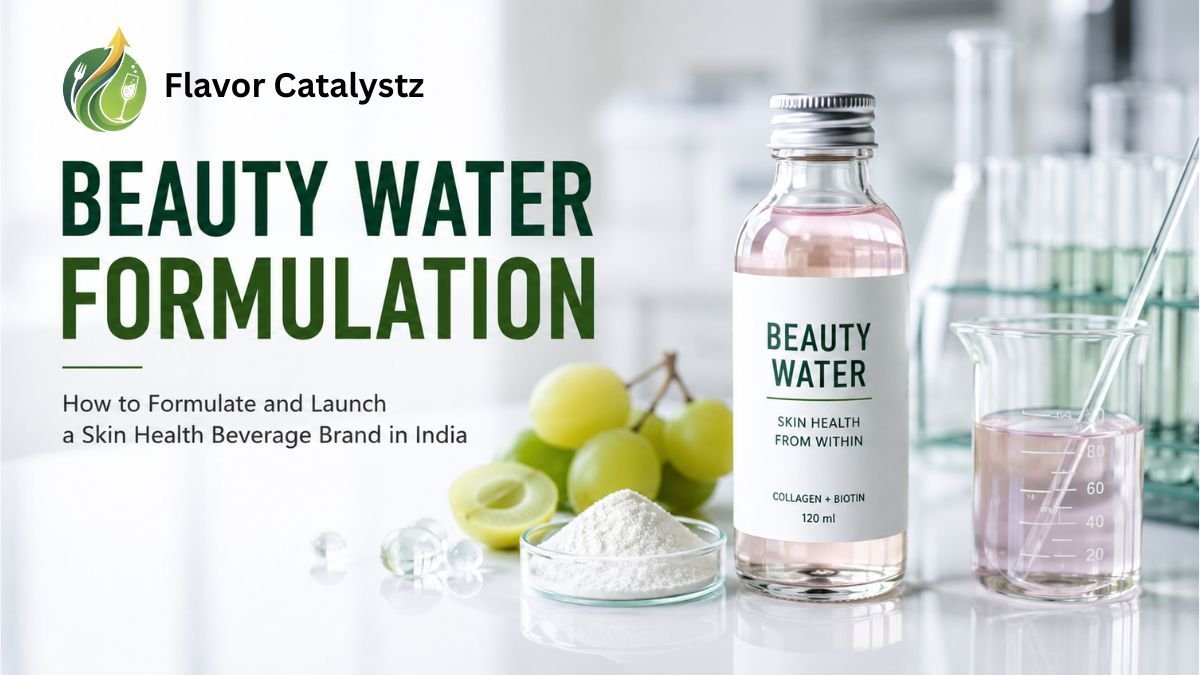
Beauty water (also called skin water, collagen water, or beauty beverage) is a functional beverage formulated with ingredients associated with skin health, hydration, or anti-ageing. It is typically presented as a premium, lightly flavoured water or beverage — more sophisticated than plain water but lighter than a traditional juice or smoothie.
The category spans a wide range of formulation approaches:
- Collagen-infused water: Hydrolysed collagen peptides added to a still or sparkling water base
- Hyaluronic acid water: Hyaluronic acid (HA) in a beverage format, targeting skin hydration
- Biotin water: Biotin (Vitamin B7) addition, positioned for skin, hair, and nail health
- Antioxidant beauty water: Vitamin C, Vitamin E, astaxanthin, or plant-based antioxidants for skin protection from oxidative stress
- Multi-action beauty water: Combination of several beauty-active ingredients in one drink
Flavor Catalystz
Planning to launch a beauty water or collagen beverage brand?
From collagen and biotin dosage optimisation to flavour masking, stability testing, FSSAI compliance, and commercial manufacturing — we help founders build beauty beverages that scale.
Key Beauty Water Ingredients: Science and Formulation
Collagen Peptides
The most widely used beauty beverage ingredient globally. Marine or bovine hydrolysed collagen at 2.5–10g per serving has clinical evidence for skin hydration, elasticity, and wrinkle reduction with regular consumption.
Formulation considerations: Collagen peptides are highly soluble in water at room temperature. They are relatively tasteless at low doses (2.5–5g) but develop a mild meaty or brothy note at higher doses that requires flavour masking. Marine collagen requires fish allergen declaration. For detailed formulation guidance, see our collagen drink formulation guide.
FSSAI: Proprietary food pathway. Fish allergen declaration mandatory for marine collagen. Non-vegetarian symbol required.
Hyaluronic Acid (HA)
Hyaluronic acid is a naturally occurring compound in the body that holds water in skin tissue — responsible for skin’s plumpness and moisture retention. Its concentration in skin decreases with age.
Clinical evidence for oral HA supplementation: several studies show improvements in skin hydration and elasticity with regular HA consumption at 80–200mg per day.
FSSAI status: Hyaluronic acid for use in food products sits in a regulatory grey zone in India. It is not on FSSAI’s standard permitted additives list but has been used in nutraceutical products. Regulatory verification is essential before including HA in a commercial beverage product.
Formulation: HA dissolves readily in water. It is odourless and flavourless at beverage inclusion levels. No flavour masking required.
Biotin (Vitamin B7)
Biotin has a strong consumer perception as a “beauty vitamin” — associated with skin health, hair growth, and nail strength. The clinical evidence specifically for oral biotin on skin health in non-deficient individuals is modest, but consumer demand is strong.
FSSAI status: Biotin is a permitted vitamin under FSSAI’s food fortification and nutraceutical regulations. Straightforward inclusion in a beauty water formulation.
Target dose: 30–60 mcg per serving for food-level inclusion. Higher doses (up to 5,000 mcg) used in supplement formats — at supplement doses, nutraceutical pathway applies.
Formulation: Odourless, flavourless. No masking required.
Vitamin C
Vitamin C is a cofactor for collagen synthesis in the body — it is required for the production of new collagen. Including Vitamin C in a collagen-based beauty water is scientifically sound and commercially compelling (and allows a permitted nutrient function claim: “Vitamin C contributes to normal collagen formation for the normal function of skin”).
Target dose: 150–500mg per serving. Natural sources (amla extract) provide additional antioxidants alongside Vitamin C.
Glutathione
The “master antioxidant” — produced naturally in the body, associated with skin lightening and overall cellular antioxidant protection. Increasingly popular in beauty supplements in India due to strong consumer interest in skin lightening/brightening.
FSSAI status: Glutathione’s regulatory status in Indian food products requires verification. It is used in nutraceutical formats — its use in a food beverage product needs specific regulatory review.
Note on skin lightening claims: FSSAI and the Drug Controller General of India (DCGI) have issued warnings about skin lightening claims on food products. Be extremely careful about any whitening or lightening language — this area is closely monitored.
Astaxanthin
A powerful carotenoid antioxidant from microalgae (Haematococcus pluvialis). Clinical evidence for skin photoprotection, hydration, and anti-ageing with regular supplementation. Gives a natural pink-orange colour to beverages.
FSSAI status: Astaxanthin has been approved as a nutraceutical ingredient by FSSAI. Use at permitted levels with nutraceutical product approval.
Plant-Based Antioxidants
Hibiscus (anthocyanins), rose (polyphenols), green tea (EGCG), pomegranate (ellagic acid) — these are food-safe botanical ingredients with antioxidant properties and strong visual and flavour appeal for a beauty beverage. They also support a more natural, plant-forward label.
Beauty Water Formulation Templates
Template 1: Collagen + Vitamin C + Rose (Premium Marine)
- Marine collagen peptides: 5g per 250ml
- Vitamin C (from natural source/ascorbic acid): 300mg
- Rose water: 5ml
- Natural rose flavour
- Lemon juice: 5ml
- Light sweetener: 5g sugar or stevia equivalent
- Sparkling water to volume
Positioning: Premium skin beauty water. Glass bottle, elegant packaging. ₹200–350 per bottle.
Template 2: Biotin + Vitamin C + Hibiscus (Plant-Based / Vegan)
- Biotin: 300 mcg
- Vitamin C: 250mg
- Hibiscus extract: 500mg
- Natural berry flavour
- Citric acid for pH stability
- Stevia or monk fruit sweetener
- Still water to volume
Positioning: Vegan beauty water. No allergens. Hair, skin, and nail claim angle. ₹150–250 per bottle.
Template 3: Multi-Beauty Stack (Comprehensive)
- Hydrolysed collagen peptides: 2.5g
- Vitamin C: 200mg
- Biotin: 150 mcg
- Zinc: 5mg (skin health nutrient function claim)
- Bamboo silica: 50mg
- Natural peach or yuzu flavour
- Sparkling water base
Positioning: Complete skin, hair, nails beauty water. Targets the consumer replacing a daily beauty supplement with a pleasant drink.
FSSAI Compliance for Beauty Water
Product approval: All beauty water formulations with functional ingredients require FSSAI product approval as proprietary food (or nutraceutical for higher-dose ingredients).
Allergen declaration: Marine collagen = fish allergen. Mandatory prominent declaration.
Non-vegetarian symbol: Required for marine or bovine collagen-containing products.
Claims framework: This is the most critical compliance area for beauty water.
Permitted:
- “Contains Vitamin C, which contributes to normal collagen formation for the normal function of skin” ✓
- “Contains Zinc, which contributes to the maintenance of normal skin” ✓
- “Biotin contributes to the maintenance of normal skin, hair, and nails” ✓
- “Contains marine collagen peptides” (ingredient declaration) ✓
Not permitted without specific authorisation:
- “Anti-ageing” ✗
- “Reduces wrinkles” ✗
- “Skin whitening / brightening” ✗ (particularly closely monitored)
- “Reverses skin damage” ✗
For full claims guidance, see our FSSAI health claims on beverages guide.
Packaging and Brand Positioning for Beauty Water
Beauty water is a category where packaging is part of the product. The visual experience — the bottle, the colour of the liquid, the label design — communicates the brand’s positioning before the consumer reads a single word.
Packaging priorities:
- Glass bottles strongly preferred over PET — communicates premium, sustainability, and product integrity
- Elegant, minimal label design with clean colour palette
- Bottle shape that is photogenic (beauty consumers are heavy Instagram/social media users — the product must look good in a photo)
- Portion size: 250–330ml for a daily beauty ritual drink
Price positioning: Beauty water commands premium pricing — ₹150–400 per bottle depending on ingredient stack and brand positioning. D2C, specialty health retail, and premium modern trade are the natural channels.
Ready to Launch Your Beauty Water Brand?
The ingestible beauty category in India is still in its early growth phase — which means the brands that build credible, well-formulated beauty water products now will be the ones that define the category as it scales.
Getting the ingredient stack right (meaningful doses, clinical evidence), the claims compliant (FSSAI-approved language), and the packaging compelling (glass, elegant, photogenic) is the formula for a beauty water brand that builds real consumer loyalty.
At Flavor Catalystz, we formulate beauty and skin health beverages for commercial launch in India. Talk to our team today.
FAQs
What is beauty water?
Beauty water is a functional beverage formulated with skin health ingredients — typically collagen peptides, hyaluronic acid, Vitamin C, biotin, or plant antioxidants. Consumed daily as part of a beauty and wellness routine.
Does drinking collagen water actually improve skin?
Clinical evidence for oral hydrolysed collagen supplementation (2.5–10g daily) shows improvements in skin hydration, elasticity, and wrinkle depth in multiple randomised controlled trials. The evidence is stronger than for most beauty ingredients.
What is the difference between collagen water and beauty water?
Collagen water specifically contains hydrolysed collagen peptides. Beauty water is a broader category that may contain collagen, hyaluronic acid, biotin, Vitamin C, antioxidants, or combinations thereof.
Is hyaluronic acid permitted in beverages in India?
HA’s status in FSSAI food products requires regulatory verification. It is used in nutraceutical formats — for a food beverage product, specific regulatory clearance is needed.
What claims can I make on a beauty water label in India?
Nutrient function claims are permitted: “Vitamin C contributes to normal collagen formation for normal skin,” “Zinc contributes to maintenance of normal skin,” “Biotin contributes to maintenance of normal skin, hair, and nails.” Anti-ageing, wrinkle reduction, or skin whitening claims are not permitted.
What packaging works best for a beauty water brand?
Glass bottles with elegant, minimal label design. The visual experience is critical in the beauty category — the product must look as good as it works. Amber or coloured glass also protects sensitive ingredients (Vitamin C, curcumin) from light degradation.