Jun 2026 · 8 min read
Your beverage formula is ready. Your product works. Now comes a decision that founders often treat as an afterthought — but which can have enormous long-term consequences: what do you name your brand, and how do you protect it?
A strong beverage brand name is a commercial asset. It is what consumers remember, what they search for, what they recommend to friends, and what ultimately gets acquired for a premium. A weak name — or worse, a name that infringes on an existing trademark — can cost you years of brand-building effort and significant legal fees to untangle.
This guide covers both sides: the creative strategy of choosing a great beverage brand name, and the legal process of protecting it through trademark registration in India.
Building a Beverage Brand? Protect the Name Before You Launch.
A strong brand starts with the right name — but it also needs trademark protection. We help founders build commercially viable beverage brands from concept and formulation to launch-ready products.
Why Brand Naming Matters More Than Most Founders Think
In FMCG, the brand name is doing a significant portion of the selling. Before a consumer reads your label, before they try your product, the name creates an impression — or fails to.
A good beverage brand name:
- Is easy to say, spell, and remember
- Communicates something about the product, the occasion, or the benefit
- Works visually on a bottle or can
- Is distinctive enough to be protectable as a trademark
- Is available — as a trademark, as a domain, and on social handles
A bad beverage brand name:
- Is generic or descriptive (harder to trademark, harder to differentiate)
- Sounds like an existing brand (legal risk, consumer confusion)
- Does not translate well across India’s linguistic diversity
- Looks awkward on packaging
Strategies for Naming a Beverage Brand in India
Strategy 1: Ingredient-Led Names
Names that reference the hero ingredient or key functional component. Communicates the product benefit immediately.
Examples: Amla+, TurmaFizz, BoostRoot, GingerShot
Strength: Instant clarity on what the product is. Strong for functional beverages.
Weakness: Can be harder to trademark (generic ingredient names are not protectable). Keep the ingredient name combined with a distinctive word.
Strategy 2: Occasion or Emotion-Led Names
Names that evoke a feeling, moment, or ritual — not the ingredients.
Examples: Pause (relaxation drink), Surge (energy), Dawn (morning wellness), Bloom (beauty beverage)
Strength: Highly brandable, evocative, emotionally resonant. Easy to extend across product lines.
Weakness: Less immediately communicative of what the product is. Requires more marketing to build category association.
Strategy 3: Heritage / Cultural Names
Names rooted in Indian culture, language, mythology, or geography. Powerful for traditional beverage brands.
Examples: Jalsa (joy), Suvarna (golden — for turmeric), Neeraj (water-born — for coconut water), Vasant (spring season — for seasonal wellness drinks)
Strength: Culturally resonant, memorable, storytelling potential, distinctly Indian.
Weakness: May not translate well for export ambitions. Some cultural names may have existing registrations.
Strategy 4: Invented / Coined Names
Completely new words with no prior meaning. The hardest to build but the most valuable once established.
Examples: Maaza, Frooti, Sting, Bira — all invented or near-invented names that mean nothing outside their brand context.
Strength: Maximum trademark protectability. No prior associations to overcome.
Weakness: Requires the most marketing investment to build meaning into the name.
Strategy 5: Founder/Origin Story Names
Names rooted in founder identity, hometown, or brand origin.
Strength: Authenticity and personal brand can be powerful in D2C.
Weakness: Can limit brand evolution and make it harder to exit or scale beyond the founder.
Trademark Registration in India: The Complete Process
What Is a Trademark?
A trademark is a registered word, phrase, logo, or combination that identifies your brand and distinguishes it from others. Registering your trademark gives you the exclusive legal right to use that name/mark for your registered goods and services in India.
Without trademark registration, you have some common law rights based on prior use — but no formal legal protection that lets you stop others from using your name.
Trademark Classes for Beverage Brands
The Indian trademark system uses the Nice Classification — international classes of goods and services. Beverage brands should register under:
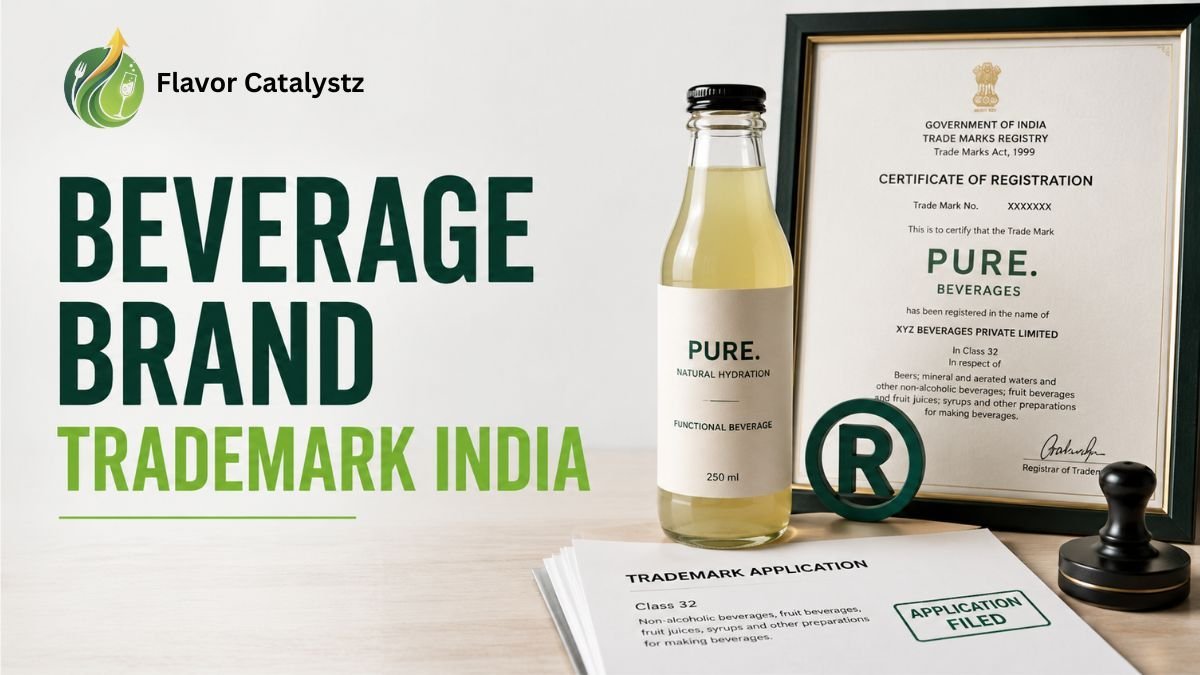
Class 32: Beers, mineral and aerated waters, non-alcoholic beverages, fruit beverages and fruit juices, syrups and other preparations for making beverages.
Class 33: Alcoholic beverages (if applicable).
Class 5: Nutritional supplements, health beverages classified as nutraceuticals or health supplements.
Class 30: Tea, coffee, cocoa, and related beverages where your product spans these categories.
For most non-alcoholic beverage brands, Class 32 is the primary registration. Also consider Class 5 if you have functional/supplement positioning.
Step-by-Step Trademark Registration Process
Step 1: Trademark Search Before filing, conduct a comprehensive trademark search on the IP India website (ipindia.gov.in) to check if your proposed name/mark is already registered or pending in your class.
Search for:
- Identical marks
- Phonetically similar marks (sounds like your name)
- Visually similar marks (looks like your logo)
This search is essential — filing without it risks rejection and wasted filing fees.
Step 2: File the Trademark Application File online through the IP India portal (ipindiaonline.gov.in) or through a registered trademark attorney.
Required:
- Applicant details (individual or company name, address)
- Mark representation (word mark or device/logo)
- Class(es) of goods/services
- Goods/services description
- Filing basis (use in commerce or intent to use)
Government filing fee:
- Individual / startup / small enterprise: ₹4,500 per class (online filing)
- Other entities: ₹9,000 per class (online filing)
Step 3: Examination The Trademark Office examines the application — typically within 3–6 months. They may issue an examination report with objections (similar mark exists, mark is too descriptive, etc.). You must respond to objections within 1 month of the report.
Step 4: Publication in Trademark Journal If accepted, the mark is published in the Trademark Journal. Third parties have 4 months to oppose the registration.
Step 5: Registration If no opposition is filed (or opposition is resolved in your favour), the trademark is registered. Certificate of registration is issued. Validity: 10 years from filing date, renewable indefinitely.
Total timeline: 12–24 months from filing to registration for uncontested marks in India.
Using ™ vs ®:
- ™ can be used immediately upon filing — indicates you are claiming trademark rights
- ® can only be used after registration is granted
Domain and Social Handle Registration
Trademark registration protects your name legally. But in 2026, you also need to secure your digital presence before launch.
Domain: Register your exact brand name as .com and .in immediately. Use GoDaddy, Namecheap, or BigRock. Cost: ₹600–2,000 per year.
Social handles: Secure your brand name on Instagram, Facebook, YouTube, and LinkedIn before you go public with the name. Even if you are not immediately active on all platforms, securing the handle prevents someone else from taking it.
Check: Before finalising your name, confirm the .com domain and @brandname Instagram handle are both available. If not, either find a variation or choose a different name.
Brand Naming and Trademarking: Common Mistakes
Filing too late: Many founders launch, build brand equity, and then discover someone else has registered the same name. File your trademark application at or before product launch.
Not searching properly: Doing a basic Google search is not a trademark search. Use the official IP India database and check phonetically similar marks, not just identical ones.
Too descriptive a name: Names like “Fresh Juice” or “Healthy Drink India” are not trademarkable — they describe the product rather than identify the brand. More distinctive names have stronger trademark protection.
Filing in only one class: If your brand extends into multiple product categories over time, single-class registration leaves you exposed. Consider filing in Class 32 and Class 5 from the beginning if functional positioning is planned.
Not budgeting for professional help: Trademark attorney fees (₹5,000–15,000 for filing and initial prosecution) are worth every rupee. A poorly filed application or an unaddressed examination report can result in abandonment of the application.
Launch a Beverage Brand Built for Long-Term Growth
Choosing the right brand name is only the beginning. From formulation and positioning to packaging, compliance, and commercial launch, Flavor Catalystz helps founders turn beverage ideas into market-ready brands.
FAQs
How much does it cost to trademark a beverage brand name in India?
Government filing fee: ₹4,500 per class for startups/individuals (online). Attorney fees: ₹5,000–15,000 for filing and initial prosecution. Total first-year cost for Class 32 trademark: approximately ₹10,000–20,000.
How long does trademark registration take in India?
12–24 months for an uncontested trademark. You can use the ™ symbol from the date of filing while registration is pending.
Can I use my brand name before the trademark is registered?
Yes — trademark rights in India are also based on prior use. Using the ™ symbol and maintaining evidence of use (sales records, invoices) from your launch date establishes your priority even before registration.
What class should a beverage brand register under in India?
Class 32 is primary for most non-alcoholic beverages. Class 5 for functional/health supplement beverages. Class 33 for alcoholic beverages. Register in all relevant classes simultaneously if your brand spans categories.
What if someone is already using my desired brand name?
If they have a registered trademark in your class, you will need to choose a different name — using it creates infringement risk. If they are using it without registration, the situation is more nuanced — consult a trademark attorney before proceeding.