Jul 2026 · 10 min read
A founder with a working drink recipe and a founder with a shelf-stable, factory-produced, FSSAI-compliant product are, in practice, two very different people. The gap between them is almost never the idea. It is production — the machinery, the batch consistency, the compliance paperwork, and the capital that a first product run demands before a single bottle reaches a retail shelf. This is exactly the gap that beverage contract manufacturing exists to close.
India’s beverage sector has grown fast enough that very few new brands still build their own plant on day one. Instead, most route their first production run through an existing, licensed manufacturing partner. Understanding how that arrangement actually works — not the marketing version, the operational one — is what separates a smooth launch from a stalled one. This is the question the Flavor Catalystz team hears most often from first-time founders, and it is the starting point for this guide. What follows walks through what beverage contract manufacturing means, how the process runs from recipe to retail, the manufacturing models available, and the questions worth asking before signing anything
What Beverage Contract Manufacturing Actually Means
Beverage contract manufacturing is an arrangement where a brand outsources the physical production of its drink — mixing, processing, filling, and packaging — to a third-party facility that already holds the licenses, equipment, and quality systems required to make it legally and safely. The brand owns the recipe, the label, and the market relationship. The manufacturer owns the plant, the production line, and the batch-to-batch execution.
This is different from simply ‘finding a factory.’ A genuine contract manufacturing partner is expected to run quality checks, maintain batch records, hold the relevant food safety certifications, and be able to reproduce the same product at 500 units and at 50,000 units without drift in taste or shelf life. That reproducibility is the entire value of the arrangement — it is what a kitchen or a small pilot unit cannot offer.
Why Brands Choose Contract Manufacturing Over Building Their Own Plant
Setting up an owned beverage plant in India involves beverage formulation and product development, land acquisition, machinery installation, boiler and utility connections, effluent treatment, and multiple layers of licensing before the first commercial batch is even legal to sell. For a new brand testing market demand, that capital commitment usually arrives long before there is enough sales data to justify it. Contract manufacturing shifts that capital risk onto a partner who already has it absorbed across multiple client brands, while also providing access to experienced formulation specialists who can refine recipes, optimize production, and ensure regulatory compliance without requiring an in-house R&D setup.
| Factor | Owned Manufacturing Plant | Contract Manufacturing |
| Upfront capital | Very high (land, machinery, utilities) | Low to moderate (per-batch or MOQ-based) |
| Time to first production run | 12–24 months typical | 6–14 weeks typical, once formulation is locked |
| Licensing burden | Full FSSAI, pollution, factory licenses owned by brand | Manufacturer’s existing licenses cover production |
| Quality control ownership | Built in-house from scratch | Inherited from an operating, audited facility |
| Flexibility to scale down or pivot | Difficult — fixed assets remain | Easier — contracts can be renegotiated or exited |
| Control over daily operations | Complete | Shared — governed by contract terms and SOPs |
Beverage Contract Manufacturing
Ready to Launch Your Beverage Brand?
From beverage formulation and pilot batches to contract manufacturing, packaging, and commercial production, our experts help you bring your beverage idea to market faster with confidence.
The Three Manufacturing Models: OEM, Private Label, and White Label
Not all contract manufacturing arrangements work the same way. The three common models differ mainly in who owns the recipe and how much customization the brand controls.
| Model | Who Owns the Formula | Best Suited For |
| OEM (Original Equipment Manufacturing) | The brand — a fully custom formula developed for one client | Brands with a distinct recipe, flavor profile, or functional claim they want to own outright |
| Private Label | The manufacturer — offered as a ready base, then branded | Brands that want speed to market with limited formulation changes |
| White Label | The manufacturer — identical product sold under multiple brand names | Brands prioritizing cost and speed over product differentiation |
Most beverage brands that plan to build long-term differentiation — a functional claim, a specific taste signature, a clean-label position — go the OEM route. This requires proper recipe development before production begins, which is where the formulation stage becomes critical rather than optional.
How the Beverage Contract Manufacturing Process Works, Step by Step
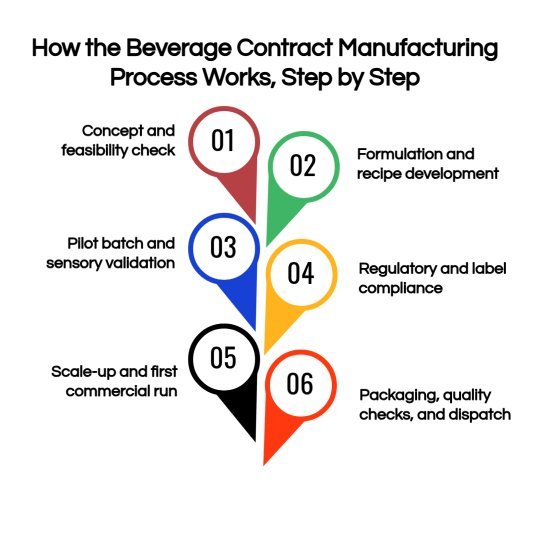
The process runs in a fairly consistent sequence across manufacturers, though timelines vary by beverage category and complexity.
1. Concept and feasibility check
The manufacturer reviews the intended product against real production constraints — available machinery, packaging formats, minimum order quantities, and ingredient sourcing — before any commercial commitment is made.
2. Formulation and recipe development
This is the technical core of the entire process. A recipe that tastes right in a kitchen blender rarely behaves the same way once carbonated, pasteurized, or held for months on a warehouse shelf. Ingredient ratios, pH, water activity, and stability all have to be engineered before scale-up — a discipline covered in detail in our guide to food formulation, which walks through how taste, shelf life, and compliance are balanced against commercial cost.
3. Pilot batch and sensory validation
Small-batch trial runs (typically a few hundred litres) are produced and tested against taste, texture, and stability targets. Most beverages go through several iterations before a formula is locked for scale-up.
4. Regulatory and label compliance
FSSAI licensing category, nutrition panel accuracy, allergen declarations, and any functional or health claims are reviewed and finalized before commercial production, since non-compliant labels are one of the most common causes of shipment holds and retail delisting.
5. Scale-up and first commercial run
The validated recipe is transferred to full production lines, with process parameters adjusted for the manufacturer’s actual equipment. This is the stage most closely tied to the broader food product development process, since beverage manufacturing rarely happens in isolation from the product’s overall development timeline, packaging decisions, and go-to-market plan.
6. Packaging, quality checks, and dispatch
Filled and sealed units go through final quality checks — fill level, seal integrity, batch coding — before dispatch to the brand’s distribution or warehousing partner.
Beverage Categories Commonly Produced Through Contract Manufacturing
| Category | Typical Manufacturing Considerations |
| Functional and wellness drinks | Active ingredient stability, dosage accuracy, claim substantiation |
| Carbonated and aerated beverages | Carbonation retention, pressure-rated filling lines |
| Juices and RTD teas/coffees | Pasteurization method, pulp stability, cold-chain requirements |
| Protein and sports beverages | Protein solubility, texture, and taste masking at scale |
| Dairy-based and plant-based beverages | pH control, homogenization, refrigerated shelf life |
What Influences Beverage Contract Manufacturing Cost
Exact pricing depends heavily on category, packaging format, and order volume, but a few factors consistently move the number up or down.
- Minimum order quantity (MOQ) required by the manufacturer
- Ingredient complexity — functional actives, natural extracts, or specialty proteins cost more than base syrups
- Packaging format — glass, PET, cans, and pouches each carry different tooling and filling costs
- Shelf-life and stability testing requirements before commercial launch
- Regulatory documentation and any product-specific FSSAI approvals needed
A category-by-category cost breakdown, including realistic MOQ ranges and per-unit pricing bands seen across Indian beverage manufacturers, is covered separately in our detailed cost guide.
Where Brands Commonly Go Wrong
The most frequent point of failure is not the manufacturer’s capability — it is a brand starting production before the recipe is genuinely stable. A formula that tastes fine at the pilot stage can still separate, lose carbonation, or drift in flavor once it sits in a warehouse through a hot season. Skipping accelerated shelf-life testing to save a few weeks is consistently one of the most expensive shortcuts a beverage brand can take, often surfacing as returns or delisting months after launch rather than at the factory gate.
Evaluating a Beverage Contract Manufacturer
Before committing to a manufacturing partner, it is worth verifying licensing status, requesting references from existing client brands, confirming batch record practices, and clarifying exactly who owns the formula once the contract ends. These evaluation criteria are detailed further in a dedicated checklist, since the wrong partner is far costlier to exit than to vet upfront.
Conclusion
Beverage contract manufacturing works best when it is treated as a technical partnership rather than a transaction. The brand that invests time in getting the formulation right, understands the compliance requirements early, and picks a manufacturing partner suited to its specific category tends to reach retail shelves faster and stays there longer. Rushing straight to a factory floor without locking the recipe, the shelf-life data, and the compliance paperwork first is the single most common reason launches stall after the first production run.
At Flavor Catalystz, this is the sequence our formulation and regulatory teams follow with beverage brands — get the recipe production-ready first, validate it against real storage and transport conditions, and only then match it to a manufacturing partner suited to that specific category. Founders evaluating contract manufacturers for the first time will find the next two questions — what a manufacturer should genuinely cost, and how to evaluate one before signing — covered in the guides that follow this one.
Frequently Asked Questions
What is the minimum order quantity for beverage contract manufacturing in India?
MOQs vary widely by category and manufacturer, ranging from a few thousand units for simpler formats like bottled juices to significantly higher volumes for canned or carbonated products where line changeovers are costly. It is one of the first things to confirm before formulation begins, since MOQ affects packaging choice and ingredient sourcing.
How long does it take to launch a beverage through contract manufacturing?
From a locked formulation to first commercial dispatch typically takes 6 to 14 weeks, depending on category complexity, packaging format, and whether shelf-life validation is already complete.
Is contract manufacturing cheaper than building an own beverage plant?
For most early-stage and mid-size brands, yes. It removes the large upfront capital expense of land, machinery, and utilities, converting production into a per-batch or per-unit cost instead.
Who owns the recipe in a beverage contract manufacturing arrangement?
This depends on the model. In OEM arrangements, the brand owns the formula outright. In private label and white label models, the manufacturer typically owns the base recipe, and the brand should clarify usage and exclusivity terms in the contract.
Do I need FSSAI approval separately if my manufacturer is already licensed?
Brand owners generally still need their own FSSAI registration or license depending on turnover and business structure, even when production happens at a licensed third-party facility. Label content, nutrition claims, and product category approvals remain the brand’s responsibility.
Can a beverage recipe be reformulated after production has already started?
Yes, but it is far more expensive and time-consuming than adjusting during the formulation and pilot stage. Reformulation after commercial launch usually requires re-running stability and shelf-life tests before the revised product can legally ship.
What packaging formats are most commonly used in beverage contract manufacturing?
PET bottles, glass bottles, aluminium cans, tetra packs, and pouches are the most common, with the choice largely driven by product type, shelf-life needs, and the manufacturer’s existing filling line capability.
How do I know if a contract manufacturer is reliable before signing a contract?
Checking current FSSAI license validity, asking for references from existing client brands, reviewing batch record and quality control practices, and running a paid pilot batch before committing to a full production run are the most reliable ways to validate a manufacturer.