May 2026 · 11 min read
So you have a beverage product — or you are about to. The formula is ready, the branding is locked, and the packaging looks sharp. But then comes the question that trips up almost every new beverage entrepreneur in India:
How do you actually get your product into stores?
The answer, more often than not, runs straight through beverage distributors.
Whether you are launching a functional drink, a traditional Indian beverage like shikanji or aam panna, or a modern energy drink, distribution is the bridge between your factory and your customer. Getting this right can make or break your brand in its first year.
This guide breaks down everything you need to know — who beverage distributors are, how the distribution system works in India, what to look for when choosing one, and how to approach them professionally.
Flavor Catalystz
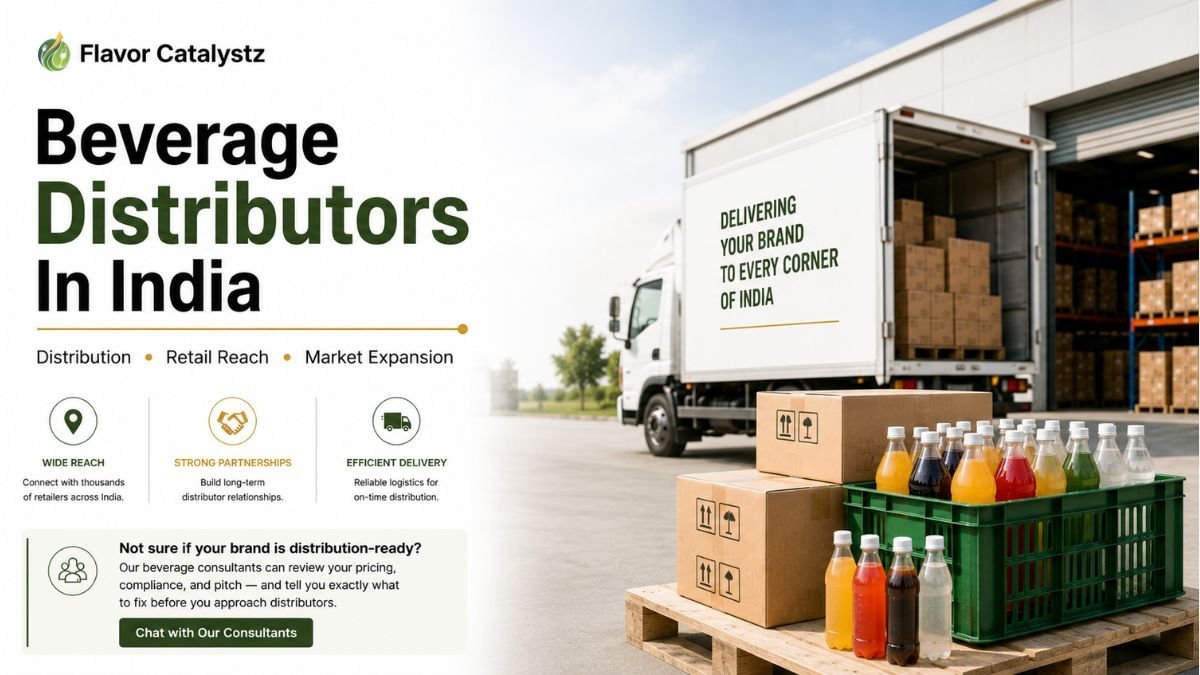
Not sure if your brand is distribution-ready?
Our beverage consultants can review your pricing, compliance, and pitch — and tell you exactly what to fix before you approach distributors.
What Are Beverage Distributors and Why Do They Matter?
Beverage distributors are companies or individuals who buy beverages from manufacturers and supply them to retail outlets — kiranas, supermarkets, restaurants, cafes, hotels, modern trade chains, and more.
They sit in the middle of your supply chain. You produce. They distribute. Retailers sell.
In India, this middleman layer is not optional — it is essential. The Indian retail ecosystem is highly fragmented, with over 12 million kiranas and thousands of modern trade outlets spread across geographies that no single brand can serve directly at scale. A well-connected beverage distributor already has relationships with hundreds or thousands of these outlets. Partnering with the right one gives you instant reach that would otherwise take years to build.
Beyond delivery, good distributors also handle:
- Local marketing and visibility (shelf placement, displays)
- Credit management with retailers
- Return and replacement handling
- Real-time market feedback
- Last-mile logistics in areas with difficult access
In short, they are an extension of your sales and operations team on the ground.
How the Beverage Distribution System Works in India
Understanding the structure helps you position your brand correctly and approach the right type of distributor.
The Typical Distribution Hierarchy
- Super Stockist / C&F Agent
These are large regional warehouses that receive goods in bulk from the manufacturer and supply them to multiple distributors in a zone. Many national and large regional brands work at this level first before going deeper. - Area / City Distributor
They buy from the super stockist or directly from the brand and distribute across a defined geography — a district, city, or urban zone. This is where most growing brands start their distribution conversation. - Sub-Distributor / Dealer
Smaller operators who typically cover specific localities, markets, or semi-urban areas. Often they work under a city distributor. - Retailer
The final touchpoint — your kirana, general store, restaurant, pharmacy, gym, or modern trade outlet.
For a new or emerging beverage brand in India, the most practical starting point is securing one or two area distributors in your target geography and proving traction there before expanding.
Types of Beverage Distributors in India
Not every distributor is the right fit for every product. Here is how to think about the different types:
General FMCG Distributors
Handle a wide range of food and beverage products. Great for mass-market or impulse beverages targeting kirana coverage. However, your product may not get the focused attention it needs in a large portfolio.
Beverage-Specific Distributors
Focused exclusively or primarily on drinks — soft drinks, water, juices, energy drinks, etc. They have better relationships with relevant retail channels and understand the category deeply.
Cold Chain Distributors
Critical for fresh juices, dairy-based beverages, and products with refrigeration requirements. If your product needs to stay cold throughout distribution, this is non-negotiable.
Modern Trade Distributors
Specialise in supplying large-format retail — Big Bazaar, DMart, Reliance Smart, Spencer’s, and so on. The requirements here are different: barcodes, compliance documents, and promotional support commitments are typically expected upfront.
HoReCa Distributors
Focus on hotels, restaurants, and cafes. If your positioning is premium or your product is a mixer, cocktail base, wellness drink, or specialty beverage, HoReCa distribution can build strong brand value and trial.
E-commerce / Quick Commerce Enablers
With platforms like Blinkit, Swiggy Instamart, and Zepto growing rapidly, some distributors now specialise in managing dark store relationships and last-mile fulfilment for online channels.
What Beverage Distributors Look for in a Brand
If you want a good distributor to take your product seriously, you need to understand their perspective. They are running a business. They take on inventory risk. They have limited space, vehicles, and salespeople.
Here is what makes a beverage brand attractive to distributors:
Margin Viability
Distributors typically expect 6–12% margin on beverages, sometimes higher for premium or niche products. If your pricing does not allow for their margin plus the retailer’s margin (another 10–20%), the numbers will not work.
Market Demand Signal
Even if you are new, showing consumer interest helps — social media traction, online orders, trial feedback, or a pilot in a few retail outlets. Distributors want to know the product will move.
Proper Licensing and Compliance
FSSAI license, GST registration, correct labelling as per Indian regulations — these are table stakes. No serious distributor will touch a product that is not compliant. (If you need help with this, our beverage consultant team can guide you through the process.)
Marketing Support
Are you going to invest in visibility? Schemes, display materials, activation support? Distributors are more willing to push a brand if they know the brand owner is invested in pulling consumers.
Consistent Supply
Can you guarantee you will not go out of stock? Supply chain reliability is one of the most common reasons distributors drop new brands.
How to Find Beverage Distributors in India
Here are the most effective ways to identify and connect with distribution partners:
- Industry Trade Events
Events like Aahar (New Delhi), Fi India, and World Food India regularly bring together manufacturers, distributors, and buyers under one roof. These are among the most efficient networking environments in the food and beverage industry. - FMCG Distributor Networks
Several online platforms list FMCG and beverage distributors by city and category — IndiaMart, TradeIndia, and the All India Food Processors’ Association (AIFPA) database are worth exploring. - Direct Field Research
Walk into retail stores in your target area. Ask the store owner who supplies similar products. Most will tell you. This gives you real, on-ground distributor contacts for your exact category and geography. - Your Contract Manufacturer’s Network
If you are working with a beverage contract manufacturer, they often have existing distributor relationships — especially regional ones. Ask them. (Exploring contract manufacturing? See our beverage formulation services.) - Brokers and Trade Consultants
In larger markets like Delhi, Mumbai, and Bangalore, there are trade brokers who specialise in connecting brands with distributors for a fee or percentage. Useful if you want to move quickly. - LinkedIn and Industry Groups
Many area distributors and super stockists are now active on LinkedIn. Searching for “FMCG distributor [city name]” or “beverage distributor [state]” often surfaces real contacts.
How to Approach a Beverage Distributor Professionally
This is where many first-time brand founders make costly mistakes. Walking into a distributor meeting without preparation is one of the fastest ways to get a “we’ll think about it” that never converts.
Here is how to come prepared:
Prepare a Brand/Product Presentation
One page or a short deck covering: what your product is, who it is for, what makes it different, your pricing structure (MRP, distributor price, retailer price), your margin scheme, and your FSSAI/GST details.
Carry Product Samples
Always. Let them taste it. Let their team try it. Sensory experience is your first sales tool.
Be Clear on Payment Terms
Most small distributors work on credit. Understand what terms you can offer without straining your cash flow. New brands typically work on advance or cash-on-delivery initially.
Start Small and Prove
Do not ask them to cover an entire city from day one. Offer a limited pilot — 20 to 30 outlets over 30 days. Show movement. Then expand.
Follow Up Consistently
Distributors deal with dozens of brands. You need to stay on their radar. Regular check-ins, scheme updates, and market support signals that you are serious.
Red Flags to Watch for When Choosing a Beverage Distributor
Not every distributor is worth partnering with. Watch out for:
- Overpromising coverage without a clear plan or salesforce to back it up
- No cold chain capability for products that require refrigeration
- Poor payment history with other brands (ask around in the trade)
- Distributors carrying too many competing brands — your product may get lost
- No market feedback mechanism — if they cannot tell you which outlets are selling and which are not, you are flying blind
The right distributor is not just a logistics partner — they are a brand ambassador on the ground.
Beverage Distribution and Your Broader Brand Strategy
Distribution decisions should not be made in isolation. They need to align with your positioning, your production capacity, and your category.
A craft cold-brew coffee brand targeting urban millennial consumers does not need kirana distribution in Tier 3 towns — it needs premium cafes, gyms, and quick commerce in metros. A traditional herbal sharbat with mass-market appeal might be better served through FMCG distributors covering small towns and semi-urban markets.
Getting this alignment right early saves you enormous time, money, and energy later.
If you are still in the product development phase, it is worth thinking about your distribution channel while you are formulating — because channel requirements affect your packaging, shelf life, pricing, and compliance needs. Our beverage formulation team works with founders from idea to launch, keeping these downstream realities in mind from day one.
The Role of a Beverage Consultant in Distribution Planning
Many brand founders approach distribution as a purely operational challenge. In reality, it is a strategic one.
A beverage consultant can help you:
- Map the right distribution channel for your product and target market
- Structure your pricing to work across the full distribution chain
- Identify and vet distributor options in your target geographies
- Prepare your brand presentation and distributor pitch materials
- Ensure your product, labelling, and documentation are distribution-ready
If you are serious about scaling your beverage brand in India, having expert guidance at this stage — not after your first failed distribution attempt — makes a measurable difference. Talk to our beverage consultants to understand how we can support your go-to-market strategy.
Ready to Take Your Beverage Brand to Market?
Distribution is just one piece of the puzzle. The brands that win in the Indian beverage market are the ones that get the product right, the pricing right, and the go-to-market right — before they scale.
At Flavor Catalystz, we work with beverage entrepreneurs at every stage — from recipe development and formulation to compliance, branding strategy, and market launch. Whether you are starting from scratch or ready to scale an existing product, we can help you move faster and smarter.
Get in touch with our team today — and let’s build something worth distributing.
Related Reading:
- How to Start a Beverage Brand in India
- Beverage Contract Manufacturing: What You Need to Know
- FSSAI Beverage Compliance Guide
- Beverage Formulation Cost: What to Expect
- Beverage Industry Trends in India
- Beverage Companies in India
FAQS
What margin do beverage distributors typically expect?
Generally between 6–12% depending on category, volume, and geography. Premium and niche products sometimes command higher distributor margins as incentive to push the product.
Can a new beverage brand approach distributors directly?
Yes. But you need to be prepared — FSSAI licence, pricing structure, samples, and a clear value proposition. Distributors receive new product inquiries regularly; preparation is what sets you apart.
What is the difference between a distributor and a C&F agent?
A C&F (Carry & Forward) agent does not typically take ownership of the goods — they store and forward on behalf of the brand. A distributor buys the product and resells it, taking on inventory risk.
How many distributors does a new brand typically need to start?
Start with one or two in your primary geography. Prove the product moves. Then expand systematically.
Do I need separate distributors for modern trade and general trade?
Often, yes. Modern trade distributors are specialists with the right systems and relationships for organised retail. General trade distributors are better suited for kirana and wholesale coverage.