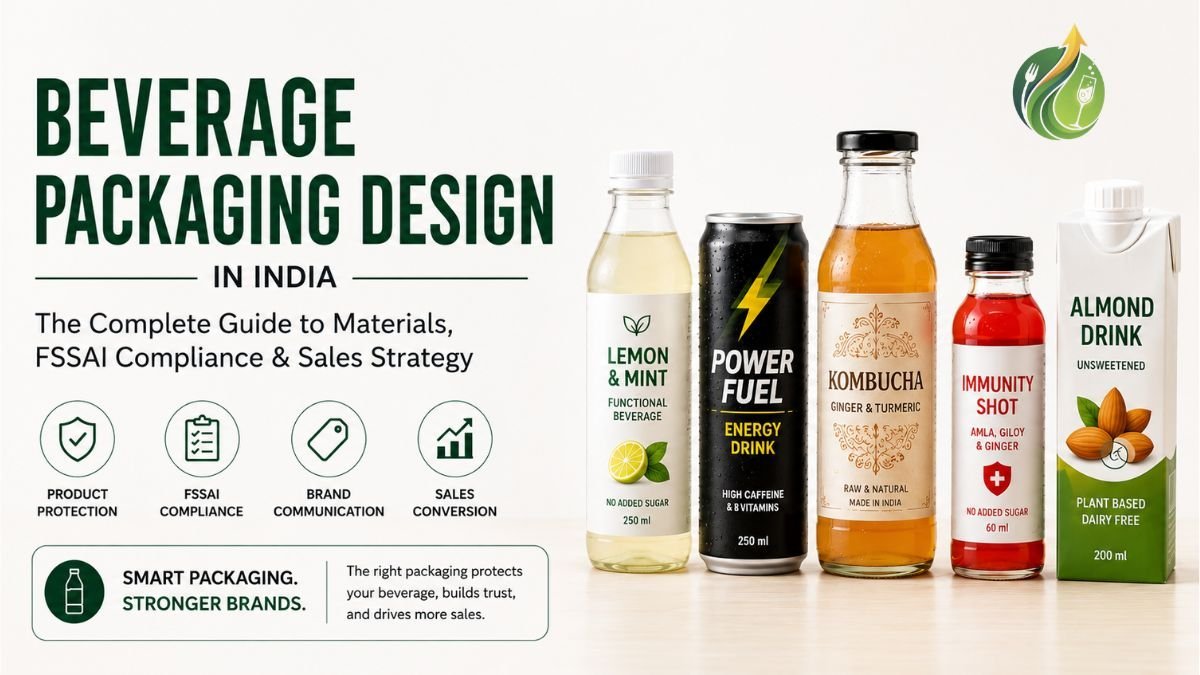
Jul 2026 · 11 min read
Walk down any beverage aisle in India today and you’ll see the same truth play out in under three seconds: shoppers don’t read labels, they react to them. Before a customer ever tastes your drink, your packaging has already made the sale — or lost it. Beverage packaging design is no longer just a bottle with a sticker on it; it is a strategic system that protects your product, meets FSSAI’s legal requirements, and converts a browsing shopper into a paying customer, all at once.
This guide breaks down everything a beverage founder needs to know before finalising packaging — the material formats that actually work in the Indian market, the mandatory compliance rules that can get a shipment rejected, the design principles that drive shelf-level conversion, and the trends shaping 2026. Whether you’re launching a functional drink, an energy drink, or a traditional Indian beverage in modern packaging, this is the practical roadmap.
Need Help Choosing the Right Packaging for Your Beverage?
The right bottle, can, or carton impacts shelf life, compliance, production costs, and consumer appeal. Our beverage experts help you select the ideal packaging format, ensure FSSAI compliance, and prepare your product for successful commercial manufacturing.
Why Beverage Packaging Design Decides Whether Your Drink Sells
In a retail environment crowded with hundreds of competing SKUs, packaging is often the only brand interaction a consumer has before deciding to buy. It works on three levels simultaneously: visually, it uses colour, typography, and imagery to trigger an instinctive emotional response; structurally, it communicates category, flavour, and benefit within seconds; and legally, it carries every mandatory declaration required to sell a packaged beverage in India.
Brands that treat packaging as a strategic asset — planned alongside recipe and manufacturing, not bolted on afterward — consistently outperform on shelf. A well-designed package builds the trust that drives a first purchase, and the recognisability that brings a customer back for a second and third. Get this part right, and packaging becomes one of the highest-leverage investments a beverage brand can make, right alongside a sound approach to
product formulation itself. If you’re still finalising your recipe, it’s worth reading our guide on beverage recipe formulation before you commit to a packaging format, since the two decisions influence each other more than most founders expect.
The Four Jobs Every Beverage Package Must Do
Effective beverage packaging design isn’t about creativity in isolation — it’s about four functions working together. Miss any one of them and the package fails, no matter how attractive it looks.
- Protect the product — preserving carbonation, flavour, colour, and shelf life against light, oxygen, and temperature.
- Ensure legal compliance — carrying every mandatory FSSAI declaration so the product can legally be sold.
- Communicate the brand — signalling category, flavour, and functional benefit within a three-second glance.
- Convert the sale — standing out on a crowded shelf and giving the shopper a reason to pick it up over a competitor.
Types of Beverage Packaging Materials Compared
Choosing the right packaging format is one of the most consequential — and most commonly rushed — decisions in beverage product development. Each material comes with distinct trade-offs in cost, shelf appeal, and compatibility with your formulation.
Aluminium Cans
The preferred format for carbonated drinks, energy drinks, and RTD cocktails. Cans are lightweight, fully recyclable, and provide an airtight seal that protects carbonation and flavour better than most alternatives. Their large printable surface also makes them ideal for bold, shelf-dominant designs.
PET Bottles
The most cost-effective and scalable format for most beverage startups in India. PET is shatter-resistant, available in countless shapes and sizes, and lets consumers see the product inside — a real advantage for juices, flavoured water, and functional drinks where colour and clarity signal freshness.
Glass Bottles
Glass signals premium positioning like no other format. Because it’s chemically inert, it doesn’t interact with the beverage, making it the format of choice for cold-pressed juices, kombucha, and craft beverages. The weight and feel of glass in hand directly reinforces perceived value, often justifying a higher price point.
Cartons and Tetra Packs
The most practical option for ambient shelf life without refrigeration. Widely used for dairy-based drinks, fruit juices, and plant-based beverages, cartons are stackable, lightweight to ship, and reduce logistics costs meaningfully at scale.
| Format | Best For | Key Strength | Watch-Out |
| Aluminium Can | Energy drinks, carbonated beverages, RTD cocktails | Airtight seal, bold branding surface | Higher tooling cost for custom shapes |
| PET Bottle | Juices, flavoured water, functional drinks | Cost-effective, scalable, transparent | Less premium perception |
| Glass Bottle | Cold-pressed juice, kombucha, craft beverages | Chemically inert, premium feel | Fragile, higher shipping cost |
| Carton / Tetra Pack | Dairy drinks, plant-based beverages | Ambient shelf life, stackable, low logistics cost | Limited premium shelf appeal |
Beverage Packaging Design by Product Category
A one-size-fits-all approach to packaging design almost always underperforms. Each beverage category has its own visual language, shaped by what the consumer expects to feel when they pick up the bottle or can.
Energy drinks demand bold, high-contrast colour schemes and confident typography that signal performance — a category we cover in depth in our energy drink formulation guide. Functional beverages — immunity shots, focus drinks, adaptogenic blends — need packaging that communicates the benefit instantly through icons and concise claims, which pairs closely with the process outlined in our functional beverage development resource.
Protein and vitamin water rely on clean, minimalist labels with the functional claim front and centre — see our protein water formulation guide for how the recipe side of this category is built. Cold-pressed juices lean into freshness cues — fruit-forward colour, uncluttered layout, and a premium finish, explored further in our cold press juice brand guide. Sparkling water and RTD coffee both trend toward restrained, premium minimalism — soft palettes and generous white space for the former, and bold, confident typography for the latter, covered respectively in our sparkling water brand guide and RTD coffee brand guide.
Traditional Indian drinks — shikanji, jaljeera, lassi, thandai — bring a different challenge: modern packaging has to honour heritage cues while still looking retail-ready next to global brands. Our roundup of traditional Indian drinks covers how several of these categories are being modernised for commercial launch.
FSSAI Mandatory Labelling Requirements for Beverage Packaging
No matter how strong the visual design, a beverage cannot legally be sold in India without specific mandatory declarations on the package. This isn’t optional polish — it’s a legal requirement enforced under the Food Safety and Standards Act, and getting it wrong at the design stage is far more expensive to fix after printing than before.
- FSSAI licence number, printed clearly and legibly
- Complete list of ingredients in descending order of composition
- Nutritional information panel
- Net quantity, batch number, and manufacturing/expiry or best-before date
- Veg or non-veg symbol, allergen declarations, and manufacturer/marketer address
- Any functional or health claim, which must be substantiated and compliant with FSSAI’s claims regulations
For the complete regulatory picture — including licensing categories and how compliance intersects with formulation — see our detailed guides on FSSAI beverage compliance, FSSAI beverage licensing, and FSSAI health claims for beverages. You can also verify current labelling regulations directly on the FSSAI’s official website.
Packaging and Formulation Compatibility: Why They Can’t Be Planned in Isolation
This is the mistake that costs beverage founders the most money after launch. Acidic beverages can degrade certain plastic liners over time. High-pressure pasteurisation requires packaging that can withstand specific stress tolerances. Carbonated products need airtight seals that standard bottles can’t always provide. These issues have to be resolved during formulation and packaging development together — not discovered after the first production run.
This is exactly why packaging decisions at Flavor Catalystz are made alongside formulation, not after it. If you’re budgeting for this stage, our breakdown of beverage formulation cost in India is a useful starting point before you approach packaging vendors.
Beverage Packaging Trends Shaping India in 2026
Packaging that looked current two years ago can already read as dated. Brands that ignore these shifts risk looking outdated within a single product cycle.
Sustainable Packaging Is Now a Baseline Expectation
Younger consumers actively check whether packaging is recyclable, refillable, or made from post-consumer material. Brands using rPET, paper-based labels, or compostable pouches are increasingly preferred in urban retail and D2C channels, and regulatory pressure around single-use plastics is only tightening this further.
Minimalist Label Design
Clean layouts with generous white space and a single dominant visual are replacing cluttered, text-heavy labels across nearly every category — and they photograph better, which matters when unboxing content drives real purchase intent online.
Functional-First Communication
Packaging now has to state what the product does — hydration, focus, immunity, gut health — not just what it is, with the functional claim prominent and credible.
For a deeper, India-specific breakdown of what’s changing, see our dedicated guide on beverage packaging trends in India, which pairs well with our broader look at functional beverage trends in India.
Common Packaging Mistakes Beverage Startups Make
- Designing packaging before the formulation is finalised — leading to costly redesigns when the recipe changes.
- Choosing a format based on aesthetics alone — without checking compatibility with carbonation, pH, or shelf-life needs.
- Skipping shelf-context testing — a design that looks great in isolation can disappear next to competitors on a crowded shelf.
- Underestimating MOQs and scalability — a format viable at 500 units a month can become unworkable at 50,000.
- Treating FSSAI compliance as an afterthought — non-compliant labels lead to rejected shipments and retailer pushback.
Many of these mistakes trace back to sourcing and cost planning. Our guides on selecting a beverage co-packer in India and beverage brand launch cost in India walk through how to plan for these constraints before they become expensive surprises.
How Flavor Catalystz Helps You Build Sales-Ready Beverage Packaging
Packaging decisions don’t happen in isolation — the strongest beverage brands treat formulation, packaging, and regulatory compliance as one integrated process, because a decision in one area directly affects the others. That’s the approach we take with every project.
If you’re starting from the recipe stage, our Beverage Formulation service ensures your product is built for the packaging format you actually plan to launch with. If you need end-to-end guidance across formulation, compliance, and go-to-market strategy, our Beverage Consultant service is built for exactly that. And if you’re developing an energy drink specifically, our Energy Drink Recipe Formulation service covers the category’s specific formulation and packaging demands in detail.
Conclusion
Beverage packaging design is one of the highest-leverage investments a drink brand can make in India’s crowded market. It protects your product, keeps you FSSAI-compliant, communicates your brand in seconds, and — when done right — converts a browsing shopper into a repeat customer. The brands that win on shelf aren’t always the ones with the best formulation; they’re the ones whose packaging makes the right promise to the right consumer, backed by a product that delivers on it.
If you’re planning a beverage launch and want packaging, formulation, and compliance handled as one connected process rather than three separate headaches, that’s exactly where Flavor Catalystz comes in.
Build Beverage Packaging That Protects, Complies & Sells
From packaging material selection and label design to FSSAI compliance, shelf-life compatibility, and commercial manufacturing readiness, Flavor Catalystz helps founders create packaging that’s built for retail, quick commerce, and long-term brand growth.
You can also reach out directly through our Contact Us page to book a consultation.
Frequently Asked Questions
What is beverage packaging design?
Beverage packaging design is the process of creating the container, label, and visual identity system for a drink — covering material selection, structural format, graphic design, and the mandatory FSSAI declarations required to sell the product legally in India.
Which packaging is best for beverages in India?
There’s no single best format — it depends on product type, target price point, and distribution channel. Aluminium cans suit carbonated and energy drinks, glass suits premium positioning, PET suits cost-effective scalability, and cartons suit ambient, sustainable formats. The right choice is the one that matches your formulation and consumer expectations.
What are the mandatory FSSAI requirements for beverage packaging?
Every packaged beverage sold in India must display the FSSAI licence number, complete ingredient list, nutritional information, net quantity, batch number, manufacturing and expiry or best-before dates, veg/non-veg symbol, allergen declarations, and manufacturer or marketer details.
How much does beverage packaging design cost in India?
Costs vary widely based on format, custom tooling, minimum order quantities, and whether you’re using stock bottles or fully custom moulds. Early-stage brands typically start with cost-effective PET or standard cans before investing in custom packaging once volumes justify it.
What is sustainable beverage packaging?
Sustainable beverage packaging uses recyclable, refillable, or post-consumer materials — such as rPET, paper-based labels, or compostable pouches — to reduce environmental impact. It has moved from a differentiator to a near-baseline expectation among Indian consumers, particularly in the D2C and urban retail space.
Can packaging be changed after the beverage formulation is finalised?
It can, but it’s rarely cost-free. Material compatibility, pH, carbonation, and pasteurisation method are all tied to your formulation. Planning packaging and formulation together from the start avoids expensive rework later.