May 2026 · 10 min read
Every drink you pick up off a shelf — whether it’s a sparkling adaptogen water, a protein-packed RTD, or a classic fruit juice — started in a lab. Someone ran experiments, failed a dozen times, adjusted ratios, retested pH, and then finally got it right. That entire process has a name: Beverage R&D.
If you’re building a drink brand, thinking about launching a new product, or trying to improve something already in market — understanding how beverage research and development works is not optional. It’s the difference between a product that survives the shelf and one that quietly disappears within a season.
This guide covers the complete landscape of beverage R&D — from what it actually involves, to the stages, the science, the regulatory side, and the smartest way to approach it if you’re starting out or scaling up.
Have a Drink Idea You Can’t Get Off Your Mind?
Whether it’s a functional tonic, an energy drink, or a healthier take on a classic — Flavor Catalystz helps you turn it into a launch-ready formula. Let’s talk formulation.
What is Beverage R&D?
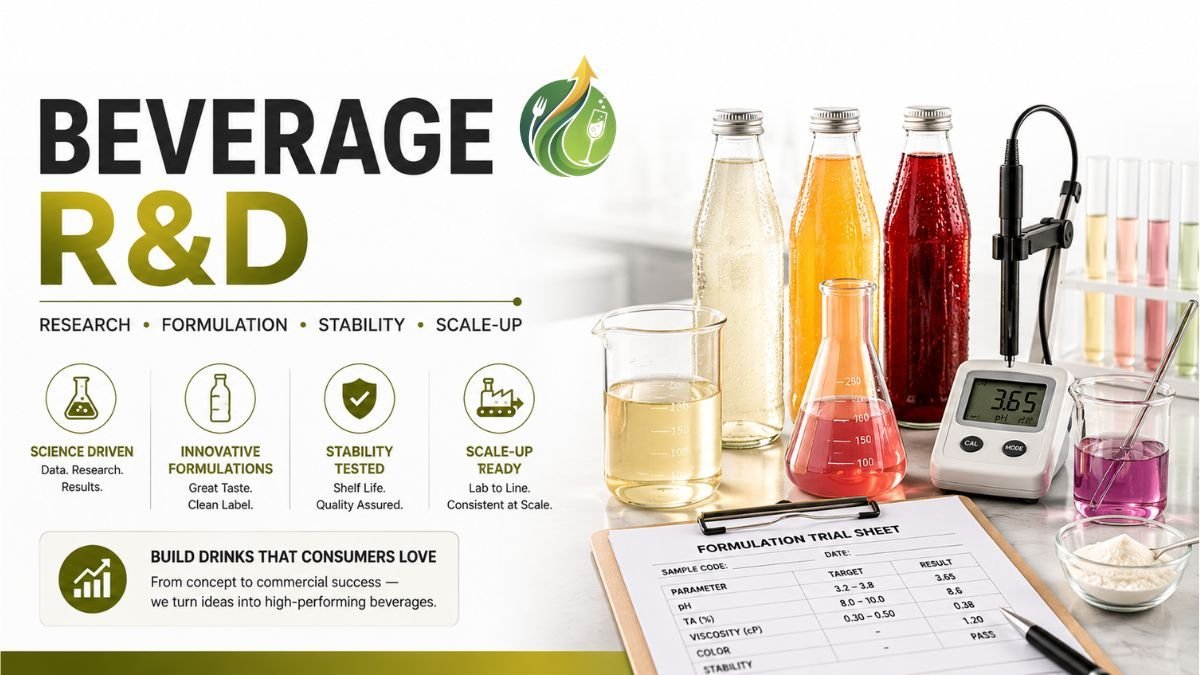
Beverage R&D (Research and Development) is the systematic process of creating new drink products or improving existing ones through science, testing, and consumer insight. It covers everything from ingredient sourcing and flavor development to stability testing, regulatory compliance, and manufacturing scale-up.
Think of it as the full backend of your drink brand. Marketing builds desire. Distribution puts the product in front of people. But R&D is what ensures your product actually tastes right, lasts on shelf, passes food safety standards, and can be manufactured at volume without changing what makes it good.
Simple definition: Beverage R&D = the process of going from “I have a drink idea” to “I have a product I can legally sell, that tastes great, and that works at scale.”
The scope of beverage research and development in 2026 has expanded significantly. It’s no longer just about carbonation levels and sugar content. Today’s R&D teams work on bioavailability of functional ingredients, clean-label formulation, plant-based alternatives, sustainable packaging compatibility, and health claim substantiation — all at the same time.
Why Beverage R&D Matters More Than Ever
India’s beverage market is growing fast. Functional drinks, health beverages, and premium RTDs are no longer niche — they’re mainstream. But with growth comes competition, and the brands that win aren’t necessarily the ones with the biggest budgets. They’re the ones with the most dialed-in products.
Key industry numbers to know:
- Global Beverage Market: $1.2 Trillion (2025)
- CAGR of Functional Beverages: 8.9% (2024–2029)
- ~70% of new drink launches fail without proper R&D validation
Consumers are also more literate now. They read labels. They question ingredients. They expect a functional beverage to actually do what it claims. That puts enormous pressure on the beverage formulation side of any brand — and rewards companies that invest in proper R&D from the start.
Beyond consumer expectations, regulatory bodies like FSSAI in India have tightened standards around labeling, health claims, and ingredient permissibility. Getting this wrong doesn’t just hurt sales — it can pull your product off shelves entirely.
7 Core Stages of the Beverage R&D Process
Good beverage product development follows a structured path. Shortcuts at any stage tend to show up as problems later — either in taste, shelf life, cost, or compliance. Here’s how a professional R&D process typically unfolds:
1. Concept & Brief
Define the drink’s purpose, target consumer, positioning, and success criteria. What problem does this drink solve?
2. Ingredient Research
Identify active ingredients, flavor bases, preservatives, and carriers. Check regulatory permissibility and supplier availability.
3. Prototype Formulation
Develop multiple working formulas. Test flavor combinations, texture, mouthfeel, and visual appeal in bench trials.
4. Sensory & Consumer Testing
Run blind taste tests. Gather feedback on flavor, sweetness, aftertaste, and overall preference. Iterate based on data.
5. Stability Testing
Test the product under various storage conditions to ensure it maintains quality, safety, and appearance throughout shelf life.
6. Regulatory Compliance
Finalize formulation against FSSAI standards, prepare label declarations, validate health/functional claims.
7. Scale-Up & Manufacturing
Transfer the formula from lab to production. Pilot runs, process adjustments, and cost-per-unit optimization happen here.
Most brands underestimate the time this takes. A realistic timeline from concept to commercial launch — for a beverage with functional ingredients — is 6 to 14 months. Rushing it is one of the most common and expensive mistakes in the industry.
The Science of Beverage Formulation
Beverage formulation is the technical heart of R&D. It’s where food scientists and flavorists decide exactly what goes into a drink — and in what proportions — to hit a specific sensory and functional target.
Consider a simple flavored water with added electrolytes. Formulating it means balancing:
- Water quality and mineral profile
- Electrolyte ratios (sodium, potassium, magnesium) for taste and efficacy
- Natural flavor compatibility with those minerals
- pH management to prevent off-notes and ensure stability
- Preservative system that doesn’t interact badly with flavors
- Sweetener choice and its impact on bitterness
- Color stability under UV, heat, and varying pH
Get any one of these wrong and the product either tastes off, looks wrong after a few weeks on shelf, or fails stability testing.
For complex products like functional beverages, nootropic drinks, or adaptogen-based tonics — the formulation challenge multiplies. Active ingredients often interact with flavors in unpredictable ways. Some are bitter, astringent, or chalky. Making them taste good while maintaining efficacy is a genuine science.
This is exactly why working with an experienced beverage formulation partner pays off → Flavor Catalystz Beverage Formulation Services
Beverage Recipe Formulation Timeline
From concept to commercial production — every stage is engineered to create beverages that are scalable, stable, and consumer-ready.
Functional Beverages: Where Beverage R&D Gets Exciting
If there’s one segment driving the most innovation in beverage R&D right now, it’s functional drinks. These are products designed to do something beyond hydration — improve focus, boost immunity, aid digestion, support sleep, enhance athletic performance, and so on.
Common Functional Beverage Categories & R&D Challenges:
- Energy Drinks (Caffeine, B-vitamins, Taurine) → Bitterness masking, regulatory limits
- Immunity Drinks (Vitamin C, Zinc, Elderberry) → pH stability, color oxidation
- Adaptogen Tonics (Ashwagandha, Rhodiola, Reishi) → Earthy flavor masking, bioavailability
- Probiotic Drinks (Live cultures) → Viable count through shelf life
- Electrolyte/Sports Drinks (Na, K, Mg, BCAAs) → Mineral taste, clarity, osmolality
- Nootropic Drinks (L-Theanine, GABA, Lion’s Mane) → Flavor compatibility, claim compliance
For further reading on global functional beverage trends: FoodNavigator Asia
5 Costly Mistakes Brands Make in Beverage R&D
After working with dozens of beverage brands, certain patterns of failure show up repeatedly. Most of them are avoidable — but only if you know to look out for them.
1. Skipping Stability Testing to Save Time
Stability testing tells you whether your product still tastes, looks, and performs the way it should after 3, 6, or 12 months on shelf — under real storage conditions. Skipping or shortcutting this is the single biggest cause of reformulations after launch. Products turn brown, separate, lose potency, or develop off-flavors in ways that weren’t obvious at launch.
2. Designing for the Lab, Not the Factory
A formula that works beautifully in small batches can fall apart at industrial scale. Mixing dynamics, heat treatment, carbonation, fill speed — all of these affect the final product. R&D that doesn’t involve the manufacturing side early tends to result in expensive last-minute reformulations.
3. Ignoring Ingredient Interaction Effects
Ingredients don’t exist in isolation. Vitamin C can cause browning reactions. Iron can make flavors metallic. Certain preservatives interact badly with specific natural colors. Understanding beverage formulation chemistry — not just individual ingredients — is what keeps these problems out of your product.
4. Underestimating Regulatory Requirements
FSSAI has specific standards for what can go into beverages, how they must be labeled, and what health claims are permissible. Many brands discover these limits after they’ve already finalized a formula — and end up having to reformulate, relabel, or drop a claim they built their whole marketing around.
5. Treating R&D as a One-Time Event
The brands that last in beverages treat R&D as an ongoing investment — not a one-time cost. Consumer preferences shift, ingredient availability changes, competitors launch new things, and regulations evolve. Continuous beverage R&D is what keeps a product relevant and competitive over time.
Regulatory Compliance & Stability Testing in Beverage R&D
This might not be the most exciting part of beverage R&D, but it’s the part that has the most direct impact on whether your product can actually be sold. In India, the Food Safety and Standards Authority of India (FSSAI) governs what goes into beverages, how they’re processed, and what can appear on the label.
Key regulatory checkpoints in beverage development:
- Ingredient permissibility under FSSAI standards (FSS Act 2006 & subsequent regulations)
- Additives, preservatives, and colors — all must be from the approved list at permitted levels
- Nutritional labeling requirements (per 100ml and per serving)
- Health and nutrition claim substantiation — what you can and cannot say on pack
- Mandatory FSSAI license for manufacture and sale
- Microbiological and chemical safety testing
Stability testing runs parallel to this. Accelerated shelf-life testing (ASLT) is used to predict how a product will behave over its intended shelf life by exposing it to elevated temperature and humidity conditions. It’s the industry standard for getting a reliable estimate before you commit to a full production run.
For brands in the functional/nutraceutical space, the FSSAI guidelines on proprietary foods are updated regularly: www.fssai.gov.in
When Do You Actually Need a Beverage Consultant?
Not every beverage startup needs a full in-house R&D team. But every serious beverage brand — at some point — needs access to the kind of expertise that a professional beverage consultant provides.
When a beverage consultant is essential:
- Launching your first beverage product → Strongly recommended
- Product failing stability tests → Get expert help immediately
- Scaling from small-batch to commercial production → Formulation transfer is tricky
- Adding functional ingredients to an existing product → Interaction risks are high
- FSSAI compliance issues or health claim review → Get expert guidance
At Flavor Catalystz, our work spans beverage consulting and end-to-end beverage formulation — from initial concept feasibility through to commercial-scale production. Learn about our Beverage Consulting →
Ready to Build Something Worth Drinking?
Your drink idea deserves more than a guess. Let’s bring science, strategy, and real formulation expertise to it — and build a product that actually performs on shelf.
FAQ: Beverage R&D — Answered
Q: What is R&D in the food and beverage (F&B) industry?
R&D in F&B is the process of developing new products or improving existing ones through systematic research and scientific testing. In beverages specifically, it covers ingredient selection, formulation, sensory testing, stability evaluation, regulatory compliance, and manufacturing scale-up. It’s how a drink idea becomes a commercially viable, safe, and shelf-stable product.
Q: What are the 7 steps of beverage R&D?
The seven core stages are: (1) Concept & Brief, (2) Ingredient Research, (3) Prototype Formulation, (4) Sensory & Consumer Testing, (5) Stability Testing, (6) Regulatory Compliance, and (7) Scale-Up & Manufacturing Transfer.
Q: What are the three types of R&D?
The three types are: (1) Basic Research — understanding fundamental science; (2) Applied Research — developing solutions to known problems; (3) Experimental Development — using existing knowledge to create or improve products. Beverage R&D primarily falls in the applied research and experimental development categories.
Q: How long does beverage R&D typically take?
For a standard beverage, 3–6 months is realistic. For functional beverages with novel ingredients or complex regulatory considerations, 8–14 months is more common. Rushing the timeline — especially stability testing — is one of the most expensive mistakes brands make.
Q: What is beverage formulation vs. R&D?
Beverage formulation is one specific stage within the broader R&D process. Formulation refers to the technical act of building the recipe — deciding on ingredients, ratios, pH, preservative system, flavor balance, etc. R&D is the end-to-end process that includes formulation alongside consumer research, stability testing, compliance, and manufacturing development.
Q: Do I need FSSAI approval for a new beverage in India?
Yes. Any food or beverage product manufactured or sold in India must comply with FSSAI regulations — including an FSSAI license, ingredient compliance, proper nutritional labeling, and health claim standards. A beverage consultant familiar with Indian regulations can help you navigate this efficiently.