Aug 2026 · 6 min read
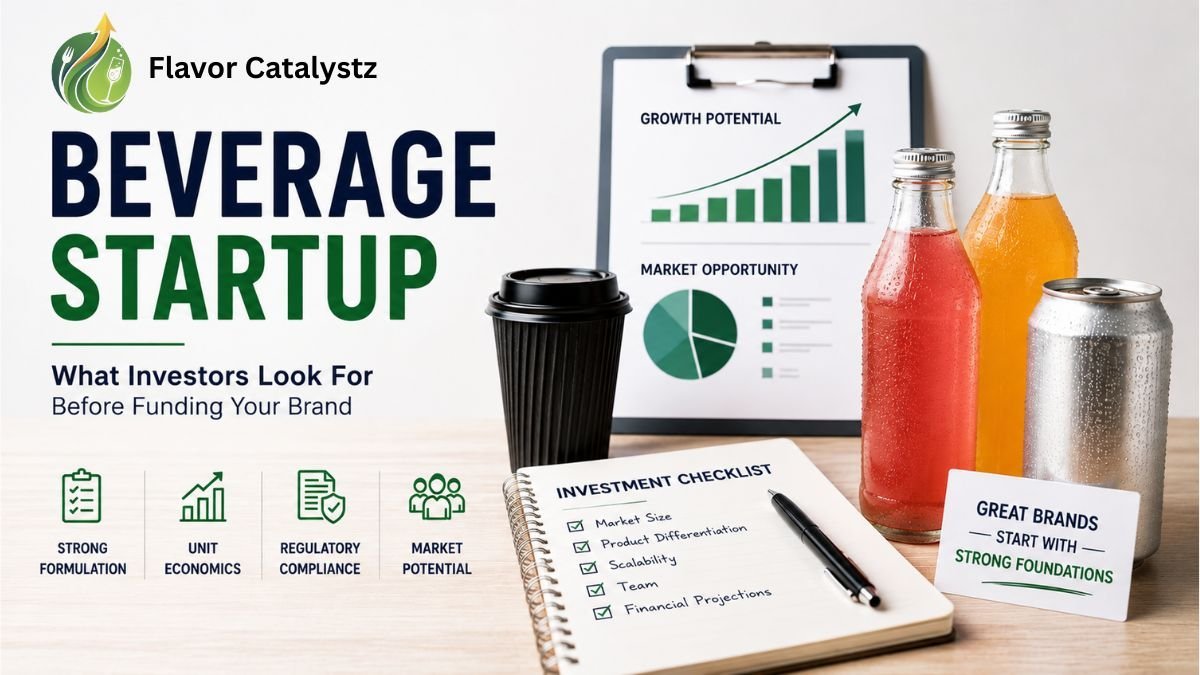
Raising money for a beverage startup in India isn’t about a good pitch deck anymore. Investors have seen hundreds of D2C beverage brands launch, and most of them stall at the same three points — inconsistent formulation, weak unit economics, or a compliance gap that surfaces during due diligence. If you’re preparing to raise a seed or pre-Series A round, the questions investors ask are far more technical than founders expect.
Before you build the pitch deck, it helps to get your formulation, cost structure, and compliance paperwork reviewed by a beverage consultant who has actually sat through these conversations. That single review often prevents the kind of red flags that quietly kill term sheets.
Want a quick formulation and compliance readiness check before you start investor conversations? Message our team on WhatsApp — we’ll tell you exactly where the gaps are.
Why Beverage Startups Get Rejected More Than Other F&B Categories
Beverages carry a unique risk profile compared to packaged food. Shelf-life is shorter, ingredient interactions are harder to control, and margins get squeezed fast once distribution costs enter the picture. Investors who’ve been burned by a beverage brand that couldn’t scale past pilot production tend to dig deeper than they would for, say, a snack brand. That’s exactly why founders need to walk in prepared — not with vague claims like “clean label” or “natural,” but with data.
1. Formulation IP — Not Just a Recipe
Investors want to know if your recipe is defensible or if a competitor can replicate it in six months. A recipe that exists only as a founder’s personal notes, without documented ratios, process parameters, and stability data, is treated as a liability rather than an asset.
What actually builds investor confidence:
- A documented formulation with exact ratios, pH, Brix, and process parameters
- Stability test data across different storage conditions
- Clear ownership — is the formulation yours, or does a co-packer hold the IP?
If your recipe was developed informally, it’s worth getting it properly structured through beverage recipe formulation before investor conversations begin — this alone changes how seriously a formulation is taken during diligence.
2. Manufacturing Scalability
A drink that tastes great in a 5-litre lab batch can behave completely differently at 5,000 litres. Investors will specifically ask whether the formulation has been tested at commercial scale, and whether your current co-packer can actually handle projected volumes for the next 18-24 months.
Common scale-up failure points investors watch for:
- Separation or sedimentation at larger batch sizes
- Inconsistent taste across production runs
- Co-packer capacity mismatched with growth projections
This is also where founders realise the gap between a home-kitchen recipe and a production-ready formulation — something covered in detail in our beverage contract manufacturing guide.
3. Unit Economics That Actually Hold Up
This is where most beverage pitches fall apart. Founders often show gross margin at MOQ pricing but investors want to see the full cost stack — ingredient cost at scale, packaging, logistics, retailer margins, and marketing spend — mapped against realistic sell-through.
Investors typically ask for:
- Cost per unit at 3 different production volumes (pilot, mid-scale, full scale)
- Contribution margin after trade/platform commissions (Amazon, Blinkit, Zepto take meaningfully different cuts)
- Payback period on customer acquisition cost
Founders who’ve mapped this out in advance — including realistic launch costs — tend to have far smoother due diligence conversations. Our breakdown on beverage brand launch cost in India is a useful starting reference for building this out.
4. Regulatory and Compliance Readiness
An FSSAI compliance gap is one of the fastest ways to lose investor trust — it signals that the founder hasn’t done the basic groundwork. This gets scrutinised especially closely for functional beverages, energy drinks, and any product carrying a health claim on the label.
Investors specifically check:
- Valid FSSAI license matching your production scale
- Label claims that are legally substantiated, not just marketing language
- Compliance documentation for any functional or “high-protein/low-sugar” claims
If your brand makes any functional claim, it’s worth reviewing our guide on FSSAI beverage compliance before your data room goes out to investors.
5. Route to Market and D2C vs Retail Strategy
Investors want clarity, not optionality. “We’ll do D2C and modern trade and quick commerce” without a sequencing plan reads as unfocused. A credible go-to-market plan usually picks a primary channel first, proves repeat purchase there, and only then expands.
This is a category where founders benefit from studying what’s actually working right now — our guide on building a D2C beverage brand breaks down channel sequencing that investors respond well to.
6. Early Traction and Repeat Purchase Data
Pilot sales numbers matter less than what they reveal about repeat behaviour. A brand with 2,000 units sold and a 35% repeat purchase rate is more fundable than one with 10,000 units sold once and no repeat data. Investors are underwriting future revenue, not past sales.
7. Funding-Readiness Documentation
Beyond the product itself, investors expect a clean data room — cap table, prior round terms if any, vendor agreements, and IP documentation. Founders raising their first round in India can benefit from understanding how funding actually flows in this category; resources like Inc42’s startup funding coverage and Tracxn’s funding data are useful for benchmarking round sizes against comparable D2C beverage brands.
The Bottom Line
Investors funding a beverage startup aren’t betting on taste alone — they’re betting on whether the formulation, cost structure, and compliance can survive scale without falling apart. Founders who walk into a pitch with documented formulation IP, realistic unit economics, and clean compliance paperwork consistently close rounds faster than those relying on brand story alone.
If you’re preparing for investor conversations and want your formulation, costing, and compliance reviewed before the pitch, talk to our team on WhatsApp — we help founders get investor-ready before the first meeting, not after the first rejection.
FAQs
What do investors look for most in a beverage startup?
Formulation defensibility, unit economics at scale, and regulatory compliance top the list — brand story matters, but only after these fundamentals check out.
How important is FSSAI compliance for raising funding?
Critical. A missing or mismatched FSSAI license is treated as a red flag during due diligence, regardless of how strong the product or brand is.
Can I raise funding before my formulation is finalised?
It’s possible at the idea stage, but most investors beyond angel/pre-seed will expect a stable, tested formulation with documented process parameters.
What’s the biggest reason beverage startups fail to close funding rounds?
Weak or unclear unit economics — founders often show margin at pilot scale without accounting for real-world distribution and platform costs.