Jul 2026 · 7 min read
Ask five caffeine gum brands how they developed their product, and you will likely get five different answers on dosage, sweetener selection, and flavor systems. Most arrived at their final recipe through trial and error rather than a structured scientific process. At Flavor Catalystz, we approach Caffeine Chewing Gum Formulation through a systematic product development process rooted in food science rather than guesswork. Caffeine Chewing Gum Formulation is far more specialized than it appears. It requires selecting a precise, legally compliant caffeine dose, masking caffeine’s naturally bitter taste, and ensuring the gum remains stable so every piece delivers consistent performance from the first batch to day 300. This guide explains the formulation process the way food scientists approach it: determining the right dosage first, choosing high-quality ingredients next, optimizing taste and stability, and finally validating the formulation through testing and quality checks.
Why Dosage Comes First in Caffeine Chewing Gum Formulation
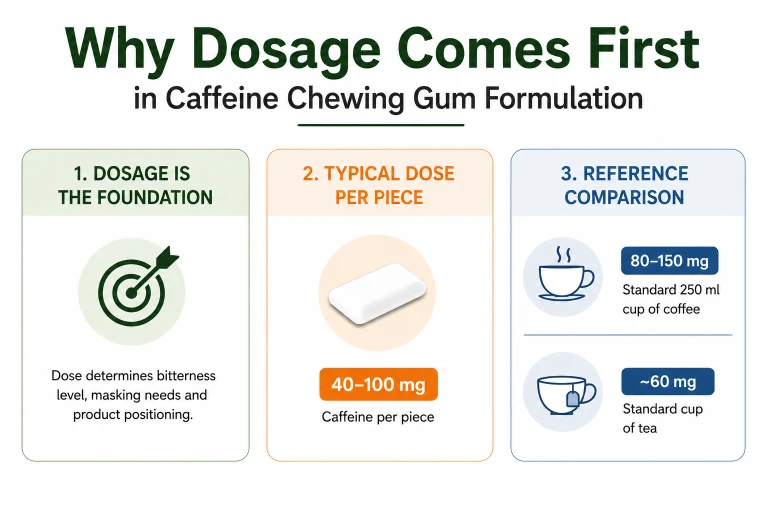
Every other formulation choice — sweetener system, flavor intensity, gum base hardness — is built around the caffeine dose, because dose determines how much bitterness has to be masked and how the product will be positioned and labeled. Most commercial caffeine gums land between 40 mg and 100 mg of caffeine per piece. For reference, a standard 250 ml cup of coffee typically delivers 80–150 mg, while a cup of tea delivers closer to 60 mg.
| Caffeine Source | Typical Dose | Reference Point |
| Cup of tea (250 ml) | ~60 mg | Standard brewed tea |
| Cup of coffee (250 ml) | 80–150 mg | Standard brewed coffee |
| Energy drink (250 ml) | Up to ~145 mg/L legally in India | Beyond this, a high-caffeine warning label is required |
| Caffeine chewing gum (1 piece) | 40–100 mg | Military-grade formulations run up to ~100–130 mg per piece |
| FSSAI health-supplement caffeine ceiling | 200 mg per serving | General benchmark cited for supplement-category products |
A formulator working backward from a target dose also has to account for how quickly that caffeine is released. Because gum releases the majority of its caffeine within the first five minutes of chewing, a 100 mg piece behaves very differently from a 100 mg slow-release capsule — which is why dosage decisions in gum formulation are usually more conservative than the equivalent dose in a tablet.
Ready to Develop Your Own Caffeine Chewing Gum?
From caffeine dosage optimization and flavor masking to gum base selection, shelf-life testing, and commercial manufacturing, our experts help transform your concept into a market-ready caffeine chewing gum.
Natural vs Synthetic Caffeine: A Real Formulation Trade-Off
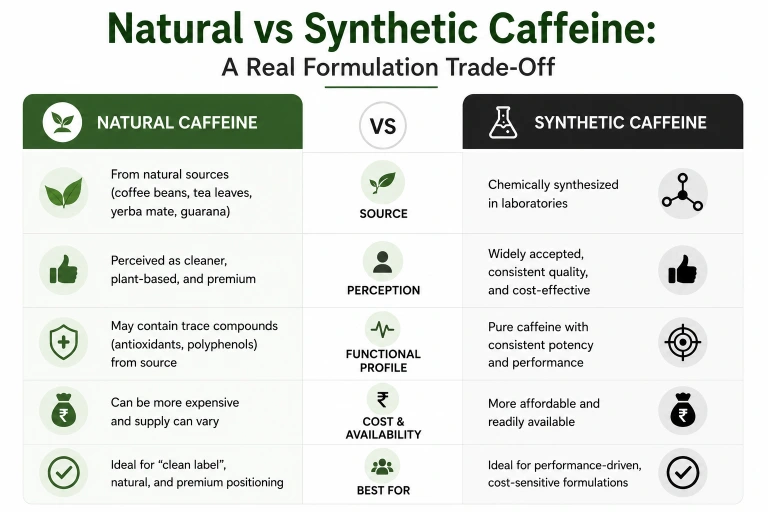
The caffeine molecule itself is identical whether it comes from a lab or a plant, but the sourcing decision still shapes cost, label positioning, and processing behavior.
| Caffeine Source | Positioning | Formulation Consideration |
| Synthetic (pharma-grade anhydrous) | Precise, consistent, cost-efficient | Easiest to dose accurately; no added plant flavor notes to mask |
| Guarana extract | “Natural energy” clean-label positioning | Lower caffeine concentration by weight; brings its own bitter, earthy notes that need masking alongside the caffeine |
| Green coffee bean extract | Natural, often paired with polyphenol claims | More expensive per mg of caffeine; requires careful flavor balancing |
Masking the Bitterness: The Formulator’s Toolkit
Unmasked caffeine is bitter enough to make even a well-flavored gum unpleasant within two or three chews. Formulators rarely rely on a single fix — they layer several techniques so the bitterness is intercepted at different points in the chewing timeline.
- Microencapsulation: coating caffeine particles so they dissolve gradually rather than hitting the tongue in one bitter burst.
- Flavor layering: pairing a strong, fast top note (mint, citrus) with a longer-lasting base flavor so bitterness never has an unmasked moment.
- Sweetener synergy: combining a high-intensity sweetener with a bulk sweetener, since the two together mask bitterness more effectively than either alone.
- Acid balancing: small, calculated additions of citric or malic acid to cut through metallic aftertaste without making the gum taste sour.
Shelf-Life Engineering: Keeping the Dose and the Taste Stable
A caffeine gum formula that tastes right on the bench can still fail commercially if it does not survive real-world storage — a hot warehouse, a delayed shipment, months on a retail shelf. Shelf-life engineering targets three failure risks specifically.
| Stability Risk | What Happens | How It’s Controlled |
| Moisture ingress | Gum softens, texture degrades, microbial risk rises | Low-moisture gum base plus a moisture-barrier wrapper or blister |
| Flavor oxidation | Top flavor notes fade, underlying bitterness becomes more noticeable | Antioxidant systems and airtight primary packaging |
| Caffeine migration | Uneven caffeine distribution between pieces in the same batch | Homogenization controls during mixing and in-process dosage sampling |
To confirm a formula will hold up, teams typically run accelerated stability studies — commonly at 40°C and 75% relative humidity — which compress roughly 12 months of ambient shelf life into a matter of weeks. This kind of structured product recipe formulation process, where formulation and stability testing happen together rather than sequentially, is what teams such as Flavor Catalystz apply when a functional confectionery product needs to hold both taste and dose steady for a full year.
Sensory Validation: How Formulators Know a Recipe Is Actually Ready
No caffeine gum formula ships on the strength of a lab technician’s opinion. It goes through structured sensory panels that score bitterness, sweetness balance, chew life, and aftertaste on a defined scale, usually across multiple iterations, until the product scores consistently above a target threshold on every attribute before moving to pilot production.
The Regulatory Lens: Formulating Within the Rules
In India, caffeine-containing functional products sit under a mix of frameworks depending on how they are positioned, as a functional food, a health supplement, or a novel food category, since chewing gum with an added active ingredient does not fall neatly under standard confectionery rules. A commonly cited benchmark is a maximum of 200 mg of caffeine per serving for supplement-category products, alongside mandatory labeling of caffeine content and warnings for sensitive groups such as children, pregnant women, and people with caffeine sensitivity.
Because this classification directly affects what claims can legally appear on pack, formulation decisions and regulatory review need to happen in parallel, not one after the other, which is exactly where many first-time brands lose months reformulating after the fact instead of before it. At Flavor Catalystz, regulatory considerations are integrated into the formulation process from the beginning, helping brands align product development with applicable compliance requirements instead of treating regulatory review as a final checkpoint.
Frequently Asked Questions
How much caffeine can legally go into a functional food product in India?
There is no single dedicated standard for caffeine chewing gum yet, but a commonly referenced ceiling for supplement-category products is 200 mg of caffeine per serving, with mandatory on-pack declaration of the exact amount.
What is the real difference between natural and synthetic caffeine in gum?
Chemically, none — the caffeine molecule is identical. The difference is in sourcing cost, label positioning (“natural” claims), and the extra plant flavor notes that natural sources like guarana bring, which need their own masking work.
Why does caffeine gum taste bitter without careful formulation?
Caffeine is inherently bitter at the concentrations used in functional gum. Without microencapsulation, flavor layering, and sweetener balancing, that bitterness comes through almost immediately during chewing.
How long can a well-formulated caffeine gum stay stable on the shelf?
With the right gum base, moisture barrier, and packaging, most functional gums are formulated for 9 to 12 months of ambient shelf life, validated through accelerated stability testing.
Does chewing caffeine gum for longer release more caffeine?
Most of the dose is released within the first 5 to 10 minutes of chewing; extending chewing time beyond that adds relatively little additional caffeine release.
Can L-theanine be added to a caffeine gum formulation to reduce jitters?
Yes, L-theanine is a commonly used functional pairing in caffeine gum and beverage formulations, often included specifically to offset the jittery feeling associated with fast-absorbing caffeine.
What testing is required before a caffeine gum formulation is launch-ready?
At minimum: caffeine purity and concentration testing (Certificate of Analysis), microbial safety testing, accelerated shelf-life studies, and a completed sensory validation panel.
Is natural caffeine like guarana automatically a better choice than synthetic caffeine?
Not necessarily. Natural sources support a clean-label claim but bring lower caffeine concentration, higher cost per milligram, and additional bitterness that has to be formulated around — the right choice depends on brand positioning, not on which is objectively “better.”