May 2026 · 17 min read
They pick a flavour. They add sugar. They carbonate. And then they wonder why the taste is inconsistent, the fizz dies in three weeks, or the launch fails compliance testing.
This guide covers what carbonated drink recipe formulation actually involves — from the science of CO₂ and water quality to ingredient ratios, sweetener systems, flavour engineering, carbonation stability, FSSAI compliance, and the specific challenges of formulating in India’s climate. Whether you’re developing a classic carbonated soft drink, a healthy carbonated drink, a non-alcoholic sparkling beverage, or a functional aerated drink — this is your complete starting point.
Quick Answer: What is a carbonated drink?
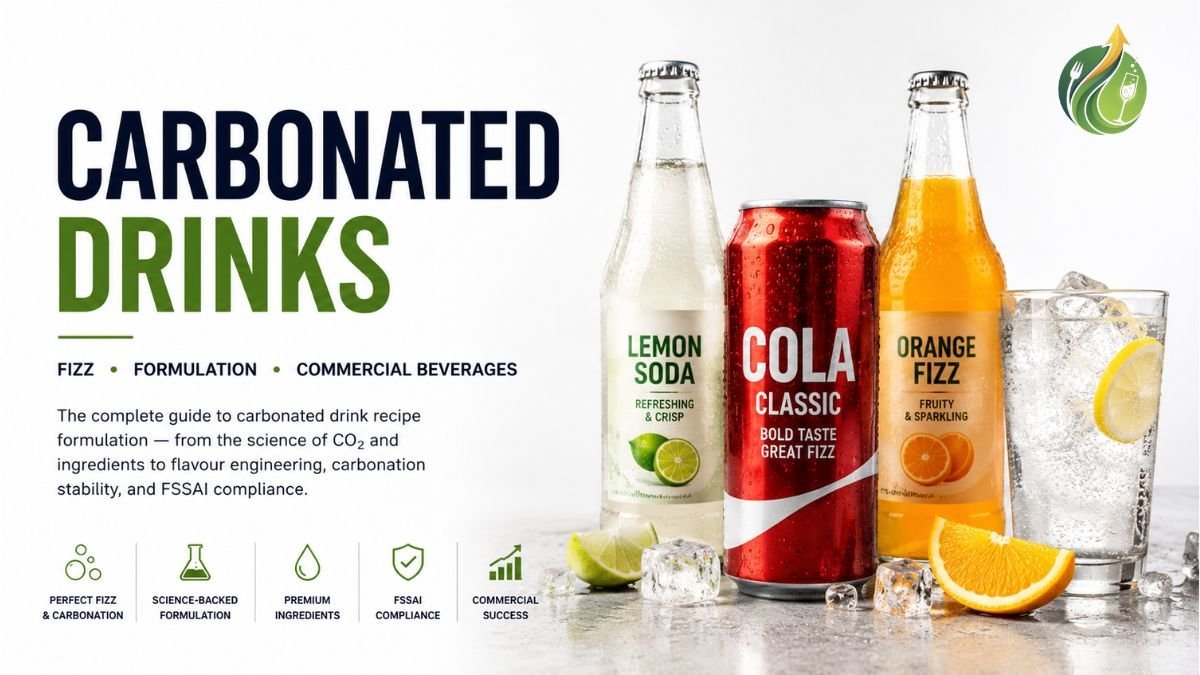
A carbonated drink is a beverage in which carbon dioxide (CO₂) gas is dissolved under pressure, creating effervescence — the characteristic fizz and bubbles released when pressure is released. Carbonated soft drinks combine this with water, sweeteners, acids, flavours, and colours. Examples include cola, lemon soda, orange fizz, ginger ale, tonic water, sparkling juice, and functional carbonated beverages.
1. India’s Carbonated Drinks Market — Why Now Is the Right Time to Launch
India’s carbonated soft drinks market reached USD 15.4 billion in 2025 and is projected to hit USD 22.4 billion by 2033 at a CAGR of 4.8%. Carbonated beverages alone account for 52.3% of India’s total soft drinks market share — the single largest product segment. And that dominance is being reshaped by a wave of health-conscious innovation.
The old market was simple: cola, lemon, orange. The new market is segmented by consumer intent:
- Classic carbonated soft drink consumers — taste, nostalgia, brand loyalty
- Health-conscious consumers — seeking low-sugar, low-calorie, or functional carbonated options
- Urban premium consumers — craft sodas, botanical sparkling drinks, premium mixers
- Diabetic and metabolic health consumers — zero sugar, low GI aerated drinks
- Non-alcoholic carbonated drinks seekers — mocktails, sparkling juices, festive substitutes
Google search data confirms this diversification. People are searching for carbonated drinks list, carbonated drinks benefits, carbonated drinks side effects, carbonated drinks non alcoholic, carbonated drinks in India, carbonated drinks formula — signals that the audience is researching, evaluating, and actively choosing their next beverage brand.
| Category | Consumer Profile | Growth Signal |
|---|---|---|
| Classic Cola & Soda | Mass market, price-sensitive, Tier 2/3 cities | Stable volume, value-driven growth |
| Healthy Carbonated Drinks | Urban health-conscious, 25–45 years | 12% YoY demand increase for low-calorie variants |
| Functional Carbonated Drinks | Athletes, wellness-oriented, professionals | Fastest growing sub-category nationally |
| Non-Alcoholic Carbonated | Festive occasions, Gen Z, mocktail culture | Strong premium pricing opportunity |
| Craft / Artisan Sodas | Metro consumers, food service, D2C brands | 14% YoY premium segment growth |
2. The Science of Carbonation — How CO₂ Works in a Beverage
Carbonation is not simply “adding bubbles.” It is a precise chemical process that affects pH, mouthfeel, flavour perception, stability, and shelf life simultaneously. Understanding this science is foundational to any serious carbonated drink recipe formulation.
How CO₂ Becomes Carbonation
Carbon dioxide (CO₂) is dissolved into liquid under pressure, forming carbonic acid (H₂CO₃) — a weak acid that gives carbonated drinks their characteristic bite and acidity. The reaction is:
When the bottle or can is opened, pressure drops and CO₂ escapes as bubbles — creating the effervescence consumers experience. The amount of CO₂ dissolved is measured in volumes of carbonation (1 volume = 1 litre of CO₂ per litre of liquid).
| Carbonation Level | Volumes of CO₂ | Typical Application | Mouthfeel |
|---|---|---|---|
| Low carbonation | 1.5 – 2.0 | Sparkling juices, light sodas | Soft, gentle fizz |
| Medium carbonation | 2.5 – 3.5 | Most carbonated soft drinks, lemon soda | Refreshing, standard fizz |
| High carbonation | 3.5 – 4.5 | Cola, ginger ale, tonic water | Bold, biting fizz |
| Very high carbonation | 4.5 – 5.5+ | Sparkling water, premium mixers | Intense, sharp effervescence |
How Carbonation Affects pH — And Why It Matters for Formulation
A standard carbonated soft drink typically has a pH of 2.6–3.0 — highly acidic. This affects:
- Flavour perception — acidity intensifies tartness and brightness of citrus and fruit profiles
- Microbiological safety — low pH inhibits most pathogen growth, reducing preservative dependency
- Sweetener stability — some sweeteners (e.g., Rebaudioside A) degrade faster at low pH during storage
- Colour stability — certain natural colorants are pH-sensitive and will shift shade over shelf life
- Packaging interaction — acidity combined with carbonation pressure demands specific PET or can specifications
Every time you change an ingredient in a carbonated drink — sweetener type, acid level, flavour system — the pH shifts, which changes CO₂ solubility, which changes perceived fizz intensity, which changes the consumer experience. This is why carbonated drink formulation is a system problem, not an ingredient-by-ingredient problem.
3. Types of Carbonated Drinks — What Brands Are Developing in 2026
The carbonated drinks category has expanded significantly beyond classic cola and lemon soda. Understanding which type you’re building determines every ingredient and process decision that follows.
| Type | Description | Key Formulation Challenge |
|---|---|---|
| Classic Carbonated Soft Drinks | Cola, lemon, orange, ginger — sugar-sweetened, standard carbonation | Cost-efficient scale-up, consistency, shelf life in Indian heat |
| Healthy Carbonated Drinks | Low sugar, reduced calorie, natural sweeteners, clean label | Taste parity with full-sugar versions, mouthfeel restoration |
| Functional Carbonated Drinks | Prebiotic sodas, electrolyte sparkling drinks, vitamin-enriched fizz | Functional ingredient stability in high-acid, carbonated environment |
| Non-Alcoholic Carbonated Drinks | Sparkling mocktails, botanical sodas, festive sparkling juices | Complexity of botanical flavour systems in acidic carbonated base |
| Indian Traditional Aerated Drinks | Carbonated jeera masala, shikanji soda, kanji-style, aam panna fizz | Preserving authentic taste profile in a shelf-stable carbonated format |
| Craft / Premium Sodas | Small-batch, premium ingredients, unique flavour narratives | Premium ingredient stability + premium price-point justification |
| Energy / Sports Carbonated Drinks | Carbonated energy with caffeine, B vitamins, electrolytes | Caffeine stability, taste masking, FSSAI functional claim compliance |
For a deep-dive into Indian regional aerated drink development, see our guide on Aerated Drinks Recipe Formulation.
4. Core Ingredients of Carbonated Drink Formulation
Every carbonated soft drink is built from the same foundational ingredient categories. Understanding the role each plays — and how they interact — is where formulation begins.
1. Water — The Foundation (86–92% of Formula)
Water quality is the single most impactful yet most underestimated variable in carbonated drink formulation. For carbonated drinks, water must meet specific standards:
- Total Dissolved Solids (TDS): <50 ppm preferred for most clear carbonated beverages
- Hardness: Must be controlled — calcium and magnesium ions interact with CO₂ and acids, causing off-flavours and haze
- Chlorine: Must be completely removed — residual chlorine destroys flavour compounds
- Microbiological quality: Must meet FSSAI drinking water standards before carbonation
Inconsistent water quality is one of the leading causes of batch-to-batch taste variation in carbonated drink production in India.
2. Sweeteners — 8–12% of Formula
The sweetener system determines caloric content, taste profile, label positioning, and cost. The choice has never been more complex — or more commercially important:
| Sweetener | Type | Caloric Impact | Best Use in Carbonated Drinks |
|---|---|---|---|
| Cane Sugar (Sucrose) | Natural | 4 kcal/g | Classic sodas, craft drinks, authentic taste |
| HFCS (High-Fructose Corn Syrup) | Processed natural | 4 kcal/g | Cost-efficient mass-market cola production |
| Sucralose | High-intensity artificial | Zero | Zero calorie carbonated drinks; stable at low pH |
| Stevia (Reb M) | Natural high-intensity | Zero | Clean-label healthy carbonated drinks |
| Monk Fruit | Natural high-intensity | Zero | Premium natural sodas, clean label |
| Erythritol | Sugar alcohol | 0.2 kcal/g | Body restoration in low-calorie formulations |
| Allulose | Rare sugar | 0.4 kcal/g | Mouthfeel + sweetness in zero-calorie drinks |
3. Acidulants — 0.05–0.3% of Formula
Acids create the tartness that defines a carbonated drink’s character and also act as natural preservatives by lowering pH. Selection depends on flavour profile:
- Citric Acid — most widely used; bright, clean tartness for citrus and tropical profiles
- Phosphoric Acid — the backbone of cola; provides the distinctive sharp bite
- Malic Acid — apple, pear, watermelon drinks; longer-lasting, rounder acidity
- Tartaric Acid — grape and wine-inspired sodas; distinct tangy persistence
- Lactic Acid — fermented and prebiotic carbonated drinks; mild, rounded
4. Flavour Compounds — 0.1–0.5% of Formula
Flavours are the identity of a carbonated drink. They fall into three categories — natural flavours (from real fruit/botanical sources), nature-identical (lab-reproduced compounds matching natural molecules), and artificial flavours. For carbonated soft drink formulation, flavour systems must be specifically engineered for:
- Stability at low pH (2.6–3.2) throughout shelf life
- Compatibility with the CO₂-acidic environment without off-note development
- Accurate sensory delivery under pressure — flavour perception changes with carbonation intensity
5. Carbon Dioxide — The Defining Ingredient
Food-grade CO₂ must meet strict purity standards (minimum 99.9% purity, free of impurities like sulfur compounds or oil residues that cause off-flavours). CO₂ is typically added at the final stage of production — after sweetener syrup preparation and just before filling — using a carbonator machine that controls both pressure and temperature to achieve target carbonation volumes.
6. Colours — Natural or Permitted Synthetic
Colour is the first sensory signal before a consumer tastes anything. For carbonated soft drinks, permitted natural colourings include beta-carotene (orange), anthocyanins (purple/red), and beet juice. Caramel colouring (Class I–IV) is used in colas. Under FSSAI regulations, all colours must be listed on labels with their INS numbers.
7. Preservatives (If Required)
At pH below 3.5, most carbonated drinks are inherently self-preserving. However, fruit juice-containing variants or slightly higher-pH formulations may require sodium benzoate or potassium sorbate — both FSSAI-permitted at defined limits.
5. The Carbonated Drinks Formula — Ratios, Balance and the Syrup System
A standard carbonated soft drink formula is built around a syrup system — a concentrated blend of sweeteners, acids, flavours, and colour — which is then diluted with treated water and carbonated. This “batch and dilute” approach is what makes commercial carbonated drink production scalable and consistent.
| Component | Typical % in Final Drink | Key Variable to Control |
|---|---|---|
| Treated Water | 86–92% | TDS, hardness, chlorine-free |
| Sugar Syrup | 8–12% | Brix consistency (target ±0.2°) |
| Acidulant | 0.05–0.3% | Target pH (typically 2.6–3.4) |
| Flavour Concentrate | 0.1–0.5% | Flavour intensity and stability |
| Colour | 0.001–0.01% | Visual consistency, pH stability of colorant |
| Preservatives (if used) | <0.025% | FSSAI permitted limits; label disclosure |
| CO₂ | 3.0–4.5 volumes | Temperature at carbonation (4–10°C ideal) |
The Three Quality Control Checkpoints Every Carbonated Drink Must Pass
- Brix measurement — confirming sugar concentration is within ±0.2° of target across every batch
- pH measurement — ensuring acidity is consistent (a pH shift of 0.2 units significantly changes taste perception)
- Carbonation volume check — measuring CO₂ volumes in the filled, sealed container under production conditions
In India, seasonal variation in fruit-derived raw materials changes the pH of natural ingredients — meaning the same sourced ingredient can produce different Brix and acid readings batch to batch. Working with a consistent, certified supplier is not optional — it is a formulation stability requirement.
For detailed guidance on budgeting your carbonated drink development project, our Beverage Formulation Cost guide covers all stages from R&D to commercial scale.
6. Flavour Engineering for Carbonated Soft Drinks
Flavour is how consumers remember a drink. It is also the most technically demanding component of carbonated drink recipe formulation — because carbonation itself changes how flavour is perceived.
How Carbonation Changes Flavour Perception
- CO₂ activates sour-sensing receptors on the tongue, amplifying tartness — which means acidulant levels must be calibrated for a carbonated state, not a still state
- Carbonation suppresses sweetness perception — a carbonated drink needs slightly higher sweetness than an equivalent still drink to taste the same
- Volatile aroma compounds are more rapidly released from carbonated drinks, making the flavour intensity hit faster and fade quicker
- Temperature affects carbonation significantly — cold drinks hold CO₂ better and taste more intensely flavoured than warm drinks
Flavour System Design for Different Carbonated Drink Categories
| Drink Category | Flavour System Approach | Key Stability Concern |
|---|---|---|
| Cola | Complex proprietary blend (vanilla, cinnamon, citrus, phosphoric) | Caramel colour stability; phosphoric acid balance |
| Lemon Soda | Lemon oil + citral + citric acid balance | Citral degradation at low pH over time |
| Orange Soda | Orange oil, aldehydes + colour system | Colour and flavour fade at high temperature |
| Ginger Ale / Beer | Ginger extract + capsaicin note + caramel | Spice note intensity fading over shelf life |
| Botanical / Craft Soda | Steam-distilled botanical extracts + modifiers | Extract stability in acid-carbonated base |
| Indian Aerated (Jeera/Shikanji) | Spice oleoresins + citrus + salt system | Authentic aroma retention at commercial scale |
For the carbonated cold drink development process end-to-end, our Cold Drink Recipe Formulation guide covers each stage in detail.
7. Healthy Carbonated Drinks — The New Formulation Frontier
The fastest-growing segment within carbonated drinks is not a new flavour — it is a new formulation philosophy. Healthy carbonated drinks are beverages that deliver the refreshing fizz and taste of a soda without the sugar load, artificial ingredients, or health trade-offs of traditional carbonated soft drinks.
Approximately 48% of Indian consumers actively seek beverages with lower sugar content, according to market research. This is not a niche — it is a mainstream shift that every carbonated drink brand must address.
Healthy Carbonated Drink Categories and Their Formulation Approach
| Category | Formulation Strategy | Consumer Claim |
|---|---|---|
| Low Sugar Carbonated Drink | Partial sugar replacement with stevia/sucralose + allulose for body | “Reduced sugar” |
| Zero Calorie Carbonated Drink | Multi-sweetener system: Reb M + sucralose + erythritol | “Zero calorie” / “Diet” |
| Prebiotic Carbonated Soda | Inulin / FOS + natural sweeteners in acid-stable format | “Gut-friendly” |
| Electrolyte Sparkling Drink | Na, K, Mg + low sugar + medium carbonation | “Hydration” |
| Adaptogenic Soda | Ashwagandha / Tulsi extracts in acid-stable microencapsulated form | “Stress-balancing” |
| Clean Label Sparkling Juice | Real fruit juice + minimal sugar + natural carbonation or CO₂ | “Natural” |
Most functional ingredients — prebiotics, vitamins, botanical extracts, adaptogens — are sensitive to the low pH (2.6–3.2) and pressure environment of a carbonated drink. Microencapsulation, pH-stable ingredient selection, and accelerated stability testing are non-negotiable steps before commercial launch of any functional carbonated drink.
For a complete guide on sparkling and healthy beverage development, see our Sparkling Beverage Development resource.
8. Formulating Carbonated Drinks for India — Climate, FSSAI Compliance & Local Taste
The India Climate Challenge
India presents unique formulation challenges that no international textbook adequately covers. Ambient temperatures regularly exceed 40°C in northern and central India during summer. This creates specific problems for carbonated drink stability:
- CO₂ loss — CO₂ solubility drops significantly at higher temperatures; improperly sealed PET closures cause rapid defizzing in transit and storage
- Microbial risk — higher ambient temperatures accelerate microbial growth in any formula not protected by low pH or preservatives
- Flavour degradation — heat accelerates oxidation and hydrolysis of flavour compounds, especially natural citrus flavours
- Colour shift — natural colourings are particularly heat-sensitive and can fade or shift shade during distribution
FSSAI Compliance for Carbonated Drinks in India
All carbonated soft drinks sold in India must comply with the Food Safety and Standards Authority of India regulations. Key requirements include:
| FSSAI Requirement | Specification | Compliance Action Required |
|---|---|---|
| Ingredient approval | All ingredients must be from FSSAI permitted lists | Ingredient audit before formula finalisation |
| Preservative limits | Sodium Benzoate: max 600 ppm; Potassium Sorbate: max 1000 ppm | Lab-validated concentration in finished product |
| Colour declaration | INS number must be declared on label | Label review before print approval |
| Nutritional labelling | Energy, carbs, sugars, sodium per 100 ml | Lab-validated nutritional analysis |
| Calorie claims | “Low calorie” = ≤40 kcal/100ml; “Zero calorie” = <4 kcal/100ml | Lab analysis mandatory — database values not accepted |
| FSSAI licence | Manufacturing licence required before commercial production | Product category registration with FSSAI |
For complete FSSAI regulatory guidance, visit the FSSAI official website.
Local Taste Preferences — Formulating for the Indian Palate
Indian consumers have distinct taste preferences that differ from Western beverage markets. Successful carbonated drinks in India typically feature:
- Higher sweetness levels — Indian palate preferences lean 10–15% sweeter than European equivalents at equivalent carbonation
- Stronger spice and masala notes — jeera, kala namak, imli, and ginger are not niche in Indian aerated drinks — they are mainstream category drivers in local markets
- Citrus profile preference — lime and lemon profiles dominate over orange in mass-market Indian carbonated soft drinks
- Regional variation — sweet in North India, tangy-spicy in South, mango-led in East, kokum-influenced in West
9. Why Carbonated Drink Launches Fail — 7 Critical Formulation Errors
| Failure Mode | Root Cause | The Correct Approach |
|---|---|---|
| Fizz dies within weeks | PET closure specification wrong; carbonation done at incorrect temperature | Carbonation at 4–10°C; validated closure torque specifications |
| Batch-to-batch taste variation | Inconsistent raw material supplier; no Brix/pH QC at each batch | Certified consistent suppliers + mandatory QC at production start |
| Flavour fades over shelf life | Flavour system not tested in acid-carbonated conditions under storage temperatures | Accelerated shelf life testing specific to carbonated format |
| FSSAI compliance failure | Unapproved ingredient used; preservative over-limit; label non-compliance | Ingredient audit + FSSAI-approved lab analysis before any submission |
| Functional ingredient failure | Prebiotic or vitamin degraded in low-pH carbonated environment | pH-stable ingredient selection + microencapsulation + stability testing |
| Consumer rejection of taste | Sweetener temporal profile mismatch or artificial aftertaste | Multi-sweetener system + sensory panel validation before finalisation |
| Scale-up taste change | Lab recipe not validated at pilot and commercial scale before launch | Staged scale-up: lab → pilot (500L) → commercial with sensory sign-off at each stage |
Developing a Carbonated Drink or Aerated Beverage?
FlavorCatalystz’s beverage formulation team helps brands develop carbonated soft drinks — from syrup system design and CO₂ optimisation to FSSAI compliance and scale-up support across India.
Carbonated Drink Formulation Is Where the Product Lives or Dies
A carbonated drink that loses its fizz in the distribution chain, tastes different batch to batch, or fails a compliance submission does not get a second chance at shelf. The Indian market is competitive, temperature-volatile, and increasingly health-conscious — which means the margin for formulation error is narrowing every year.
The brands that will win the next decade of India’s carbonated drinks market are the ones building on formulation discipline: consistent water quality, calibrated sweetener systems, flavour-stable ingredient choices, CO₂-specific production controls, and FSSAI-compliant processes documented before the first commercial run.
Whether you’re launching a classic carbonated soft drink, a healthy carbonated drink for the urban health consumer, a functional aerated beverage, or a regional Indian soda at commercial scale — the formulation decisions you make in R&D determine everything that follows.
Our beverage formulation services and beverage consultancy team work with brands at every stage — from initial concept and ingredient selection to pilot validation, scale-up, and FSSAI compliance support.
Frequently Asked Questions — Carbonated Drinks
What is a carbonated soft drink?
A carbonated soft drink is a non-alcoholic beverage infused with CO₂ gas to create fizz and bubbles. Examples include cola, lemon soda, ginger ale, and sparkling juice.
Which drinks are carbonated?
Carbonated drinks include cola, lemon soda, orange soda, sparkling water, tonic water, energy drinks, and sparkling juices. In India, jeera soda and carbonated shikanji are also popular.
Is a carbonated drink healthy?
Plain sparkling water is generally healthy. High-sugar soft drinks should be consumed in moderation due to sugar and acidity concerns.
Can carbonated drinks cause stomach pain?
Yes, carbonation can cause bloating or discomfort in sensitive individuals, especially those with acid reflux or IBS.
Can diabetics have soft drinks?
Diabetics should avoid sugary soft drinks. Zero-calorie drinks with stevia or erythritol may be consumed in moderation after medical advice.
What is the formula for a carbonated drink?
A carbonated drink typically contains treated water, sweetener, acidulant, flavour concentrate, colour, and dissolved CO₂ gas.
What are the best carbonated soft drink brands in India?
Popular brands include Coca-Cola, Pepsi, Thums Up, Sprite, Limca, Appy Fizz, and Paper Boat Sparkling.
What is the carbonated drinks machine used in production?
A carbonation machine (carbonator) dissolves CO₂ into chilled water under pressure for commercial beverage production.
What are the side effects of carbonated drinks?
Excessive intake may cause bloating, dental erosion, high sugar intake, and weight gain. Low-sugar versions reduce these risks.