May 2026 · 9 min read
Packaged coconut water is one of the fastest-growing beverage categories in India — and globally. It sits at the intersection of two of the biggest trends in beverages right now: natural hydration and functional drinks. No artificial additives, naturally isotonic, culturally familiar, and with a health story that practically writes itself.
And yet, most packaged coconut water brands in India today either compete on low price in commodity formats, or are premium imports that most consumers cannot afford regularly.
The gap for a well-positioned Indian coconut water brand — with quality product, smart packaging, and a clear consumer story — is real and growing.
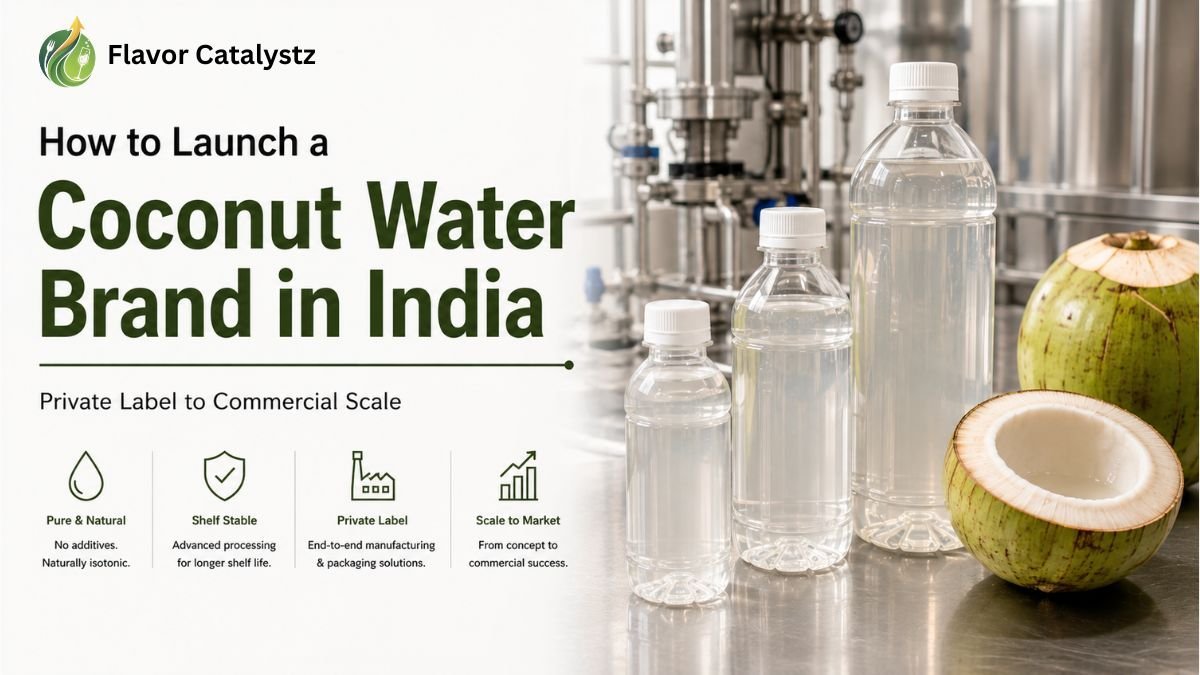
This guide walks you through what it actually takes to build a coconut water brand in India, from understanding the product’s technical requirements to going to market through private label manufacturing.
Why Coconut Water Is a Strong Beverage Brand Opportunity in India
India is the world’s largest producer of coconuts — accounting for roughly 31% of global output. The raw material is abundant, domestic, and well-understood. Culturally, tender coconut water (nariyal pani) is universally recognised as a healthy, natural drink. The consumer habit already exists. What is still lacking is a brand that packages it in a format that modern consumers can trust and access consistently.
The commercial case is strong:
- The packaged coconut water market in India is growing at a double-digit CAGR
- Modern trade, quick commerce, and D2C channels are actively looking for quality domestic brands
- Health-conscious millennials and Gen Z consumers actively seek natural hydration alternatives to sugary sports drinks
- The “isotonic coconut water” positioning — natural electrolytes that support hydration — aligns directly with the growing fitness and wellness consumer segment
The challenge is product quality and consistency, which is where most aspiring coconut water brands struggle.
Flavor Catalystz
Planning to launch a coconut water brand in India?
From processing technology and shelf-life stability to private label manufacturing and FSSAI compliance — we help founders build scalable coconut water beverage brands.
The Technical Reality of Packaged Coconut Water
Tender coconut water is remarkably fragile. Unlike a syrup or a carbonated drink, fresh coconut water oxidises and ferments quickly once extracted. This creates the core technical challenge of any coconut water brand: preserving the fresh, delicate flavour and nutritional profile over a shelf life long enough for commercial distribution.
Here is what you are working with technically:
Natural composition: Tender coconut water is approximately 94–95% water, with natural sugars (3–5%), electrolytes (potassium, sodium, magnesium, calcium), and small amounts of protein and vitamins. Brix typically ranges from 4–7° depending on maturity and variety.
pH: Natural coconut water is mildly acidic to neutral (pH 4.5–5.5). This pH range is not low enough to provide significant preservation on its own.
Microbial risk: Coconut water is a rich growth medium for bacteria and yeast. Without proper processing, spoilage happens within hours at ambient temperature.
Colour change: Fresh coconut water is clear. Oxidation causes it to turn pink/red within minutes of exposure to air. This is natural (caused by polyphenol oxidation) but commercially unacceptable if consumers expect a clear product.
These challenges are all solvable — they are solved routinely in commercial production. But understanding them upfront determines what processing and packaging approach you choose.
Processing Options for a Coconut Water Brand
Your processing choice is the most fundamental decision in building a coconut water brand. It affects shelf life, nutritional claims, taste, cost, and distribution model.
1. High-Temperature Short-Time (HTST) Pasteurisation
The most common approach for mainstream packaged coconut water. Heat treatment (typically 72–85°C for 15–30 seconds) kills spoilage organisms, followed by hot-fill or aseptic fill into packaging.
Shelf life: 9–12 months ambient
Taste impact: Mild — some consumers detect a slight cooked note
Nutritional impact: Some reduction in heat-sensitive vitamins; electrolytes largely unaffected
Cost: Moderate — standard commercial equipment
Best for: Mass market, modern trade, quick commerce
2. Ultra-High Temperature (UHT) Processing
Higher heat (135–140°C for 2–4 seconds) followed by aseptic filling into Tetra Pak or similar packaging. This is the technology behind most long-life dairy and juice products in India.
Shelf life: 12–18 months ambient
Taste impact: More noticeable than HTST — coconut water can develop a slight caramel note
Cost: Higher capital requirement; Tetra Pak filling requires specific equipment
Best for: Large-scale distribution, export, institutional supply
3. High Pressure Processing (HPP)
Cold processing technology that uses pressure (not heat) to kill pathogens while preserving fresh flavour and nutrients. The closest product to fresh coconut water in a packaged format.
Shelf life: 30–45 days refrigerated
Taste impact: Minimal — very close to fresh
Nutritional impact: Best preservation of vitamins and enzymes
Cost: Significantly higher — HPP equipment is expensive; cold chain distribution required
Best for: Premium positioning, health food stores, D2C subscription
4. Cold Fill with Preservatives
Some commercial products use permitted preservatives (sodium metabisulphite or ascorbic acid as antioxidant) combined with cold fill and refrigerated distribution.
Shelf life: 30–60 days refrigerated
Cost: Lower capital investment
Regulatory note: Must declare preservatives on label; perceived as less clean-label than HPP
For most new coconut water brands in India starting with realistic capital, HTST pasteurisation with aseptic filling into bottles or cartons is the most practical entry point. As the brand scales, a move toward HPP for a premium line is a natural evolution.
Packaging Options for a Coconut Water Brand in India
Packaging choice significantly affects consumer perception and shelf life:
Tetra Pak / Aseptic Carton: The category standard globally. Lightweight, shelf-stable, recyclable. Available in 200ml, 250ml, 330ml, 500ml, 1L. Requires aseptic filling equipment or a co-manufacturer with this capability.
PET Bottle: Widely used and familiar. Available in various sizes. More susceptible to oxygen ingress over time than cartons; shorter effective shelf life. Lower investment for a startup.
Glass Bottle: Premium positioning. Works well for HPP coconut water at health food stores and premium cafes. Higher cost, heavier distribution weight.
Aluminium Can: Growing in popularity for coconut water globally. Excellent barrier properties for shelf life, strong modern visual appeal. Requires can-fill capability.
Young Coconut Shell / Novelty Formats: Occasionally used for premium gifting and HoReCa but not practical for mainstream distribution.
For a new Indian coconut water brand, starting with PET or Tetra Pak and moving to cans or glass as the brand scales is the typical path.
Private Label vs. Own Brand: Which Route for Your Coconut Water?
This is a critical decision for anyone entering the coconut water space.
Private Label Manufacturing means a manufacturer produces the product to your specification, packaged under your brand. You manage the brand, marketing, and distribution. The manufacturer handles production.
Benefits: Lower capital investment, faster time to market, no need to own manufacturing infrastructure, ability to test the market before committing to owned production.
Considerations: Less control over production process day-to-day, MOQ requirements (typically 5,000–20,000 units per run depending on the manufacturer), need to manage quality standards contractually.
Own Manufacturing means investing in your own processing and filling line.
Benefits: Full control over quality and production scheduling, better margins at scale, proprietary process advantages.
Considerations: High capital investment (₹50 lakh to several crore depending on scale and processing technology), longer setup timeline, operational complexity.
For most new coconut water brands in India, private label manufacturing is the right starting point. It lets you validate the market, build distribution, and establish your brand before committing to infrastructure. Our beverage consultant team can help identify reputable coconut water contract manufacturers matched to your product specification and volume needs.
FSSAI Compliance for Packaged Coconut Water
Packaged coconut water in India falls under FSSAI’s fruit juice and beverage standards. Key requirements:
- Product standard: Must meet FSSAI standards for packaged drinking water or fruit-based beverage depending on whether it is pure coconut water or a blended product
- Label requirements: Product name (tender coconut water / coconut water), ingredient list, nutritional declaration, FSSAI licence number, best before, batch code, manufacturer details
- Claims: “Natural electrolytes,” “isotonic,” “no added sugar,” “no preservatives” — each requires the formulation to actually support the claim and FSSAI compliance review
- Nutritional profile: Potassium content is often highlighted as a label claim for coconut water — ensure this is lab-verified
See our detailed FSSAI beverage compliance guide for a deeper look at the regulatory framework.
Positioning Your Coconut Water Brand in India
With several packaged coconut water products already in the market, positioning is critical. The key is specificity — do not try to be everything.
Natural Hydration / Sports Recovery: Position around electrolytes and natural isotonic properties. Target fitness consumers, sports occasions, post-workout. Compete on natural credentials vs. synthetic sports drinks.
Heritage / Artisanal: Emphasise source (Kerala, Tamil Nadu coconuts), traditional processing, small-batch quality. Premium pricing, HoReCa and specialty retail focus.
Functional Plus: Add a functional ingredient — ashwagandha, tulsi, or amla — to create a coconut water + Ayurvedic wellness proposition. Higher differentiation, premium price point.
Kids / Family: Focus on natural hydration for children as an alternative to fruit drinks and packaged juices. School tuck shops, family retail.
Related reading: How to start a beverage brand in India and beverage product development.
Ready to Launch Your Coconut Water Brand?
The coconut water category in India needs better brands — and the market is ready for them. Getting the product technically right, the compliance sorted, and the go-to-market strategy clear from the start is what separates brands that last from those that stall on the launchpad.
At Flavor Catalystz, we help founders build beverage brands that are formulated properly and launched smartly. If a coconut water brand is what you are building, we would like to help.
FAQs
What is the shelf life of packaged coconut water?
HTST-processed coconut water in aseptic packaging: 9–12 months ambient. UHT in Tetra Pak: 12–18 months. HPP cold-processed: 30–45 days refrigerated. PET-bottled with preservatives: 30–60 days refrigerated.
How much does it cost to start a coconut water brand in India?
Starting with private label manufacturing, initial investment typically ranges from ₹10–25 lakh covering product development, FSSAI compliance, packaging design, initial production run, and marketing. Own manufacturing requires significantly higher capital.
What FSSAI licence is required for packaged coconut water?
A Central FSSAI Licence is required for manufacturers with annual turnover above ₹20 lakh. A State FSSAI Licence applies to smaller businesses. Your distributor or modern trade partners will require valid FSSAI licensing before listing your product.
Why does packaged coconut water turn pink?
Natural coconut water contains polyphenols that oxidise when exposed to air and light, causing a pink/red colour change. This is prevented commercially through oxygen-barrier packaging, ascorbic acid addition (as antioxidant), and rapid processing after extraction.
Can I add flavours to coconut water and still call it coconut water?
If flavours are added, the product cannot be labelled as “coconut water” per FSSAI standards. It would need to be labelled as a “coconut water-based beverage” or “flavoured coconut drink.” This is an important distinction for label compliance.
Is coconut water a good business in India?
Yes — the category is growing, raw material supply is domestic and abundant, and consumer health awareness is driving demand. The key success factors are product quality (taste and freshness), consistent supply chain, and brand positioning clarity.