Jun 2026 · 9 min read
Cold press juice is the premium end of the Indian juice market — and it has built a genuinely loyal consumer base in urban India. Walk into any health food store, premium cafe, or browse a D2C wellness brand and you will find cold-pressed juices positioned as the most nutritionally intact, freshest, and most authentic juice format available.
The consumer proposition is clear and compelling: no heat, no degradation, no compromise. Just fruit and vegetables, pressed at high pressure to extract maximum juice with minimum nutritional loss.
But cold press juice is also one of the most technically demanding beverage categories to build a commercial brand around. The shelf life challenge is real. The cold chain requirement is significant. And the FSSAI licensing pathway for HPP (High Pressure Processing) beverages involves specific considerations that first-time founders frequently miss.
This guide gives you the complete picture.
Planning a Cold Press Juice Brand?
Before investing in bottles, cold-chain logistics, or HPP processing, validate your formulation, shelf life, and compliance strategy with beverage experts.
Cold Press vs. Centrifugal Juice: The Fundamental Difference
Before building a cold press juice brand, it helps to understand precisely what makes cold press different — because this difference is both your brand story and your commercial challenge.
Centrifugal Juicing: High-speed spinning blade extracts juice through centrifugal force. Fast, efficient, and the method used by most commercial juices. Generates significant heat from friction (30–60°C at blade contact point). Heat degrades some enzymes and heat-sensitive vitamins, particularly Vitamin C. Higher oxidation due to the spinning motion incorporating air into the juice. Typical juice output: 70–80% yield.
Cold Press (Slow Press / Hydraulic Press): A hydraulic press or masticating mechanism crushes and presses the produce at very low RPM with no heat generation. No heat means better retention of enzymes, Vitamin C, and heat-sensitive phytonutrients. Lower oxidation due to less air incorporation. Slower process, lower yield (60–70%). Higher juice quality — the difference is detectable in taste and colour.
The commercial implication: Cold press juice genuinely tastes better and has a better nutritional profile than centrifugal juice. This justifies the premium price point — typically ₹150–400 per 250–330ml bottle in India. But it also requires more expensive equipment, more careful handling, and more complex shelf life management.
HPP Technology: The Key to Commercial Cold Press Juice
The core commercial challenge for cold press juice is shelf life. Fresh cold-pressed juice without any treatment has a microbiological shelf life of 3–5 days refrigerated — completely impractical for any distribution beyond local same-day delivery.
HPP (High Pressure Processing) is the technology that makes commercial cold press juice viable. It is the defining technical investment in this category.
How HPP Works
HPP subjects sealed beverage containers to extremely high water pressure — typically 4,000–6,000 bar (400–600 MPa), equivalent to several times the pressure at the deepest point of the ocean. This pressure:
- Inactivates pathogens (Listeria, E. coli, Salmonella) — making the product microbiologically safe
- Does NOT use heat — so enzymes, vitamins, and flavour compounds are preserved
- Does NOT add preservatives
- Extends refrigerated shelf life to 30–90 days
The result: A juice that maintains the freshness and nutritional quality of cold-pressed juice with a commercially viable shelf life — and a completely clean label (“cold pressed, high pressure processed — no preservatives, no heat”).
HPP in India: Access for Brands
HPP equipment is expensive (₹5–15 crore for a commercial system) — not viable for most startup brands to own. The practical solution is toll processing — using a third-party HPP facility to process your juice.
HPP toll processing facilities exist in India, primarily in food manufacturing clusters in Maharashtra, Delhi NCR, and Karnataka. Your manufacturing and filling process produces the sealed bottles; the HPP facility processes them. For early-stage cold press juice brands, this is the standard commercial model.
Cold Press Juice Formulation: Principles and Blends
Produce Selection and Sourcing
The quality of a cold press juice is entirely determined by the quality of the produce input. Unlike processed beverages where formulation can compensate for ingredient variability, cold press juice cannot hide poor quality produce.
Key sourcing principles:
- Source ripe, high-quality, fresh produce — not overripe or damaged
- Establish consistent supplier relationships with traceability
- Use produce specifications (Brix, acidity, colour) to ensure consistency
- Certified organic sourcing is a strong commercial differentiator for premium positioning
Core Juice Formulation Categories
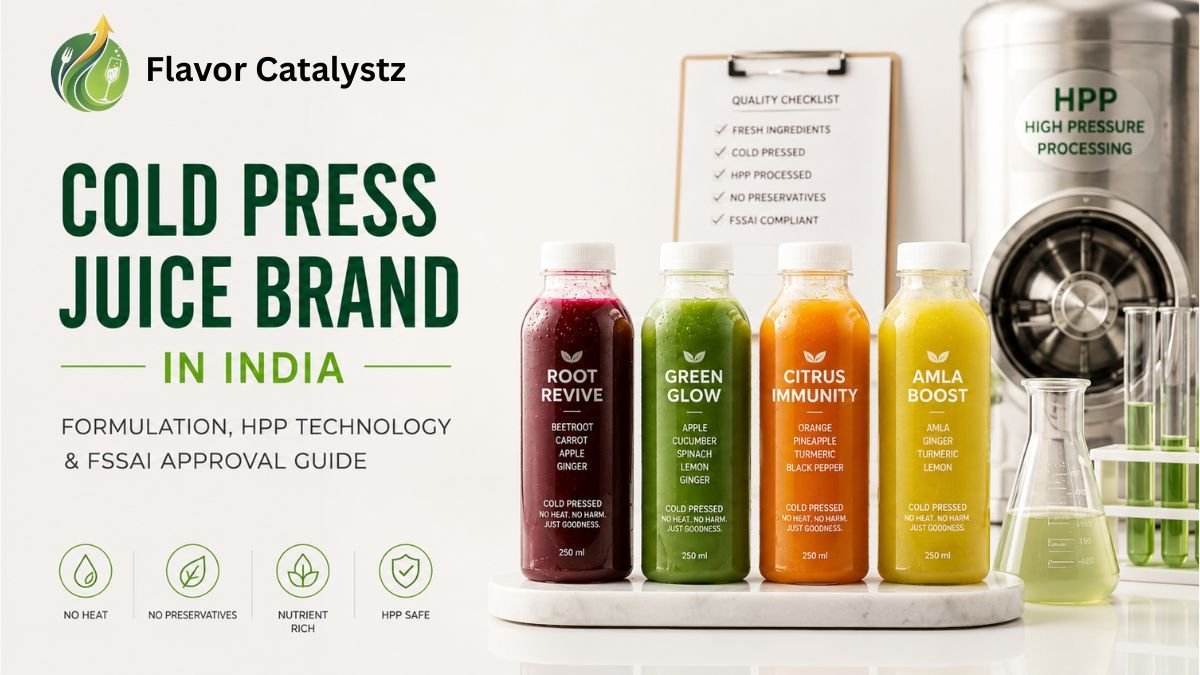
Green Juices: Apple + cucumber + spinach/kale + lemon + ginger — the most popular cold press juice category. Balanced sweet-sour-green profile. Apple provides sweetness and body; cucumber adds mild hydration; greens add nutrition and colour; lemon adds brightness; ginger adds warmth.
Root Juices: Beetroot + carrot + apple + ginger — deep red-orange colour, earthy-sweet flavour, high in folate and antioxidants. Strong Ayurvedic wellness positioning.
Citrus Blends: Orange + pineapple + turmeric + black pepper — tropical, bright, high Vitamin C.
Immunity Blends: Amla + ginger + turmeric + lemon — the authentically Indian immunity shot scaled to a full juice format.
Tropical Blends: Mango + pineapple + coconut water — accessible, mainstream-appealing.
Formulation Technical Parameters
Brix control: Target Brix 8–14° depending on blend. Higher Brix from sweeter fruit (apple, mango) improves palatability but also calorie density. Document Brix specification for each blend and monitor per batch.
pH: Cold press juice pH varies by blend — citrus-forward blends: 3.2–3.8; green juices: 3.8–4.5; beet-forward blends: 3.5–4.2. Low pH supports microbiological stability. Blends with pH above 4.5 require more careful HPP validation.
Colour: Define colour specifications (L*, a*, b* values) for premium quality control. Colour consistency batch to batch affects consumer perception significantly.
FSSAI Licensing and Compliance for Cold Press Juice
Product category: Cold press juice falls under FSSAI’s fruit juice and beverage standards. “Juice” labelling requires minimum fruit content per FSSAI standards. Review the specific standard for each juice type you produce.
NFC (Not From Concentrate) claim: Cold press juice is by definition NFC — made directly from fresh produce without concentration. “Cold pressed, not from concentrate” is a factual and permitted label declaration.
HPP declaration: FSSAI requires that any non-thermal processing technique used to ensure food safety be declared on the label. Declare: “Processed by High Pressure Processing” or “HPP Processed” on your label.
FSSAI Licence: Central FSSAI Licence required for commercial juice manufacturing. Your HPP toll processor also needs a valid FSSAI licence — verify this before engaging.
Organic claim: If using certified organic produce, you may use “organic” claims — but only with valid organic certification from an FSSAI-accredited certification body.
For the complete FSSAI licensing process, see our FSSAI beverage licence guide.
Shelf Life Validation for HPP Cold Press Juice
Shelf life validation is not optional for a commercial cold press juice brand — it is a regulatory and commercial requirement. Your declared best-before date must be supported by shelf life testing data.
Standard shelf life study for HPP juice:
- Test each blend/SKU separately
- Test at target storage temperature (4°C refrigerated)
- Test parameters at regular intervals (Day 0, Day 14, Day 30, Day 45, Day 60): microbiological counts, pH, Brix, colour, sensory evaluation
- Also conduct accelerated shelf life test at slightly elevated temperature to model temperature excursions in distribution
Typical HPP cold press juice shelf life outcomes:
- At 3–4°C continuous refrigeration: 45–60 days
- At 4–8°C (typical retail refrigerator): 30–45 days
- With citric acid addition for pH control: can extend to 60–90 days
Commercial Strategy: Building a Cold Press Juice Brand in India
D2C subscription: The most commercially viable model for early-stage cold press brands. Weekly delivery subscription to urban consumers. Solves cold chain challenge (controlled delivery), builds recurring revenue, and creates consumer habit.
Quick commerce: Blinkit, Zepto, Swiggy Instamart — cold press juice is a natural fit for instant health purchases. Gets you in front of the urban health consumer when they want it now.
Health food stores and premium modern trade: Consistent visibility with health-conscious consumers. Requires cold chain compliance in the retailer’s refrigeration.
Cafes and gyms: Wholesale supply to premium cafes, yoga studios, and gyms. Lower margin but volume and visibility building.
Pricing: ₹150–300 per 250–330ml bottle for standard cold press juice. Premium single-origin or certified organic blends can command ₹300–450.
For production support, see our beverage contract manufacturing guide and beverage formulation service.
Ready to Launch Your Cold Press Juice Brand?
Cold press juice is one of the most credible premium positions in the Indian beverage market — the consumer story is genuine, the quality difference is real, and the health-conscious urban consumer segment is growing fast. Getting the HPP process right, the shelf life validated, and the FSSAI compliance sorted is what turns a great-tasting juice into a commercially sustainable business.
At Flavor Catalystz, we help cold press juice brands navigate the technical and regulatory pathway from concept to commercial product. Talk to our team today.
Ready to Launch a Commercial Cold Press Juice Brand?
From formulation and ingredient selection to HPP compatibility, shelf-life validation, cold-chain planning, and FSSAI compliance, Flavor Catalystz helps founders transform premium juice concepts into commercially scalable products.
FAQs
What is HPP and why is it important for cold press juice?
HPP (High Pressure Processing) uses extremely high water pressure (400–600 MPa) to eliminate pathogens without heat, extending refrigerated shelf life of cold press juice to 30–90 days while preserving enzymes, vitamins, and flavour. It is the essential technology for commercial cold press juice production.
How long does HPP cold press juice last?
30–60 days refrigerated under continuous cold chain (3–8°C). Specific shelf life depends on the juice blend, pH, and HPP parameters. Each blend requires its own validated shelf life study.
What FSSAI licence is needed for cold press juice?
A Central FSSAI Licence for the manufacturing facility. Cold press juice is NFC fruit juice — it must comply with FSSAI’s fruit juice product standards. HPP processing must be declared on the label.
What is the difference between cold press juice and NFC juice?
Cold press juice is a subset of NFC (Not From Concentrate) juice — it specifies the extraction method (hydraulic or slow press at low RPM, no heat). All cold press juice is NFC, but not all NFC juice is cold pressed.
How much does it cost to start a cold press juice brand in India?
Starting with toll HPP processing and contract manufacturing: ₹20–40 lakh for product development, FSSAI compliance, shelf life studies, packaging, and first production run. Own cold press extraction equipment: ₹5–15 lakh additional depending on scale.
Can I use HPP toll processing instead of buying my own HPP machine?
Yes — most cold press juice brands in India use HPP toll processing facilities rather than owning HPP equipment. You fill and seal the bottles; the HPP facility processes them. This is the standard model for startup and growth-stage brands.