Apr 2026 · 11 min read
If you are planning to launch a roasted makhana brand in 2026, the biggest question is not whether the market is ready — it is. The bigger question is how you manufacture at scale without building your own factory. That is exactly where contract manufacturing of roasted makhana becomes the most practical and profitable route for brands of all sizes.
This guide covers everything you need to know about food product development for roasted makhana from market numbers and manufacturing models to cost structures, compliance, and how to choose the right partner. If you are a D2C brand, an FMCG company, a health food startup, or a retailer looking to launch your own makhana line, read this before making any decision.
Why Roasted Makhana is a Category You Cannot Ignore in 2026
The India makhana market is valued at approximately USD 1.46 billion in 2025 and is projected to reach USD 2.23 billion by 2030, growing at a CAGR of 8.8% through the forecast period. Roasted makhana alone accounts for around 67% of total makhana sales by product type, making it the single largest and fastest-growing segment in this category.
What is driving this growth in 2026 specifically?
- Urban health shift: Consumers in Delhi, Mumbai, Pune, and Bengaluru are actively replacing fried snacks with roasted, low-calorie alternatives. Makhana fits perfectly — it is gluten-free, high in protein, low in fat, and has a natural crunch that does not compromise on taste.
- Tier 2 and Tier 3 expansion: Rising disposable incomes in smaller cities are creating entirely new demand pockets. Brands that set up distribution in these markets now are positioning themselves for the next wave of growth.
- Quick commerce and D2C boom: Platforms like Blinkit, Zepto, and Swiggy Instamart have made it possible for niche snack brands to compete with national players. The barrier to entry is low if your product quality and packaging are right.
- Export demand: India produces over 90% of the world’s makhana. Global markets in the US, UK, UAE, and Europe are actively sourcing branded and private label roasted makhana from Indian manufacturers. If you have FSSAI and optional certifications in place, export is a serious revenue stream.
- National Makhana Mission impact: The government’s dedicated push for makhana farming — with over INR 500 crore allocated in subsidies and infrastructure — has improved raw material supply, reduced quality inconsistency, and made Bihar-sourced makhana more accessible to processors across India.
The bottom line: the timing in 2026 is right. The market is growing, supply chains are maturing, and consumer demand is proven. What brands need now is manufacturing reliable, scalable, compliant manufacturing.
What is Contract Manufacturing of Roasted Makhana?
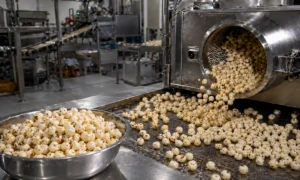
Contract manufacturing means you the brand own the recipe, the brand name, and the market strategy. A specialized manufacturer handles the actual production: sourcing raw makhana, roasting, flavoring, quality testing, and packing it under your brand label.
You pay for production per kg or per batch. You get finished, shelf-ready product. You do not invest in machinery, factory space, raw material procurement infrastructure, or production staff.
For roasted makhana specifically, the contract manufacturing process covers:
- Raw makhana sourcing and grading (typically Sita and Lava grade from Bihar)
- Pre-cleaning and moisture conditioning
- Roasting — air roasting or oil-assisted roasting depending on the product spec
- Flavoring and seasoning application
- Cooling and QC testing (crunch level, moisture content, microbial counts)
- Packaging — pouch, jar, or bulk — as per your brand requirement
- Labeling with FSSAI compliance, nutritional info, and shelf life declaration
The manufacturer operates under your product specifications. If you want a specific crunch level, a particular seasoning intensity, or a specific shelf life — that is agreed upon during the product development phase before bulk production begins.
Manufacturing Models — Which One Fits Your Business?
Not every brand has the same requirement. Here is how the three main models work and which one suits which type of business:
| Model | What You Get | Who It Suits | Key Advantage |
| White Label | Standard roasted makhana in pre-set flavors, packed under your brand | Startups, D2C brands, retailers launching a new SKU quickly | Fastest time to market, lowest upfront cost |
| Private Label | Existing base recipe with tweaks to flavor, seasoning, and packaging format | Brands that want differentiation without full R&D investment | Balance of speed and customization |
| OEM / Full Contract | Your proprietary recipe, your texture spec, your packaging design — fully custom | Established FMCG brands, health food companies, export-focused businesses | Complete product ownership and differentiation |
Most new-to-market brands start with white label or private label to test sales and consumer response, then move to full OEM once the product has validated demand. A good manufacturing partner supports this transition without disrupting your supply chain.
Popular Roasted Makhana Variants Brands Are Launching in 2026
The flavored makhana segment is where most of the product innovation is happening. In 2026, over 30% of urban makhana sales consist of flavored variants. Here are the variants with proven commercial demand:
- Classic Salted — light, crunchy, clean label. Works across all demographics and channels.
- Peri Peri — high demand among the 18-35 age group. Strong repeat purchase behavior.
- Cheese & Herbs — popular in modern trade and quick commerce. Premium price point.
- Black Pepper — clean, bold flavor. Performs well in corporate gifting and health retail.
- Himalayan Pink Salt — premium positioning, minimal ingredient list, works for export markets.
- Thai Sweet Chilli — newer variant gaining traction in metro markets.
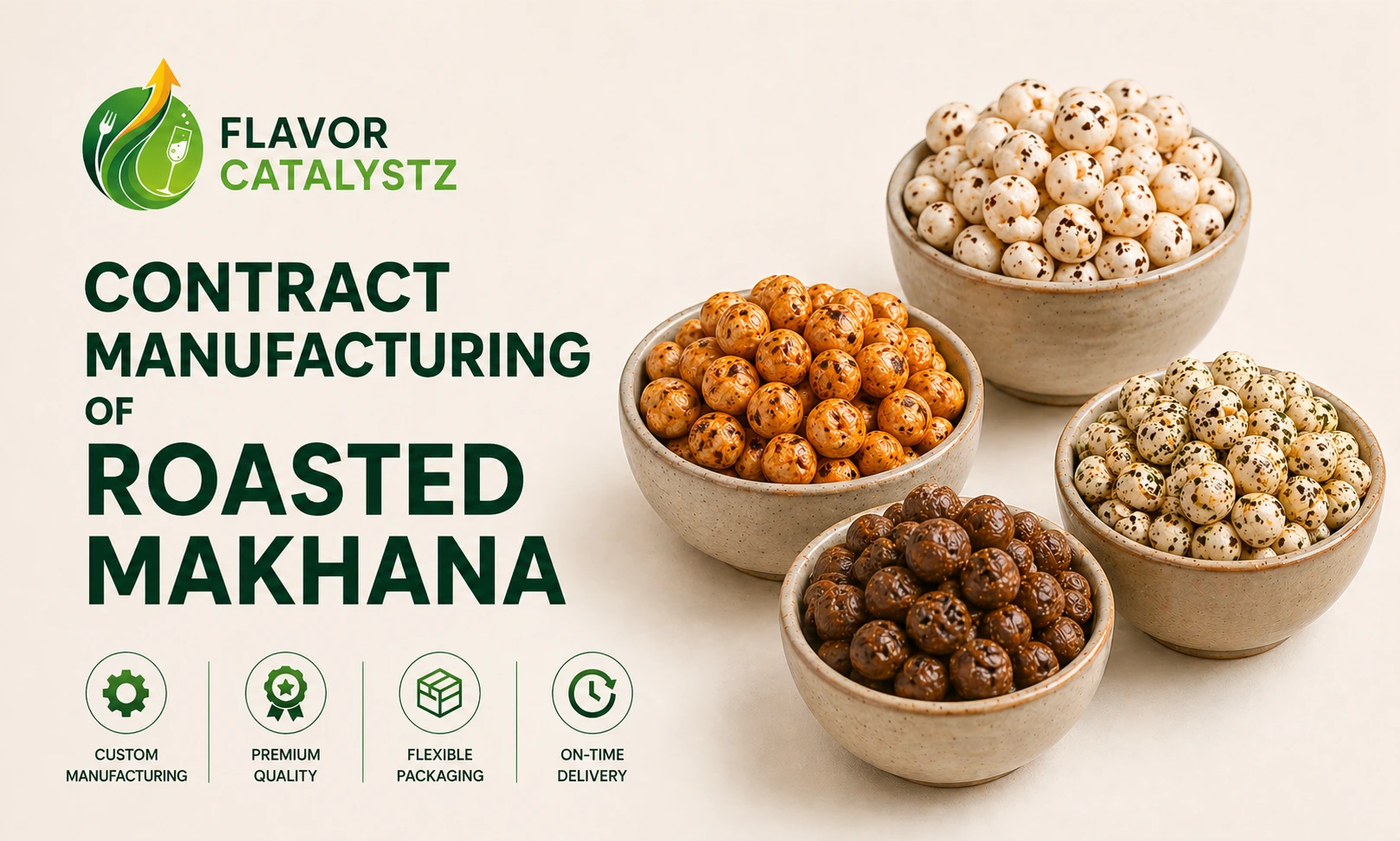
- Protein-Coated Makhana — chocolate or vanilla coating with added protein. Appeals to fitness segment.
- Masala Makhana — traditional Indian spice blend. Strong in general trade and value segment.
At Flavor Catalystz, we help you decide which variant to launch based on your target channel, consumer profile, and price positioning — not just what is trending.
The Step-by-Step Process When You Partner for Contract Manufacturing
Understanding the process helps you plan timelines and budget accurately. Here is how a typical engagement works:
Step 1 — Initial Brief: You share your product idea, target market, packaging format, and expected volumes. We assess feasibility and suggest the right manufacturing model.
Step 2 — Recipe Development & Sampling: Our R&D team develops the formulation as per your spec. You receive physical samples for taste, texture, and shelf life evaluation. Iteration happens at this stage — not after bulk production.
Step 3 — Costing & MOQ Confirmation: Once the sample is approved, we provide a detailed cost sheet covering per kg pricing, MOQ, lead times, and packaging costs.
Step 4 — Compliance Setup: We support FSSAI product approval, nutritional label design, shelf life declaration, and any export certifications required.
Step 5 — Pilot Batch: A small commercial batch is run to validate the process at scale. Quality parameters are checked against approved sample specifications.
Step 6 — Full Production: Bulk manufacturing with batch-wise QC documentation. You receive COA (Certificate of Analysis) with each batch.
Step 7 — Dispatch & Ongoing Supply: Products are dispatched as per agreed lead times. We maintain a rolling production schedule for repeat orders and scale-ups.
Cost Structure for Roasted Makhana Contract Manufacturing in 2026
Transparent cost understanding is essential before you commit. Here is a realistic breakdown for the Indian market in 2026:
| Cost Component | Typical Range | Notes |
| Minimum Order Quantity (MOQ) | 500 kg to 2,000 kg per batch | Varies by flavor complexity and packaging type |
| Manufacturing Cost (per kg) | INR 180 – INR 350 per kg | Based on makhana grade, seasoning, and packaging format |
| Recipe Development & Trials | INR 50,000 – INR 2,00,000 | One-time cost for custom formulation; waived for white label |
| Packaging Design | INR 30,000 – INR 1,00,000 | Pouch, jar, or box. Print-ready files included. |
| FSSAI & Lab Testing | INR 25,000 – INR 75,000 | Product approval, shelf life testing, nutritional analysis |
| Export Certifications (optional) | INR 50,000 – INR 1,50,000+ | Halal, Organic, USFDA registration depending on destination market |
Total first-batch investment for a new brand launching a single SKU in white label format typically falls between INR 3,00,000 and INR 7,00,000, depending on packaging and volume. Brands with proprietary recipes and full OEM requirements should budget higher for R&D and compliance.
Certifications and Compliance – What You Need in 2026
Regulatory compliance is non-negotiable, whether you are selling on Amazon India, entering modern trade, or exporting. Here is what matters:
- FSSAI License: Mandatory for all food products sold in India. Your contract manufacturer must hold a valid FSSAI manufacturing license. Product-specific approval is required if you are making any nutritional or health claims.
- Nutritional Labeling: As per FSSAI labeling regulations, your pack must carry per-serving nutritional information, ingredient list, allergen declaration, and correct net weight.
- ISO 22000 / FSSC 22000: Food safety management certifications that top-tier manufacturers carry. These are especially important for institutional buyers, modern trade, and export.
- Agmark / DMI Standards: The Directorate of Marketing and Inspection has issued draft trading standards for processed makhana covering moisture limits, foreign matter, grading by size, and cleanliness. Your manufacturer should be aligned with these standards.
- Halal Certification: Required if you plan to export to UAE, Malaysia, or other Gulf and Southeast Asian markets.
- USFDA Registration: Required for any product entering the United States market. Your manufacturer’s facility must be FDA-registered.
At Flavor Catalystz, compliance documentation is part of the engagement not an afterthought. We help you get the right certifications for your target market from day one.
What to Look for in a Roasted Makhana Contract Manufacturer
Choosing the wrong manufacturing partner is one of the most common and costly mistakes new food brands make. Here is a checklist that separates reliable manufacturers from unreliable ones:
- Makhana-specific experience: Generic food contract manufacturers often lack the understanding of roasting parameters, moisture management, and seasoning adhesion specific to makhana. Look for manufacturers who have handled makhana brands previously.
- Transparent R&D process: Can they show you a documented recipe development process? Can they provide sample batches before you commit to bulk? If not, that is a red flag.
- Quality documentation: Every batch should come with a COA covering moisture content, microbial parameters, and shelf life. If a manufacturer cannot provide this, walk away.
- Scalability: What is their maximum production capacity? Can they support you when your brand scales from 1 MT per month to 10 MT? Understand their capacity ceiling before you get locked in.
- Packaging capabilities: Do they support multiple SKU formats – 30g, 100g, 200g, bulk? Can they run your custom printed pouches or do they only offer generic packaging?
- Regulatory competency: Are they experienced in FSSAI product approvals, labeling compliance, and export documentation? Or do they leave that entirely on you?
- Communication and responsiveness: Slow communication during R&D or production is a strong predictor of supply chain problems down the line. Test responsiveness early.
Why Brands Choose Us for Roasted Makhana Contract Manufacturing
Flavor Catalystz is a dedicated F&B consulting and contract manufacturing company, not a generalist food factory. Our focus on the food and beverage category means we bring genuine product expertise not just production capacity.
Here is what working with us looks like in practice:
- Makhana-specific formulation expertise: We understand roasting profiles, seasoning adhesion chemistry, and shelf life optimization for makhana specifically. We do not apply generic snack manufacturing processes to a specialized ingredient.
- Recipe ownership stays with you: All formulations we develop for you are documented and belong to your brand. We do not use your recipe for another client.
- Flexible batch sizes: We work with brands at different stages — from 500 kg pilot batches for market testing to multi-tonne monthly production runs. We scale with you.
- End-to-end support: From flavor ideation and recipe development to FSSAI filing, packaging design guidance, and batch-wise QC documentation — we handle the complexity so you can focus on sales and brand building.
- Export readiness: If your target includes international markets, we have experience with export compliance and can support Halal, ISO, and USFDA documentation.
- Transparent pricing: No hidden costs. You get a detailed cost sheet before any production commitment. MOQ, per-unit price, R&D fees, and testing costs are all stated upfront.
Frequently Asked Questions
What is the minimum order quantity for roasted makhana contract manufacturing?
MOQ typically starts at 500 kg per batch for standard flavors and may go up to 2,000 kg for custom formulations with complex seasoning profiles. Flavor Catalystz works with brands to find a practical MOQ based on your initial sales forecast.
How long does it take to launch a new roasted makhana product?
For white label, the timeline from brief to first dispatch is typically 4 to 6 weeks. For custom OEM with proprietary recipe development, plan for 8 to 14 weeks including R&D trials, sample approvals, and compliance setup.
Can I get my own packaging design and branding on the product?
Yes. All contract manufacturing we do is under your brand name and packaging. We can work with your existing packaging design or refer you to packaging design resources if needed.
Do you provide FSSAI-compliant nutritional labels?
Yes. Nutritional analysis, ingredient list formatting, allergen declaration, and label compliance review are part of our engagement for all product launches.
Is contract manufacturing suitable if I am a first-time food brand?
Absolutely. Contract manufacturing is specifically designed to let new brands launch without factory investment. We have onboarded and successfully launched multiple first-time food entrepreneurs.
What happens if product quality does not match the approved sample?
We maintain batch-wise quality records and conduct QC checks against the approved specification before dispatch. In case of any deviation, the batch is held and reworked before it reaches you