Jul 2026 · 9 min read
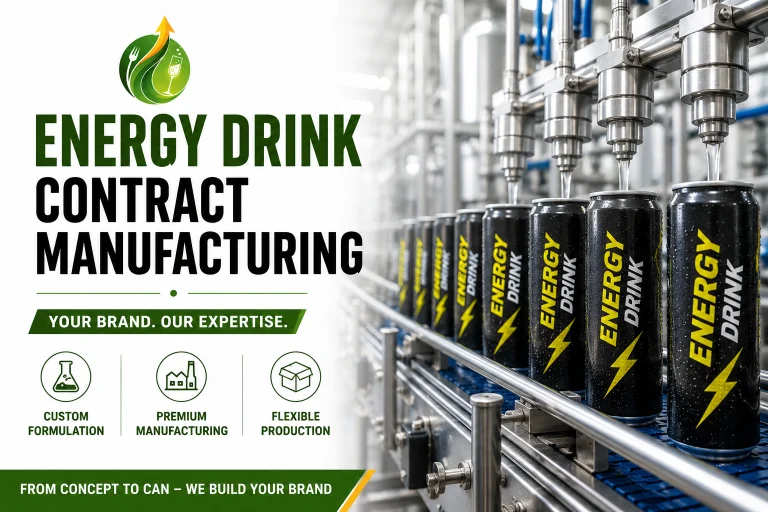
Most energy drink brands don’t fail because the recipe tastes wrong. They fail because the gap between “we have a formula we like” and “we have 20,000 cans on a retail shelf” is treated as a formality instead of a project with its own risks, timelines, and costs. Energy drink contract manufacturing is how most beverage brands in India successfully bridge that gap, whether they’re launching a D2C product in one city or building a national FMCG brand. Building a dedicated caffeinated-beverage plant from scratch is rarely the smartest first step for a new business. Instead, partnering with an experienced contract manufacturer provides access to production expertise, regulatory compliance, and scalable manufacturing without massive capital investment. This guide explains how energy drink contract manufacturing works from start to finish, including the production process, realistic batch sizes and cost expectations, mandatory FSSAI requirements, and the common mistakes that cause founders to lose time and money.
What Contract Manufacturing Actually Means for an Energy Drink Brand
The term gets used loosely, so it helps to separate the three models founders usually run into.
| Model | What the Brand Owns | Typical Fit | Approx. MOQ Range |
| White label | Branding only — the base formula is standard and shared across multiple brands | Fast, low-risk market entry with minimal differentiation | 5,000–10,000 units |
| Private label (existing base, customised) | Branding plus some flavour/format customisation on a manufacturer’s base recipe | Brands that want a distinct SKU without a full R&D cycle | 20,000–50,000 units |
| Full contract manufacturing (custom formula) | A formula developed specifically for the brand, with IP terms defined in contract | Brands building a long-term, defensible product | 1,000–10,000 units for the first commercial run, scaling after |
These ranges vary by manufacturer, packaging format, and region, so treat them as planning benchmarks rather than fixed rules — always confirm the specific number in writing before committing to a production slot. A structured new food product development process before the manufacturing conversation — covering market gap, target consumer, and a validated product brief — is what usually decides which of these three models actually suits a brand, rather than the brand guessing and finding out after the first batch is booked. Consultancies that work across this stage, such as
Flavor Catalystz, describe this as the difference between “finding a factory” and “finding the right factory for this specific product,” which is a distinction that only becomes obvious once a batch has already gone wrong.
The Manufacturing Process, Stage by Stage
A caffeinated beverage moves through a fairly consistent sequence once a manufacturer is engaged, even though the exact duration varies with formulation complexity and how prepared the brand is at the start.
| Stage | What Happens | Typical Duration |
| 1. Brief and feasibility | Recipe concept, positioning, budget, and packaging preference are reviewed against what the plant can realistically run | 1–2 weeks |
| 2. Formulation or formula validation | Bench-scale trials for taste, caffeine dosing, and functional ingredients; sensory rounds to lock the recipe | 2–4 weeks |
| 3. Pilot batch and stability testing | A small commercial-scale batch is run to check carbonation, fill accuracy, and how the product holds up over accelerated shelf-life trials | 3–6 weeks |
| 4. Regulatory documentation | FSSAI category classification, caffeine and additive limits, label copy, and warning statements are finalised — usually run in parallel with pilot testing | 2–3 weeks |
| 5. Line trial and packaging finalisation | Filling, carbonation, capping/seaming, and label application are tested on the actual production line at target speed | 2–4 weeks |
| 6. Commercial production and QC release | Full batch runs with in-process checks, Certificate of Analysis, and batch traceability before dispatch | Ongoing per order cycle |
End to end, a first commercial batch typically lands somewhere between 8 and 16 weeks from brief to dispatch. Formulations using standard, already-approved ingredient systems move faster; anything with a novel functional ingredient, an unusual claim, or an export destination with its own regulatory review will sit at the longer end.
Also read: Top 10 Energy Drink Brands
Batch Sizes and MOQ Benchmarks in India
Energy drinks are typically produced in batches of roughly 3,000 to 10,000 cans or bottles per run for stability and shelf-life validation, while the private-label MOQ many Indian beverage manufacturers quote for a first order sits in a similar 2,500–7,500-unit band. Some manufacturers, particularly those running high-speed canning lines, will only accept larger commitments once a brand moves past the pilot stage, since changing over a filling line between SKUs can take four to eight hours of cleaning and recalibration. If a manufacturer quotes an MOQ far outside this range, it’s worth asking directly whether that number reflects a full production run or a smaller pilot/trial batch — the two are often quoted interchangeably and that confusion causes budget surprises later.
Cost Structure of Energy Drink Contract Manufacturing
Per-unit cost is driven mostly by ingredients and packaging, not by the manufacturing process itself.
| Cost Component | Approx. Share of Unit Cost |
| Raw materials (caffeine, taurine, B-vitamins, sweeteners, flavour, preservatives) | 50–60% |
| Packaging (can or bottle, cap/lid, label or shrink sleeve) | 25–35% |
| Labour, utilities, and line overhead | 10–15% |
For a 250 ml can, this typically works out to roughly ₹15–₹45 per unit depending on order volume, ingredient grade, and whether the packaging uses standard or premium finishing — with larger volumes pulling the per-unit cost toward the lower end. Beyond per-unit production cost, most brands underestimate the one-time setup spend that sits alongside it:
- Formulation and R&D trials: roughly ₹2.5–5 lakh, covering bench trials, sensory panels, and stability documentation.
- FSSAI and BIS licensing: typically ₹18,000–₹20,000, though this scales with the specific claims and product category.
- Branding, packaging design, and artwork: roughly ₹2.5–5 lakh for a first-time brand identity.
- First commercial run (10,000–50,000 units through a contract manufacturer): commonly ₹2.5–15 lakh in production cost alone, excluding marketing and distribution.
A useful sense-check once these numbers are in hand: retail price to manufacturing cost typically needs to sit around a 2.5x–3x ratio to leave room for distributor margin, retailer margin, and brand profit — worth mapping before locking a packaging format or an MOQ.
FSSAI Compliance Essentials for Energy Drinks
India regulates energy drinks under the “caffeinated beverage” category rather than a separate “energy drink” classification, and the word “energy” itself carries regulatory restrictions. The core limits every formulation and label needs to respect:
| Parameter | FSSAI Limit |
| Caffeine content | Not less than 145 mg/litre; not more than 300 mg/litre. Above 145 mg/l, the product must be labelled “Caffeinated Beverage.” |
| Saccharin sodium | Not more than 100 ppm |
| Acesulfame-K | Not more than 300 ppm |
| Aspartame (methyl ester) | Not more than 770 ppm |
| Sucralose | Not more than 300 ppm |
| Neotame | Not more than 33 ppm |
| Vitamins (B1, B2, B3, B6, B12) | Capped at 100% RDA per day’s serving |
Beyond the ingredient table, labelling and packaging carry their own mandatory requirements: a prominent warning stating the product is “not recommended for children, pregnant or lactating women, or persons sensitive to caffeine”; a clear declaration of maximum daily consumption; removal of the word “energy” from the product’s regulatory category name; and, for containers of 5 litres or more made from PET or polycarbonate, compliance with the blue-tint standard under IS 9833. Manufacturers are also expected to appoint a designated food safety supervisor and run periodic hazard analysis and audits against these standards. None of this is optional at any production scale — a compliant formulation is designed around these limits from the first bench trial, not adjusted afterward.
What to Verify Before Signing a Manufacturing Agreement
A handful of checks catch most of the problems brands run into later:
- Confirm whether the FSSAI licence covers caffeinated beverages specifically, not just general beverage manufacturing.
- Ask for a Certificate of Analysis format and batch traceability process before the first commercial run, not after.
- Get MOQ, pricing, and packaging cost quoted for the same volume tier — comparing a 5,000-unit quote against a 50,000-unit quote from another vendor isn’t a real comparison.
- Clarify formula ownership and confidentiality terms in writing, especially if the manufacturer is contributing to the recipe.
- Check whether accelerated shelf-life testing is included or billed separately — skipping it is one of the most common causes of post-launch recalls.
Common Mistakes Brands Make
- Finalising packaging and can artwork before the formulation has completed stability testing.
- Choosing a manufacturer purely on the lowest quoted per-unit price without checking category-specific experience with carbonated or functional beverages.
- Treating the caffeine warning label as an afterthought rather than a mandatory design element from day one.
- Committing to a large MOQ before a pilot batch has validated taste, carbonation, and shelf stability.
Frequently Asked Questions
What is the difference between contract manufacturing and private label energy drinks?
Private label typically means branding an existing or lightly customised formula, while contract manufacturing usually involves a formula developed specifically for the brand, with the brand retaining rights to that recipe under the manufacturing agreement.
What is the minimum order quantity for energy drink contract manufacturing in India?
Most Indian manufacturers work within a 2,500–10,000-unit range for a first commercial batch, though this depends heavily on packaging format and whether the formula is standard or fully custom.
How much does it cost to manufacture an energy drink in India?
Per-can production cost typically ranges from about ₹15 to ₹45 for a 250 ml format, excluding GST and logistics, with raw materials making up roughly half to two-thirds of that figure.
Is an FSSAI licence mandatory for energy drink production?
Yes. Energy drinks fall under FSSAI’s caffeinated beverage regulations, and manufacturing, marketing, or importing them without the correct licence and category classification is not compliant.
How long does it take to launch an energy drink through contract manufacturing?
A realistic timeline from brief to first commercial dispatch is 8 to 16 weeks, depending on formulation complexity, ingredient sourcing, and how quickly regulatory documentation is finalised.
Can a brand use its own formulation with a contract manufacturer?
Yes, most manufacturers will run a brand’s own recipe through validation and pilot trials, though it still needs to be adapted to that specific plant’s equipment and process parameters before scaling.
What packaging formats are available for energy drinks in India?
Aluminium cans, PET bottles, and glass bottles are all in commercial use, with cans generally requiring higher MOQs due to the automation involved in high-speed canning lines.
Does an energy drink have to be labelled as a “caffeinated beverage” rather than an “energy drink”?
Under current FSSAI rules, products above the 145 mg/litre caffeine threshold must carry the “Caffeinated Beverage” designation and associated warning statements, and the regulatory use of the word “energy” is restricted.