May 2026 · 11 min read
If you have ever walked into a five-star hotel and been served a perfectly chilled welcome drink, or ordered a specialty mocktail at a fine dining restaurant, you have experienced food and beverage service at its best.
But what exactly is food and beverage service — and why should anyone building or scaling a beverage brand in India care about it?
The answer is more practical than you might think. The F&B service industry is one of the largest and fastest-growing channels for beverage products in India. Hotels, restaurants, cafes, airlines, event caterers — they all need beverages, and they need them consistently, compliantly, and in a format that works for their service model.
Understanding F&B service is not just useful for hospitality students. It is essential knowledge for any serious beverage entrepreneur.
Flavor Catalystz
Is your beverage actually ready for hotel and restaurant channels?
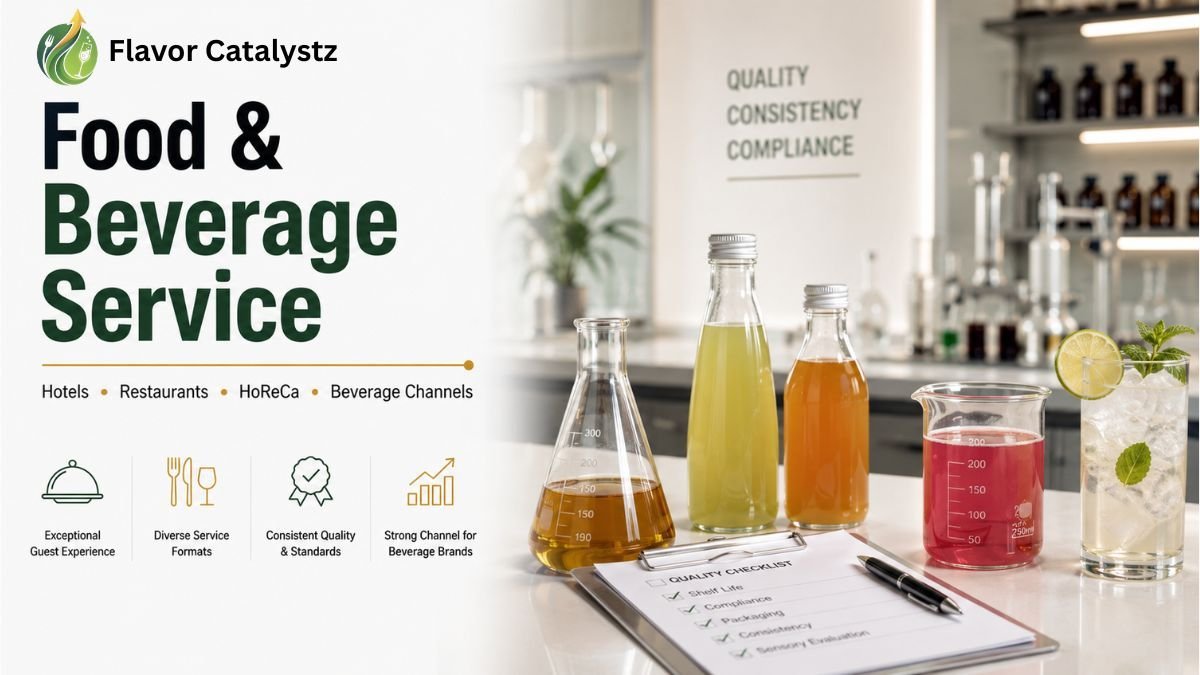
Shelf life, compliance, packaging, consistency — most brands miss at least one. Our formulation team will tell you exactly where your product stands.
What Is Food and Beverage Service?
Food and beverage (F&B) service refers to the entire process of preparing, presenting, and serving food and drinks to customers in a commercial setting. It is a core department in the hospitality industry — found in hotels, restaurants, airlines, catering companies, clubs, resorts, and any establishment that feeds or drinks its customers.
F&B service is not just about carrying plates or pouring glasses. It encompasses:
- Menu planning and design
- Procurement and stock management
- Staff training and service standards
- Hygiene and safety protocols
- Guest experience and interaction
- Revenue management and cost control
In large hotels, the F&B department can account for 30–40% of total revenue. It is one of the most operationally complex — and commercially significant — divisions in hospitality.
The 7 Main Types of Food and Beverage Service
One of the most common questions on this topic is: how many types of F&B service are there? The answer varies slightly by classification, but here are the seven most widely recognised types:
1. Table Service
The most traditional form — guests are seated, and staff bring food and beverages to them. Subcategories include English service (platter to plate), French service (tableside preparation), Russian service (silver service), and American service (pre-plated). Found in fine dining, sit-down restaurants, and hotel restaurants.
2. Buffet Service
Guests serve themselves from a spread of dishes laid out on counters or tables. Common in hotel breakfasts, wedding banquets, and large events. Beverages are often self-served from dispensers or served from a beverage station by a dedicated staff member.
3. Counter Service or Cafeteria Service
Guests select and collect their food from a counter and either carry it themselves or have it brought to their table. Common in fast-casual restaurants, canteens, and food courts.
4. Tray Service
Typically used in hospitals, airlines, and room service. Food and beverages are assembled on a tray and delivered to the guest. Packaging, seal integrity, and shelf stability of beverages are especially important here.
5. Guéridon or Trolley Service
A specialised form of table service where food or drinks are prepared, finished, or carved at the guest’s table using a trolley. Found in premium dining establishments. Signature beverage preparations — like tableside mocktail mixing — fall into this category.
6. Lounge or Bar Service
Beverages — alcoholic, non-alcoholic, and specialty drinks — are served in a lounge, bar, or lobby setting. This channel is particularly relevant for premium non-alcoholic beverages, wellness drinks, and signature mocktails.
7. Outdoor or Catering Service
F&B service delivered outside a fixed establishment — at weddings, corporate events, concerts, or outdoor venues. Packaging and portability of beverages is critical here. RTD (ready-to-drink) formats perform especially well in this service type.
The F&B Department in a Hotel: How It’s Structured
Understanding the F&B department structure matters if you are trying to get your beverage product placed or specified in hospitality accounts.
Director of F&B / F&B Manager
The head of the entire food and beverage function. Makes strategic decisions about menus, supplier relationships, and product specifications. This is your key contact for high-value beverage placement.
Restaurant Manager / Outlet Manager
Runs individual F&B outlets within the hotel — the all-day restaurant, the bar, the room service operation. Often has input on beverage lists.
Executive Chef
Controls kitchen operations and may have significant influence over beverage menu development, especially for mocktails, culinary drinks, and specialty infusions.
Beverage Manager / Bar Manager
Specifically manages the drinks program — curating the beverage list, managing stock, training bartenders. A critical influencer for any premium, craft, or specialty beverage brand.
Purchase Manager
Handles procurement decisions and vendor approvals. Any beverage brand wanting to supply a hotel needs to go through this person’s process — which typically requires FSSAI documentation, product samples, pricing proposals, and sometimes lab reports.
Why Beverage Brands Should Understand F&B Service
Here is the part that most beverage blogs skip over — and it is arguably the most important.
The F&B service industry is not just a theoretical framework for hospitality students. It is a live, high-value sales channel for beverage products. And the brands that understand how this channel works are the ones that get placed, reordered, and recommended.
Format requirements differ by service type.
A beverage destined for tray service needs to be sealed, shelf-stable, and portion-accurate. The same product going into a lounge bar might need a premium glass bottle format and a compelling visual story. Beverage formulation decisions — base ingredients, carbonation levels, shelf life, packaging — must be made with the end service context in mind.
Compliance is non-negotiable in institutional F&B.
Hotels, airlines, and large restaurant groups have strict vendor approval processes. FSSAI licensing, accurate nutritional labelling, allergen declarations, and sometimes third-party lab reports are required before a beverage even reaches a purchase committee. Brands that are not compliance-ready lose these accounts before the conversation even starts.
Consistency is valued above novelty.
In F&B service, a product must taste exactly the same every time. Batch-to-batch variation is unacceptable in hospitality. This is one reason why professional beverage formulation — with standardised recipes, controlled ingredient specifications, and defined processing parameters — is so important for brands targeting this channel.
The HoReCa channel rewards differentiation.
Hotels and restaurants are actively looking for products that add to their guest experience. A unique welcome drink, a signature mocktail base, an Ayurvedic thandai served in the lobby — these are exactly the kinds of products that get featured on menus and become talking points. Brands with a genuinely differentiated product story have a real edge here.
If you are developing a beverage with the HoReCa channel in mind, getting the formulation right from the start is critical. Our beverage formulation service is specifically designed to help brands build products that are consistent, compliant, and channel-ready.
Beverage Formulation and F&B Service: The Connection Most Brands Miss
The relationship between beverage formulation and F&B service success is direct — and yet most new beverage brands do not connect these dots early enough.
Consider what happens when a beverage is developed without the service context in mind:
- A beautiful cold-pressed juice with a 3-day shelf life cannot serve the hotel room service channel, which may need 15–21 days
- A carbonated drink formulated without considering temperature variation may go flat or over-carbonate during transport and storage in a catering setting
- A sugar syrup-based beverage with non-standard sweetness levels will not fit into a bartender’s recipe matrix, killing chances of menu inclusion
These are not exotic problems. They are the everyday reality of beverage brands that did not think downstream during development.
Professional beverage formulation accounts for all of this — shelf life targets, service temperature range, dilution ratios for concentrates, carbonation stability, and packaging compatibility. It is the difference between a product that works in theory and one that actually works in the field.
If you are serious about placing your beverage in F&B service channels — or any commercial channel — working with a specialist from the formulation stage makes a measurable difference. Explore our beverage consultant services to understand how we work with brands end-to-end.
What Are the 4 Main Types of Service in Food and Beverage?
While there are seven recognised types (covered above), textbooks and hospitality courses often group F&B service into four core categories:
- Table Service — Staff serve guests who are seated at tables. Includes all variants: English, French, Russian, American.
- Assisted Service — A combination of self-service and staff service. Buffets and carvery formats fall here. Guests help themselves to some elements while staff assist with others.
- Self Service — Guests serve themselves entirely. Cafeterias, food courts, and vending are examples. For beverages, this includes dispensers, vending machines, and grab-and-go RTD formats.
- Single Point Service — Customers order and receive at a single point, then consume elsewhere. Takeaway counters, kiosks, and drive-throughs operate this way. Packaging and portability are paramount for beverages in this format.
F&B Service in the Context of Modern Beverage Trends
The nature of food and beverage service in India is evolving rapidly — and this is creating new opportunities for beverage brands.
Functional Beverages Are Entering F&B Menus
Hotels and wellness resorts are increasingly featuring health-forward drinks — immunity boosters, adaptogenic infusions, low-sugar options, and Ayurvedic beverages — on their menus. This is a direct entry point for brands in the functional beverage space.
Non-Alcoholic Is No Longer Second-Class
Premium non-alcoholic beverages — sophisticated mocktails, shrubs, botanical sodas, sparkling infusions — are now given dedicated sections on menus at quality establishments. The non-alcoholic beverage market in India is growing, and F&B service is where a lot of that growth is happening.
Indian Traditional Beverages Are Having a Moment
Thandai, jaljeera, aam panna, shikanji — traditionally these were made in-house. Hotels and restaurants are now looking for branded, shelf-stable, consistently formulated versions of these classics. The commercial opportunity for brands that can deliver quality and consistency is significant. See how brands are building on this in our guides on commercial thandai RTD and aam panna brand development.
Quick Commerce and Delivery Platforms
Ghost kitchens, cloud restaurants, and food delivery platforms are blurring the line between F&B service and retail. Beverages now need to work in both contexts — and this is shaping formulation decisions around packaging, shelf life, and portion formats.
Ready to Build a Beverage for the F&B Market?
Whether you are developing a signature hotel beverage, a craft mocktail base, a traditional Indian drink in RTD format, or a functional wellness drink for HoReCa — getting the product right is the starting point for everything else.
At Flavor Catalyst, we specialise in building beverages that are formulated for real commercial contexts — not just taste tested in a lab. From recipe development and stability testing to FSSAI compliance and packaging specification, we work with you end-to-end.
Talk to our team today — and let’s create something that belongs on every F&B menu worth drinking from.
Related Reading:
- Beverage Formulation: A Complete Guide
- Non-Alcoholic Beverage Development
- Functional Beverage Development
- How to Start a Beverage Brand in India
- Beverage Industry Trends in India
- Types of Beverages
FAQs: Food and Beverage Service
What is food and beverage service in simple terms?
It is the organised process of offering food and drinks to customers in a commercial setting — from preparation and presentation to the moment it is consumed. It covers everything from a five-star hotel restaurant to a college canteen.
What are the 7 types of food and beverage service?
Table service, buffet service, counter/cafeteria service, tray service, guéridon/trolley service, lounge/bar service, and outdoor/catering service. (Covered in detail above.)
What is the role of the F&B department in a hotel?
The F&B department manages all food and drink operations within a hotel — restaurants, bars, room service, banquets, and sometimes in-room minibar stocking. It is one of the largest revenue-generating departments in full-service hotels.
Why do you choose food and beverage service as a career?
F&B service offers diverse career paths — from restaurant management to beverage consultancy, from hotel F&B director to product development for beverage companies. It combines hospitality, business, creativity, and sensory expertise in a way few industries do.
What is F&B service in hotel management?
In hotel management, F&B service is a core operational function covering all aspects of serving food and drinks to hotel guests — in restaurants, bars, room service, banquet halls, and other outlets. It has its own P&L, staff structure, and quality standards.
How does F&B service affect beverage product development?
Significantly. The service format determines the packaging requirements, shelf life targets, portion size, carbonation level, and dilution ratios of a beverage product. Brands that design with the service context in mind have much better success rates in commercial channels.
What documents does a beverage brand need to supply F&B accounts?
Typically: FSSAI registration or licence, GST details, product specification sheets, nutritional information, allergen declarations, and sometimes third-party lab test reports. Premium chains may also require supplier audits.
Is F&B a good business opportunity in India?
Yes — India’s food service industry is projected to be one of the fastest-growing in the world through 2030. The beverage segment within this is particularly dynamic, with growth in premium, functional, and traditional categories creating real commercial opportunities for well-positioned brands.