Jun 2026 · 9 min read
Delhi NCR is one of the hardest food markets in India to win and one of the easiest to lose money in. The region blends deep traditional food culture with a fast-moving modern retail scene, thousands of cloud kitchens, a dense restaurant economy and a manufacturing belt spread across Ghaziabad, Noida and beyond. That mix creates opportunity, but it also means a half-finished product gets exposed quickly. The real question for most founders is not whether to hire a food consultant in Delhi, but at what point doing so becomes the cheaper option.
Rather than a generic overview, this guide is built as a series of decisions. It walks through the signals that tell you it is time to bring in expertise, what that expertise actually covers, how to vet it, and the compliance facts that catch Delhi food businesses out in 2026.
Free food consulting
Trusted Food Consultant in Delhi 2026
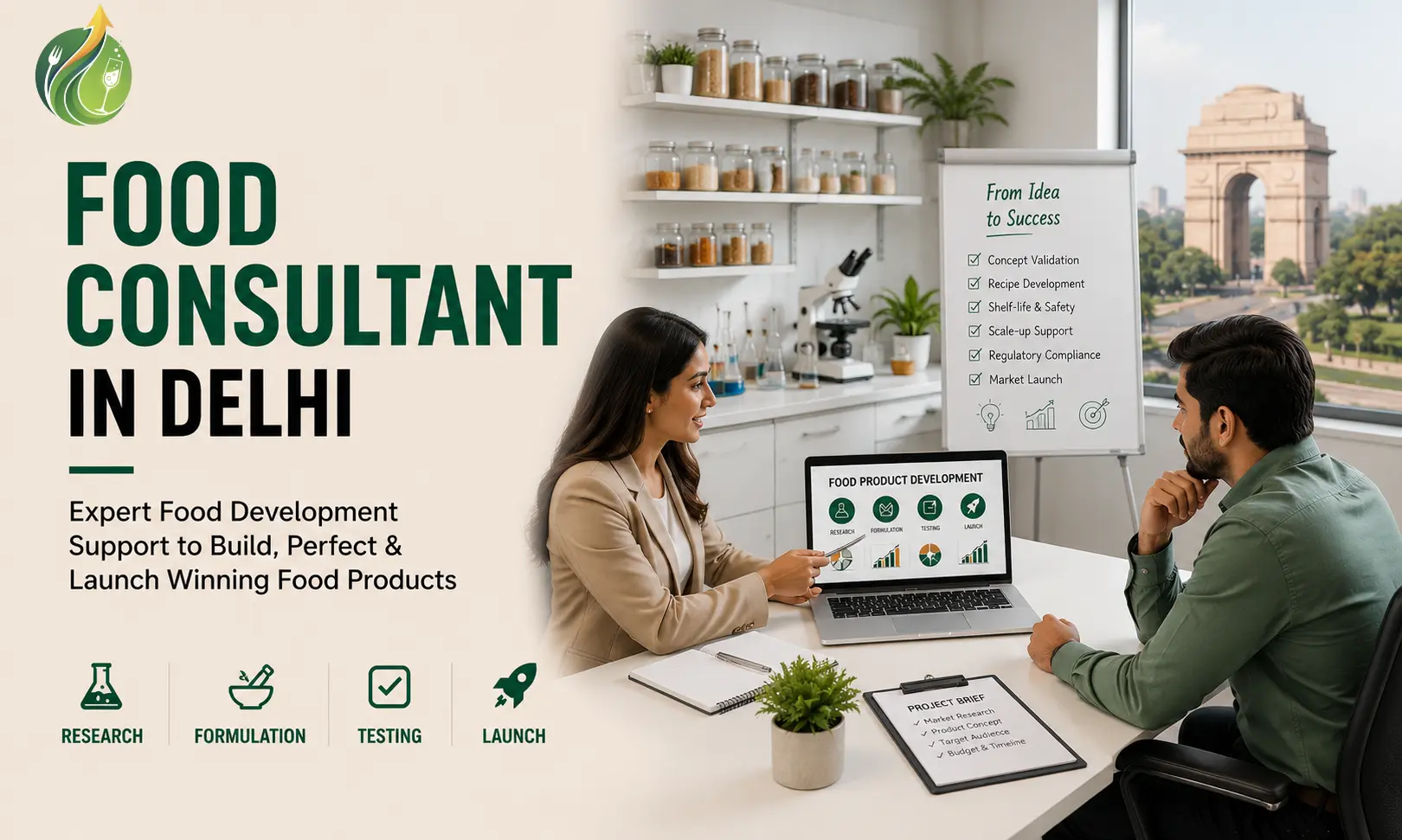
Expert food consultant in delhi helping new and established brands transform ideas into successful products through market research, formulation, regulatory guidance, testing, manufacturing support, and go-to-market strategy.
Decision One: Do You Actually Need a Consultant Yet?
Hiring too early wastes money; hiring too late wastes far more. The table below lists the signals that usually mean the value of expert help now outweighs the cost of learning the hard way.
| Signal in your business | What it usually means | Hire now? |
| Your kitchen recipe behaves differently every batch | The formula is not yet controlled or repeatable | Yes |
| A co-packer asked for specifications you cannot provide | You need formulation and manufacturing documentation | Yes |
| You are unsure which FSSAI licence applies | Compliance risk before you have even launched | Yes |
| Customers like the taste but the product spoils fast | Shelf-life and stability work is missing | Yes |
| You only need a name and a logo decided | This is branding, not food technical work | Not yet |
| You have one untested idea and no budget | Validate demand cheaply first, then formulate | Soon, not yet |
Decision Two: What Kind of Work Do You Need?
Food consulting in Delhi spans several distinct disciplines that are often confused with one another. Knowing the difference stops you from paying for the wrong thing.
At the technical core sits food formulation — the science of selecting and balancing ingredients so a product delivers consistent taste, texture and nutrition, holds its quality through storage and transport, and stays within a defined cost of goods. This is where most product failures are quietly born, because a formula that is fragile or expensive cannot be rescued later with marketing.
Formulation usually sits inside a wider food product development process that also covers concept validation, prototyping, shelf-life and food-safety testing, regulatory labelling and scale-up. A founder who understands which layer they are buying — a single formula or end-to-end development — negotiates a far clearer scope and avoids paying for stages they do not yet need.
Decision Three: Build In-House or Bring In a Consultant?
Established Delhi brands often weigh hiring an internal food technologist against engaging a consultant. Both are valid; the right answer depends on how much development work you have and how predictable it is.
| Factor | In-house hire | External consultant |
| Best when | You have a constant, year-round development pipeline | You have specific projects or occasional needs |
| Cost shape | Fixed salary and overhead, paid whether busy or not | Paid per project or per phase, scales with need |
| Breadth of skill | Limited to that individual’s specialisation | Access to formulation, sensory, regulatory and scale-up expertise |
| Speed to start | Weeks or months to recruit | Days to begin a defined brief |
| Risk | A wrong hire is costly to unwind | Easier to change if the fit is poor |
Decision Four: How Do You Vet a Delhi Food Consultant?
The NCR market has genuine specialists and a long tail of generalists. A short, pointed conversation usually reveals which you are talking to. Look for evidence, not adjectives.
- Ask for category-specific examples and the exact technical problem that was solved, not just a client list.
- Confirm who physically does the formulation work and whether qualified food scientists are involved.
- Check that taste decisions come from structured sensory panels and target-consumer testing, not personal opinion.
- Make sure scale-up is considered from the start, with the formula designed around real factory equipment.
- Get intellectual property ownership confirmed in writing before any work begins.
If answers stay vague across these five points, you are likely buying confidence rather than capability — an expensive mistake in a market as unforgiving as Delhi’s.
Decision Five: How Will the Engagement Be Structured?
Once you have chosen who to work with, agree how the work is shaped before money changes hands. Clear structure protects both sides and keeps the project moving. Four arrangements cover almost every case. A defined project fixes one scope and one fee, which suits developing or reformulating a single product. A phase-by-phase model commits one stage at a time with a review gate between each, which fits cautious founders managing cash flow. An ongoing retainer buys continuous monthly support and makes sense for brands launching several products a year. An expert-review arrangement provides hourly or session-based advice on your own work, ideal for teams with internal capability who simply want a qualified second opinion. Whichever you choose, tie the fee to a written scope rather than a vague promise of full support.
The Delhi Factor: Why Local Conditions Shape the Formula
Delhi NCR is not one market but several layered on top of each other, and that directly affects how a product should be formulated. Taste expectations span deep traditional preferences and fast-moving modern, global flavours, so a product often has to satisfy a wider palate than it would in a more uniform city. Price sensitivity varies sharply between segments, which puts real pressure on cost of goods and ingredient selection.
Climate adds a hard technical constraint. Delhi’s extreme summer heat and the long supply runs across NCR test a product’s stability and shelf life far more aggressively than a temperate market would. A formula that holds up in a cool kitchen can separate, stale or spoil in transit and on a warm shelf. Building heat tolerance, moisture control and a realistic shelf life into the formulation from the start is not optional here; it is the difference between a product that survives the NCR supply chain intact and one that arrives already compromised. This is exactly why founders who treat formulation as a local engineering problem, not a generic recipe, tend to outlast those who do not.
The Compliance Reality: FSSAI Changes That Hit Delhi Businesses in 2026
Delhi NCR straddles multiple states, which makes licensing decisions easy to get wrong. The framework also shifted this year. From 1 April 2026, FSSAI revised the turnover thresholds that determine your licence category, and the multi-state nature of NCR makes one rule especially important.
| Licence | Applies to (from 1 April 2026) | NCR-specific catch |
| Basic Registration | Turnover up to about ₹1.5 crore | Fine for a single-location, single-state micro business |
| State Licence | Turnover above ₹1.5 crore up to ₹50 crore, within one state | Operating across Delhi, Haryana and UP can push you beyond a single state licence |
| Central Licence | Turnover above ₹50 crore, or any importer, exporter or nationwide online seller | Required for most NCR brands selling pan-India through e-commerce |
Two points trip up NCR founders most often. First, if you sell nationwide online, import an ingredient or export a product, you need a Central Licence whatever your turnover. Second, licences issued on or after 1 April 2026 now carry perpetual validity, so the old renewal cycle no longer applies — although annual fees still do. Treat licence classification as a launch-stage decision, not an afterthought.
Putting the Decisions Together
Read end to end, the five decisions form a simple logic. Confirm you genuinely need help; identify whether you need a single formula or full development; decide between an in-house hire and a consultant; vet for real evidence of capability; and lock down a clear engagement structure and compliance plan before spending.
In Flavor Catalystz‘s experience working with brands across the country, founders who move through these decisions in order rarely make the expensive mistakes that the Delhi market punishes so quickly.
Frequently Asked Questions
When should a Delhi food brand hire a food consultant?
The moment expert help becomes cheaper than learning the hard way — typically when your recipe is not yet repeatable at scale, a co-packer needs specifications you cannot supply, your product spoils too quickly, or you are unsure which FSSAI licence applies. If you only need branding decided, it is not yet time.
What is food formulation and why does it matter so much?
Food formulation is the science of choosing and balancing ingredients so a product tastes consistent, holds its texture and nutrition through storage, and stays within a target cost. It matters because most product failures originate in a fragile or expensive formula, and no amount of marketing fixes a product that does not perform.
Is it better to hire an in-house food technologist or a consultant in Delhi?
An in-house hire suits brands with a constant, year-round pipeline, while a consultant suits specific projects or occasional needs and scales cost with demand. Consultants also bring broader expertise across formulation, sensory, regulatory and scale-up than a single employee usually can.
How do I check if a Delhi food consultant is genuinely capable?
Ask for category-specific examples with the technical problem explained, confirm qualified food scientists do the formulation, check that taste is validated through structured panels, ensure scale-up is planned early, and get IP ownership confirmed in writing. Vague answers across these points are a warning sign.
Which FSSAI licence does a Delhi NCR food business need in 2026?
From 1 April 2026, turnover up to about ₹1.5 crore needs Basic Registration, ₹1.5 crore to ₹50 crore within one state needs a State Licence, and above ₹50 crore needs a Central Licence. Because NCR spans several states and many brands sell pan-India online, a Central Licence is common; importers and exporters always need one.
How much should I budget for food consulting in Delhi?
Budget depends entirely on scope. A single-product project carries a fixed fee, phase-based work is paid stage by stage, and a pipeline of products is often handled on a monthly retainer. Expect a quote tied to a defined scope rather than a flat published rate.
Can a consultant help me launch a cloud-kitchen product into retail?
Yes. Taking a kitchen or restaurant recipe into a packaged retail format is common work, and it requires reformulating for shelf stability, validating shelf life, completing FSSAI labelling and aligning the formula to a manufacturer’s equipment — all distinct from running a kitchen.
Do I keep ownership of my recipe when I work with a consultant?
With a reputable consultant you should retain full ownership of your formula and all documentation. Always confirm this in writing before work starts, and treat any ambiguity about intellectual property as a reason to pause.