Jun 2026 · 8 min read
Gurugram has grown into one of North India’s most concentrated hubs for modern food businesses. Corporate headquarters, a dense cloud-kitchen and QSR scene, a wave of well-funded D2C brands and easy access to NCR’s manufacturing belt have all gathered here. The result is a market full of ambition and capital, where the difference between a product that scales and one that stalls often comes down to the technical decisions made early. Choosing the right food consultant is one of those decisions — and choosing badly is expensive.
30 Minutes consulting
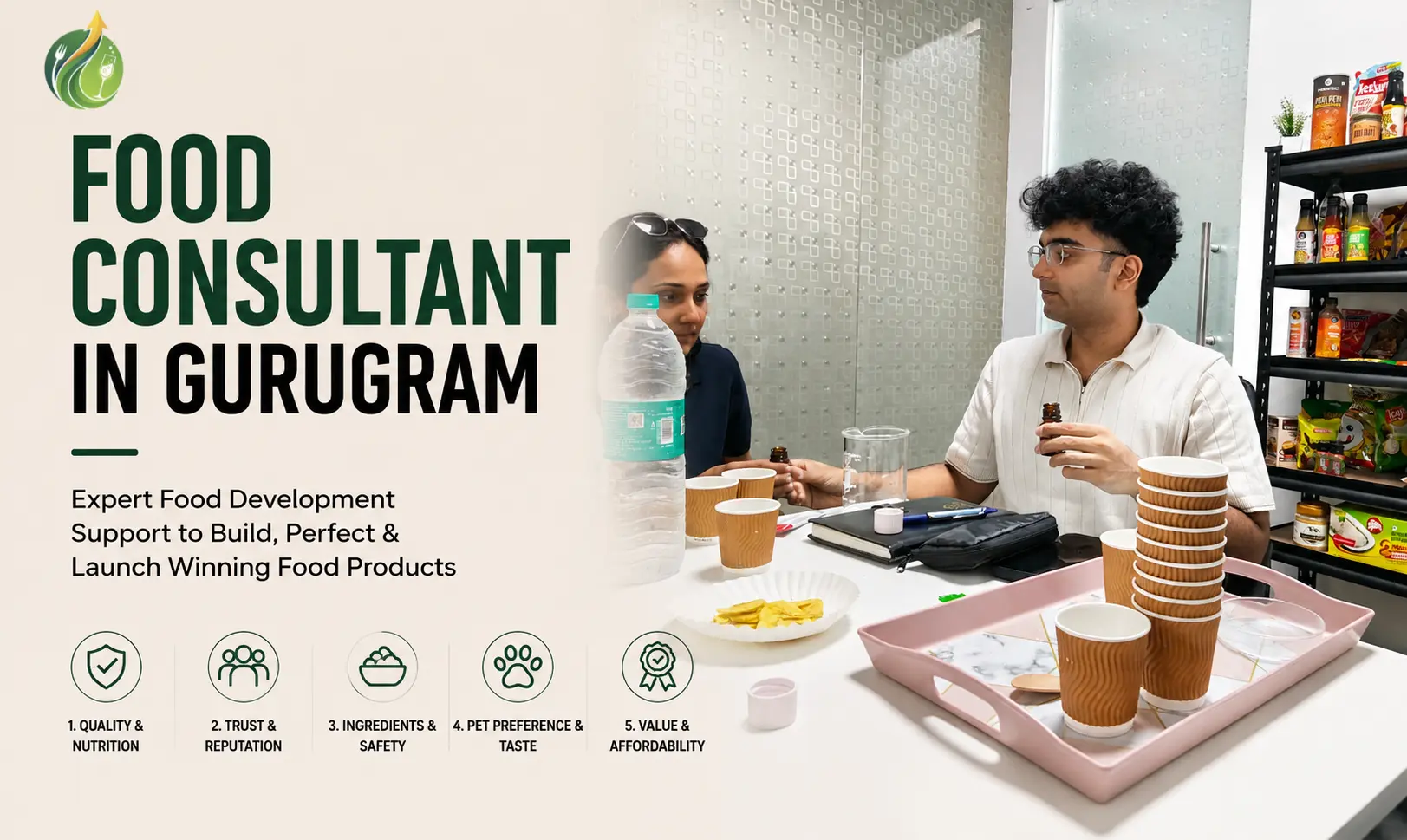
Best Food Consultant in Gurugram, Haryana
Turn food ideas into market-ready products with expert consulting, formulation, testing, compliance support, and manufacturing guidance designed to accelerate successful launches and business growth.
This is a hiring guide, not a sales pitch. It sets out what to look for, what to ask, the mistakes that cost Gurugram brands the most, and the compliance facts that should shape any food launch in 2026. Use it as a checklist before you sign anything.
First, Know Your Requirements From Food Consultant
Before evaluating anyone, get clear on the scope you need. Some brands need a single formula fixed; others need full end-to-end development. Match your situation to what you are actually hiring for:
- A recipe that is not yet repeatable means you are hiring for formulation — one precise, documented, costed formula.
- A product that spoils too fast means you need shelf-life and food-safety work, including stability studies and a HACCP review.
- A complete new launch calls for end-to-end food product development, every stage from concept to scale-up.
- An existing product you want to improve points to reformulation — reducing sugar, salt, fat or cost, or cleaning up the label.
- Moving to a co-packer means you need scale-up and manufacturing support, with equipment alignment and pilot trials.
Knowing which of these applies turns a vague conversation into a precise brief, and a precise brief is what gets you an honest quote instead of an inflated one.
The Gurugram Buyer’s Checklist
Once you know your scope, evaluate candidates against a consistent checklist. Strong consultants pass every line comfortably; weaker ones get vague on at least one.
| Checklist item | What good looks like |
| Relevant experience | Specific work in your category with the technical problem explained |
| Who does the work | Named, qualified food scientists or development chefs in-house |
| Taste validation | Structured sensory panels and target-consumer testing, not opinion |
| Manufacturing readiness | Formula designed around real factory equipment from the start |
| Regulatory depth | FSSAI labelling, nutrition panels and claim checks handled properly |
| Transparency | Clear scope, clear pricing, no hidden hand-offs |
| Ownership | Your full IP over the recipe, confirmed in writing |
Five Questions to Ask From Food Consultant in the First Call
A short call usually tells you most of what you need. These five questions cut through polished introductions quickly.
- Can you show me work in my product category and explain the technical challenge you solved?
- Who on your team will actually formulate and test the product?
- How do you decide whether a product tastes good enough to launch?
- How early do you involve manufacturing and scale-up considerations?
- Who owns the recipe and documentation when the project ends?
Mistakes That Cost Gurugram Brands the Most
Well-funded markets attract avoidable errors because money can paper over weak foundations — until it cannot. These are the mistakes that surface most often, and how to avoid them.
| Mistake | Why it hurts | How to avoid it |
| Spending on branding before the product works | A polished brand cannot save an inconsistent product | Get the formula validated first |
| Choosing on price alone | Cheap, unqualified work is reworked expensively later | Weigh capability and evidence, not just fee |
| Ignoring scale-up until the end | Lab formulas often fail on factory equipment | Plan manufacturing from the first formulation |
| Treating compliance as paperwork | Wrong licence or labels delay or block launch | Build FSSAI compliance in from the start |
| Leaving IP ownership unclear | You may not fully control your own product | Confirm ownership in writing before work begins |
How Engagements and Costs Usually Work
Gurugram’s market supports a full range of engagement models, and consultancies such as Flavor Catalystz scale their involvement to match a brand’s budget and stage. Match the structure to the size and predictability of your need rather than defaulting to the cheapest option. A defined project carries a fixed fee for an agreed scope and suits a single launch or reformulation. A phase-based arrangement lets you pay per stage with review gates, which helps founders managing cash flow carefully. A retainer provides ongoing monthly support and fits brands launching several products a year. An advisory engagement, priced hourly or per session, works for in-house teams that need expert review rather than full delivery.
Why Speed Is Gurugram’s Biggest Hidden Risk
Gurugram runs fast. Well-funded D2C brands and high-velocity cloud kitchens often feel pressure to launch quickly, capture attention and show traction to investors or marketplaces. That urgency is understandable, but it is also where the most expensive mistakes are made. Compressing or skipping product validation to hit a launch date tends to resurface later as inconsistent batches, premature spoilage, poor marketplace reviews or a compliance hold — each of which costs far more time and money to fix after launch than it would have to prevent.
The brands that scale well here treat speed and rigour as partners rather than opposites. They move quickly on branding, marketing and distribution while refusing to shortcut the technical foundation: a validated formula, a proven shelf life and clean FSSAI compliance. A capable consultant can actually accelerate a launch by running development stages in parallel wherever it is safe to do so, so you gain speed without trading away the reliability that keeps customers coming back. It also helps to separate what truly must be fast from what only feels urgent: a marketplace listing can be revised in an afternoon, but a formulation flaw discovered after thousands of units have shipped cannot. Spending a little longer on the parts that are expensive to undo is what protects the momentum a fast launch is meant to create.
FSSAI Compliance for Gurugram Food Businesses in 2026
Gurugram food businesses fall under Haryana’s jurisdiction within the national FSSAI framework, which was revised this year. From 1 April 2026, the turnover thresholds that determine your licence category changed, and Gurugram’s pan-India and e-commerce-heavy brand profile makes one category especially common.
| Licence | Applies to (from 1 April 2026) | Relevance in Gurugram |
| Basic Registration | Turnover up to about ₹1.5 crore | Small kitchens, single outlets and early-stage makers |
| State Licence | Above ₹1.5 crore to ₹50 crore, within Haryana | Growing brands operating within the state |
| Central Licence | Above ₹50 crore, or any importer, exporter or nationwide online seller | Common for Gurugram’s D2C and e-commerce-first brands |
Because so many Gurugram brands sell nationwide online, the Central Licence requirement frequently applies regardless of turnover; the same is true for any importer or exporter. Licences issued on or after 1 April 2026 carry perpetual validity, so the old renewal cycle no longer applies, though annual fees remain payable. Decide your category before you launch, not after.
Frequently Asked Questions
How do I choose a food consultant in Gurugram?
Start by defining your scope — a single formula, a full launch, a reformulation or scale-up — then evaluate candidates against a consistent checklist: relevant category experience, qualified scientists doing the work, structured taste validation, manufacturing readiness, regulatory depth, transparent pricing and written IP ownership. Strong consultants pass every point comfortably.
What questions should I ask a food consultant before hiring?
Ask for category-specific work with the technical problem explained, who will actually formulate and test the product, how taste is validated, how early manufacturing is considered, and who owns the recipe at the end. Vague answers to these are a reliable warning sign.
How much does a food consultant cost in Gurugram?
There is no fixed rate; fees track scope and complexity. A single product is usually a fixed-fee project, cautious founders prefer phase-based pricing with review gates, and brands with a pipeline often use a monthly retainer. Expect a quote against a defined scope rather than a published figure.
What mistakes do Gurugram food brands make most often?
The common ones are spending on branding before the product is validated, choosing on price alone, ignoring scale-up until the end, treating compliance as mere paperwork, and leaving IP ownership unclear. Each is avoidable by getting the product and the contract right before spending big.
Which FSSAI licence does a Gurugram food business need in 2026?
From 1 April 2026, turnover up to about ₹1.5 crore needs Basic Registration, ₹1.5 crore to ₹50 crore within Haryana needs a State Licence, and above ₹50 crore needs a Central Licence. Brands selling pan-India online, and all importers and exporters, need a Central Licence regardless of turnover.
Should I fix my product before investing in branding?
Almost always, yes. A strong brand cannot rescue a product that is inconsistent or performs poorly, and customers forgive an imperfect brand far more readily than an unreliable product. Validate the formula and its performance first, then invest in brand and packaging.
Can a consultant help my cloud kitchen launch a retail product?
Yes. Converting a cloud-kitchen or QSR recipe into a packaged retail product requires reformulating for shelf stability, validating shelf life, completing FSSAI labelling and aligning the formula to a manufacturer’s equipment — work that is distinct from running a kitchen and where expert help adds clear value.
Will I own my recipe after working with a consultant?
With a reputable consultant you should retain full ownership of your formula and documentation. Always confirm intellectual property ownership in writing before work starts, and treat any ambiguity as a reason to pause and clarify.