Jun 2026 · 9 min read
Pune occupies an unusual and valuable position in India’s food economy. It sits inside one of the country’s strongest manufacturing and food-processing belts, it has a deep pool of food technology and engineering talent from its universities, and it is now producing a fresh wave of D2C and regional food brands of its own. That combination makes Pune a natural place to take a product from concept all the way to commercial production — if the technical work is done in the right order.
This guide follows the journey itself. It walks stage by stage through how a food consultant supports a product from first idea to factory floor, why Pune’s manufacturing access changes the picture, and what every local food business should know about compliance in 2026.
Free food consulting
Leading Food Consultant in Pune 2026
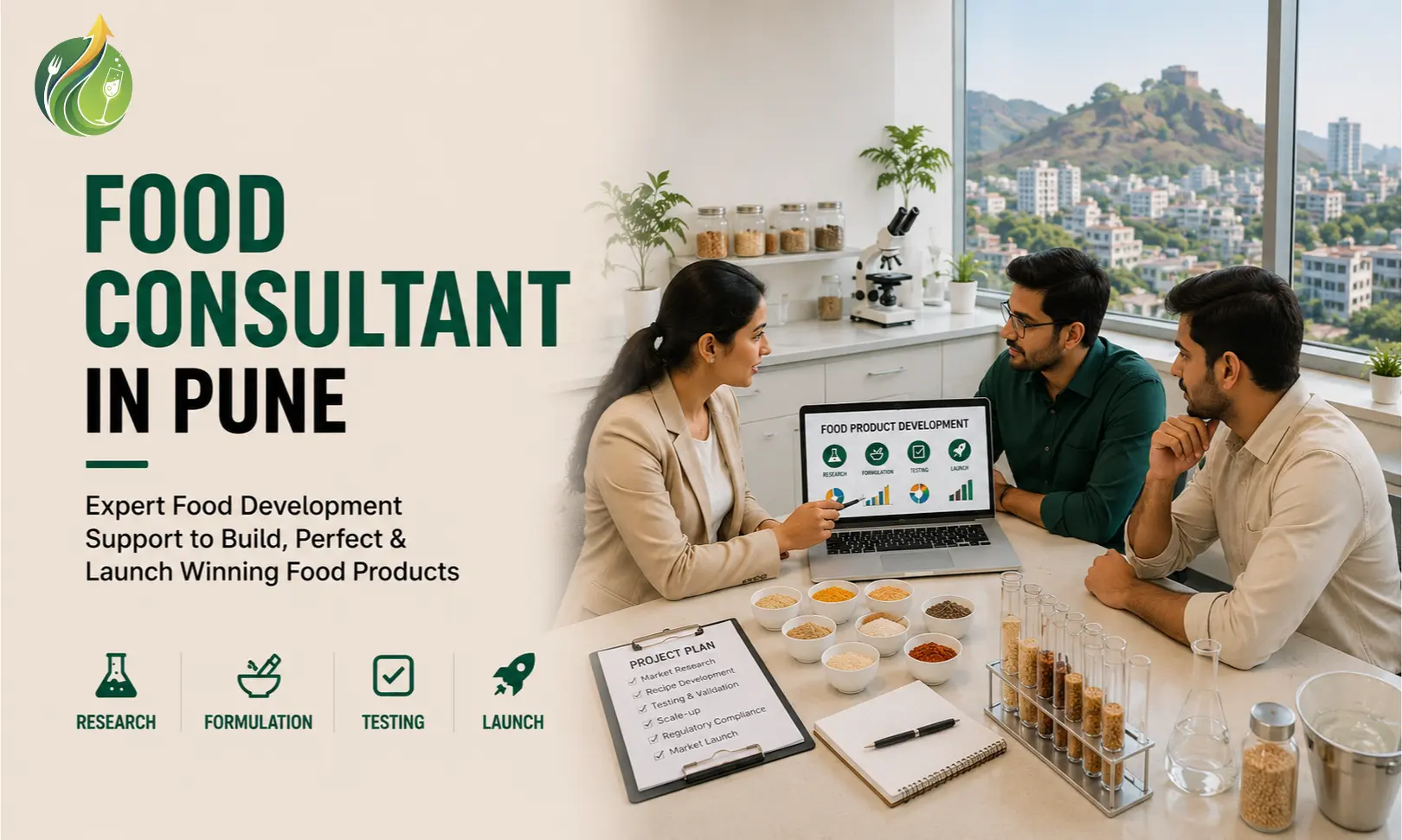
Helping Pune food brands accelerate product innovation through consumer insights, formulation expertise, compliance support, product testing, manufacturing coordination, and successful market launches.
Stage 1: Concept and Feasibility
Every sound product begins with a hard look at whether it should exist. A consultant studies the idea against real consumer demand, a realistic cost ceiling and what is technically possible to manufacture. The output is a clear brief that sets direction for everything that follows. Skipping this stage is how founders end up with products that are clever but unmakeable or unaffordable.
Stage 2: Formulation and Ingredient Selection
This is the technical heart of the project. Food formulation is where ingredients are selected and balanced so the product delivers the right taste, texture, appearance and nutrition while staying inside the cost of goods. It is also where allergen management, clean-label requirements and reliable ingredient supply are designed in. A formula built carefully here is one that will survive storage, transport and the realities of a production line later on.
Stage 3: Prototyping and Sensory Testing
Once a formula exists, it has to be made and tasted under structured conditions. Physical samples go through sensory evaluation — internal technical panels and target-consumer feedback — and the recipe is refined until it scores above target on taste, texture, aroma and appearance. This is where opinion is replaced by evidence, which is exactly what stops a likeable idea from launching as a disappointing product.
Stage 4: Shelf Life and Food Safety
No packaged product reaches retail without a proven shelf life. Accelerated shelf-life tests and real-time stability studies confirm a safe use-by date, while microbial testing and HACCP risk assessment confirm the product stays safe across its full life. For Pune brands aiming at wider distribution, this stage is what makes a product fit to travel beyond the local market.
Stage 5: Nutrition and Regulatory Compliance
Before packaging is finalised, the product needs a full nutritional profile, an accurate ingredient list, allergen declarations and a label that meets FSSAI requirements. Any ingredient that carries claim restrictions or needs special approval is flagged now, not after the labels are printed. Building compliance in at this stage prevents the expensive reprints and delays that catch unprepared founders.
Stage 6: Scale-Up and Manufacturing — Pune’s Real Advantage
This is where Pune’s location pays off. A formula that works in a development kitchen has to be matched to a factory’s equipment, with process parameters adjusted and the first production runs attended to resolve issues before commercial output begins. Pune’s dense network of food-processing units and contract manufacturers means brands can often find suitable production partners close at hand, shortening the path from validated prototype to shelf.
The Journey at a Glance
Seen together, the six stages form a controlled sequence, each with a goal and a checkpoint before the next begins.
| Stage | Goal | What you have at the end |
| Concept and feasibility | Confirm the idea is worth building | A clear product brief |
| Formulation | Engineer a precise, costed formula | A repeatable, documented recipe |
| Prototyping and sensory | Prove customers will like it | A validated prototype |
| Shelf life and safety | Confirm it stays safe and stable | A proven shelf life and safety file |
| Nutrition and regulatory | Make it compliant and labelled | A launch-ready label and nutrition panel |
| Scale-up | Make it consistently at volume | A production-ready manufacturing spec |
Why Pune Brands Often Prioritise the Manufacturing Link
Many Pune founders come from, or are surrounded by, manufacturing. That shapes how they use a consultant: the formulation and the factory are treated as one connected problem rather than two separate ones, an approach Flavor Catalystz follows by aligning the formula to real production conditions from the outset. A formula designed in isolation from the equipment that will produce it often has to be reworked at scale, wasting time and money.
- Aligning the formula to real batch sizes, mixing and processing equipment from the start.
- Choosing ingredients that are reliably available to the chosen manufacturer, not just in a lab.
- Defining clear process parameters and quality checkpoints the factory can actually follow.
- Attending early production trials so problems are solved on the line, not discovered after launch.
Choosing a Food Consultant in Pune
Pune’s technical depth means there is real expertise available, but capability still varies. A short evaluation protects your budget and your timeline.
| What to check | Why it matters |
| Category-relevant track record | Experience in your product type predicts fewer surprises |
| Qualified food scientists in-house | Formulation is technical work, not guesswork |
| Structured sensory testing | Removes personal bias from taste decisions |
| Manufacturing alignment from the start | Avoids costly reformulation at scale, a Pune priority |
| Written IP ownership | Your formula and documentation should remain yours |
Pune’s Ingredient and Supply Advantage
One reason Pune is well suited to food product work is what surrounds it. The city sits within a rich agricultural belt that supplies grains, pulses, fruit, vegetables, dairy and more, giving local brands unusually direct access to raw materials. For a formulator, proximity to reliable, fresh and competitively priced ingredients is not a minor detail; it shapes cost of goods, supply consistency and the ability to design around what is genuinely available rather than what merely looks good on paper.
That access pairs well with Pune’s manufacturing depth and its steady supply of food-technology and engineering talent from local institutions. Together they let brands shorten supply chains, control costs and build supplier relationships that hold quality steady as volumes grow. A consultant who understands the regional ingredient landscape can specify a formula that is both excellent and practical to source at scale, avoiding the common trap of designing a product around an ingredient that becomes unreliable or expensive the moment production ramps up. In a processing hub like Pune, that supply realism is often what separates a product that scales smoothly from one that stalls at its first big order.
FSSAI Compliance for Pune Food Businesses in 2026
Maharashtra food businesses follow the national FSSAI framework, which was revised this year. From 1 April 2026, the turnover thresholds that decide your licence category changed, and the rules around multi-state and manufacturing operations matter for scaling Pune brands.
| Licence | Applies to (from 1 April 2026) | Note for Pune manufacturers |
| Basic Registration | Turnover up to about ₹1.5 crore | Suits small local makers and single units |
| State Licence | Above ₹1.5 crore to ₹50 crore, within Maharashtra | Common for growing processors operating in-state |
| Central Licence | Above ₹50 crore, or any importer, exporter or nationwide online seller | Needed once you sell pan-India, export, or import ingredients |
Production capacity also matters: a manufacturing unit producing above a specified daily limit can require a higher licence category even when turnover is moderate, which is relevant in a processing hub like Pune. Licences issued on or after 1 April 2026 carry perpetual validity, though annual fees still apply. Confirm your category early so it does not constrain your scale-up plans.
Frequently Asked Questions
What does a food consultant in Pune do?
A food consultant guides a product through every stage from concept and formulation to prototyping, shelf-life and safety testing, regulatory labelling and scale-up to manufacturing. In Pune, the scale-up and manufacturing link is often emphasised because of the city’s strong food-processing base.
What are the stages of developing a new food product?
The usual stages are concept and feasibility, formulation and ingredient selection, prototyping and sensory testing, shelf-life and food-safety studies, nutrition and regulatory compliance, and finally scale-up to manufacturing. Each stage has a defined goal and a review point before the next begins.
Why is formulation considered the technical heart of the process?
Formulation is where ingredients are balanced for taste, texture, nutrition, stability and cost all at once. A formula engineered well here survives storage, transport and the production line, while a fragile or expensive formula causes problems at every later stage that cannot easily be fixed.
How does Pune’s manufacturing base help food brands?
Pune sits in a strong food-processing belt with many contract manufacturers and processing units nearby. That means brands can often find suitable production partners close at hand and design the formula around real factory equipment from the start, shortening the path from prototype to shelf.
How long does it take to take a product to production in Pune?
It depends on complexity. A simple ambient product with a clear brief can be production-ready in a few months, while products with health claims, novel ingredients or demanding shelf-life needs take longer because each stage requires proper testing before moving on.
Which FSSAI licence does a Pune food business need in 2026?
From 1 April 2026, turnover up to about ₹1.5 crore needs Basic Registration, ₹1.5 crore to ₹50 crore within Maharashtra needs a State Licence, and above ₹50 crore needs a Central Licence. Importers, exporters and nationwide online sellers need a Central Licence regardless of turnover, and high daily production capacity can also raise the category.
Should the formula and the factory be planned together?
Ideally yes. A formula designed without reference to the equipment that will produce it often has to be reworked at scale. Aligning the recipe to real batch sizes, equipment and ingredient supply from the start avoids costly rework, which is why many Pune brands treat them as one connected problem.
Will I keep ownership of my recipe?
With a reputable consultant you should retain full intellectual property over your formula and all documentation. Confirm ownership in writing before any work begins, and treat vagueness on this point as a clear warning sign.