May 2026 · 10 min read
Food formulation is one of the most underestimated reasons new food brands succeed or fail. Across the global packaged food industry, an estimated 70–85% of new launches fail within the first year — and the root cause is rarely marketing or packaging. It is almost always formulation.
A product that tastes great in the kitchen but goes stale in 60 days, separates in the bottle, or fails FSSAI compliance never gets a second chance on the shelf. In 2026, food formulation and food product development have evolved into a precise, multi-disciplinary science combining food chemistry, sensory engineering, regulatory strategy, and consumer psychology.
This guide walks you through everything that goes into modern food formulation: the science, the 6-stage process, real cost benchmarks, common failure points, and two real case studies that show how the right formulation approach transforms a struggling product into a market winner.
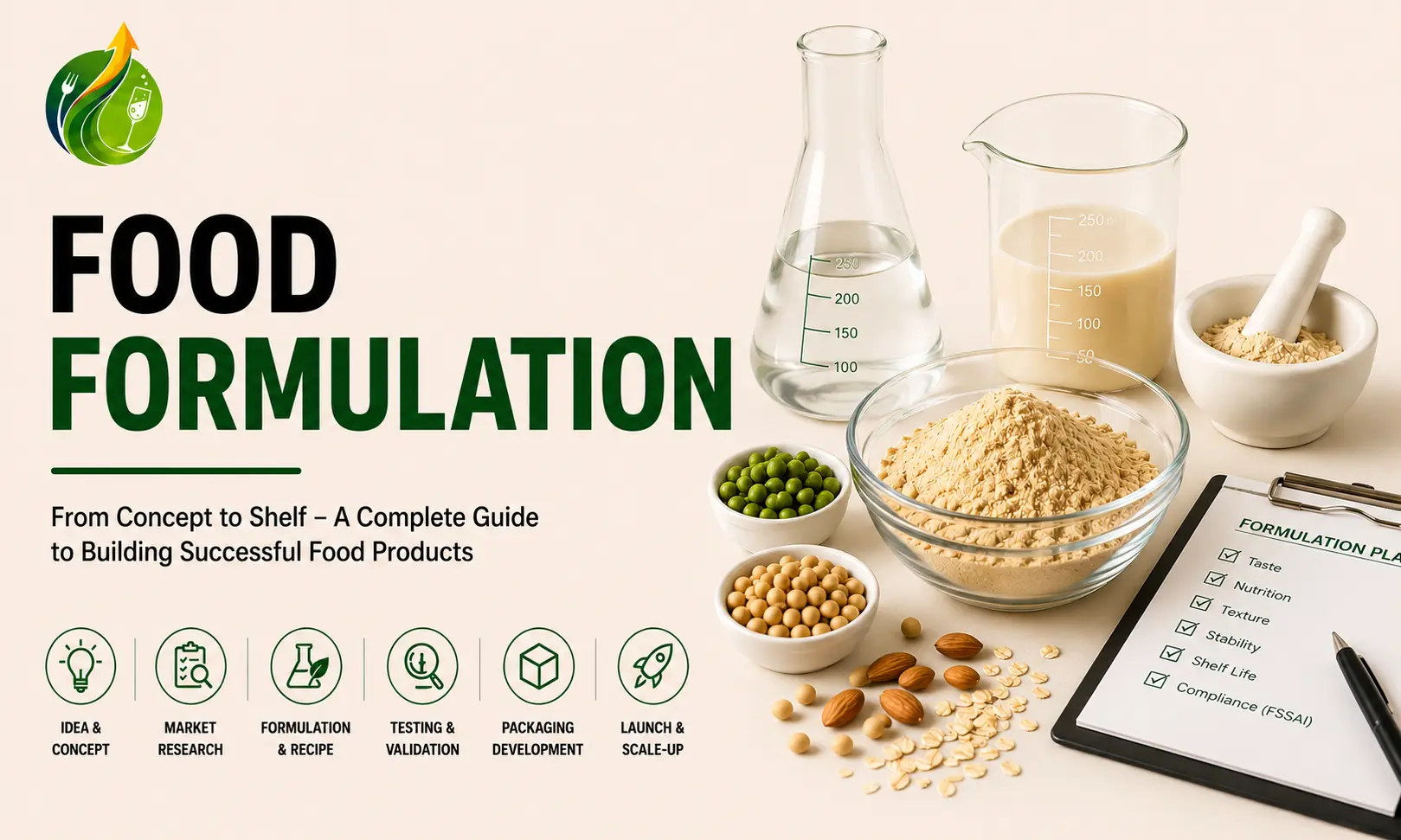
Food Formulation
Get Food Formulation Support for Scalable Products
Create food products consumers love with balanced taste, texture, nutrition, shelf stability, and FSSAI-ready formulations built for long-term brand growth.
What Is Food Formulation?
Food formulation is the structured scientific process of designing a food or beverage product by selecting, balancing, and stabilizing ingredients to achieve a specific taste, texture, nutrition profile, shelf life, and regulatory compliance — at a commercially viable cost.
It is different from cooking in three key ways:
- Every ingredient is measured to 0.01% precision for batch-to-batch consistency.
- The recipe must remain stable for 6–24 months, not just one meal.
- It must pass FSSAI, FDA, or EFSA compliance before reaching the shelf.
A perfectly cooked dish is a one-time experience. A perfectly formulated product is the same experience, 10 million times, across two years.
Why Food Formulation Decides Whether Your Brand Survives
The Indian packaged food market is projected to cross USD 110 billion by 2027 (Statista, 2025), but the failure rate of new food launches remains stubbornly high at 70–85%. Industry analysis of failed launches consistently points to the same five formulation gaps:
- Taste drift after 90 days (oxidation, flavor migration)
- Microbial instability (incorrect water activity or pH)
- Cost overrun at scale (lab-grade ingredients that can’t be sourced commercially)
- Label non-compliance (additives banned under FSSAI or unsupported claims)
- Sensory mismatch with the target Indian palate
A scientifically formulated product addresses all five before the first production run.
The 7 Core Pillars of Modern Food Formulation
Strong formulation rests on seven interconnected pillars. Skip one, and the entire product collapses — often after launch, when fixes cost 10× more.
1. Ingredient Functionality Mapping
Every ingredient must serve at least one of these roles: structure, flavor, preservation, nutrition, texture, color, or cost optimization. Multi-functional ingredients (e.g., inulin for fiber + sweetness + prebiotic) reduce the bill of materials by 15–25%.
2. Water Activity (aw) & pH Control
These two numbers silently decide whether your product spoils or survives. Most pathogenic bacteria stop growing below aw 0.85 and below pH 4.6. Honey (aw ~0.6) lasts decades; fresh dairy (aw ~0.99) lasts days.
3. Sensory Engineering
The eating experience — first bite, mid-palate, finish, aftertaste — is designed using a 5-attribute sensory wheel: aroma, taste, mouthfeel, sound, and visual appearance. Crunch loudness alone can shift purchase intent by 22% (Spence, Oxford, 2024).
4. Nutritional Architecture
Macros, micros, and bioavailability are designed before taste — not after. Adding 10g of plant protein after the recipe is locked usually destroys mouthfeel; designing for it from day one preserves both.
5. Shelf-Life Stability
Real-time and accelerated stability studies (typically 40°C / 75% RH) predict 12-month behavior in just 90 days. Without this data, retail buyers will not list your product.
6. Regulatory Compliance
FSSAI in India, FDA/GRAS in the US, EFSA in Europe. Every additive, claim, and label must be pre-validated. One non-compliant claim can trigger a full product recall.
7. Scale-Up Engineering
A recipe that works in a 2 L beaker rarely works unchanged in a 2,000 L tank. Heat transfer, shear, and hold times must be re-engineered during pilot.
The 6-Stage Food Formulation Process
| Stage | What Happens | Timeline | Key Output |
| 1. Concept & Brief Lock | Define target consumer, USP, channel, price point, and claims | 1–2 weeks | Product Requirement Document (PRD) |
| 2. Ingredient Architecture | Select base, functional, and supporting ingredients with sourcing plan | 2–3 weeks | Bill of Materials (BOM) v1 |
| 3. Prototyping (Bench) | Lab-scale recipes, 5–15 iterations, internal sensory panels | 3–6 weeks | Gold Standard Sample |
| 4. Sensory & Consumer Testing | Blind panels, CLT, 80–150 respondents | 2–4 weeks | Sensory acceptance score (target ≥75%) |
| 5. Stability & Compliance | Accelerated shelf-life, micro testing, FSSAI label finalization | 4–12 weeks | Shelf-life certificate + FSSAI-ready label |
| 6. Pilot & Scale-Up | 50–500 kg pilot batch, process validation, factory transfer | 3–8 weeks | Production-ready formula + SOP |
Total realistic timeline: 3–6 months for simple products, 6–12 months for functional or novel formats.
The Science Layer: What’s Actually Happening Inside Your Product
Maillard Reactions & Flavor Development
Browning reactions between amino acids and reducing sugars between 140–165°C create the deep, roasted flavors in coffee, biscuits, and roasted snacks. Controlling temperature and time here is the difference between “premium” and “burnt.”
Emulsion Stability
Salad dressings, plant milks, and creamy beverages depend on emulsifiers like lecithin or mono-/diglycerides keeping oil and water phases bonded. The stability window is measured in months, not days.
Glass Transition Temperature (Tg)
For crunchy snacks, biscuits, and protein bars, Tg dictates whether the product stays crisp or goes soft. A bar formulated at Tg too close to room temperature will go sticky within 30 days on the shelf.
Microencapsulation
Sensitive ingredients — probiotics, omega-3, vitamins, caffeine — are encapsulated in lipid or polysaccharide shells so they survive heat, moisture, and stomach acid before releasing in the gut.
Common Food Formulation Challenges & Proven Fixes
| Challenge | Root Cause | Practical Fix |
| Taste fades after 60 days | Volatile flavor loss / oxidation | Add tocopherols + nitrogen-flush packaging |
| Texture goes soft/sticky | Moisture migration, Tg too low | Lower aw, switch humectant, multi-layer packaging |
| Color darkens over time | Maillard or enzymatic browning | Add ascorbic acid, reduce reducing sugars, control pH |
| Plant protein bitterness | Saponins, phenolics | Taste masking (zinc gluconate, sweetness modulators) |
| Probiotic die-off | Heat, moisture, acidity | Microencapsulation + low-aw matrix |
| Separation in beverages | Weak emulsion or hydrocolloid system | Reformulate with gellan + xanthan blend |
| Cost overrun at scale | Lab ingredients unavailable in bulk | Re-architect BOM with commercial-grade equivalents |
Case Study 1: Reformulating a Failing Protein Bar Brand
Client: A Bengaluru-based D2C protein bar brand (under NDA).
Problem: The bar tasted excellent at launch but turned grainy and bitter within 75 days, triggering a 38% return rate from Amazon and Blinkit.
Formulation partner: Flavor Catalystz R&D Lab.
Approach taken:
- Diagnosis:Pea protein was undergoing slow hydrolysis due to residual moisture (aw 0.71 — too high for the format).
- Reformulation:A 60:40 pea–brown rice protein blend, glycerin replaced with sorbitol, and 0.2% rosemary extract added for oxidation control.
- aw reduction:From 0.71 to 0.58 by adjusting the binding syrup ratio.
- Sensory validation:120-person blind panel across Bengaluru, Mumbai, and Delhi — acceptance rose from 64% to 89%.
Result (6 months post-relaunch):
- Return rate dropped from 38% → 4.2%
- Shelf life extended from 4 months → 9 months
- COGS reduced by 14% through BOM re-architecture
- Monthly revenue grew 3.2× within two quarters
Case Study 2: Building a Functional Cold Brew Coffee from Scratch
Client: A founder-led wellness brand entering the RTD coffee space.
Brief: Launch a sugar-free, nootropic-enhanced cold brew with 6-month ambient shelf life — priced under ₹150 for a 200 ml bottle.
Formulation partner: Flavor Catalystz R&D Lab.
The challenge:
Most cold brews require refrigeration. Going ambient meant the formulation had to survive 40°C summer warehouses without losing taste or developing micro risk.
Approach taken:
- Base selection:A low-acid, slow-extracted Arabica base (TDS 1.4%) to reduce bitterness without sugar.
- pH engineering:A precise citric–malic acid buffer holding pH at 4.8 — bacteriostatic without souring the cup.
- Functional layer:L-theanine (100 mg) + lion’s mane extract, microencapsulated to prevent earthy off-notes.
- Shelf-life validation:90-day accelerated study at 40°C / 75% RH — equivalent to 12 months ambient.
- Label & compliance:Built to FSSAI Schedule VII with substantiated “smooth focus” functional claim.
Result:
- Launched in 4.5 months from brief to first dispatch.
- Achieved 84% repeat purchase in the first 1,000-bottle pilot drop.
- Listed on Blinkit, Zepto, and 90+ cafes within 6 months of launch.
- Won “Best Functional Beverage Innovation” at India Food Forum 2026.
Food Formulation Cost Reality (India, 2026)
| Product Category | Avg. R&D Investment | Min. Order Quantity (Pilot) | Time to Launch |
| Beverages (RTD, juices, cold brew) | ₹1.5L – ₹4L | 500–2,000 L | 3–5 months |
| Snacks & Bars | ₹2L – ₹5L | 100–500 kg | 4–6 months |
| Functional Foods (gummies, sachets) | ₹3L – ₹7L | 50–200 kg | 5–8 months |
| Nutraceuticals & Supplements | ₹3L – ₹8L | 30–100 kg | 6–10 months |
| Dairy & Plant-Based Alternatives | ₹4L – ₹10L | 500–1,500 L | 6–12 months |
Figures reflect typical full-service formulation including sensory testing, stability studies, and FSSAI documentation. Excludes packaging design and marketing.
What’s Changing in Food Formulation in 2026
- AI-assisted ingredient discovery: Tools like Brightseed and NotCo are accelerating ingredient–outcome mapping from 18 months down to weeks.
- Precision fermentation: Animal-free dairy proteins and egg whites now match traditional functionality at <1.5× the cost.
- Hyper-personalized nutrition: DNA, microbiome, and wearable data are starting to drive truly individualized formulations.
- Clean label 2.0: Consumers no longer accept “natural” alone — they want traceable, regenerative, and transparent sourcing.
- Sugar reduction without compromise: Allulose, brazzein, and rare sugars are replacing stevia in premium segments due to clean aftertaste.
Why Brands Choose Flavor Catalystz for Food Formulation
We are not a generic R&D shop. We are a hands-on formulation lab built by food scientists, flavorists, and ex-CPG founders. Every project is led by a senior formulator with 10+ years of category-specific experience.
- 230+ products formulated across beverages, snacks, functional foods, and nutraceuticals
- In-house sensory panel of 40+ trained tasters
- Accelerated shelf-life chamber for 90-day predictive testing
- FSSAI, FDA & EFSA compliance built into every formulation brief
- End-to-end execution — from concept to first production batch under one roof
- Transparent milestone-based pricing — no hidden costs
- NDA-protected projects — your formula stays yours
Industries We Serve
- Beverages — RTD, cold brew, functional drinks, energy drinks, hydration
- Snacks & Bars — protein bars, baked snacks, healthy chips, makhana
- Functional & Nutraceutical — gummies, sachets, powders, supplements
- Dairy & Plant-Based — alt-milks, yogurts, cheeses, plant proteins
- Confectionery & Bakery — chocolates, cookies, premium baked goods
Frequently Asked Questions
What is food formulation in simple terms?
Food formulation is the scientific process of designing a packaged food or beverage by selecting and balancing ingredients to deliver a specific taste, texture, nutrition, and shelf life — at a price that can scale commercially.
How long does it take to formulate a new food product?
Most products take 3 to 6 months from concept to production-ready formula. Functional foods, nutraceuticals, and novel formats can take 6 to 12 months due to additional stability and compliance work.
How much does food formulation cost in India?
Full-service food formulation in India typically ranges from ₹1.5 lakh to ₹8 lakh, depending on category complexity, number of prototypes, sensory testing, and stability study requirements.
What is the difference between food formulation and product development?
Food formulation is the recipe and stability layer — getting the science right. Product development is the broader process that also includes branding, packaging, market positioning, and launch. Formulation is one critical stage inside product development.
Why do most food startups fail at formulation?
The top reasons are inconsistent batch-to-batch taste, short shelf life, non-compliant ingredients, and cost overrun at scale. Working with an experienced formulation partner avoids 80% of these failures upfront.
Can I get my food product FSSAI-compliant during formulation?
Yes — and you should. Strong formulation partners design FSSAI compliance into the recipe from day one, covering permitted additives, label claims, nutritional declarations, and shelf-life documentation, so launch is never delayed by paperwork.