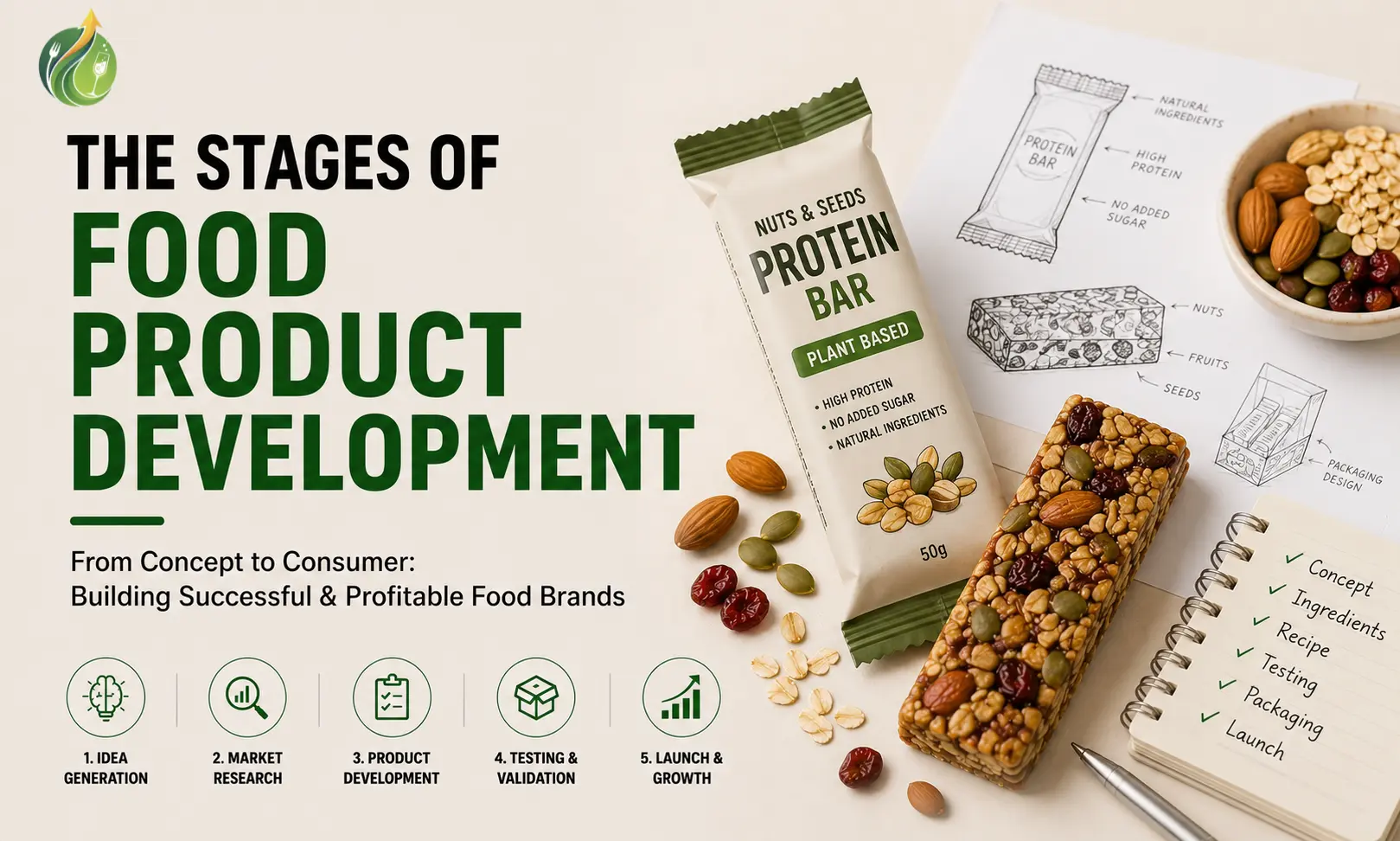
May 2026 · 14 min read
Food product development is the end-to-end process of turning a food idea into a market-ready product through seven stages: ideation, concept development, formulation, prototyping, consumer testing, scale-up, and commercial launch. In India, the full cycle typically takes 3 to 18 months and requires market research, food science, FSSAI compliance, sensory validation, and shelf-life testing before mass production.
Why Most New Food Products Fail (And What This Guide Fixes)
Every year, more than 15,000 new food products enter the global market — and over 60% of them fail within the first 12 months. The reason is rarely a bad idea. It is almost always a broken process: skipping consumer validation, weak formulation that does not survive scale-up, missed FSSAI requirements, or shelf-life failures discovered after launch.
This guide walks you through the exact 7-stage food product development process that we follow at Flavor Catalystz to take a food concept from a single recipe in a kitchen to a fully compliant, shelf-stable, scalable product on retail shelves and quick-commerce platforms like Zepto, Blinkit, and Instamart.
What Is Food Product Development?
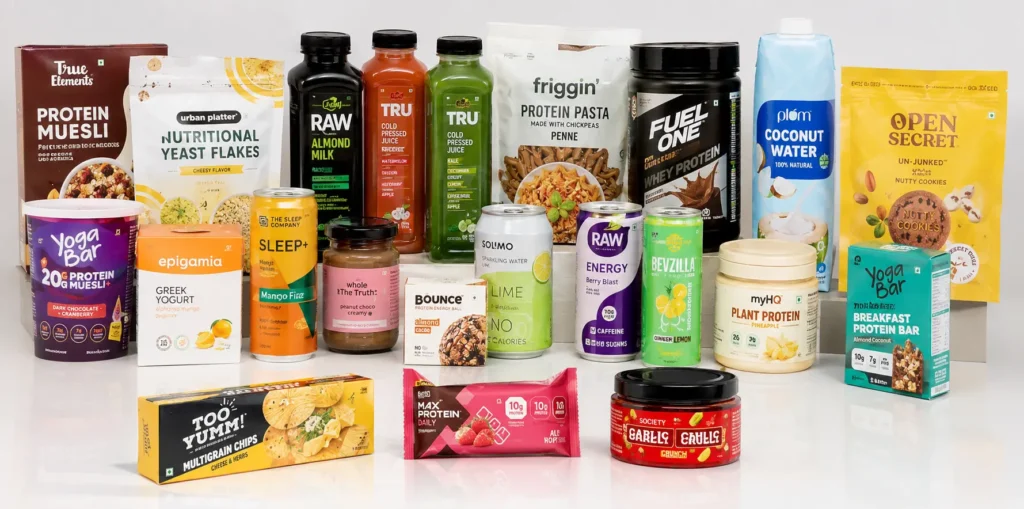
Food product development is the systematic process of conceptualizing, formulating, testing, and commercializing new food and beverage products from ideation to market launch. It integrates ingredient science, sensory evaluation, nutritional optimization, regulatory compliance, manufacturing scalability, and cost analysis to create consumer-ready products that meet market demand and brand positioning.
It sits at the intersection of food science, consumer research, sensory evaluation, regulatory affairs, and commercial strategy. A food product developer is not just a recipe creator — they are responsible for ensuring the product can be manufactured consistently at thousands of units, remains safe and stable through its declared shelf life, and complies with every applicable law in the markets where it will be sold.
Food Product Development vs. Food Formulation: The Key Difference
These two terms are often used interchangeably, but they are not the same. Food formulation is one specific stage within the larger food product development process. Formulation is the technical work of selecting ingredients, fixing ratios, and locking down processing parameters. Food product development is the entire journey — from the moment an idea is born to the moment it lives on a retail shelf and starts generating repeat purchases.
The 7 Stages of Food Product Development
Below are the seven sequential stages. Each stage has clear deliverables, validation gates, and exit criteria. A project should not move to the next stage until the previous one is signed off — this is the single biggest reason food products fail in the market.
Stage 1: Ideation and Market Research
This is where every successful food product begins and where most failed ones quietly die before anyone notices. Ideation is not just brainstorming flavors. It is the disciplined practice of identifying a real, unmet consumer need and matching it to a category opportunity.
In this stage, the team analyses market trends (plant-based, high-protein, clean-label, millet-based, functional, low-sugar), studies competitor product lines, reviews social listening data, and runs primary research through surveys, focus groups, and store visits. The deliverable is a validated product idea backed by data — not a hunch.
- Key activities: trend mapping, category gap analysis, competitor SKU teardown, target consumer definition, primary and secondary research.
- Deliverable: Product Development Brief (PDB) — a 1 to 2 page document defining concept, target consumer, price corridor, key claims, and mandatory attributes.
- Typical duration: 2 to 6 weeks.
Stage 2: Concept Development and Feasibility
Once the idea is validated, it is shaped into a tangible concept. This stage tests whether the idea is technically, commercially, and legally viable before any money is spent on lab work.
Concept development covers product positioning, target price point, ingredient availability, supply chain mapping, and a preliminary regulatory review under FSSAI or the relevant export market. The feasibility study answers a single question: can this product be made profitably, safely, and legally at the volume we need?
- Key activities: concept boards, pricing architecture, ingredient sourcing check, regulatory feasibility, SWOT, financial modelling.
- Deliverable: Concept document with go / no-go decision and committed budget.
- Typical duration: 2 to 4 weeks.
Stage 3: Formulation and Prototyping
This is where food science takes over. The formulator translates the concept into an actual recipe — selecting ingredients by functional grade, fixing ratios, choosing processing methods, and balancing sensory targets against cost-per-kilogram discipline.
Prototypes are produced in small lab batches, typically 1 to 5 kilograms in India, and iterated on until the product hits its target sensory profile, water activity, pH, nutritional profile, and cost. Multiple variants are usually developed in parallel so the consumer testing stage has options to compare.
- Key activities: ingredient functional grading, recipe iteration, water activity and pH control, costing per kg, allergen mapping.
- Deliverable: 2 to 3 locked prototype variants with full bill of materials (BOM) and process sheets.
- Typical duration: 4 to 12 weeks.
Stage 4: Consumer Testing and Sensory Evaluation
A product that tastes great to the developer means nothing. What matters is how it performs with the actual target consumer, against the actual competitor product, in a blind setting. This stage uses sensory panels and consumer panels to score appearance, aroma, taste, texture, mouthfeel, and overall purchase intent.
Iterative reformulation happens here. If the consumer panel scores the prototype below the competitor benchmark on any critical attribute, the formula goes back to Stage 3. Skipping this stage is the most common cause of product failure post-launch.
- Key activities: blind sensory panels, central location tests, home-use tests, purchase intent scoring, hedonic rating.
- Deliverable: Consumer test report with go / refine / reject recommendation.
- Typical duration: 3 to 8 weeks.
Stage 5: Scale-Up and Pilot Production
A formula that works in a 5 kg lab batch will not automatically work in a 500 kg factory batch. Heat transfer rates change, mixing dynamics change, residence times change, and ingredient behaviour changes. This stage adapts the locked recipe for commercial equipment.
Pilot batches are typically 20 to 100 kilograms in India, run on the actual production line that will manufacture the final product. Process parameters — temperature, time, mixing speed, packaging line speed — are locked and documented in a Master Production Record. Shelf-life and stability trials are initiated in parallel.
- Key activities: pilot batch trials, process parameter validation, equipment compatibility check, shelf-life trial initiation, microbial testing.
- Deliverable: Validated Master Production Record and pilot batch sign-off.
- Typical duration: 4 to 10 weeks (plus parallel shelf-life testing which can run 3 to 12 months).
Stage 6: Regulatory Compliance and Packaging
In India, this stage is non-negotiable and gates the launch. Every food product sold in the country must comply with the Food Safety and Standards Act, 2006. Depending on the product category, this means either a standard FSSAI licence under existing product categories, or — for novel and functional foods — prior product approval under Section 22 with scientific substantiation of safety and efficacy.
Packaging design, label compliance, nutritional panel calculation, allergen declarations, claims approval, and shelf-life declaration are all finalised here. For export-bound products, destination market regulations (FDA, EU 1169/2011, UAE-ESMA) are layered on top of FSSAI.
- Key activities: FSSAI licensing or product approval, label vetting, nutritional analysis, claims substantiation, packaging design, barcode and FSSAI logo placement.
- Deliverable: Compliant artwork, valid FSSAI licence, regulatory dossier.
- Typical duration: 6 to 16 weeks (longer for functional / novel foods).
Stage 7: Commercial Launch and Post-Launch Monitoring
Launch is not the finish line. It is the start of the validation loop. The first 90 days post-launch reveal whether everything done in the previous six stages actually worked under real market conditions.
This stage covers production planning, channel readiness (D2C website, modern trade, general trade, quick commerce), marketing rollout, and the launch tracker that monitors sales velocity, repeat purchase rate, consumer complaints, shelf-life performance in distribution, and competitor response. Findings feed directly back into reformulation or repositioning if needed.
- Key activities: launch plan, channel onboarding, marketing rollout, performance dashboard, consumer complaint tracking.
- Deliverable: Launch report at 30, 60, and 90 days with optimisation action plan.
- Typical duration: 90 days of intensive monitoring, then quarterly reviews.
The 7 Main Food Development Stages at a Glance
| S. no | Stage | Key Deliverable | Typical Duration |
| 1 | Ideation & Market Research | Product Development Brief | 2 to 6 weeks |
| 2 | Concept Development & Feasibility | Concept doc + go / no-go | 2 to 4 weeks |
| 3 | Formulation & Prototyping | Locked prototypes + BOM | 4 to 12 weeks |
| 4 | Consumer Testing & Sensory | Consumer test report | 3 to 8 weeks |
| 5 | Scale-Up & Pilot Production | Master Production Record | 4 to 10 weeks |
| 6 | Regulatory & Packaging | FSSAI licence + artwork | 6 to 16 weeks |
| 7 | Launch & Post-Launch Monitoring | Launch report + dashboard | 90 days + ongoing |
How Long Does Food Product Development Take?
End-to-end food product development typically takes 3 to 18 months. The actual timeline depends on three variables: product complexity, regulatory pathway, and shelf-life testing duration.
- Simple products (sauces, blends, beverages, line extensions): 3 to 6 months
- Standard products (snacks, ready-to-eat, bakery, dairy): 6 to 12 months
- Complex / functional / novel foods requiring FSSAI Section 22 approval: 12 to 24 months
Shelf-life trials almost always become the bottleneck. A product claiming a 9-month shelf life cannot be definitively validated in less than 9 months of accelerated and real-time stability data. Smart developers run shelf-life trials in parallel with regulatory work to compress the timeline.
Cost of Food Product Development in India
Honest numbers based on what Indian food brand founders actually spend. These are development costs only — separate from manufacturing, packaging procurement at scale, and marketing.
| Cost Component | Typical Range (INR) |
| Concept development & feasibility study | 25,000 to 75,000 |
| Formulation & lab prototyping | 50,000 to 2,50,000 |
| Consumer & sensory testing | 30,000 to 1,50,000 |
| Pilot production & scale-up trials | 50,000 to 3,00,000 |
| FSSAI licensing & label vetting | 25,000 to 1,50,000 |
| Shelf-life & microbial testing | 20,000 to 1,00,000 |
| Packaging design & artwork | 30,000 to 2,00,000 |
| Total development (excl. launch & marketing) | 2.3 lakh to 12 lakh+ |
| Full launch including marketing & first production run | 3 lakh to 20 lakh+ |
Functional foods, nutraceuticals, and export-bound SKUs sit at the higher end of these ranges because of additional substantiation, testing, and destination-market compliance work.
Common Challenges in Food Product Development (And How to Solve Them)
1. Recipe That Works in the Kitchen, Fails at Factory Scale
A formula that tastes perfect in a 2 kg lab batch can completely fall apart at 200 kg on a commercial line. Heat transfer, shear forces, and mixing dynamics behave differently at scale. Solution: lock the formula only after a successful pilot batch on the actual target equipment, not in a lab beaker.
2. Inconsistent Taste Between Batches
Customers expect the same taste in every pack. Variation in ingredient quality, weighing tolerances, or processing parameters destroys trust. Solution: define ingredient specifications with functional grading, use weight-based dosing instead of volume, and lock process parameters in a Master Production Record.
3. Shelf-Life Failures After Launch
Products that separate, develop off-flavours, change colour, or grow mould before the declared expiry date trigger recalls and FSSAI penalties. Solution: run accelerated stability trials early, validate with real-time data, and design packaging for the worst storage conditions in your distribution chain.
4. FSSAI Non-Compliance Discovered Late
Many founders discover only after launch that their health claim needs prior approval, or their ingredient is not permitted at the dosage used, or their label violates labelling regulations. Solution: bring regulatory review into Stage 2 (concept feasibility), not Stage 6.
5. Skipping Consumer Validation
Founders fall in love with their own recipe and skip blind consumer testing. The market does not care about the founder’s opinion. Solution: every prototype goes through at least one blind consumer panel before the formula is locked.
Food Product Development in India: The FSSAI Compliance Layer
India has one of the strictest food safety frameworks in Asia, and FSSAI compliance runs through every stage of food product development — not just Stage 6. Founders who treat it as a last-mile checkbox are the ones who end up redesigning their entire formula three weeks before launch.
The Food Safety and Standards Act, 2006 covers manufacture, storage, distribution, sale, and import of all food products. Depending on annual turnover and operations scale, businesses need either FSSAI registration, a State Licence, or a Central Licence. For functional foods, nutraceuticals, and any product making a health claim, additional product approval under Section 22 is mandatory and requires scientific safety and efficacy data.
Critical FSSAI touchpoints across the development cycle:
- Stage 2: ingredient permissibility check under Schedule VI and other applicable regulations
- Stage 3: nutritional profiling against FSSAI Health Claims Regulations
- Stage 5: microbial limits per FSSAI category standards
- Stage 6: licensing, label vetting, nutritional panel, allergen and FSSAI logo placement
- Stage 7: ongoing compliance with surveillance sampling and Form D reporting
Why Brands Choose Flavor Catalystz for Food Product Development
Flavor Catalystz is a food product development partner that takes brands from concept to commercial launch under one roof. Our team brings together food technologists, sensory scientists, regulatory experts, and packaging specialists who have collectively launched products across snacks, beverages, dairy, bakery, confectionery, functional foods, and ready-to-eat categories.
What sets our process apart:
- Stage-gated development with clear validation criteria at every milestone — no project moves forward on guesswork
- In-house formulation, sensory, and shelf-life capabilities — no handoffs between disconnected vendors
- FSSAI regulatory integrated from Stage 2, not bolted on at the end
- Pilot batch validation on commercial-grade equipment before any factory commitment
- Transparent costing and timeline — you see exactly where every rupee and every week is going
Whether you are a D2C food founder launching your first SKU on Zepto and Blinkit, an established FMCG company extending into a new category, or a global brand exploring private label manufacturing from India, our 7-stage framework adapts to your scale without losing rigour.
Frequently Asked Questions
What Food Product Development Really is?
Food product development is the structured, multidisciplinary process of transforming a food concept into a commercially viable, market-ready product through systematic research, formulation, testing, regulatory compliance, and full-scale manufacturing. It bridges the gap between consumer demand and profitability by integrating food science, sensory evaluation, regulatory expertise, manufacturing engineering, and market strategy to create products that are safe, appealing, scalable, and compliant with regional standards.
What are the 7 stages of food product development?
The seven stages of food product development are: (1) ideation and market research, (2) concept development and feasibility, (3) formulation and prototyping, (4) consumer and sensory testing, (5) scale-up and pilot production, (6) regulatory compliance and packaging, and (7) commercial launch and post-launch monitoring. Each stage must be validated and signed off before progressing to the next.
How long does food product development take?
Food product development typically takes 3 to 18 months from concept to launch. Simple formulations like sauces, blends, or beverages can be developed in 3 to 6 months. Standard snacks, bakery, dairy, and ready-to-eat products take 6 to 12 months. Complex functional foods or nutraceuticals requiring FSSAI Section 22 product approval can take 12 to 24 months.
How much does it cost to develop a food product in India?
In India, food product development costs typically range from 2.3 lakh to 12 lakh for development alone. A full launch — including formulation, packaging, FSSAI compliance, shelf-life testing, and the first production run — usually costs 3 lakh to 20 lakh or more. Functional foods, nutraceuticals, and export-bound SKUs sit at the higher end because of additional substantiation and destination-market compliance.
What is the difference between food formulation and food product development?
Food formulation is one stage within the broader food product development process. Formulation refers specifically to the technical work of selecting ingredients, fixing ratios, and locking processing parameters to create a recipe. Food product development is the complete end-to-end process — from initial idea and market research through formulation, consumer testing, regulatory approval, scale-up, and commercial launch.
Do I need FSSAI approval to launch a new food product in India?
Yes. Every food product manufactured, stored, or sold in India requires FSSAI registration or licensing under the Food Safety and Standards Act, 2006. Standard products fit within existing FSSAI categories. Novel foods, functional foods, or any product making a health claim require prior product approval under Section 22, supported by scientific safety and efficacy data. Labelling, nutritional claims, and packaging must also meet FSSAI regulations.