May 2026 · 10 min read
Food product formulation is the process of designing a food recipe with the right combination of ingredients, ratios, and processes so the product is safe, stable, tasty, scalable, and compliant with food laws. For a startup founder, formulation is not just cooking. It is the bridge between an idea on paper and a packaged product that can sit on a shelf for months and be reproduced the same way in every single batch.
In India, where the packaged food market is expected to cross record numbers by 2030, founders who treat food formulation as a science from day one save lakhs of rupees, avoid product recalls, and launch faster. This guide explains what food product formulation is, the stages involved, the cost, the role of FSSAI, the team you need, and the mistakes that sink most first time founders.
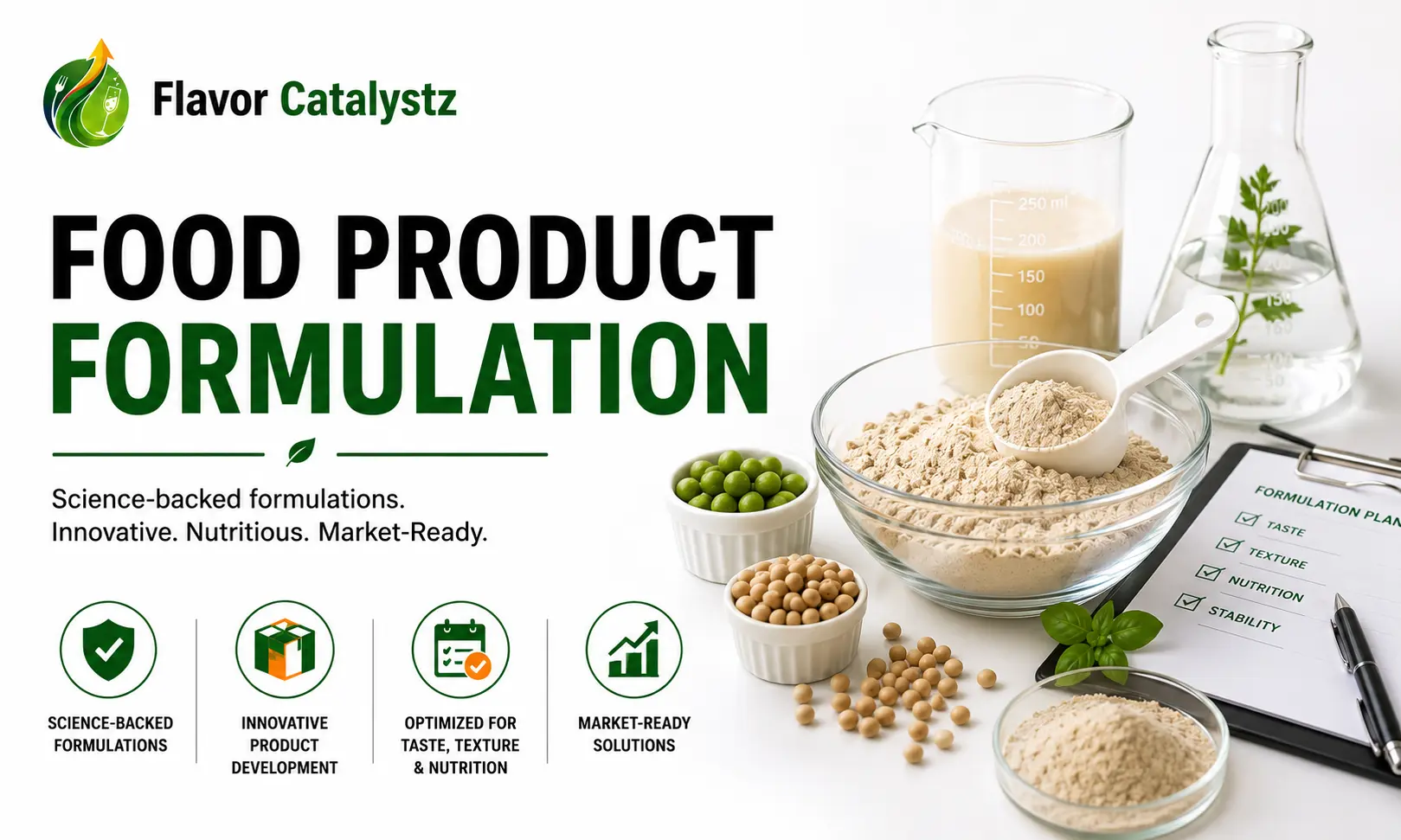
FOOD PRODUCT FORMULATION
Need expert food product formulation support?
Develop market-ready food products with the right taste, texture, nutrition, shelf life, and FSSAI compliance for scalable brand growth.
What is Food Product Formulation?
Food product formulation is the structured process of combining ingredients in measured proportions to create a final food product that meets specific targets for taste, texture, nutrition, shelf life, cost, and regulatory compliance. It blends food science, sensory evaluation, ingredient functionality, and process engineering into one repeatable recipe that can be manufactured at commercial scale.
Unlike home cooking, where a recipe can change with the mood of the cook, a formulated product must perform identically in batch one and batch one thousand. Every gram matters. Every variable, from the type of starch to the moisture in the air, is tested and locked.
How Food Formulation is Different from a Recipe
A recipe tells you how to make a dish once. A formulation tells you how to make the same product a million times, in any season, in any factory, with the same flavour, the same nutrition panel, and the same shelf life. That difference is what separates kitchen experiments from real food businesses.
Why Food Product Formulation Matters for Startups
Most food startup failures in India do not happen because of bad marketing. They happen because the product was not formulated properly. A protein bar melts in summer. A cold pressed juice ferments in week two. A snack tastes different in every batch. Each of these is a formulation failure that drains cash and kills trust.
- Consistency: every batch tastes and looks the same, which builds repeat purchase.
- Shelf life: products survive transport, storage, and retail without spoiling.
- Compliance: nutrition claims, allergen labels, and ingredient lists match FSSAI rules.
- Cost control: ingredient ratios are optimised so margins stay healthy at scale.
- Scalability: the recipe works in a factory line, not just a kitchen blender.
The Stages of Food Product Formulation
Most successful food products move through six clear stages from idea to shelf. Skipping or rushing any of these stages is the single biggest reason new products fail in the first year.
1. Ideation and Market Research
Every product begins with a problem the founder wants to solve. This stage is about validating that the problem is real, the audience is large enough, and competitors have left a gap worth filling. Surveys, focus groups, retail audits, and review analysis on Amazon and quick commerce platforms all feed this stage.
2. Concept and Ingredient Selection
Once the idea is locked, ingredients are chosen for function, nutrition, taste, availability, and cost. A high protein cookie needs binders that hold under heat. A vegan beverage needs emulsifiers that stay stable for months. Choosing clean label, easy to source ingredients keeps the product scalable later.
3. Recipe Development and Prototyping
This is the lab phase. Food technologists run small batches, change one variable at a time, and document every iteration. Most products go through five to fifteen prototype rounds before the final formula is locked. Sensory panels and taste tests guide the changes.
4. Shelf Life and Stability Testing
A product is not market ready until it survives accelerated shelf life testing. Samples are stored at high temperature and humidity to simulate months of real life storage in weeks. Microbial growth, oxidation, moisture migration, and flavour changes are all tracked.
5. FSSAI Compliance and Labelling
Every food product sold in India needs FSSAI approval. Nutrition panels, allergen declarations, ingredient lists in descending order of weight, and front of pack labels must follow the latest FSSAI rules. Non standard or new category products may need additional FSSAI product approval.
6. Pilot Production and Scale Up
Lab recipes rarely work the same way in a factory. Pilot runs of 50 to 500 kilograms test how the formula behaves on industrial mixers, extruders, ovens, and packaging lines. Reformulation often happens here to match equipment, throughput, and cost targets.
Stage Wise Time and Output Summary
| Stage | Typical Duration | Key Output |
| Ideation and research | 2 to 4 weeks | Validated product brief |
| Ingredient selection | 1 to 2 weeks | Locked ingredient list |
| Prototyping | 4 to 8 weeks | Final lab formula |
| Stability testing | 4 to 12 weeks | Shelf life report |
| FSSAI compliance | 2 to 8 weeks | Approved label and license |
| Pilot and scale up | 3 to 6 weeks | Production ready recipe |
How Much Does Food Product Formulation Cost in India?
The cost of food product formulation in India depends on product complexity, claims, testing requirements, and how much R and D work the founder outsources. A basic snack recipe can be developed for under one lakh rupees, while a functional or fortified product with health claims can run into several lakhs once stability studies and lab tests are added.
| Product Type | Approximate Cost Range | What it Covers |
| Basic snack or beverage | INR 30,000 to 1,00,000 | Recipe development and basic trials |
| General packaged food | INR 1,50,000 to 2,50,000 | Formulation, prototypes, basic testing |
| Functional or fortified food | INR 3,00,000 to 5,00,000 | Advanced R and D, stability, claims |
| Innovative or claim based | INR 7,00,000 to 10,00,000+ | Novel ingredients, FSSAI approval, full testing |
These ranges cover formulation and initial R and D only. Packaging design, FSSAI license fees, lab testing for nutrition and microbial safety, and pilot batches add another twenty five thousand to one and a half lakh rupees on top.
The Team Behind a Strong Food Formulation
No founder builds a great food product alone. Even lean startups assemble or hire a network of specialists across the formulation journey. Each role solves a specific problem the founder cannot solve from instinct alone.
- Food technologist: handles the science of ingredients, processing, and shelf life.
- Sensory analyst: runs taste panels and helps the team move past personal bias.
- Regulatory consultant: keeps labels, claims, and licenses in line with FSSAI rules.
- Packaging engineer: matches the package material to the product and shelf life target.
- Pilot plant operator: validates the recipe on real production equipment.
Common Mistakes Founders Make During Food Formulation
Most first time founders repeat the same handful of formulation mistakes. Knowing them upfront can save months of rework and lakhs of rupees in wasted ingredients.
- Locking the recipe before stability testing, only to see the product fail in month two.
- Skipping pilot production and discovering the lab recipe will not run on factory lines.
- Choosing ingredients that look great on a label but cannot be sourced consistently.
- Designing nutrition claims that the formula cannot legally support under FSSAI.
- Treating taste as the only metric and ignoring texture, shelf life, and cost per unit.
How to Avoid These Mistakes
Build a checklist before each stage. Test one variable at a time. Document every prototype. Bring in a food technologist early instead of late. And always plan for the worst case shelf condition the product will see, whether it is a Delhi summer truck or a chilled retail shelf.
FSSAI Rules Every Food Founder Should Know
The Food Safety and Standards Authority of India sets the rules every packaged food in the country must follow. Founders should treat compliance as part of product design, not a paperwork task at the end. Skipping FSSAI rules can lead to recalls, fines, and platform bans on Amazon, Flipkart, Blinkit, and Zepto.
- FSSAI license: every food business needs basic, state, or central registration based on turnover.
- Nutrition panel: protein, fat, carbohydrates, sugar, sodium, and energy must be declared per serving.
- Allergen declaration: milk, soy, nuts, wheat, eggs, and other allergens need clear callouts.
- Front of pack labelling: new rules on high salt, sugar, and fat are rolling out across categories.
- Product approval: novel ingredients or non standard products may need extra FSSAI clearance.
Should You Hire a Food Formulation Consultant?
Most first time founders do not have a food science background. Hiring a formulation consultant or partnering with a food R and D lab speeds up the journey by months. Consultants bring access to pilot equipment, regulatory know how, supplier networks, and tested formulation libraries that would take years to build alone.
Founders should look for consultants who can show real launched products, who understand both Indian and export FSSAI rules, and who price the project in clear stages rather than one large lump sum. Flavor Catalystz works with early stage food brands on exactly these formulation and compliance needs.
Food Formulation Trends in 2026
The Indian food market in 2026 is being shaped by a few clear formulation trends. Founders who design products around these trends find it easier to win shelf space and quick commerce listings.
- High protein: bars, beverages, and snacks with 10 to 20 grams of protein per serving.
- Millet based: ancient grains used in cookies, breakfast cereals, wafers, and mixes.
- Low sugar and front of pack ready: products designed to avoid red warning labels.
- Clean label: short ingredient lists with no artificial colours, flavours, or preservatives.
- Functional ingredients: ashwagandha, moringa, probiotics, and adaptogens with claim backing.
Final Thoughts on Food Product Formulation
Food product formulation is the single most important investment a founder makes before launch. A weak formula breaks at scale, fails compliance, and burns marketing budget. A strong formula gives a brand the consistency, shelf life, and margins needed to grow from one SKU to a national presence.
Treat formulation as a science, not guesswork. At Flavor Catalystz, pilot production planning starts from day one, shelf life is tested for worst-case conditions, and every product is built around FSSAI compliance from the beginning instead of retrofitting later. This disciplined approach helps brands move from kitchen idea to crore-plus annual revenue without expensive resets.
Frequently Asked Questions
What is food product formulation in simple terms?
Food product formulation is the process of choosing the right ingredients in the right ratios so a food product is safe, tasty, stable, and can be made the same way every time at factory scale.
How long does food product formulation take?
A basic food product takes three to six months from idea to pilot batch. Complex products with health claims, novel ingredients, or full FSSAI approval can take eight to twelve months or longer.
How much does it cost to formulate a food product in India?
Basic formulation costs between thirty thousand and one lakh rupees. General packaged food products usually cost one and a half to two and a half lakh rupees. Functional or claim based products can cost three to ten lakh rupees once testing and approvals are added.
What are the stages of food product formulation?
The six core stages are ideation and research, ingredient selection, prototyping, stability testing, FSSAI compliance, and pilot production. Each stage feeds into the next and skipping any of them usually causes problems later.
Do I need an FSSAI license for a new food product?
Yes. Every food business in India needs FSSAI registration or license before selling. Basic, state, or central licenses apply based on turnover. Novel or non standard products may also need product approval from FSSAI.
Can a startup formulate a food product without a food scientist?
Technically yes, but it is risky. Startups without in house food scientists usually work with food technology consultants, R and D labs, or contract manufacturers. This brings expertise, equipment, and regulatory know how without the cost of a full time hire.
What is the difference between a recipe and a formulation?
A recipe is a set of instructions to cook something once. A formulation is a precise, scalable, and documented system to produce the same food product consistently across thousands of batches in a factory environment.