Jul 2026 · 9 min read
Granola looks simple from a home kitchen: oats, a binder, a tray, and an oven. Turning that same idea into a packaged product that survives a three-month shelf life, ships across states, and tastes identical in batch 1 and batch 400 is a different problem entirely. That gap is exactly why most granola brands in India do not build their own factory on day one — they work with a contract manufacturer, also called a co-packer or third-party manufacturer, who already owns the ovens, mixers, cooling tunnels, and FSSAI licensing to produce at scale.
India’s breakfast cereal and muesli category, of which granola is a fast-growing sub-segment, is currently estimated at roughly ₹18,600 crore and is projected to more than double by 2033, with volume growth outpacing the broader packaged food market. Quick-commerce platforms have also opened a genuine distribution channel for smaller granola brands that could never have secured modern trade shelf space five years ago. The opportunity is real, but so is the operational complexity of actually getting a bag of granola made correctly. This guide walks through what granola contract manufacturing involves, what it typically costs, and how to choose a partner who will not waste your first year of runway.
What Granola Contract Manufacturing Actually Means
Contract manufacturing is an arrangement where a food brand supplies (or co-develops) a formulation, and a third-party facility handles ingredient sourcing, blending, baking, cooling, and packing on the brand’s behalf, under the brand’s own label. It is distinct from simply buying generic bulk granola and repackaging it — a genuine contract manufacturing partner should be able to work from your recipe, adjust it for factory-scale equipment, and produce it consistently, batch after batch.
For granola specifically, this typically covers cold-mix and toasting-oven based production — blending oats, nuts, seeds, oils, and sweeteners, baking the mixture into a sheet, cooling it under controlled conditions, breaking it into clusters, and packing it into pouches, jars, or bulk bags. Some manufacturers also offer bar-forming and enrobing lines if a brand wants to extend into granola bars later.
Granola Contract Manufacturing
Launch Your Granola Brand with a Trusted Manufacturing Partner
From custom granola formulation and recipe development to contract manufacturing, packaging, and private label production, our experts help you build a premium granola brand with flexible MOQs and scalable manufacturing solutions.
Why Brands Choose Contract Manufacturing Over Setting Up Their Own Unit
Building a dedicated granola production line — mixer, tunnel oven, cooling conveyor, and packing line — is a meaningful capital commitment before you know whether the product will sell. Most first-time and early-stage granola brands in India choose contract manufacturing for exactly this reason: it converts a large upfront capital decision into a variable, per-batch cost.
| Factor | Own Manufacturing Unit | Contract Manufacturing |
| Upfront investment | High — equipment, plant, licensing, staffing | Low — formulation and trial batch costs only |
| Time to first sellable batch | Several months to over a year | Typically 6-14 weeks after formulation is locked |
| Production flexibility | Fixed to your own capacity and equipment | Can scale up or pause based on demand |
| Technical ownership | Full control, but you carry all the risk | Shared with a partner who already runs the process |
| Best suited for | Brands with proven volume and long-term category commitment | New launches, seasonal SKUs, and brands testing demand |
How the Granola Contract Manufacturing Process Works
Every credible manufacturer structures the engagement as a series of gated steps rather than a single handover. Skipping any of these stages is where most avoidable production failures come from.
| Stage | What Happens | Typical Duration |
| Formulation review | Your recipe or concept is assessed for ingredient sourcing, cost per kilogram, and whether it will hold up on factory equipment | 1-2 weeks |
| Trial batch | A small lab or pilot-scale batch is produced to validate taste, texture, and cluster formation before committing to a full run | 1-2 weeks |
| Sensory and shelf-life sign-off | Taste panels confirm consistency; accelerated shelf-life testing estimates real-world stability | 2-4 weeks (parallel to other steps) |
| FSSAI and label finalisation | Nutritional panel, allergen declarations, and claims are checked against FSSAI Schedule I and II requirements | 1-2 weeks |
| Pilot production run | First commercial-scale batch on the actual production line, with the brand present to sign off | 1 batch cycle |
| Packing and dispatch | Filling into pouches, jars, or bulk bags, followed by quality checks and dispatch to warehouse or channel | Ongoing |
A well-run food product development process treats formulation, trial, and scale-up as connected stages rather than isolated tasks — this is where an experienced consulting partner earns its fee, because a recipe that tastes right in a 2 kg lab batch does not automatically behave the same way in a 200 kg factory batch.
Granola Contract Manufacturing Cost and MOQ in India
Exact pricing depends heavily on your recipe (ratio of nuts, seeds, and dried fruit vs. oats), packaging format, and order volume, so treat the figures below as directional rather than a quote. What matters more than the headline number is understanding which cost buckets exist so you are not surprised later.
| Cost Component | What It Covers | When It Applies |
| Formulation and trial fee | R&D time, small-batch trials, sensory testing | One-time, at project start |
| Per-kg production cost | Ingredients, processing, labour, packing | Every production run |
| FSSAI license and testing | Registration/state license, lab testing for nutrition and microbial safety | One-time plus annual renewal |
| Packaging tooling and minimums | Pouch printing plates or cylinders, jar minimums | One-time or per design change |
| Minimum Order Quantity (MOQ) | The smallest batch size a manufacturer will run | Every production order |
On MOQ specifically: most Indian food co-packers work with batch sizes in the range of a few hundred kilograms for trial or first commercial runs, scaling up as demand is proven, though this varies by facility and equipment type. Manufacturers who insist on very large minimum runs before you have any sales data are usually not set up for early-stage brands — it is worth asking directly about their smallest workable batch size before signing anything.
FSSAI Licensing and Compliance for Granola
Under India’s food safety regulations, granola is legally classified within the breakfast cereal category, which specifically includes granola-type products, muesli, and cereal bars prepared by baking, roasting, or toasting. This classification determines the nutritional labelling, additive limits, and testing standards your product must meet before it goes to market.
| License Type | Who It Applies To | Annual Turnover Threshold |
| Basic Registration | Very small manufacturers and petty food businesses | Up to ₹12 lakh |
| State License | Small to mid-sized manufacturers | ₹12 lakh to ₹20 crore |
| Central License | Large manufacturers and multi-state operations | Above ₹20 crore |
If you are working with a contract manufacturer, the facility should already hold the appropriate manufacturing license for cereal-based products — always ask to see and independently verify the license number on the FSSAI FoSCoS portal rather than accepting a screenshot. Your brand will separately need its own FSSAI registration for marketing the product under your label, even when production is outsourced.
How to Choose the Right Granola Contract Manufacturer
The manufacturer you pick shapes your product quality, your margins, and your ability to reformulate later. A short evaluation checklist saves months of rework.
- Do they have dedicated granola or cold-mix/toasting-oven capability, not just a general bakery line that has never run an agglomerated cluster product?
- Can they run a genuinely small trial batch (a few dozen kilograms) before you commit to a full production order?
- Do they hold a valid FSSAI manufacturing license for the cereal category, and can they support allergen segregation if you need nut-free or gluten-free variants?
- Do they ask technical questions about your oil-to-sweetener ratio, moisture targets, and desired cluster size — or do they agree to everything without pushback? The latter is a warning sign.
- Can they support your realistic order volume without forcing an MOQ you cannot sell through before shelf life expires?
- Do they provide batch documentation, certificates of analysis, and consistent sensory results across repeat orders?
Common Mistakes Brands Make When Outsourcing Granola Production
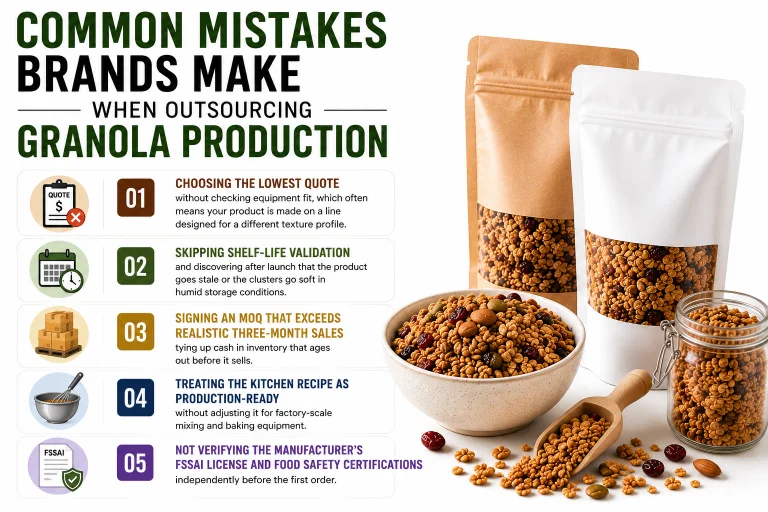
Most production failures trace back to a handful of avoidable decisions rather than bad luck.
- Choosing the lowest quote without checking equipment fit, which often means your product is made on a line designed for a different texture profile.
- Skipping shelf-life validation and discovering after launch that the product goes stale or the clusters go soft in humid storage conditions.
- Signing an MOQ that exceeds realistic three-month sales, tying up cash in inventory that ages out before it sells.
- Treating the kitchen recipe as production-ready without adjusting it for factory-scale mixing and baking equipment.
- Not verifying the manufacturer’s FSSAI license and food safety certifications independently before the first order.
Working with a consulting team that manages formulation, compliance, and manufacturer coordination as a single connected process — rather than treating each as a separate vendor relationship — is generally what separates a smooth first production run from a stalled one. At Flavor Catalystz, this connected approach is exactly how granola and breakfast cereal projects are structured, from the first trial batch through to a validated commercial-scale process.
Getting From Formulation to Commercial Scale
A granola launch is only as strong as the formulation behind it. Before locking in a manufacturing partner, most brands benefit from a structured food product development process that stress-tests the recipe for cost, sourcing, and shelf-life resilience — this is the stage where problems are cheapest to fix, long before they show up on a factory floor.
Frequently Asked Questions
What is the difference between granola contract manufacturing and private label granola?
Contract manufacturing produces your own custom formulation under your brand. Private label typically means selecting from a manufacturer’s existing recipes and applying your branding, which is faster but offers less product differentiation.
How much does granola contract manufacturing cost in India?
Cost depends on your ingredient mix, batch size, and packaging format. Expect separate costs for formulation and trial work, per-kilogram production, FSSAI compliance, and packaging tooling. Ask any shortlisted manufacturer for a batch-wise breakdown rather than a single lump figure.
What is a typical MOQ for granola manufacturing in India?
MOQs vary widely by facility, generally ranging from a few hundred kilograms for a first commercial run to larger volumes for established brands. Facilities experienced with early-stage food brands are usually willing to work with smaller trial and first-order quantities.
Do I need an FSSAI license if I use a contract manufacturer?
Yes. Your contract manufacturer needs its own manufacturing license, but your brand also needs FSSAI registration to legally market the product under your label, since you are the entity selling it to consumers.
How long does it take to launch a granola product through contract manufacturing?
From a finalised formulation to a commercial-scale first production run typically takes six to fourteen weeks, depending on trial iterations, shelf-life testing, and packaging lead times.
Can a contract manufacturer help develop my granola recipe, or do I need my own formulation first?
Most established manufacturers and consulting partners can develop the formulation with you rather than requiring a finished recipe upfront, which is useful if you have a product concept but not yet a factory-ready recipe.
What certifications should a granola manufacturer have?
At minimum, a valid FSSAI license appropriate for cereal-based products. Depending on your target retailers or export markets, HACCP, FSSC 22000, or BRCGS certification may also be relevant.