Jul 2026 · 9 min read
What if the most commercially powerful functional beverage category of the next five years is not a protein shake, not an energy drink, not even an immunity shot — but a fizzy soda?
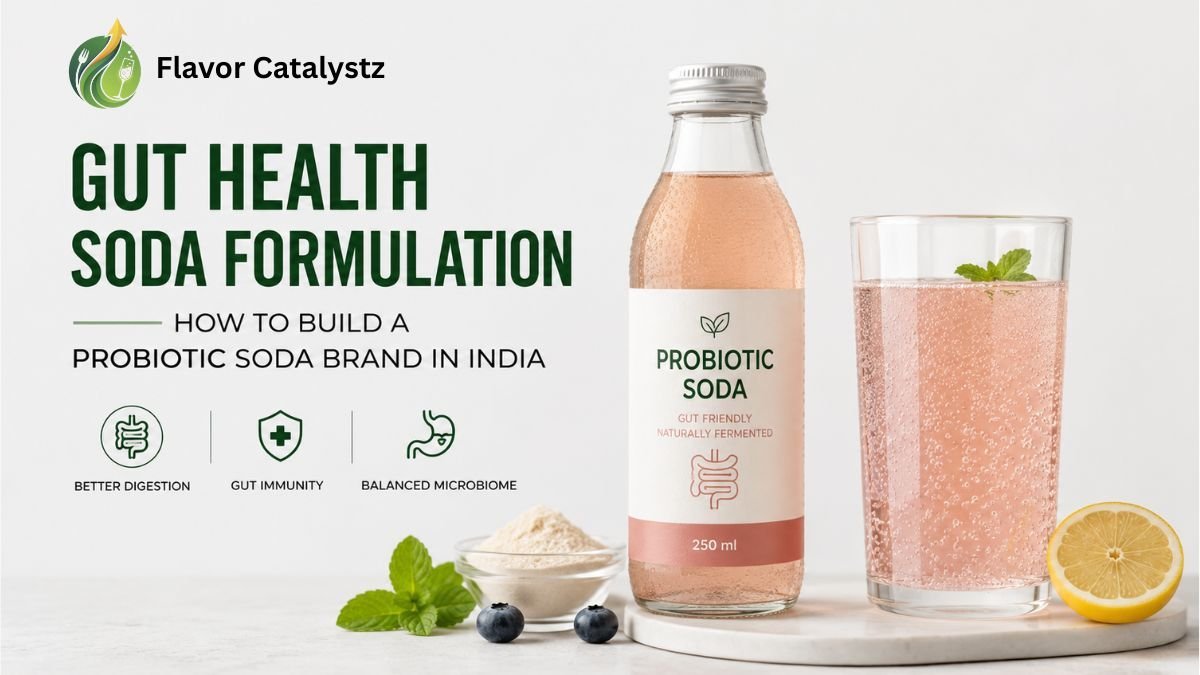
Gut health soda is exactly that category. A carbonated beverage formulated with probiotics, prebiotics, or fermented ingredients — designed to support digestive health while delivering the refreshing, fizzy experience of a conventional soft drink. No medicine-like format. No compromise on taste. Just a drink that is genuinely good for your gut and genuinely enjoyable to consume.
In the US, brands like Poppi and Olipop have built hundreds of millions of dollars in revenue on this premise. In India, the category is still largely unclaimed — which means the founders who move now are the ones who will define it.
This guide covers how to formulate a gut health soda, what the regulatory pathway looks like in India, and how to position your brand in this emerging category.
What Is Gut Health Soda?
Gut health soda is a broad category that includes any carbonated beverage formulated with ingredients specifically intended to support the gut microbiome or digestive function. The category includes:
Probiotic soda: Contains live probiotic cultures at meaningful counts. The carbonation creates a kombucha-adjacent experience — light fizz, slightly tart, functional.
Prebiotic soda: Contains prebiotic fibres (inulin, FOS, chicory root extract) that feed beneficial gut bacteria. No live cultures — cleaner processing, longer shelf life, easier formulation.
Apple cider vinegar soda: ACV-based carbonated drink combining the functional credentials of apple cider vinegar with the carbonated refreshment of soda. See our switchel formulation guide for the non-carbonated ACV beverage approach.
Fermented soda: Naturally fermented using fruit or botanical bases — includes traditionally fermented kanji, naturally carbonated tepache (fermented pineapple), or lacto-fermented ginger beer.
Kombucha alternative: A product with kombucha-like flavour profile and functional positioning but with more controlled formulation — easier to manufacture at scale and with more predictable shelf life than traditional kombucha.
Why Gut Health Soda Is the Right Category for India Right Now
The digestive health problem is enormous. India has a massive burden of digestive disorders — IBS, constipation, acidity, bloating — affecting a significant portion of the urban population. Yet most consumers do not connect their daily beverage choices to their gut health. A gut health soda bridges this gap in a format consumers already engage with daily.
Cola is under pressure. India’s cola consumption per capita is still growing — but among urban health-aware consumers aged 22–40, the shift away from sugary cola is real and accelerating. Gut health soda positions perfectly as the functional alternative: same fizzy, refreshing occasion but with a benefit rather than a cost.
The category has global proof. Poppi (US) was acquired by PepsiCo for $1.65 billion in 2025. Olipop reached $500M+ in revenue. The consumer behaviour is proven at scale internationally — India follows with a 3–5 year lag in many functional food trends.
Indian gut health awareness is rising. Post-pandemic, Indian consumers have become dramatically more aware of gut microbiome, probiotics, and digestive health. The consumer education has been done by the supplement market, the yoghurt market, and health media. A gut health soda rides this awareness into a beverage format.
Gut Health Soda Formulation: The Three Approaches
Approach 1: Prebiotic Soda (Recommended Starting Point)
Prebiotic sodas contain non-digestible fibres that selectively feed beneficial gut bacteria — without containing live organisms themselves.
Why start here: No live culture viability challenges. Standard beverage processing (pasteurisation) is compatible. Longer ambient shelf life. FSSAI product approval pathway is more straightforward than probiotic.
Key prebiotic ingredients:
Inulin: Extracted from chicory root. The most widely used prebiotic fibre in commercial food and beverage. Slightly sweet, clean taste, dissolves well in beverages. FSSAI-permitted as a food ingredient.
Fructooligosaccharides (FOS): Short-chain fructose polymers. Slightly sweeter than inulin, very similar functional profile. Well-tolerated at beverage inclusion levels (2–5g per serving).
Apple cider vinegar (with the mother): At 15–25ml per 330ml serving, ACV contributes acetic acid and trace prebiotic properties alongside its direct digestive function.
Formulation template (per 330ml can):
- Carbonated water: 270ml
- Inulin: 3–4g
- Apple cider vinegar (5% acidity): 15ml
- Natural fruit juice concentrate: 20–30ml (apple, berry, or tropical for flavour)
- Natural flavour: 0.4g
- Citric acid: 0.8g (pH target: 3.4–3.8)
- Stevia (Reb A): 0.012g
- Erythritol: 3g (body and sweetness)
Target: 2–3g dietary fibre per serving (allows “source of fibre” claim), low sugar (below 2.5g/100ml), genuinely refreshing fizzy drink.
Approach 2: Probiotic Soda
Contains live probiotic cultures at minimum 10^6 CFU/ml through shelf life. The formulation and processing requirements are significantly more demanding.
The core challenge: Live cultures and carbonation create a complex formulation environment. Probiotics must survive:
- The acidic pH of a carbonated beverage (typically 3.4–4.0)
- The carbonation pressure
- The shelf life period (30–90 days refrigerated)
- The temperature variations in distribution
Strain selection: Choose strains with documented acid tolerance. Lactobacillus rhamnosus GG, Lactobacillus plantarum, and certain Bifidobacterium strains have better survival in acidic, carbonated environments than more delicate strains.
Processing: Cold fill only. No pasteurisation after probiotic addition — heat kills cultures. Sterile cold fill environment required. Refrigerated shelf life only.
Microencapsulation: Encapsulating probiotic cultures before addition to the beverage significantly improves survival through the acidic, pressurised environment. Microencapsulated probiotics are available from specialty ingredient suppliers and are the recommended approach for commercial probiotic soda production.
For complete probiotic regulatory requirements, see our FSSAI probiotic drink compliance guide.
Approach 3: Fermented Soda
Naturally fermented using a starter culture — producing natural carbonation, organic acids, and microbial diversity from the fermentation process itself.
Kanji-style fermented soda: Black carrot, beet, mustard seed, water — traditional North Indian fermented drink with natural probiotic activity. Deep purple colour, tangy flavour, distinct spiced note.
Ginger beer (fermented): Naturally fermented ginger brew with natural carbonation. Can be positioned as a traditional kombucha alternative.
Challenge: Natural fermentation produces variable results — alcohol content, carbonation level, microbial count, and flavour vary batch to batch. Commercial scale requires controlled fermentation systems, consistent starter culture management, and rigorous microbiological testing. Alcohol content must be controlled below 0.5% ABV for food classification.
Related: Fermented beverages guide and kombucha drink formulation.
Flavour Strategy for Gut Health Soda
The flavour of a gut health soda must achieve something specific: it must signal “healthy and functional” while actually tasting like something you want to drink again.
Winning flavour profiles:
Apple + ginger + ACV: The gold standard gut health combination. Apple provides familiar sweetness. Ginger adds warmth and digestive credibility. ACV provides the functional backbone and a pleasant sharpness. This is essentially a sparkling switchel — and it works enormously well.
Berry + hibiscus: Deep red-pink colour from anthocyanins. Tart, fruity, refreshing. Strong visual appeal. The hibiscus adds a floral complexity that makes the drink interesting. See our hibiscus functional drink guide for hibiscus formulation parameters.
Lemon + mint + ACV: Bright, clean, refreshing. The lemon-mint combination is universally appealing in India. ACV sits comfortably in this profile without dominating.
Tropical (mango + pineapple + ginger): Highly accessible flavour for mainstream Indian consumer. Strong commercial potential for modern trade and quick commerce where mainstream palatability is more important than functional credibility signalling.
Indian-inspired (jaljeera + sparkling): Cumin-spiced, black salt, lemon — a gut health soda version of traditional jaljeera. The digestive credentials of jaljeera are genuine and culturally resonant. See our jaljeera drink guide.
FSSAI Compliance for Gut Health Soda
Product category: Gut health soda is proprietary food under FSSAI — product approval required before commercial sale regardless of whether it is prebiotic or probiotic.
Carbonation + probiotic combination: If the product contains live cultures AND is carbonated, FSSAI will evaluate both the probiotic viability claim and the carbonated beverage standards. Ensure your product approval application addresses both dimensions.
Fibre claims: “Source of dietary fibre” is permitted if the product contains at least 1.5g of dietary fibre per 100ml (or 3g per serving). “High in fibre” requires 3g per 100ml or 6g per serving.
Prebiotic claims: FSSAI does not currently have a defined “prebiotic” claim category. Declare inulin or FOS as ingredients and make fibre-based nutrient content claims rather than specific “prebiotic” label claims.
Probiotic claims: Require the product to meet FSSAI’s criteria — approved strain, minimum 10^6 CFU/ml through shelf life, strain identity declared on label. See our FSSAI probiotic compliance guide for complete requirements.
Health claims: “Supports digestive health” is in a grey zone — framing around ingredient nutrient function is safer. “Contains inulin, a source of dietary fibre” is compliant. “Improves your gut health” is not.
Commercial Positioning for a Gut Health Soda Brand in India
The primary consumer: Urban health-conscious consumer aged 25–40 who is already aware of gut health, has perhaps tried a probiotic supplement or yoghurt for gut health, and is looking for a more enjoyable daily format to get their gut support.
Occasion: Afternoon alternative to chai or cola. Post-meal digestive support. Occasion: “I want something fizzy and refreshing but not a cola.” This is a 2pm–6pm occasion drink.
Channel strategy:
- Quick commerce: Primary trial channel. A ₹99–149 gut health soda purchased on Blinkit in the moment of wanting something cold and fizzy is the perfect acquisition scenario.
- Modern trade: Health and wellness aisle alongside kombucha and probiotic yoghurt.
- D2C subscription: Monthly box for the committed gut health consumer. 12-can subscription at discount.
- HoReCa: Premium restaurants and cafes replacing regular cola on the soft drink menu. Growing channel for functional soda globally.
Pricing: ₹80–150 per 330ml can for an accessible functional positioning. ₹150–250 for a premium probiotic soda.
Ready to Build Your Gut Health Soda Brand?
The gut health soda category is one of the most commercially compelling functional beverage opportunities in India right now. The consumer need is massive, the global proof is clear, and the domestic market is wide open.
At Flavor Catalystz, we formulate prebiotic and probiotic sodas for commercial production in India. Talk to our team today.
FAQs
What is gut health soda?
A carbonated beverage formulated with prebiotic fibres, probiotic cultures, fermented ingredients, or digestive botanicals — designed to support gut microbiome health while delivering the refreshing experience of a conventional fizzy drink.
What is the difference between prebiotic and probiotic soda?
Prebiotic soda contains non-digestible fibres (inulin, FOS) that feed beneficial gut bacteria already present in the gut. Probiotic soda contains live beneficial bacteria that add directly to the gut microbiome. Prebiotic is simpler to formulate and has longer shelf life.
How do probiotics survive in a carbonated acidic beverage?
Through careful strain selection (acid-tolerant strains), microencapsulation to protect cultures from pH and pressure, cold fill processing (no heat treatment), and refrigerated shelf life. Survival rates vary significantly by strain and processing approach.
Does gut health soda need FSSAI product approval?
Yes — gut health soda is proprietary food and requires FSSAI product approval before commercial sale. Probiotic versions require additional FSSAI nutraceutical/functional food compliance.
What is the commercial opportunity for gut health soda in India?
Very significant — India has a massive digestive health burden, a growing consumer awareness of gut microbiome, and no established domestic gut health soda brand. The category is proven globally (Poppi was acquired for $1.65B in 2025). India is 3–5 years behind the US curve.