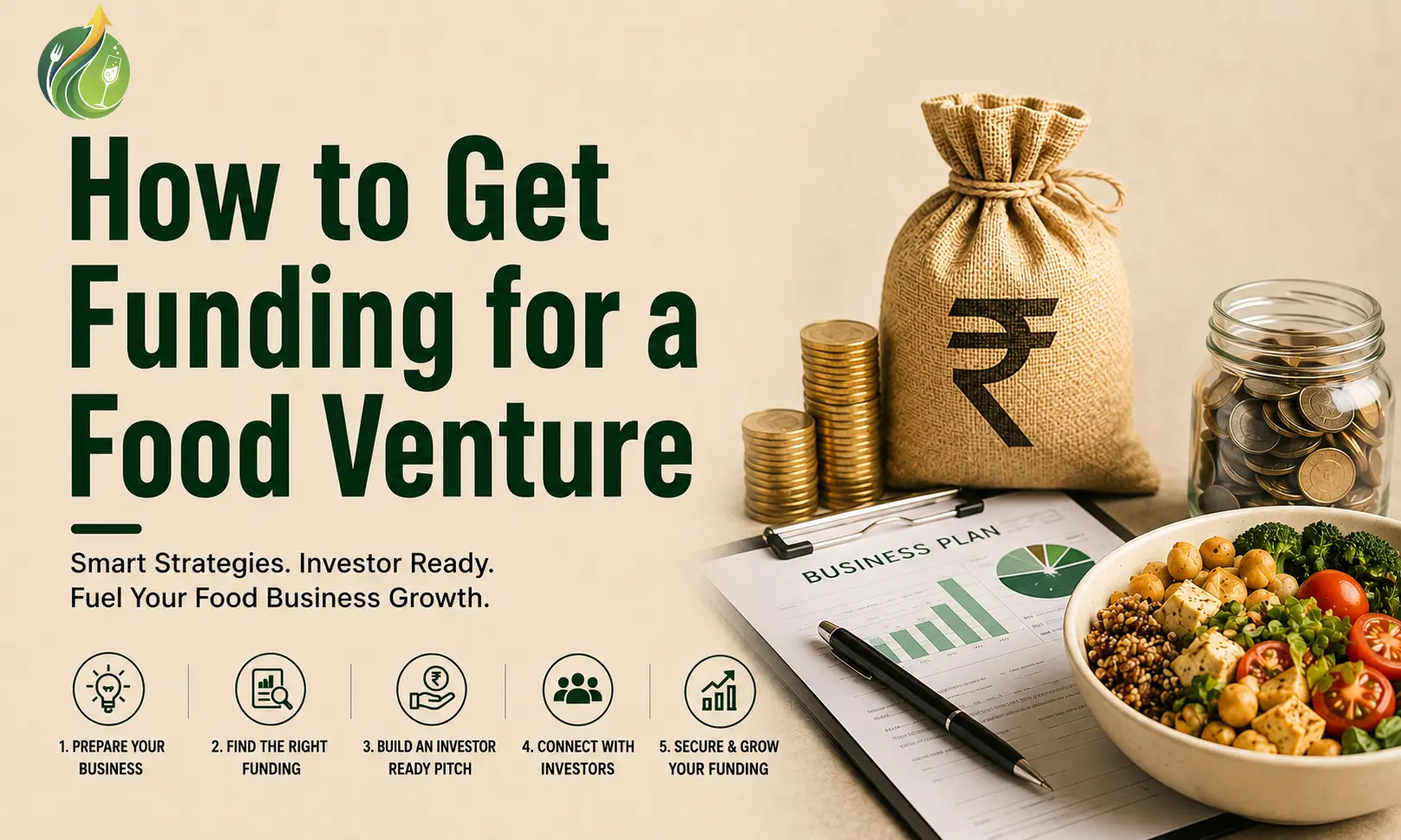
Aug 2026 · 11 min read
The Indian food and beverage startup ecosystem has witnessed remarkable growth, with 873 companies securing funding as of January 2026. Yet securing investor capital remains one of the most challenging hurdles for emerging food entrepreneurs. Whether you’re launching a direct-to-consumer (D2C) food brand, building a cloud kitchen platform, or developing specialized food formulation services, understanding investor expectations is crucial to your fundraising success.
This guide draws from real funding data, investor criteria, and emerging market trends to equip you with actionable insights for attracting capital. We’ll cover funding stages, what investors actually evaluate, common pitfalls that derail deals, and strategic approaches tailored to India’s regulatory and competitive landscape.
Free Consulting
Expert Guidance to Get Funding for Food Venture
Turn your food business idea into an investor-ready venture. Get expert guidance on funding, pitching, business planning, and scaling your brand with confidence.
Understanding Startup Funding Stages: Which Round Fits Your Food Business?
Startup funding follows a structured progression, with each stage designed for businesses at different maturity levels. For food ventures, the path from idea to scale involves multiple rounds, each with distinct capital amounts, investor types, and business expectations.
Funding Stages Overview
| Stage | Capital Range | Investor Type | Business Milestone |
| Pre-Seed/Friends & Family | ₹5L – ₹50L | Friends, family, angels | MVP, proof of concept |
| Seed Round | ₹50L – ₹5Cr | Angel networks, micro-VCs | Product launched, initial customers |
| Series A | ₹2Cr – ₹15Cr | Venture capital firms | Proven PMF, recurring revenue |
| Series B & Beyond | ₹20Cr – ₹100+Cr | Growth equity, large VCs | Market leadership, strong margins |
The critical distinction is not just the amount raised, but your business’s readiness. Approaching investors too early with weak metrics typically results in rejection that damages your reputation. Conversely, waiting too long means missing growth windows in your category.
What Food Investors Actually Evaluate: Beyond the Pitch Deck
Unlike generic startups, food business investments trigger additional scrutiny. Investors assess regulatory compliance, unit economics, supply chain resilience, and whether your business model can sustain profitability in an increasingly capital-intensive sector.
The Five Critical Evaluation Dimensions
1. Market Validation and Customer Demand
Investors want tangible proof that real customers want your product. They look for: repeat purchase rates, customer acquisition cost versus lifetime value ratio, pre-orders or early revenue traction, and third-party validation such as retailer interest or influencer backing.
For D2C food brands, having at least 3-6 months of revenue data or 10,000+ engaged customers on social proof significantly increases funding success. Founders presenting at idea stage without traction face a much steeper climb.
2. Unit Economics and Profitability Path
This is where many food startups fail investor scrutiny. Investors need to see that your cost of goods sold (COGS), operational expenses, and marketing costs create a sustainable margin structure. They specifically ask: What’s your COGS percentage? Can you achieve profitability at scale?
For packaged food products, investors typically expect COGS below 40%. Cloud kitchens should target 65%+ margins after delivery costs. D2C brands need to demonstrate a clear path to unit-level positive economics within 12-18 months.
3. Regulatory Compliance and Food Safety Standards
This is non-negotiable in India’s context. Investors verify: FSSAI license status, compliance with Food Safety and Standards Act 2006, any past violations, facility inspections, and product certifications.
Lacking proper FSSAI registration is an instant deal-breaker. FSSAI Central License costs ₹7,500 and is required for businesses with turnover above ₹20 crores or multi-state operations. Even early-stage founders should have at least Basic Registration secured before pitching Series A.
4. Founder Track Record and Team Composition
Investors back founders as much as ideas. They evaluate: founder experience in food manufacturing or food product development, previous exits or scaling experience, industry domain knowledge, and team gaps. A founder with prior food business experience gets 2-3x higher valuation than a first-time entrepreneur.
Critical team roles investors expect: co-founder with supply chain expertise, someone with D2C go-to-market experience, and ideally an advisor or board member with food industry credibility.
5. Competitive Differentiation and Defensibility
Pure consumer food brands without technology differentiation struggle to attract venture capital. Investors prefer startups combining food products with: proprietary food formulation techniques, supply chain technology, predictive nutrition platforms, or alternative protein production methods.
Demonstrate how your business is defensible against large competitors. Intellectual property, brand loyalty, and network effects are stronger signals than just product quality.
Funding Sources Tailored to Food Startups: Finding the Right Investor
Not all capital is created equal. Different funding sources serve different stages and come with distinct expectations.
Funding Source Comparison
| Source | Amount | Dilution | Best For | Timeline |
| Bootstrapping | ₹1-10L | 0% | MVP, validation | Immediate |
| Angel Investors | ₹10-100L | 3-15% | Seed phase | 2-4 months |
| Crowdfunding | ₹5-50L | 0-10% | D2C brands | 3-6 months |
| Venture Capital | ₹2-50Cr | 15-40% | Growth stage | 4-8 months |
| Govt. Schemes | ₹20-50L | 0-5% | DPIIT startups | 2-3 months |
Why This Matters: The India Advantage
In 2026, India has 873 food and beverage startups with confirmed funding, representing significant investor confidence in the category. However, competition for capital is intense. According to Tracxn data, Food & Beverage Products startups in India raised ₹327 crores across 105 rounds in 2025. The key advantage: the angel tax was abolished in April 2024, removing historical friction from early-stage investments.
Common Mistakes That Kill Food Startup Funding: What Investors Immediately Reject
Understanding what repels investors is as important as knowing what attracts them. Based on recent due diligence analyses, certain mistakes are instant deal-breakers:
1. Approaching Investors Without Traction
At least 70% of failed funding rounds in India occur because founders pitch before achieving product-market fit. Investors expect: 3-6 months of revenue history, at least 1,000+ engaged customers for D2C brands, or retailer letters of intent for B2B2C models.
2. Unclear Unit Economics and Financial Projections
Many founders cannot articulate their COGS, customer acquisition costs, or path to profitability with confidence. Investors view this as an immediate red flag. Your financial model should reflect realistic growth assumptions and demonstrated understanding of unit economics.
3. Missing or Inadequate FSSAI Compliance
This is non-negotiable. Lacking FSSAI registration is an instant pass from institutional investors. Investors also scrutinize: food testing certificates, facility inspection reports, any past compliance violations, and proof that your manufacturing partners hold proper licenses.
4. Weak or Unproven Founding Team
A team without food industry experience or prior startup scaling experience raises doubts about execution capability. Investors look for founders who have either built and sold businesses or spent 5+ years in relevant operational roles.
5. Operating in a Tiny or Saturated Market Without Differentiation
Even with flawless execution, venture capital cannot generate the returns needed if your market is too small or too crowded. Investors evaluate: total addressable market opportunity, competitive landscape, and your sustainable competitive advantage.
Building an Investor-Ready Food Business: A Practical Roadmap
Attraction of investor capital requires systematic preparation. Here’s what founders should prioritize before reaching out:
Phase 1: Pre-Pitch Preparation (Months 1-3)
Secure FSSAI Registration: Start with the appropriate license based on your turnover and scope. Most early-stage founders begin with State License or Central License.
Build Revenue Traction: Launch to early customers, even at limited scale. Pre-orders, crowdfunding campaigns, or early D2C sales provide concrete proof of demand.
Develop Clean Financial Models: Work with a CA to build investor-grade financial projections covering 3-5 years. Include detailed assumptions for COGS, operational costs, and CAC.
Clarify Your Unique Positioning: Define what makes your product or business model defensible against large competitors. This might be innovative food formulation techniques, a proprietary supply chain model, or a culturally differentiated brand narrative.
Phase 2: Materials and Storytelling (Months 2-4)
Craft a Compelling Pitch Deck: Your deck should move from problem to solution to market opportunity to team to financials to capital ask. Investors spend minimal time on decks, so clarity and brevity are essential.
Prepare Executive Summary and Business Plan: Document your business model, competitive analysis, go-to-market strategy, and team bios. Ensure all claims are verifiable with data.
Develop a Due Diligence Data Room: Create an organized folder containing: FSSAI certificates, facility photos/videos, supplier agreements, customer testimonials, financial statements, cap table, and team background documents.
Phase 3: Investor Outreach and Pitching (Months 4-12)
Target the Right Investors: Narrow your list to 50+ investors who have backed similar-stage food startups. Look for investors with prior exits in food and check their portfolio for conflicts.
Use Warm Introductions: Cold emails have <5% response rates. Leverage advisors, mentors, other founders, or accelerators to get introduced to investors.
Manage Expectations on Timeline: Seed fundraising typically takes 3-4 months; Series A can take 4-8 months. Plan your burn rate accordingly.
Key Trends Food Investors Watch in 2026: Positioning Your Startup for Interest
Investor thesis changes annually based on market macro trends. In 2025-2026, food investors prioritize:
Profitability and Unit Economics Over Growth-At-All-Costs: Investors now demand proof of sustainable unit-level positive economics. Companies demonstrating strong margins and clear paths to profitability attract 2-3x larger checks.
Technology-Enabled Food Solutions: Pure-play consumer brands without technology differentiation face funding headwinds. Investors prefer startups combining food products with: AI-driven supply chain optimization, personalized nutrition platforms, alternative protein production methods, or restaurant operations technology.
Sustainability and Regulatory Alignment: Startups with strong sustainability practices and clear regulatory roadmaps attract premium valuations. This includes environmental compliance, plastic-free packaging, and transparent supply chains.
Vertical Integration and Supply Chain Control: Investors favor founders who can demonstrate vertical integration plans or secured supply relationships.
Conclusion
Securing investor capital for your food venture is achievable, but requires disciplined preparation and realistic expectations. The Indian food startup ecosystem has matured significantly—₹327 crores flowed into Food & Beverage startups in 2025, and investor appetite remains strong for founders who demonstrate market validation, sustainable unit economics, and clear regulatory compliance.
Whether you’re building a D2C food brand, cloud kitchen platform, or food formulation-led business targeting other brands, the fundamentals remain: validate customer demand early, achieve financial clarity, secure regulatory compliance, build credible team composition, and tell a coherent investor story.
The most common founder mistake is approaching investors too early with weak traction. Instead, use bootstrapping, friends-and-family capital, or government grants to reach 3-6 months of revenue or 1,000+ engaged customers. This single shift increases your Series A success rate by 3x.
As you navigate fundraising, remember that investor conversations validate your business model as much as securing capital. Use each interaction to refine your go-to-market strategy and build relationships for future funding rounds.
For founders building food businesses, professional guidance on product development, regulatory compliance, and operational scaling can be invaluable during this phase. Platforms and consultancies specializing in food product development and formulation services can accelerate your path to investor-ready status.
Your food venture has genuine potential—the market data confirms it. Now it’s about executing with discipline and building the credibility that attracts capital.
Working with experienced food formulation and product development consultants early in your fundraising journey can significantly improve your positioning with investors by ensuring your product, regulatory compliance, and supply chain story are bulletproof. Flavour Catalystz helps food founders build investor-ready businesses through strategic formulation guidance and regulatory navigation specializes in supporting food product development strategies that resonate with investor due diligence requirements.
Frequently Asked Questions
What percentage of equity should I give up in a Seed round?
Typical seed rounds involve 10-20% equity dilution. This varies by: founder experience (serial entrepreneurs dilute less), market opportunity, traction level, and investor type. Angels typically take 3-8%, micro-VCs 8-15%, early-stage VCs 12-25%. If an investor demands >25% in seed, negotiate using comparable funding rounds from peers as benchmarks.
How much runway should I plan before pitching Series A?
Investors expect founders to raise Series A with 24 months of runway remaining. Most Series A fundraising takes 4-8 months, so plan accordingly. Raising while financially desperate forces unfavorable valuations.
Do I need existing product or revenue to raise Seed funding?
Not strictly necessary, but it dramatically improves your chances. For institutional seed funding, having 3-6 months of traction (revenue or strong user engagement) significantly increases likelihood. Benchmark: if approaching VCs without revenue, you should have clear evidence of customer demand through pre-orders, crowdfunding validation, or retailer interest letters.
What role do accelerators play in food startup fundraising?
Quality accelerators provide: mentorship in pitch preparation, access to investor networks, credibility signaling, and sometimes direct funding. Completing a top accelerator’s program increases Series A fundraising success by 40-60%. For DPIIT-approved accelerators, this pathway offers up to ₹20 lakhs as non-dilutive grants plus ₹50 lakhs in convertible debt.
How important is having an advisory board for funding?
Critical. An advisory board comprising industry veterans, successful founders, or functional experts de-risks investor perception. A strong advisor in food industry operations or food product development signals that you’ve thought through execution gaps. One or two high-credibility advisors outweigh five inactive board members.
What’s the difference between SAFE, convertible note, and equity?
Equity: immediate ownership stake, clear valuation, legal complexity. Convertible Note: debt that converts to equity at Series A with a discount; simpler legal process. SAFE: no interest/maturity date, converts only if Series A or liquidation occurs. For early-stage rounds, SAFEs and convertible notes are increasingly popular. However, institutional VCs prefer equity for Series A onward to clarify governance.
How should I value my food startup for fundraising?
Pre-revenue startups typically value using the VC method: working backward from target Series A valuation, your founder ownership goal, and required return (typically 10-30x). For revenue-generating startups, multiples-based approaches are used. For food specifically, comparable company analysis is valuable. A Series A-ready food startup typically commands 3-8x revenue multiple if profitable, but 1-2x if in growth mode.
What if investors pass on my food startup?
Don’t take it personally; most pitches receive rejections. Always ask for specific feedback: Was it traction, market size, team concerns, or timing? Address those gaps and re-approach 6-12 months later with improved metrics. Many successful food founders raised from their 20th+ target investor, not their first.