May 2026 · 12 min read
Most food businesses that need a consultant spend more time searching for the right person than the actual project requires. They either cast too wide a net (reaching out to everyone who has the word ‘food’ in their LinkedIn headline) or too narrow a one (only knowing one or two names in their immediate network). The result is a slow, frustrating process that delays product launches, compliance filings, or operational improvements by weeks or months.
This guide is written for food business owners, product managers, and startup founders who need to hire a food consultant for food product development quickly without compromising on the quality of the expert they bring in. It explains what a food consultant does, which types your situation requires, where to find credible candidates, and how to structure the hiring process from first contact to signed agreement in the shortest possible time.
Hire food Consultant
Hire a Expert Food Consultant
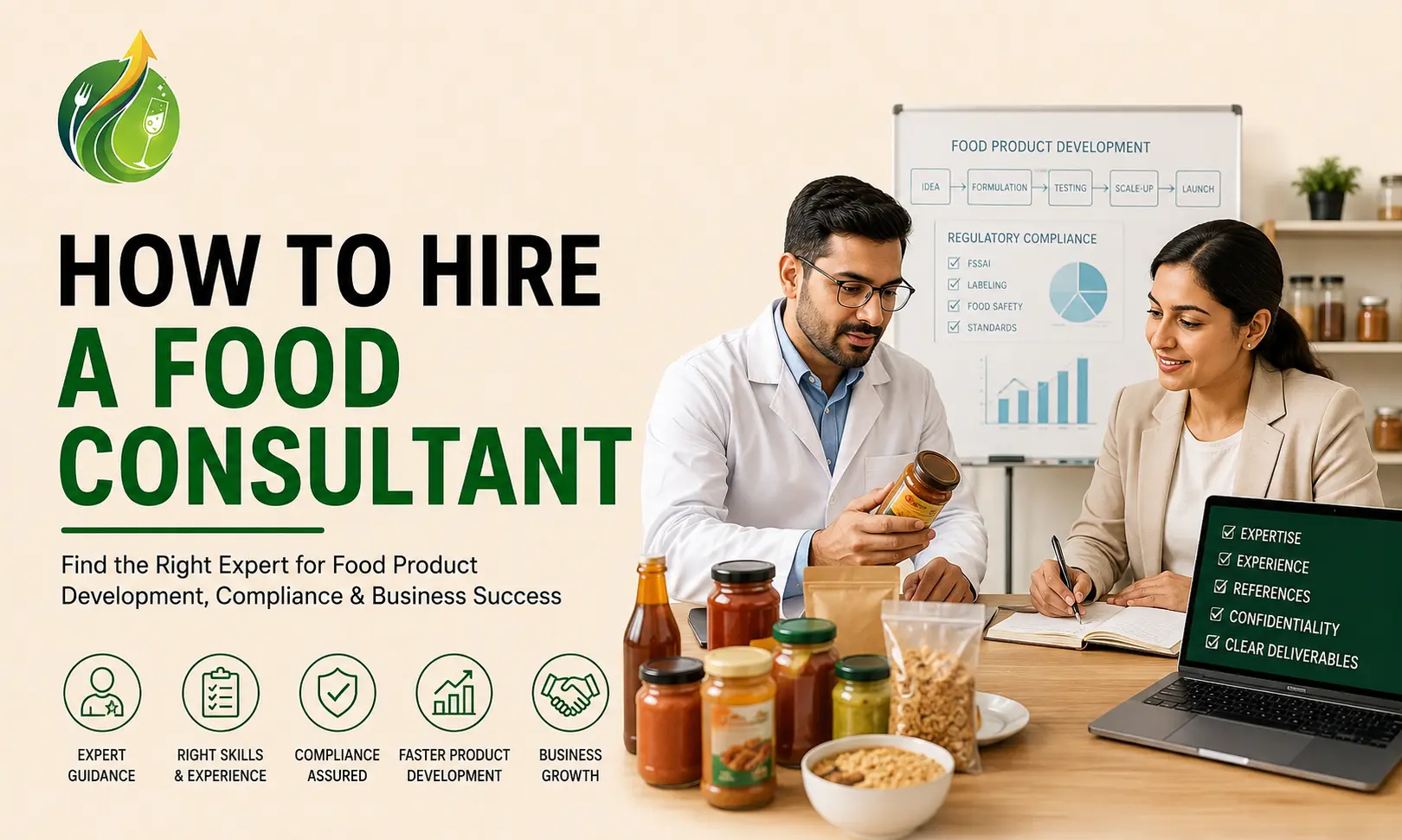
Build your food brand faster with expert food consultant support for product development, formulation, FSSAI compliance, shelf-life stability, packaging, and scalable manufacturing.
What Is a Food Consultant and What Do They Actually Do?
A food consultant is an independent expert who provides advisory services to businesses in the food industry, including restaurants, food manufacturers, packaged food brands, food startups, caterers, food service companies, and food retailers. They are brought in to solve specific problems the internal team cannot solve alone, either because of a knowledge gap, a capacity constraint, or the need for an external perspective.
Food consultants work across a surprisingly wide range of specialisations. Here are the most common types:
- Food formulation consultants: Work on recipe development, ingredient selection, processing parameters, and product formulation to create or improve food products. These professionals have a background in food science or food technology.
- Food safety consultants: Help businesses develop HACCP plans, manage food safety systems, prepare for audits, and comply with regulations from bodies such as FSSAI (India), FDA (USA), or EFSA (European Union).
- Menu development consultants: Work with restaurants, hotels, and food service operators to design or redesign menus, develop new dishes, manage food costs, and align offerings with consumer trends.
- Food operations consultants: Analyse kitchen workflow, production efficiency, inventory systems, vendor relationships, and labour scheduling to reduce costs and improve throughput.
- Regulatory and labelling consultants: Specialise in food law, nutritional labelling, health claims, product registration, and market entry compliance across different regulatory jurisdictions.
- Food marketing and positioning consultants: Help brands identify their market segment, develop brand narratives, and position products for retail, D2C, or institutional channels.
- Food technology consultants: Bridge the gap between food science and commercial manufacturing, helping businesses scale recipes from lab to production and select the right processing equipment and manufacturing partners.
Step 1: Define Exactly What You Need Before You Start Searching
The single biggest cause of slow food consultant hiring is vague job definition. When a food business posts that it is looking for a ‘food consultant’ without specifying the area of work, the timeline, the deliverables, and the budget, it receives inquiries from people who are qualified for entirely different problems than the one at hand.
Before making a single call or posting a single message, answer these questions in writing:
- What specific problem are you trying to solve? (e.g., ‘We need to reformulate our energy bar to reduce sugar content while maintaining taste and shelf life.’)
- What is the deliverable? (e.g., ‘A finalised formulation with cost analysis, updated nutritional label, and manufacturing SOP by the end of the third month.’)
- What is the timeline? Weeks or months, and are there fixed deadline dependencies (a product launch date, an audit, a trade show)?
- What is the engagement model? Project-based (fixed fee for a defined deliverable), retainer (ongoing monthly fee for defined hours or access), or time-and-materials (hourly rate for variable scope)?
- What is the realistic budget? Knowing your ceiling before starting conversations saves time for both parties.
- What level of experience is needed? A startup building its first product needs different expertise than a large manufacturer looking to optimise an existing line.
A well-defined brief cuts the qualification time with each candidate from hours to minutes.
Step 2: Know the Different Types of Food Consulting Engagements
Understanding how food consulting engagements are typically structured helps you communicate clearly with candidates and evaluate their proposals accurately.
| Engagement Type | What It Involves | Best For |
| Project-based | A fixed scope, fixed fee arrangement for a specific deliverable such as product formulation, HACCP plan, or menu design | Defined projects with clear outputs and timelines |
| Retainer | An ongoing monthly fee for access to the consultant for a defined number of hours or a defined scope of recurring work | Continuous quality oversight, regulatory monitoring, or ongoing product development |
| Hourly consulting | Billing by the hour for advice, review, or technical guidance without a committed project scope | Spot questions, second opinions, or narrowly scoped technical inputs |
| Full project delivery | The consultant manages and delivers an entire end-to-end process, such as taking a new product from concept to commercial launch | Startups without internal food science teams who need turnkey product development |
Step 3: Where to Find Food Consultants Quickly
The fastest hiring happens when you go directly to sources where food consultants are already visible and have track records attached.
Professional Networks and Industry Associations
In India, the Association of Food Scientists and Technologists India (AFSTI) maintains a network of food science professionals. The Institute of Food Technologists (IFT) has international chapters. Professional associations are one of the few places where you can find credible experts who have demonstrated knowledge through active participation in the field.
LinkedIn with Specific Search Queries
LinkedIn is the most practical tool for finding food consultants quickly, provided you use specific search terms. Instead of searching for ‘food consultant,’ search for ‘food technologist consultant,’ ‘food formulation consultant,’ ‘FSSAI compliance consultant,’ or ‘HACCP consultant India.’ Reviewing the actual work history and endorsements of shortlisted candidates tells you far more than a general profile.
Referrals from Manufacturers, Ingredient Suppliers, and Co-Packers
Your ingredient suppliers, packaging vendors, and co-manufacturing partners work with multiple food brands and often know which consultants the better-run companies in your category use. A direct referral from a trusted operational partner is often the fastest and most reliable route to a qualified consultant.
Food Technology Consultancies
Specialist food technology consultancies offer a significant advantage over independent freelancers for complex or multi-phase projects: they provide a team of experts with defined capabilities in formulation, food safety, regulatory affairs, and scaling. Flavor Catalystz is one example of a food consultancy that works with brands across product development, regulatory compliance, and manufacturing scale-up.
Freelance Platforms
Platforms like Upwork and Toptal have growing pools of food consultants. These platforms work best for narrowly defined tasks such as nutritional panel calculation, HACCP document review, or labelling compliance checking rather than complex technical projects where you need to assess the consultant’s hands-on manufacturing experience.
Step 4: Evaluate Candidates Quickly with the Right Criteria
Speed does not mean skipping the evaluation. It means focusing your evaluation energy on the factors that actually determine whether a consultant will solve your problem.
The following five criteria cover the most important evaluation dimensions for food consultants:
- Relevant experience in your product category: A dairy formulation expert is not automatically the right person for a snack bar project. Ask specifically about their experience with your product type, target consumer, and regulatory context.
- Regulatory knowledge: For any project with a compliance dimension (which includes product labelling, health claims, ingredient approval, and export), verify that the consultant understands the specific regulations in your target market.
- Portfolio of completed work: Ask for examples of specific products they have formulated, safety systems they have designed, or audits they have supported. Generic claims of experience are less useful than specific case examples.
- References from food businesses: Contact at least two previous clients and ask whether the consultant delivered on time, within budget, and whether they would use them again.
- Communication style and availability: A technically excellent consultant who communicates poorly or becomes unavailable during critical project phases creates more problems than they solve.
For India-specific projects, also verify that the candidate understands FSSAI regulations, including the Food Safety and Standards (Food Products Standards and Food Additives) Regulations and the Packaging and Labelling Regulations, relevant to your product category.
Step 5: Structure the Conversation to Qualify Faster
A structured first conversation with a food consultant candidate covers four areas in approximately 30 to 45 minutes: their relevant experience, their understanding of your specific problem, their proposed approach to solving it, and their availability and fee expectations.
Share your written brief before the meeting so the candidate has time to prepare a relevant response rather than asking them to react to a vague verbal description. Candidates who come prepared with specific questions or initial observations about your brief are signalling the kind of engagement you want on a paid project.
For technical roles (formulation, food safety), ask a practical question that has a specific correct answer relevant to your project. For example: ‘What water activity level would you target for a bar using dates and oats as primary ingredients, and how would you test for it?’ The quality of the answer tells you more about technical competence than any general conversation.
Step 6: Structure the Agreement Clearly
Slow hiring often gets even slower at the contracting stage because the scope, payment terms, IP ownership, and deliverables were never defined clearly enough. A straightforward consulting agreement for a food project should specify:
- Scope of work: The specific deliverables the consultant will produce.
- Timeline and milestones: Key dates by which interim and final deliverables are due.
- Fee and payment schedule: Whether payment is a lump sum, milestone-linked, or monthly, and the invoicing process.
- IP ownership: Confirm in writing that all formulations, recipes, documents, and designs produced under the engagement belong to your business.
- Confidentiality: An NDA covering your product formulations, business plans, and proprietary data.
- Revision rounds: Define how many rounds of revision are included in the agreed fee and what constitutes a change in scope.
These six elements cover 90% of the disagreements that arise during and after food consulting engagements.
Common Mistakes That Slow Down Food Consultant Hiring
- Not defining the scope before starting outreach: Vague briefs attract mismatched candidates and waste everyone’s time.
- Expecting one person to do everything: A single food consultant is rarely expert in formulation, food safety, regulatory compliance, and marketing simultaneously. Be clear about the primary expertise you need.
- Delaying because the budget is not finalised: If you know your approximate budget range, start conversations now. Most consultants will tell you quickly whether the project is within reach.
- Over-relying on credentials without checking relevant work: A PhD in food science does not guarantee practical experience in commercial product development. Always check for relevant project experience.
- Starting without securing IP protection: Ensure the NDA and IP clauses in your agreement are in place before sharing proprietary formulations or business plans.
Food Consultant Fees: What to Expect in India
| Consultant Type and Scope | Typical Fee Range (India, 2026) |
| Hourly advisory (experienced food technologist) | Rs 2,500 to Rs 8,000 per hour |
| Product formulation project (single product, bench to pilot) | Rs 75,000 to Rs 5,00,000 depending on complexity |
| HACCP plan development and documentation | Rs 50,000 to Rs 2,00,000 |
| FSSAI labelling compliance review (per product) | Rs 10,000 to Rs 40,000 |
| Full product development (concept to commercial scale) | Rs 3,00,000 to Rs 20,00,000 and above for complex projects |
| Monthly retainer (part-time technical advisory) | Rs 25,000 to Rs 1,50,000 per month |
International food consultants working on India-related projects typically charge in USD or EUR and bill at significantly higher rates. For most domestic projects, engaging a locally based expert with relevant India market knowledge is both faster and more cost-effective.
Conclusion
Hiring a food consultant faster is not about cutting corners. It is about removing the inefficiencies that make a straightforward process drag on unnecessarily. Define what you need precisely. Go to the right sources. Evaluate candidates on relevant experience and demonstrated work. Structure the agreement clearly before work begins.
Most food businesses that struggle to find the right consultant quickly are not facing a shortage of available expertise. They are facing a shortage of clarity about what they are actually looking for. Fix that, and the right consultant becomes much easier to find.
Whether you are a startup launching your first product, an established brand navigating a regulatory change, or a food service operation looking to improve efficiency, the right food consulting expertise is available. The process of finding it does not have to take as long as most businesses allow it to.
Frequently Asked Questions
How long does it take to hire a food consultant?
With a clear brief and an organised search process, most food businesses can identify, evaluate, and agree terms with a suitable consultant within 2 to 4 weeks. Without a clear brief, the process can drag on for months.
What is the difference between a food consultant and a food technologist?
A food technologist is a professional with a specific scientific qualification applying food science to development, production, safety, and quality. A food consultant is a broader term for any external expert advising a food business on any aspect of its operations. A food technologist can function as a food consultant, but not all food consultants have food technology qualifications.
How do I know if a food consultant is qualified?
Check their educational background (food science, food technology, chemistry, or microbiology), their work history with food companies of relevant scale, any industry certifications they hold (HACCP, CFS), and references from previous clients. For FSSAI-related work in India, verify familiarity with the specific regulations governing your product category.
Can a food consultant help me get FSSAI registration?
Yes. A food consultant with regulatory expertise can guide product classification, prepare technical documentation, assist with label compliance, and advise on the appropriate licence category. However, the actual licence application is submitted by the business, not the consultant.
Should I hire a freelance food consultant or a food consultancy firm?
Freelance food consultants are generally more cost-effective for narrowly defined technical tasks. Consultancy firms are better suited for complex multi-phase projects that require expertise across formulation, safety, regulatory, and scale-up because they can assign multiple specialists. The choice depends on project scope, budget, and the depth of expertise required.
What should I include in a food consultant brief?
Your brief should include: the problem you need solved, the specific deliverable you need, the timeline, the budget range, any regulatory constraints, the target market and consumer, and any existing product information relevant to the project.
Do food consultants sign NDAs?
Yes, and they should. Any food consultant working with proprietary formulations, business plans, or unreleased product information should sign a non-disclosure agreement before the project begins. This is standard practice and any credible consultant will be familiar with signing one.