May 2026 · 9 min read
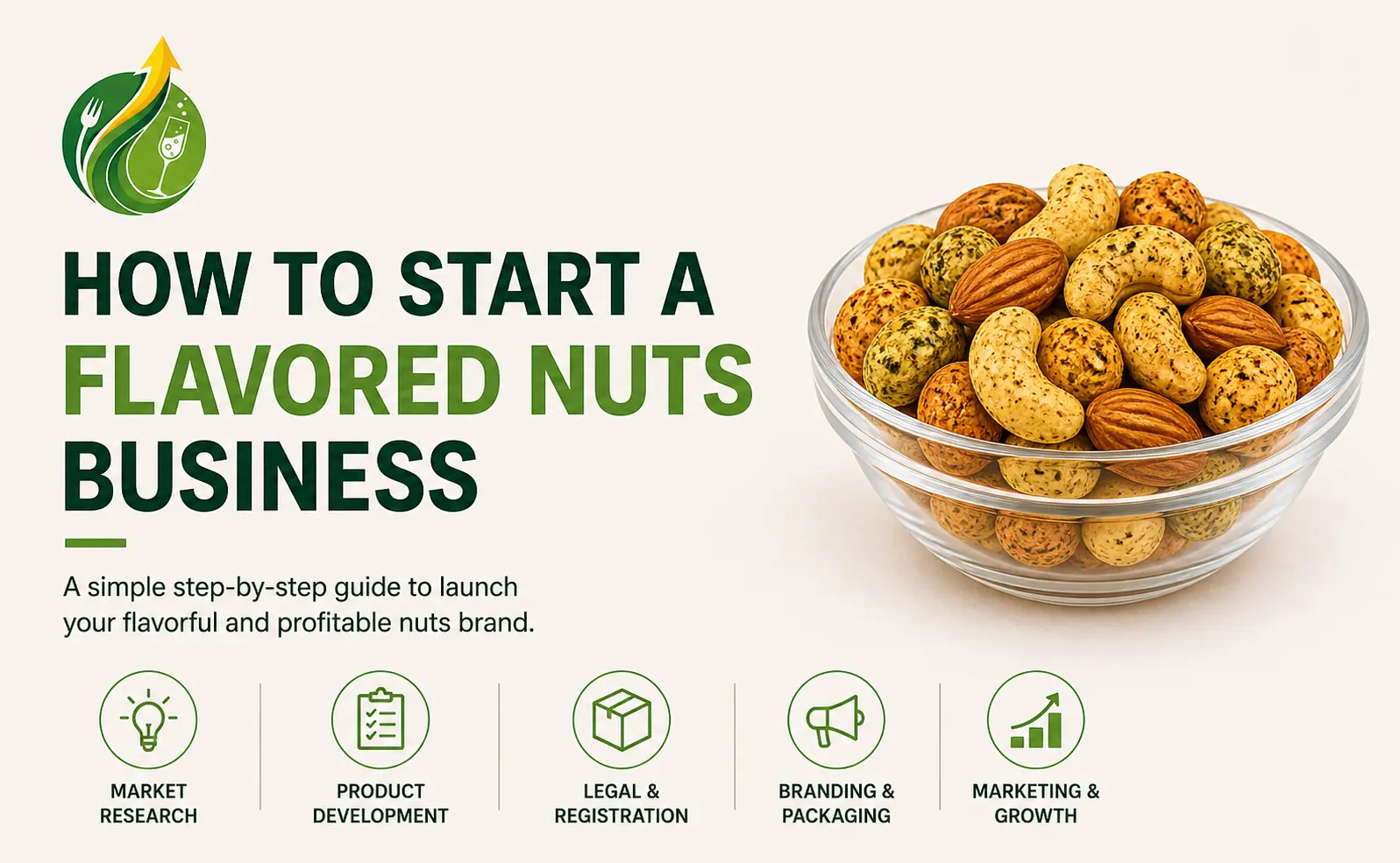
Starting a flavoured nuts business in India is one of the most accessible and rewarding ways to enter the packaged food industry in 2026. The category has low raw material complexity, a well-established contract manufacturing ecosystem, strong and growing consumer demand, and a distribution landscape that makes it genuinely possible to go from idea to first sale within 60 to 90 days.
The nut snacking market in India crossed Rs. 5,500 crore in 2024 and continues to grow. Consumers are buying flavoured nuts across D2C platforms, quick commerce apps, modern trade, and corporate gifting channels. They are willing to pay a significant premium for products that taste distinctive, look premium, and come with a clear story.
This guide walks you through every step of starting a flavoured nuts business in India, from flavoured nuts product development and choosing your business model to getting licensed, finding a manufacturer, pricing your product, and reaching your first 1,000 customers.
Why the Flavoured Nuts Business Makes Sense Right Now
The timing for entering the flavoured nuts category has never been better. Growing consumer demand, the rise of quick commerce, high repeat purchase rates, and significant white space at the niche level all make this a strong category to enter in 2026.
- Growing consumer demand: Urban India is actively searching for healthy snack alternatives. Nuts fit perfectly into clean label and protein-conscious eating.
- Low barriers to entry: No manufacturing investment needed. Contract manufacturing lets you launch under your brand from a licensed facility.
- Quick commerce growth: Blinkit and Zepto have made impulse purchases of premium snacks mainstream. Nuts are a top-selling category on both platforms.
- Gifting market: Flavoured nuts are now a standard inclusion in corporate and festive gifting. This is a high-margin channel with seasonal volume spikes.
- Low competition at niche level: While mass-market salted nuts are crowded, specific flavors and positionings still have significant white space.
- Repeat purchase rate: Consumers who like a nut product reorder frequently. The category naturally drives subscription and reorder behavior on D2C channels.
Step 1: Choose Your Product and Positioning
Before you register a business or approach a manufacturer, you need to know what you are selling and to whom. This decision drives everything else.
Pick Your Nut Type
Start with one nut type. Trying to launch five flavors across three nut types as your first product is a recipe for high inventory cost, complex manufacturing, and scattered brand identity. The most common starting points are cashews (premium, gifting, high perceived value), almonds (health and nutrition positioning), or peanuts (affordable mass-market or flavoured variety).
Choose 1 to 3 Flavors for Launch
Your launch flavors define your brand’s personality. Pick flavors that are distinctive but understandable. A flavor that requires too much explanation will not convert. Top-performing launch flavors in 2026 are cheese and herbs, chili lime, honey roast, dark chocolate, and peri peri. Each has clear consumer recognition and high reorder rates.
Decide Your Positioning
Positioning is the story you tell about your product. Are you the premium gifting nut brand? The office snack brand? The fitness-friendly protein-rich nut brand? The Indian flavors specialist? A clear positioning makes every other decision easier and cheaper, from packaging design to marketing channels to pricing.
Step 2: Choose Your Business Model
| Model | How It Works | Best For | Approx. Starting Capital |
| Contract Manufacturing | You own the brand and formulation. A licensed partner handles production. | First-time founders, D2C brands, brand builders | Rs. 2 to 6 lakh |
| White Label | Use existing formulations from a manufacturer. Add your branding and sell. | Quick entry, low product development time | Rs. 75,000 to Rs. 2 lakh |
| Own Manufacturing | Build or lease a production unit. Full control over every aspect. | Manufacturers entering the branded space, large-scale operations | Rs. 30 lakh and above |
Step 3: Register Your Business and Get Licenses
You cannot legally sell food products in India without the right registrations. The following are mandatory for a flavoured nuts business.
- Business Entity Registration with MCA or local authority. Cost: Rs. 3,000 to Rs. 12,000. Provides legal identity for your business.
- FSSAI Food Business Operator License. Cost: Rs. 2,000 to Rs. 7,500 per year. Mandatory to manufacture or sell packaged food.
- GST Registration via GST Portal. Free. Mandatory above Rs. 20 lakh turnover, recommended from launch.
- Trademark Registration with IP India. Cost: Rs. 4,500 per class. Protects your brand name and logo from copying.
- Shop and Establishment Act registration with state-specific authority. Cost: Rs. 1,000 to Rs. 5,000. Required for physical business premises.
Your FSSAI registration or license number and your manufacturer’s FSSAI license number must both appear on every product label. Without both, the product cannot legally be sold in India.
Step 4: Find and Evaluate a Manufacturing Partner
Your manufacturing partner is your most important business relationship. The quality of your product, the consistency of your supply, and a large part of your cost structure depend on who you work with.
Where to Find Manufacturers
- Trade directories like Indiamart and TradeIndia list nut processing manufacturers by city and capability.
- Food ingredient and packaging expos like Annapoorna World of Food India attract nut manufacturers.
- Referrals from other D2C food brands in adjacent categories often lead to quality manufacturers.
- State food processing associations in Goa, Kerala, Maharashtra, and Gujarat maintain directories of licensed processors.
What to Check Before Signing
Verify the FSSAI license number directly on the official FSSAI portal (foscos.fssai.gov.in), not from screenshots. Ask for samples from current production runs, not R&D samples. Confirm they have industrial rotary drum roasters. Ask how they check incoming raw material through COA, visual grading, and moisture testing.
Always order a 1 kg or 2 kg sample of their standard production output before committing to any agreement. Evaluate it for roasting consistency, flavor balance, texture, and shelf stability after a few days in open air.
Step 5: Develop Your Formulation
If you are doing contract manufacturing, your manufacturer’s food science team will develop your formulation based on your flavor brief. Brief them clearly on the exact nut type and grade, the flavor profile in detail, whether you want natural or artificial flavors, the texture you want, your target retail price, and 1 to 2 competitor products that are closest to your flavor vision.
Expect to go through 2 to 4 sample rounds before locking the formulation. This is normal and necessary. Do not rush this step, as it directly determines whether customers reorder.
Step 6: Design Your Packaging
In the flavoured nuts category, packaging is often the first purchase driver. Use stand-up zipper pouches for most online formats, rigid boxes for gifting, and tins for ultra-premium products. Use metalized laminate film for best oxygen and moisture barrier properties.
Seal type should be nitrogen flushed and heat sealed for maximum shelf life. Start with 100 gm and 200 gm for online, 200 gm and 500 gm for gifting. Use minimal, clean, premium design. Avoid cluttered packaging designs.
Mandatory label elements include FSSAI license numbers (yours and manufacturer’s), nutritional panel, ingredients, allergen declaration, net weight, best before date, and batch number.
Step 7: Price Your Product Correctly
| Product | Typical COGS (100 gm) | Suggested Retail Price | Gross Margin (Approx.) |
| Flavoured Cashews (100 gm) | Rs. 70 to Rs. 100 | Rs. 180 to Rs. 280 | 40 to 55 percent |
| Flavoured Almonds (100 gm) | Rs. 90 to Rs. 130 | Rs. 220 to Rs. 350 | 40 to 55 percent |
| Flavoured Peanuts (100 gm) | Rs. 20 to Rs. 40 | Rs. 80 to Rs. 140 | 50 to 65 percent |
| Mixed Nuts with Flavoring (100 gm) | Rs. 110 to Rs. 160 | Rs. 280 to Rs. 420 | 40 to 50 percent |
| Dark Chocolate Coated Nuts (100 gm) | Rs. 120 to Rs. 180 | Rs. 300 to Rs. 500 | 40 to 52 percent |
COGS here includes raw nut cost, flavoring ingredients, manufacturing, and packaging. For D2C and marketplace sales, total landed cost per unit should be calculated carefully before setting a final price.
Step 8: Reach Your First Customers
For most first-time founders with limited capital, starting with Amazon and Instagram simultaneously gives you volume discovery and brand building at the same time. Corporate gifting is a strong add-on channel from month 3 onward if you develop premium packaging options.
- Instagram and D2C Website: Highest margin, full brand control. Requires strong content and paid ad budget.
- Amazon and Flipkart: High traffic, trust, and pan-India reach. Watch for competitive pricing pressure and listing fees.
- Blinkit and Zepto: Fast delivery drives reorder. Good for snack categories. Watch for high slotting fees.
- Corporate Gifting: Large order sizes and good margins on premium packaging. Seasonal and relationship-dependent.
- Modern Trade: Brand credibility and shelf visibility. Long payment cycles and listing fees to watch for.
Build a Scalable Flavoured Nuts Brand with Expert Product Development
Building a successful flavoured nuts brand requires more than premium ingredients or attractive packaging. The fastest-growing brands focus on strong flavoured nuts product development, balanced seasoning systems, shelf stability, clean-label formulations, and consistent taste that drives repeat purchases.
At Flavor Catalystz, we help brands with expert food formulation support for flavoured nuts, including seasoning formulation, flavor optimization, shelf-life stability, and scalable manufacturing solutions designed for long-term growth in India’s competitive healthy snacks market.
Frequently Asked Questions
How much money do I need to start a flavoured nuts business in India?
With contract manufacturing and one SKU, a realistic starting budget is Rs. 2 to 5 lakh. This covers raw materials, flavoring R&D, packaging design and print, FSSAI registration, lab testing, and a small initial marketing spend. Businesses starting with peanut-based products can start at the lower end of this range.
Do I need to own a factory to sell flavoured nuts?
No. Contract manufacturing is the standard model for most Indian D2C and online-first nut brands. Your manufacturing partner’s factory holds the production license. You hold your own FSSAI food business operator license as the brand owner.
Can I sell flavoured nuts from home?
You can manage and run the business from home, but production must happen in a licensed facility. FSSAI does not permit commercial food manufacturing in residential kitchens. Contract manufacturing solves this completely.
What is the best platform to sell flavoured nuts online in India?
Amazon is typically the highest-volume starting platform due to its search traffic for snack products. Blinkit and Zepto have strong repeat purchase behavior for snacks in urban markets. Instagram and D2C websites offer higher margins and better brand building but require more marketing investment upfront.
How do I stand out from other flavoured nut brands?
The fastest way to differentiate is through a genuinely distinctive flavor that is well-executed, premium packaging that looks significantly better than alternatives at your price point, and honest storytelling about what is in your product and why it is different. Brands that compete only on price in this category have thin margins and high churn.