May 2026 · 13 min read
The Indian packaged food and beverage market is projected to grow from USD 33.7 billion in 2023 to USD 46.3 billion by 2028. Within that growth, the most significant structural shift is the rise of new domestic brands not extensions of legacy players, but founder-led food companies that began with a single product idea and a reliable food product development. Understanding exactly how to build a food brand in India in 2026 the process, the compliance steps, the capital requirements, the channel strategy is what separates founders who launch from founders who spend years planning.
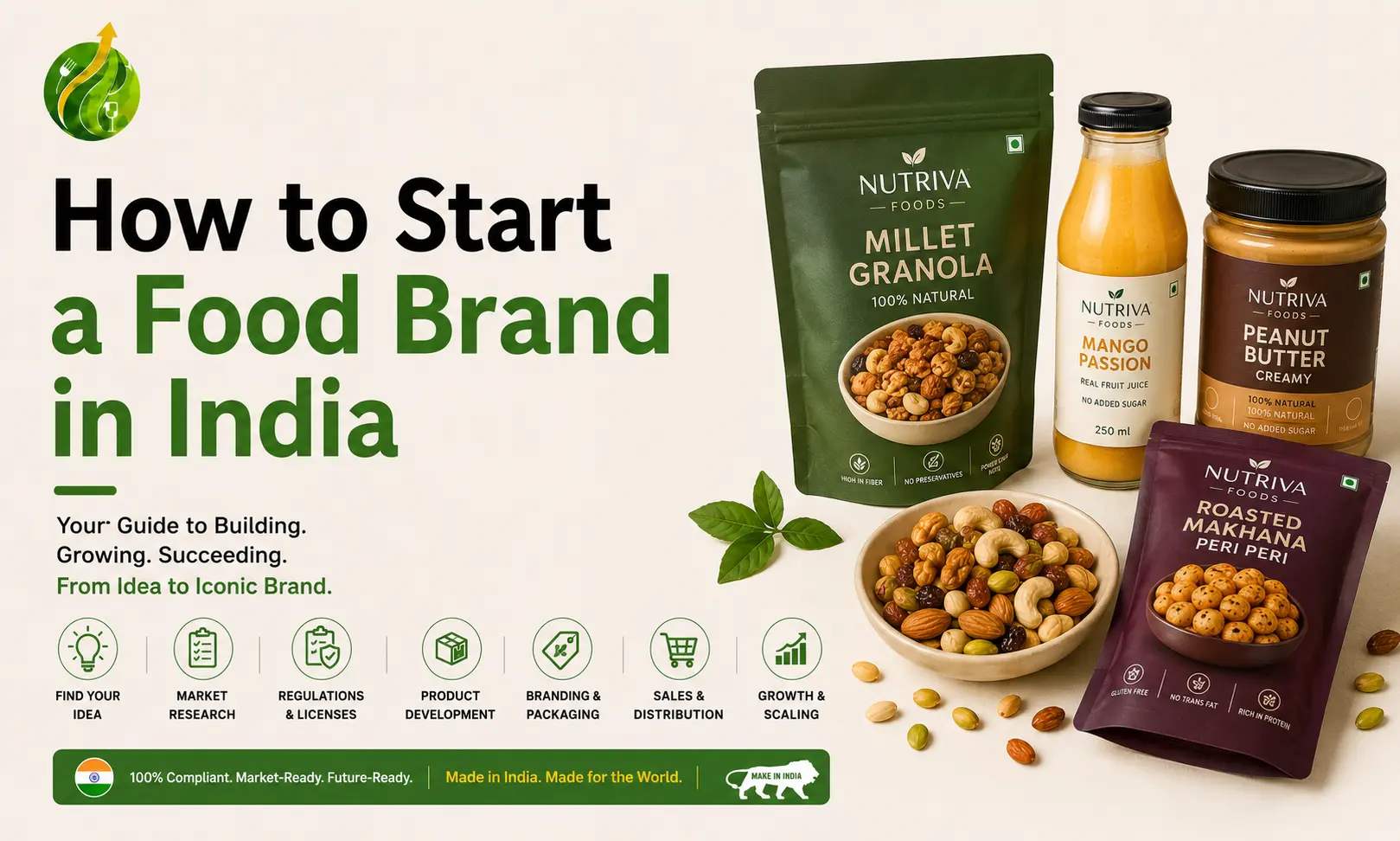
This guide provides a complete, step-by-step breakdown of starting a food brand in India in 2026. It covers every decision you need to make, in the order you need to make them.
Step 1: Define Your Product and Target Consumer with Precision
The most dangerous phase of starting a food brand is also the most tempting: the idea stage. The failure mode here is defining a product around what you want to make rather than what a specific, well-defined consumer needs and cannot currently find.
Start by identifying one consumer occasion. Not a demographic an occasion. ‘Office lunch for a working professional who has 8 minutes and no microwave access’ is a usable product brief. ‘Healthy food for busy people’ is not. The more specific the occasion, the more specific your food formulation, packaging format, and pricing decisions become and the more differentiated your product is from everything already on shelf.
Conduct at minimum 30 interviews with people who match your target consumer profile. Ask them what they currently eat for the occasion you are targeting, what frustrates them about those options, what they wish existed, and what they would pay. Avoid asking people if they would buy your product idea people consistently overestimate their willingness to pay for hypothetical products. Instead, ask them to compare your concept to their current spending patterns.
Step 2: Validate the Product Through Sampling Before Any Investment
No capital should be committed to manufacturing, equipment, or formal business registration until a minimum viable version of your product has been in the hands of at least 100 potential customers. This is not a product launch. It is a data collection exercise.
For packaged food, a validation batch can be produced at home or in a licensed community kitchen for most dry and ambient product categories. Produce 100 to 200 units, distribute them through your personal network and relevant online communities, and collect structured feedback using a simple 10-question form covering taste, texture, convenience, packaging, and price sensitivity. A repurchase rate above 40 percent from this group is a meaningful signal of commercial potential.
Step 3: Business Registration and Legal Structure
Once the product concept is validated, register the business. For most food brand founders in India, the appropriate legal structure at launch is either a Sole Proprietorship (lowest cost, simplest setup, appropriate for under Rs 20 lakh annual revenue) or a Private Limited Company (more credible for retail buyers and investors, mandatory for equity fundraising).
A Private Limited Company requires a minimum of two directors, authorized capital, and incorporation through the Ministry of Corporate Affairs (MCA) portal. Incorporation typically takes 10 to 15 working days from document submission. The registration cost, including government fees and professional charges, ranges from Rs 7,000 to Rs 20,000 depending on the service provider.
GST registration is mandatory once your annual turnover exceeds Rs 20 lakh (Rs 10 lakh for northeastern states). However, many food brands register for GST from the outset because GST registration is required by most modern trade retailers and e-commerce platforms as a condition of supplier onboarding.
Step 4: Obtain Your FSSAI License The Non-Negotiable Compliance Requirement
Every food brand in India must hold a valid FSSAI registration or license. This is not optional, and the type of registration required depends on your annual turnover and the scale of your operations.
| FSSAI License Type | Annual Turnover Criteria | Application Portal | Processing Time | Annual Fee |
| Basic Registration | Below Rs 12 lakh | FoSCoS portal | 7–10 working days | Rs 100 |
| State License | Rs 12 lakh – Rs 20 crore | FoSCoS portal | 30–60 days | Rs 2,000–5,000 |
| Central License | Above Rs 20 crore / multi-state / export | FoSCoS portal | 45–90 days | Rs 7,500 |
Apply through the FoSCoS (Food Safety Compliance System) portal at foscos.fssai.gov.in. The application requires a valid business address proof, identity documents, a site plan of the production premises, and a list of food products to be manufactured. A geo-tagged photograph of the manufacturing premises is now required as part of the 2026 digital verification process.
The FSSAI 14-digit license number must appear on all product packaging, invoices, and business correspondence related to food products. Late renewal beyond 30 days of license expiry attracts a penalty of Rs 100 per day. Annual returns must be filed by May 31st each year for manufacturing and importing units.
Step 5: Develop Your Brand Identity
Brand identity for a food company in India in 2026 is doing more work than it has ever done. The proliferation of brands on quick-commerce and e-commerce platforms means a consumer is choosing between your product and 12 others in under 10 seconds. Visual identity pack design, colour palette, typography, photography is not a secondary concern after the product is ready. It is part of the product.
Naming Your Brand
A good food brand name in India in 2026 is short (one or two syllables preferred for quick-commerce search), easy to spell in both English and at least one regional language, phonetically distinct from existing brands in your category, and available as a trademark. Before finalising a name, check the IP India trademark database, verify domain availability, and confirm the Instagram and Meta handle is available.
Pack Design for Indian Retail and E-Commerce
Pack design must work across three distinct viewing contexts: a physical retail shelf at arm’s length, a 200×200 pixel thumbnail image on a mobile quick-commerce app, and a social media post shared by an influencer. These three contexts have different requirements, and most early-stage food brand pack designs fail at the mobile thumbnail because the brand name and product descriptor are too small to read on a phone screen.
Invest in professional pack design. A competent food-category designer in India charges Rs 20,000 to Rs 80,000 for a complete pack design system. This is one of the highest-return investments a new food brand can make, and cutting corners here consistently reduces conversion at retail and online.
Step 6: Packaging Compliance Under FSSAI and Legal Metrology
Every packaged food product sold in India must comply with both FSSAI labelling regulations and the Legal Metrology (Packaged Commodities) Rules, 2011. These are separate regulatory frameworks with separate enforcement authorities.
Under FSSAI labelling rules effective from 2026, mandatory information on every food package includes: product name, FSSAI license number, list of ingredients in descending order of proportion, nutritional information per 100g or 100ml (in the prescribed front-of-pack format), allergen declarations, net quantity, batch or lot number, manufacturing date, best before or expiry date, manufacturer name and address, and country of origin.
Under Legal Metrology Rules, the MRP (Maximum Retail Price inclusive of all taxes) must be printed on the pack with the words ‘Maximum Retail Price’ in full or ‘MRP’ and must include a declaration that it is inclusive of all taxes.
Packaging non-compliance is one of the top three reasons that food brand products are rejected by modern trade buyers and e-commerce platforms during supplier onboarding. Getting label review done by a qualified food regulatory consultant before printing your first batch of packaging is far less expensive than reprinting 10,000 pouches.
Step 7: Manufacturing Own Kitchen, Co-Packer, or Production Unit
For most food brands at launch, contract manufacturing (co-packing) is the most capital-efficient production model. A co-packer with the appropriate FSSAI license manufactures your product to your specification and takes responsibility for production-side compliance. You focus on brand building, sales, and consumer relationships.
Finding a co-packer involves verifying that their FSSAI license covers your specific product category, that their facility meets the hygiene and GMP standards required for your product type, that their minimum order quantities are compatible with your launch volume, and that they can consistently meet the product specification you have validated with consumers.
Once monthly production volumes exceed approximately 5,000 to 10,000 units (depending on product type), the economics of co-packing begin to erode gross margins significantly. At that point, leasing or setting up a manufacturing unit becomes worth evaluating seriously. Small food manufacturing units in industrial areas of Tier 1 and Tier 2 cities can be set up for Rs 15 to 50 lakh in capital expenditure, excluding land or property costs.
Step 8: Choose Your Sales Channels and Build Your Go-to-Market Plan
Quick Commerce: The 2026 Priority Channel for New Food Brands
Blinkit, Zepto, and Swiggy Instamart collectively represent the fastest-growing and most accessible channel for new food brands in urban India. Vendor registration on these platforms typically takes 2 to 4 weeks and requires FSSAI license, GST registration, bank account details, product images meeting platform specifications, and a barcode (EAN-13) on each SKU.
Quick-commerce conversion is driven almost entirely by product imagery and category placement. Platforms allocate above-the-fold placement to products with high review ratings and strong in-stock consistency. New brands should plan to run a structured sampling and review-gathering campaign in the first 4 to 6 weeks post-listing to build social proof quickly.
D2C Website: Building Consumer Data Ownership
A Shopify or WooCommerce store, combined with Meta and Google advertising, gives a food brand direct access to consumer purchase data who is buying, where they are, what they are buying alongside your product, and how often they return. This data is not available when selling exclusively through third-party marketplaces.
D2C gross margins are typically 15 to 25 percentage points higher than modern trade margins because the retailer’s cut is eliminated. These higher margins fund the digital marketing spend required to acquire customers at an acceptable cost. Target a customer acquisition cost (CAC) below 30 percent of the first-order value, and a 90-day retention rate above 40 percent for the D2C channel to be sustainable.
Modern Trade: The Credibility Channel
Getting listed in DMart, Reliance Smart, or a regional supermarket chain signals consumer trust in ways that digital channels alone cannot. Modern trade entry typically requires a minimum of 6 months of tracked sales from other channels, a distributor relationship for in-store replenishment, and the ability to absorb listing fees and promotional slotting costs. Plan for 90-to-120-day payment cycles from modern trade buyers.
Step 9: Funding Options for a New Food Brand in India
| Funding Source | Stage Suitable For | Typical Ticket Size | Key Requirement | Dilution |
| Self-Funding / Bootstrapping | Idea to Rs 50 lakh revenue | As available | Product-market fit proof | None |
| MSME / Mudra Loan | Launch to Rs 1 Cr revenue | Rs 50,000 – Rs 10 lakh | Business registration + basic docs | None |
| PMFME Scheme Subsidy | Micro food processors | 35% subsidy up to Rs 10 lakh | FSSAI + business plan | None |
| Angel Investors | Rs 50 lakh – Rs 3 Cr revenue | Rs 25 lakh – Rs 1.5 Cr | Traction data; strong founder | 10–25% |
| Venture Capital (Seed) | Rs 2 Cr – Rs 10 Cr revenue | Rs 1 Cr – Rs 5 Cr | Repeatable growth metrics | 15–30% |
Step 10: Build Operational Systems Before You Scale
The brands that scale without breaking are the ones that invest in operational systems before they need them. Inventory management, purchase order tracking, batch number recording (mandatory for FSSAI compliance), and consumer complaint logging are not administrative tasks they are the foundation of a food business that can pass a retailer audit, handle a recall, and maintain consistent product quality across growing production volumes.
A basic ERP or inventory management system appropriate for a food brand at the Rs 50 lakh to Rs 5 crore stage includes tools like Zoho Inventory, Unicommerce, or a customized Google Sheets setup. The key is that batch records, expiry dates, and stock movements are tracked in real time not reconstructed from memory after an FSSAI inspector asks.
Timeline Expectations: How Long Does It Take to Launch a Food Brand in India
- Month 1 to 2: Product validation sampling, consumer interviews, business concept definition
- Month 2 to 3: Business registration (Private Limited or Proprietorship), GST registration, FSSAI application
- Month 3 to 4: FSSAI license approval, packaging design finalization, label compliance review
- Month 4 to 5: Co-packer finalization, pilot production run, shelf-life testing initiation
- Month 5 to 6: Photography, marketplace listings (quick-commerce, Amazon), website setup
- Month 6: First commercial sale
Six months is achievable for a focused founder working on a single SKU in an ambient product category. Chilled, frozen, or complex processed products requiring retort may add 2 to 3 months due to longer shelf-life validation timelines. Ambitious parallel workstreams can compress timelines but increase risk if regulatory steps are not completed before manufacturing is committed.
Mistakes That Delay Food Brand Launches Most Frequently in India
Attempting to launch too many SKUs simultaneously is the most common operational error. Every additional SKU multiplies procurement complexity, FSSAI compliance requirements, and minimum order quantity commitments from co-packers. Most successful Indian food brands launched with one to three SKUs and expanded the range only after the first products demonstrated repeat purchase rates above 35 percent.
Underbudgeting for digital marketing is the most common financial error. A food brand that reaches shelf whether physical or digital without a consumer awareness strategy has spent money to create no revenue. In 2026, a minimum viable digital marketing budget for a new Indian food brand is Rs 30,000 to Rs 60,000 per month, primarily across google search engine, with content created specifically for the quick-commerce thumbnail and 15-second video format.
Flavor Catalystz works with founders navigating each of these steps from product development and co-packer sourcing to regulatory compliance and channel strategy also providing expert formulation, connect at +91 97117 30492 The food brand opportunity in India in 2026 is real and structurally supported. The founders who succeed are the ones who move through validation, compliance, and early sales with methodical focus rather than waiting for conditions to be perfect.
Frequently Asked Questions
How do I start a food brand in India?
To start a food brand in India, you need to finalize your product category, develop the product, obtain FSSAI registration, create packaging and branding, choose a manufacturing model, and start selling through online or offline channels.
How much investment is required to start a food brand in India?
The investment required to start a food brand in India can range from Rs 2 lakh for small-scale private label launches to Rs 25 lakh or more for custom manufacturing, branding, inventory, and distribution.
Can I start a food brand without owning a factory?
Yes, many startups launch food brands using third-party manufacturing or private label food manufacturers. This reduces initial investment and speeds up product launch timelines.
What are the best food categories to start in India?
Fast-growing food categories in India include healthy snacks, protein foods, millet products, Ready-to-Eat meals, functional beverages, peanut butter, sauces, and instant mixes.
How long does it take to launch a food brand in India?
Launching a food brand in India typically takes 2 to 6 months depending on product development, packaging design, regulatory approvals, and manufacturing timelines.
What is private label food manufacturing?
Private label food manufacturing is a business model where a manufacturer produces food products that are sold under your own brand name instead of the manufacturer’s brand.
How do I create a unique food brand in India?
A unique food brand is built through strong positioning, differentiated products, attractive packaging, consistent quality, and targeted digital marketing strategies.
What are the biggest challenges in starting a food brand?
Common challenges include product consistency, shelf life stability, packaging costs, finding reliable manufacturers, distribution, and building customer trust in a competitive market.