May 2026 · 17 min read
Most beverage brands make the same costly mistake when entering the low calorie space: they treat it as a Most beverage brands make the same costly mistake when entering the low calorie space: they treat it as a subtraction exercise. Remove the sugar. Find something sweet. Hope the consumer doesn’t notice the difference.
They always notice. The result is a flat, watery, metallic drink that gets tried once and abandoned. And the brand wonders why repeat purchases never materialise.
This guide changes that. We cover everything you need — from the science of what sugar actually does in a beverage, to advanced sweetener blending strategy, mouthfeel restoration, low GI energy drink formulation for diabetic and metabolic health consumers, and FSSAI compliance requirements.
Whether you’re building a low calorie beverage for weight loss, a sugar-free carbonated drink, a diabetic-friendly energy drink, or a clean-label functional soda — this is your formulation foundation.
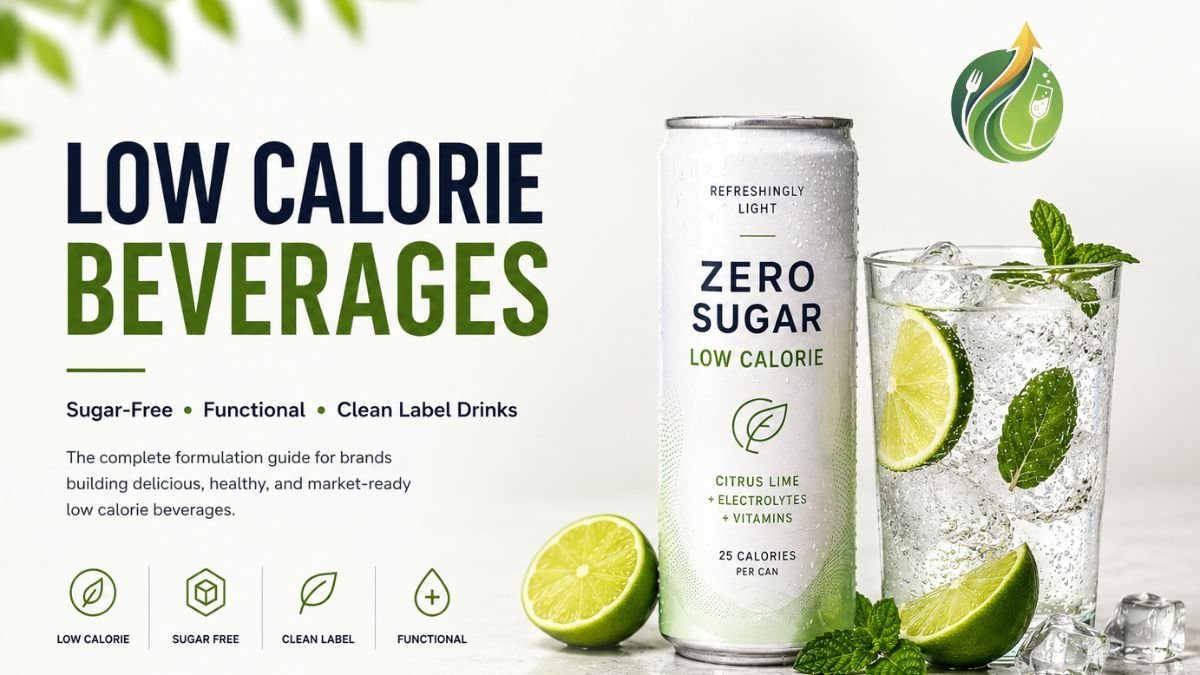
What are low calorie beverages?
Low calorie beverages contain 40 calories or fewer per 100 ml (FSSAI definition). They use alternative sweeteners, mouthfeel agents, and calibrated flavour systems to maintain taste while significantly reducing caloric load. Simply removing sugar is not enough — formulation science is required to replace every functional role sugar played in the drink.
1. Why the Low Calorie Beverage Market Is Exploding Right Now
The global zero-calorie drinks market was valued at USD 6.6 billion in 2024 and is projected to reach USD 13.4 billion by 2034 at a CAGR of 7.3%. In India, ‘Low Calorie Beverages’ registers 720 monthly searches at just 21% keyword difficulty — meaning brands that act now on this space with authoritative content and great products will capture significant market share ahead of mass competition.
But search volume is just the surface signal. The real driver is a fundamental shift in what consumers expect from every drink they pick up:
- Fewer calories without sacrificing taste or satisfaction
- Reduced sugar — especially important for diabetics, metabolic health-conscious, and weight-management consumers
- Clean-label ingredients they can read, recognise, and trust
- Functional health benefits that justify the purchase beyond just “less bad”
- Stable blood sugar and sustained energy — no spike, no crash
Google’s “People also search for” data around this keyword reveals the full consumer intent landscape: low calorie drinks non alcoholic, low calorie beverages for weight loss, what to drink to lose belly fat in 1 week, low calorie beverages at home, weight loss drink for female — signals that this audience spans demographics, health goals, and purchase occasions. One well-positioned beverage product can legitimately serve multiple of these segments.
| Beverage Category | Primary Consumer Need | Key Search Terms |
|---|---|---|
| Low Calorie Beverages | Weight management, everyday health | low calorie beverages for weight loss, low calorie drinks |
| Zero / Calorie-Free Drinks | Strict calorie counting, diet positioning | zero calorie drinks, calorie free drinks, diet beverages |
| Low GI Energy Drinks | Diabetic-friendly, metabolic health | low GI energy drink, diabetic friendly energy drink, healthy energy drink India |
| Sugar-Free Beverages | Clean label, no artificial additives | sugar free beverage, no sugar drinks, sugar control energy drink |
| Weight Loss Drinks | Belly fat reduction, female wellness | what to drink to lose belly fat, weight loss drink for female |
| Low Cal Non-Alcoholic | Social occasions without caloric guilt | low calorie drinks non alcoholic, low calorie alcoholic drinks in a can |
2. What Sugar Actually Does in a Beverage — And Why Removing It Is Hard
The 5 Functional Roles of Sugar in a Beverage
| Sugar’s Role | What Happens When Removed | Formulation Fix Required |
|---|---|---|
| Sweetness delivery | Drink tastes flat, wrong, or underwhelming | Multi-sweetener blended system |
| Mouthfeel and body | Drink tastes thin and watery | Allulose, soluble fibre, hydrocolloids |
| Flavour carry & amplification | Aromatics weaken — 10–25% flavour loss | Higher flavour dose + modulators |
| Acidulant buffering | Same acid level tastes sharper | Reduce acid levels by 10–20% |
| Temporal sweetness arc | Sweetness hits wrong, fades wrong — feels “artificial” | Temporal profiling across sweetener blend |
The temporal sweetness profile is the most underestimated challenge in the entire category. Sucrose has a specific onset speed, intensity peak, and fade duration. Most alternative sweeteners disrupt this arc — arriving too fast, lingering too long, or both. That mismatch is the precise reason a drink feels “artificial” even when its Brix reading is identical to the full-sugar version.
This is why our beverage formulation process begins not with ingredient selection, but with a full sensory baseline of the target product — documenting every dimension before a single substitute is chosen.
3. Three Types of Health-Conscious Beverages — And Their Different Formulation Needs
Before selecting a single ingredient, every brand must understand which product type they are actually building. The technical requirements, regulatory thresholds, and consumer positioning logic differ significantly across these three categories.
Type 1 — Low Calorie Beverages
FSSAI Definition: 40 calories or fewer per 100 ml. This requires laboratory validation — database calculations are not accepted for compliance or label claims.
Common applications: Low calorie carbonated drinks, diet fruit beverages, functional sodas, low calorie drinks non-alcoholic for health-conscious everyday consumption, low calorie beverages at home equivalents scaled to commercial production.
Formulation challenge: Staying under the 40 kcal threshold while maintaining acceptable taste, using a combination of sweeteners and body agents without creating an ingredient list that undermines clean-label positioning.
Type 2 — Zero Calorie / Calorie-Free Drinks
FSSAI Definition: Fewer than 4 calories per 100 ml. The strictest tier, covering most ‘diet’ and ‘zero sugar’ carbonated drinks.
Formulation challenge: At near-zero caloric load, every ingredient’s glycemic and caloric contribution must be precisely managed. Allulose (0.4 kcal/g) and erythritol (0.2 kcal/g) become essential body agents — they add near-zero calories while dramatically improving texture.
Type 3 — Low GI Energy Drinks (Fastest-Growing Functional Sub-Category)
A low glycemic index (GI) drink releases energy slowly without causing rapid blood glucose spikes. Traditional energy drinks use glucose, sucrose, or high-fructose corn syrup — all high-GI ingredients — producing the classic spike-and-crash cycle.
India context: According to the WHO, India has one of the world’s largest diabetic populations. The demand for low GI energy drink India products — specifically diabetic friendly energy drinks and sugar control energy drinks — is growing faster than almost any other functional beverage category.
Formulation challenge: Maintaining energy-delivery performance (via caffeine, B vitamins, adaptogens) while eliminating all high-GI sweetener systems — and preserving great taste without sugar’s flavour-masking properties.
For a deeper look at how we approach energy drink development specifically, see our guide on Energy Drink Formulation.
4. The Sweetener System: Why One Sweetener Is Never Enough
The most common and most costly mistake in low calorie beverage development is selecting a single sweetener. Every sweetener has a unique temporal profile, intensity range, aftertaste signature, pH behaviour, and heat stability. The goal of a sweetener system is to combine multiple ingredients so their strengths cover each other’s weaknesses — and together they recreate the full sensory experience of sucrose.
| Sweetener | Intensity vs Sugar | Temporal Profile | Key Aftertaste Issue | Best Application |
|---|---|---|---|---|
| Sucralose | 600× | Long-lasting, sugar-like | Mild chlorine note at high dose | RTD sodas, low calorie carbonated drinks |
| Rebaudioside A (Stevia) | 200–300× | Delayed onset, long linger | Bitter/licorice at high dose | Clean label; pair with citrus/tropical |
| Rebaudioside M (Stevia) | 200–300× | Cleaner than Reb A | Minimal — premium option | Premium clean-label low calorie drinks |
| Monk Fruit (Mogroside V) | 150–250× | Moderate, fruity character | Mild fruity note, well tolerated | Natural/clean label positioning |
| Acesulfame-K (Ace K) | 200× | Fast onset, short duration | Bitter at high concentration | Blend filler only — never solo |
| Allulose | 70% of sucrose | Very close to sucrose | Virtually none | Body restoration, flavour rounding |
| Erythritol | 70% of sucrose | Moderate, mild cooling | Cooling sensation at high dose | Bulk and mouthfeel in blends |
| Isomaltose | ~45% of sucrose | Slow, sustained release | None | Low GI drinks — slow energy carrier |
Building the Sweetness Temporal Arc
The most effective sweetener systems combine a fast-onset ingredient (Ace K), a mid-range sustained sweetener (sucralose or Reb M), and a body agent (allulose or erythritol) to recreate sugar’s full temporal arc. Exact blend ratios depend on:
- Beverage pH — acidic carbonated drinks (pH 3.2) behave very differently from neutral functional beverages (pH 6.8)
- Processing temperature — some sweeteners degrade under high heat during pasteurisation
- Flavour system type — citrus and tropical systems mask stevia bitterness better than mild fruit profiles
- Target calorie count — <40 kcal vs <4 kcal per 100 ml determines which sweeteners are viable
For carbonated low calorie drinks: Rebaudioside M + Allulose + low-dose Sucralose is the gold-standard clean-label combination. Reb M provides natural positioning and clean onset, Sucralose extends the sweetness tail, and Allulose rebuilds body and rounds the whole system without adding meaningful calories.
5. Formulating Low GI Energy Drinks — The Diabetic-Friendly Opportunity
The glycemic index measures how quickly a carbohydrate ingredient raises blood glucose. High-GI ingredients create the spike-and-crash energy cycle that millions of consumers are actively trying to avoid. Formulating a low GI energy drink means replacing the entire sugar-based energy delivery mechanism with one that performs the same function — but more sustainably.
Why Traditional Energy Drinks Are Losing Relevance
- Glucose, sucrose, and HFCS cause rapid blood sugar spikes followed by an energy crash
- Diabetic consumers cannot safely use standard energy drinks
- Athletes seeking sustained performance need steady energy curves, not sharp peaks
- Metabolic health-conscious consumers actively read labels and reject high-sugar formulations
- The “sugar crash” brand association is becoming a serious commercial liability
The Low GI Energy Drink Ingredient Stack
| Category | Ingredient | Function in Low GI Drink |
|---|---|---|
| Low GI Sweeteners | Stevia — Rebaudioside M | High-intensity sweetness, zero glycemic impact, clean label |
| Low GI Sweeteners | Monk Fruit Extract | Clean sweetness, zero GI, natural label positioning |
| Low GI Sweeteners | Allulose | Sugar-like taste and texture, 0.4 kcal/g, glycemic index ~0 |
| Low GI Sweeteners | Isomaltose | Slow-release carbohydrate, low GI, sustained energy source |
| Energy Delivery | Natural caffeine (green tea / coffee) | Mental stimulation without glucose dependency |
| Energy Modulation | L-Theanine | Smooths caffeine — sustained focus, eliminates jittery crash |
| Metabolic Support | B Vitamins (B3, B6, B12) | Cellular energy metabolism and nerve function support |
| Performance | Adaptogens (Ashwagandha, Rhodiola) | Stress adaptation, endurance, cortisol regulation |
| Functional Bonus | Electrolytes (Na, K, Mg) | Hydration support and performance enhancement |
India has one of the world’s largest diabetic populations, with metabolic health awareness rising fastest among urban consumers aged 25–45. A well-formulated, great-tasting diabetic friendly energy drink that delivers sustained energy without blood sugar spikes addresses a genuine unmet need — with strong export potential across Southeast Asia, Middle East, and UK diaspora markets.
Our team works with brands building in this exact category. If you’re exploring a low GI or diabetic-friendly energy drink, speak with a FlavorCatalyst beverage consultant before you finalise your ingredient strategy.
6. Rebuilding Taste Without Sugar — Mouthfeel, Flavour and Acid Balance
Restoring Mouthfeel and Body
Body — the physical, viscous sensation of a drink in the mouth — is the most frequently lost quality in low calorie beverage development, and the most frequently cited reason for failed repeat purchases. A drink that tastes “thin” or “watery” will not generate loyalty regardless of how accurately the sweetness level is calibrated.
Ingredients that rebuild mouthfeel in low calorie and zero calorie beverages:
- Allulose — replicates sugar’s viscosity contribution at just 0.4 kcal/g; the best all-around body agent for most categories
- Pectin (0.1–0.2%) — ideal for fruit-based low calorie beverages; adds natural texture associated with real juice
- Soluble corn fibre — increases viscosity with neutral flavour, zero meaningful calories per serving
- Hydrocolloids at low dose — xanthan, guar, or gellan gum provide structure without caloric contribution
- Erythritol — at sub-digestive-threshold levels, adds bulk and mild mouthfeel without the cooling effect that appears at high doses
Flavour System Calibration
Without sugar’s aromatic carrying capacity, the perceived flavour intensity of a low calorie beverage drops significantly — typically requiring 10–25% higher flavour dosage compared to the full-sugar equivalent. Dosage alone is not sufficient. The flavour system must be selected and tuned to work synergistically with the sweetener system:
- Citrus and tropical flavour profiles (high aldehyde content) naturally mask stevia’s characteristic bitter notes — the most formulator-friendly pairing
- Mild fruit profiles (strawberry, melon, lychee) require dedicated flavour modulation compounds when paired with Reb A
- Flavour modulators — compounds that enhance sweetness perception — allow lower sweetener concentrations and a cleaner label
- Best practice: co-develop the flavour system alongside the sweetener system from day one, not after the sweetener blend is locked
Acidulant Rebalancing — The Most Overlooked Step
Sugar buffers the consumer’s perception of acidity. Remove sugar and the exact same acid level tastes noticeably sharper — even though the pH reading is unchanged. Standard protocol: reduce acidulant concentration by 10–20% when transitioning any full-sugar beverage to a low-calorie variant.
| Acidulant | Primary Use | Post–Sugar-Removal Adjustment |
|---|---|---|
| Citric Acid | Citrus, tropical, berry drinks — most widely used | Reduce 10–15%; recheck tartness via sensory panel |
| Malic Acid | Apple, pear, watermelon, green tea | Rounder, softer acidity — more forgiving than citric |
| Tartaric Acid | Grape-based, wine-inspired beverages | Long persistence — reduce 15% and monitor carefully |
| Phosphoric Acid | Cola-type carbonated low calorie drinks | Very sharp without sugar — reduce 15–20% |
7. Functional Ingredients — Adding Value Beyond Just Fewer Calories
The most commercially successful low calorie beverages in today’s market don’t just remove something — they add something. Pairing low-calorie positioning with a meaningful functional benefit creates a significantly stronger proposition, supports premium pricing, and builds genuine category differentiation.
For more on building a complete functional beverage strategy, see our guide on Functional Beverage Development.
| Beverage Type | Functional Ingredient(s) | Consumer Benefit | Claim Possible |
|---|---|---|---|
| Low Cal Energy Drink | Natural caffeine + L-Theanine | Sustained focus and mental clarity | “Natural energy” |
| Diabetic Energy Drink | Inulin + Low GI sweeteners + adaptogens | Blood sugar management + endurance | “Low glycemic” |
| Weight Loss Drink (Female) | Green tea extract + CLA + electrolytes | Metabolism support + hydration | “Supports metabolism” |
| Diet Hydration Drink | Electrolytes (Na, K, Mg, Zn) | Hydration and performance recovery | “Electrolyte drink” |
| Functional Low Cal Soda | Prebiotics / Postbiotics | Gut health and digestive balance | “Gut-friendly” |
| Low Cal Wellness Drink | Adaptogens (Ashwagandha, Tulsi) | Stress balance and sustained energy | “Adaptogenic” |
Note: Any functional claim requires regulatory substantiation. FlavorCatalyst identifies which claims are legally supportable before you invest in marketing or label design.
8. FSSAI Compliance — Label Claims, Calorie Thresholds and What Brands Get Wrong
One of the most costly mistakes in low calorie beverage development is using database calorie values rather than laboratory analysis for regulatory submission. This is especially critical when using allulose, erythritol, or polyols — ingredients with atypical caloric values compared to standard 4 kcal/g carbohydrates.
For a complete overview of regulatory requirements for beverages in India, see the FSSAI official guidelines.
| Claim | FSSAI Threshold (per 100 ml) | Validation Required |
|---|---|---|
| Low Calorie | ≤ 40 kcal | Laboratory analysis — mandatory |
| Calorie Free / Zero Calorie | < 4 kcal | Laboratory analysis — mandatory |
| Reduced Calorie | ≥ 25% less than reference product | Comparative lab data required |
| No Added Sugar | No sugars added during manufacturing | Ingredient audit + label review |
| Low GI Claim | Glycemic index ≤ 55 (international standard) | Clinical GI testing strongly recommended |
Accelerated shelf life testing for sweetener blends must be completed before regulatory submission. Some sweetener combinations show flavour shift or degradation over time — particularly Rebaudioside A in high-acid, high-temperature beverage formats. Build stability testing into your formulation timeline from the start, not after scale-up.
Understanding beverage formulation costs — including compliance testing — is critical for project planning. Our guide on Beverage Formulation Cost breaks this down in full.
9. Why Most Low Calorie Beverage Launches Fail — 7 Critical Formulation Errors
The beverage graveyard is full of products with compelling branding that failed at the sensory level when the consumer took the first sip. Here are the seven most common formulation failures — and how they’re avoided:
| Failure Mode | Root Cause | The Fix |
|---|---|---|
| Metallic / bitter aftertaste | Single high-dose sweetener (Ace K, Reb A) | Multi-sweetener system + flavour modulation |
| Thin, watery texture | No mouthfeel replacement strategy | Allulose + soluble fibre + hydrocolloid blend |
| Artificial taste perception | Sweetener temporal profile mismatch | Temporal profiling and blend to match sucrose arc |
| Drink too sharp / too acidic | Acidulant not reduced after sugar removal | 10–20% acid reduction + full rebalancing |
| Sweetener degradation in storage | No shelf life testing of sweetener blend | Accelerated stability testing in formulation phase |
| Compliance submission failure | Database calorie values used, not lab values | Mandatory lab-validated calorie data |
| Poor repeat purchase rate | Product feels like a compromise, not a choice | Full sensory gap analysis vs full-sugar reference |
Formulation Is Where the Brand Is Won or Lost
The consumer does not forgive a low calorie beverage that feels like a compromise. They compare it to the full-sugar version they know, sense the difference, and go back to what they know. The brands that win in this category are the ones that close that gap completely — not through marketing language, but through formulation executed correctly.
That gap is closed at the ingredient level: the right sweetener blend, the right mouthfeel restoration, the right flavour calibration, and the right acid balance — before a single label is printed, before the first post goes live, before the product reaches shelf.
Low calorie beverages, zero calorie drinks, and low GI energy drinks are not niche categories anymore. They are where the market is going. The question is whether your product leads that shift or spends the next three years chasing it.
If you’re building in this space, our beverage formulation services and beverage consultancy are designed specifically to take you from concept to a shelf-ready, compliance-approved product — with the flavour science to earn repeat purchases.
Building a Low Calorie or Low GI Beverage?
Our formulation experts help brands design the right sweetener system, restore mouthfeel, calibrate flavour — and get to shelf faster with full compliance support.
Frequently Asked Questions
Q1. What are low calorie beverages?
Low calorie beverages contain 40 calories or fewer per 100 ml as defined by FSSAI. They use alternative sweeteners, mouthfeel agents, and adjusted flavour systems to maintain acceptable taste while significantly reducing caloric load compared to full-sugar products.
Q2. What is the best sweetener for low calorie drinks?
There is no single best sweetener. Effective formulations use a multi-sweetener system. A widely used clean-label combination is Rebaudioside M (stevia) + allulose + monk fruit, delivering near-sucrose taste with minimal aftertaste. For carbonated formats, a small addition of sucralose improves sweetness longevity.
Q3. How is mouthfeel restored in zero calorie drinks?
Mouthfeel is rebuilt using: allulose (sugar-like texture at 0.4 kcal/g), soluble fibre (adds viscosity), low-dose hydrocolloids (xanthan, gellan), and erythritol at sub-threshold concentrations. The exact combination depends on the beverage category and target pH.
Q4. What is a low GI energy drink and who is it for?
A low GI energy drink uses low glycemic index ingredients instead of high-GI sugars, delivering energy without blood glucose spikes. It’s designed for diabetic consumers, metabolic health-conscious individuals, athletes wanting sustained performance, and professionals who want energy without the post-drink crash.
Q5. What are the best low calorie beverages for weight loss?
The most effective options combine low caloric load with functional ingredients that support metabolism — green tea extract, electrolytes, CLA, or adaptogens. Low calorie RTD teas, functional waters, and low GI hydration drinks are growing strongly in the weight loss segment. For women specifically, beverages combining metabolism support with clean ingredients and wellness positioning are seeing the strongest adoption.
Q6. What low calorie beverages can I make at home?
Common home options include cucumber-mint infused water, green tea with stevia, sparkling water with a small ratio of fresh fruit juice, and homemade kombucha. For commercial producers, a proper sweetener system and stability testing are required to replicate these at scale with consistent flavour and shelf life.
Q7. Why does my low calorie drink taste artificial even when the sweetness level is correct?
Because sweetness match is only one dimension. The artificial perception comes from three simultaneous problems: temporal profile mismatch (sweetener hits or fades differently to sugar), loss of mouthfeel (watery texture), and loss of flavour carry (aromatics sugar normally amplifies are no longer delivered). All three must be addressed together.
Q8. What is the FSSAI calorie threshold for a calorie-free drink?
Fewer than 4 calories per 100 ml. A “low calorie” claim requires 40 calories or fewer per 100 ml. Both require laboratory-validated calorie data — database calculations alone are not accepted for regulatory label claims.