May 2026 · 11 min read
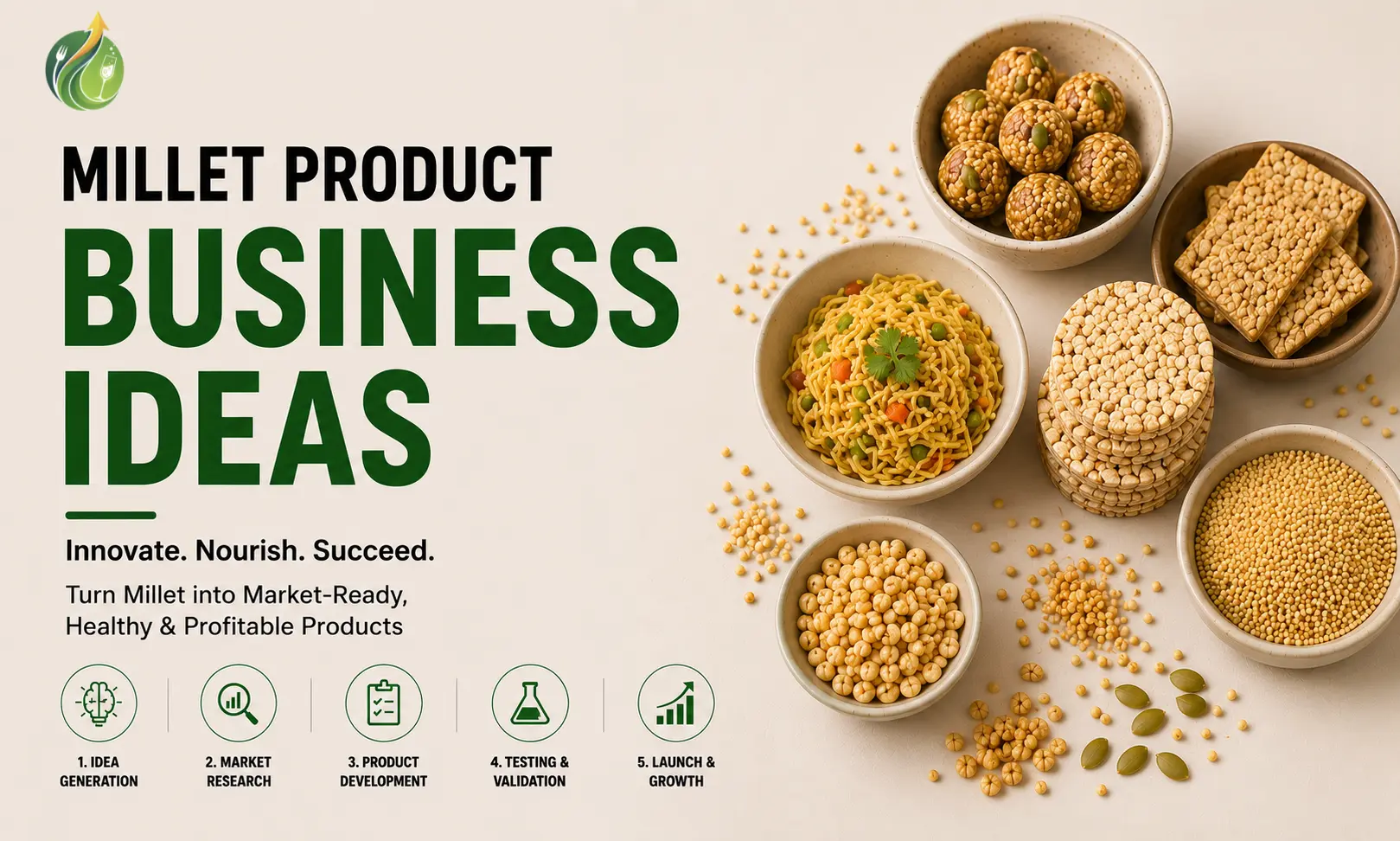
Millet product business ideas are one of the hottest opportunities in the Indian food market in 2026. After the United Nations declared 2023 the International Year of Millets, demand for jowar, ragi, bajra, foxtail, and barnyard millet products has crossed urban gym audiences into mainstream kitchens, school canteens, and quick commerce shelves. India is the world’s largest producer of millets, and value added millet products carry far higher margins than raw grain, with brands reporting gross margins between thirty five and sixty five percent.
This guide lists ten profitable millet product business ideas you can launch in 2026, with details on food product development, raw material, equipment, target customers, margins, FSSAI requirements, and how to position each product for retail, D2C, quick commerce, and exports.
Why the Millet Product Business is a Big Opportunity in 2026
The Indian millet market is being pulled by three powerful forces. The first is government support through the Shree Anna mission, public procurement, and inclusion in mid day meal programs. The second is rising consumer demand for gluten free, low glycaemic, and high fibre foods. The third is faster export growth, with millet based exports from India growing more than twenty percent year on year and crossing eighty million US dollars in the last reporting year.
Key Reasons Founders Are Entering the Millet Category
- India produces the largest share of the world’s millets and supply is stable.
- Millets are climate resilient, need less water, and grow on poor soils.
- Value added millet products carry margins between thirty five and sixty five percent.
- D2C millet brands have scaled to twenty crore rupees annual revenue within three years.
- Government schemes offer subsidies on processing units, drying, and cold storage.
10 Millet Product Business Ideas to Launch in 2026
The list below covers ten of the most promising millet product categories for new founders. Each has clear demand, defined buyers, and a workable production process. Founders should pick one hero product, lock the formulation, and scale before adding more SKUs.
1. Millet Flour and Multigrain Atta
Millet flour is the simplest entry point into the category. Single grain flours like ragi atta, jowar atta, and bajra atta sell well to home cooks. Multigrain atta blends three to five millets with whole wheat for chapatis with better nutrition. Diabetic friendly and gluten free positioning lifts the price to a premium over regular wheat flour.
Target buyers include diabetic households, fitness focused buyers, and parents. Quick commerce platforms move large volumes of small one kilogram packs.
2. Millet Breakfast Cereals and Flakes
Millet flakes, puffed millet cereals, and granola style products are growing fast as cleaner alternatives to corn flakes and chocolate cereals. Jowar flakes, ragi puffs, and foxtail millet granola with nuts, seeds, and dried fruits sit at premium price points and earn strong margins.
Target buyers include urban families, gym goers, and parents looking for protein and fibre at breakfast.
3. Millet Snack Bars and Energy Bars
Millet based snack bars combine puffed millets with dates, nuts, seeds, and natural sweeteners. They serve as a healthier alternative to chocolate based bars and crossover well into the protein bar shelf. RiteBite Max Protein Millet Wafer Bars launched in January 2026 show that even large players are entering this space.
Target buyers include office snackers, gym goers, students, and travel snackers.
4. Millet Cookies and Bakery Products
Millet cookies in flavours like jowar jaggery, ragi chocolate chip, and bajra coconut are a strong gateway product for new millet consumers. Bakery products like muffins, rusks, and breads using millet blends are gaining shelf space in premium grocery chains.
Target buyers include parents buying for school tiffins, urban families, and gift hampers.
5. Millet Snacks, Chips, and Puffs
Extruded millet snacks like puffs, chips, and rings compete directly with kurkure style snacks but with cleaner nutrition. Air fried jowar chips, ragi puffs, and roasted bajra mixes hit price points between thirty and ninety nine rupees per pack and move very well on quick commerce.
Target buyers include children, college students, and office snackers.
6. Millet Ready to Cook Mixes
Ready to cook mixes are one of the highest margin millet categories. Idli mix, dosa mix, upma mix, khichdi mix, and dhokla mix using ragi, jowar, or foxtail millet save preparation time for busy households. Brands like Soulfull and Slurrp Farm built large businesses around this format.
Target buyers include working couples, hostel students, and the Indian diaspora abroad.
7. Millet Beverages and Health Drinks
Ragi malt, jowar based hot drinks, and millet based plant milks are emerging as healthier alternatives to chocolate drinks and dairy. Single serve sachets and ready to drink bottles are both viable. Functional positioning with added vitamins, minerals, or ashwagandha lifts the price point further.
Target buyers include children, new mothers, diabetic adults, and the wellness segment.
8. Millet Pasta and Noodles
Millet pasta and millet noodles offer a gluten free, low glycaemic alternative to wheat based formats. Foxtail millet noodles, ragi pasta, and multi millet vermicelli have growing demand among health conscious urban families and the export market in North America and Europe.
Target buyers include diabetic households, gluten free shoppers, and the export wellness market.
9. Millet Baby Food and Kids Nutrition
Ragi based baby food, millet porridge mixes, and kids nutrition powders are a high trust category where parents pay premium prices. Brands like Slurrp Farm built a strong following in this niche. FSSAI compliance for baby food is strict, so founders should invest in proper R and D and lab testing.
Target buyers include parents of infants, toddlers, and school aged children.
10. Millet Based Laddoos and Indian Sweets
Traditional Indian sweets reformulated with millets, jaggery, and ghee in measured amounts find strong demand in the gift and festive market. Ragi laddoo, jowar chikki, bajra burfi, and millet protein laddoos sell at premium prices through D2C and gift hamper channels.
Target buyers include festive shoppers, gift buyers, and households cutting refined sugar.
Summary Table of 10 Millet Product Business Ideas
| Product Idea | Key Buyer | Margin Potential |
| Millet flour and multigrain atta | Home cooks, diabetic households | 30 to 45 percent |
| Millet breakfast cereals and flakes | Urban families, fitness buyers | 40 to 55 percent |
| Millet snack and energy bars | Office, gym, students | 40 to 55 percent |
| Millet cookies and bakery | Parents, gift buyers | 45 to 60 percent |
| Millet chips, puffs, snacks | Kids, college, office | 35 to 50 percent |
| Ready to cook millet mixes | Working couples, diaspora | 50 to 65 percent |
| Millet beverages and drinks | Kids, new mothers, wellness | 45 to 60 percent |
| Millet pasta and noodles | Gluten free, exports | 40 to 55 percent |
| Millet baby and kids nutrition | Parents of infants and kids | 50 to 65 percent |
| Millet laddoos and sweets | Festive and gift market | 45 to 60 percent |
Cost of Starting a Millet Product Business in India
Investment depends on which millet product you choose and whether you go private label or set up your own unit. A lean private label launch with one or two SKUs can begin between five and ten lakh rupees. An own manufacturing setup with basic processing, packaging, and quality testing usually starts around twenty lakh rupees and scales higher with automation.
| Cost Head | Approximate Range | Notes |
| Recipe and prototyping | INR 1 to 3 lakh | Food technologist and trials |
| FSSAI and other licenses | INR 10,000 to 1 lakh | Based on turnover and scope |
| Basic processing machinery | INR 5 to 25 lakh | Cleaner, dehuller, mill, packer |
| Packaging design and dies | INR 1 to 3 lakh | Logo, dieline, first print |
| Initial raw material stock | INR 2 to 6 lakh | Millets, nuts, sweeteners |
| Marketing and launch | INR 3 to 10 lakh | Ads, sampling, influencer seeding |
FSSAI and Compliance for Millet Products
Every millet product sold in India needs FSSAI registration or license, just like any other packaged food. Founders should plan compliance as part of product design rather than as an afterthought. Front of pack labelling, nutrition panels, allergen declarations, and gluten free claims all need backing from lab tests and proper documentation.
- FSSAI license: basic, state, or central depending on turnover and reach.
- Nutrition panel: protein, fibre, fat, sugar, sodium, and energy per serving.
- Gluten free claim: needs lab testing and proper substantiation.
- Organic claim: requires NPOP or PGS India certification through APEDA.
- Export compliance: APEDA registration and destination country labelling rules.
Common Mistakes Millet Product Founders Make
Most first time millet entrepreneurs repeat the same handful of avoidable mistakes. Founders who plan around these issues launch faster and stretch their initial capital further.
- Launching too many millet SKUs in the first six months instead of one hero product.
- Underestimating the short shelf life of milled millets due to rancidity issues.
- Using packaging that lets in moisture and oxygen, ruining product quality.
- Pricing on cost plus instead of competitive benchmarks across categories.
- Ignoring quick commerce and depending only on slow traditional retail channels.
- Overclaiming health benefits without lab backed nutrition and clinical support.
Millet Product Business Trends to Watch in 2026
The millet category in India in 2026 is being shaped by clear product and channel trends. Founders who design their launch around these trends find it easier to win shelf space and online visibility.
- Premium positioning: clean label, organic, and traceable single farm sourcing.
- Functional add ons: protein, fibre, probiotics, and adaptogens layered onto millet base.
- Export focus: ready to eat and ready to cook millet products for the Indian diaspora.
- Hybrid formats: millet wafers, millet protein bars, and millet pasta crossing categories.
- Government push: Shree Anna mission funds, subsidies, and millet incubation centres.
How Flavor Catalystz Supports Millet Brand Founders
Flavor Catalystz works with millet brand founders on the technical foundations of launching a strong product, including formulation, shelf life testing, FSSAI ready labels, and pilot production. Brands that align formulation, compliance, and pilot batches early launch with fewer reformulation cycles and stronger unit economics.
Final Thoughts on the Millet Product Business
The millet product business in India in 2026 is at a rare moment where government support, consumer demand, and export pull are all moving in the same direction. The founders who win this category are not the ones who launch the widest range, but the ones who lock a single strong hero product, build it on a clean label, get the FSSAI and shelf life work right, and choose a sharp channel strategy. With the right plan, a single millet product can grow into a multi crore brand within three years.
Frequently Asked Questions
Which is the most profitable millet product to launch in India?
Ready to cook millet mixes, millet based baby food, millet snack bars, and millet cookies tend to be the most profitable categories in 2026, with margins between forty five and sixty five percent.
How much investment is needed to start a millet product business?
A lean private label launch starts between five and ten lakh rupees. An own manufacturing setup with cleaning, milling, and packaging machinery typically needs twenty to forty lakh rupees including licenses, raw material, packaging, and working capital.
Is the millet business profitable in India?
Yes. Branded millet products carry gross margins between thirty five and sixty five percent. Value added formats like ready to cook mixes, snack bars, and baby food sit at the higher end of the range.
Which millet has the highest demand in India?
Ragi, jowar, and bajra have the largest established demand in India. Foxtail millet and barnyard millet are growing fastest in premium categories like ready to cook mixes, cookies, and snack bars.
Do millet products need FSSAI approval?
Yes. Every millet product sold in India needs FSSAI registration or license. Founders should plan FSSAI compliance, nutrition labelling, and any gluten free or organic claims at the formulation stage itself.
Can I start a millet product business from home?
Small scale home production is allowed with basic FSSAI registration. To scale to Amazon, quick commerce, or modern retail, founders typically need a state license and a properly equipped facility.
Which government schemes support millet businesses?
The Shree Anna mission, PMFME scheme, state level millet missions in Odisha, Karnataka, Telangana, and Andhra Pradesh, and APEDA support for exports all offer funds, subsidies, and incubation for millet startups.
What is the shelf life of millet products?
Millet flours typically last three to six months due to natural oils that turn rancid. Roasted millets, biscuits, and dry mixes last six to twelve months. Vacuum sealing, nitrogen flushing, and proper barrier packaging extend shelf life.
How do I sell millet products online in India?
Most founders start with a direct website, then list on Amazon and Flipkart, and finally enter quick commerce platforms like Blinkit, Zepto, and Swiggy Instamart. Government linked platforms and exhibitions also help discovery.
Are millet products in demand in export markets?
Yes. Millet based exports from India have crossed eighty million US dollars and are growing more than twenty percent year on year. North America, Europe, the Middle East, and Southeast Asia are the strongest export markets for value added millet products.