May 2026 · 9 min read
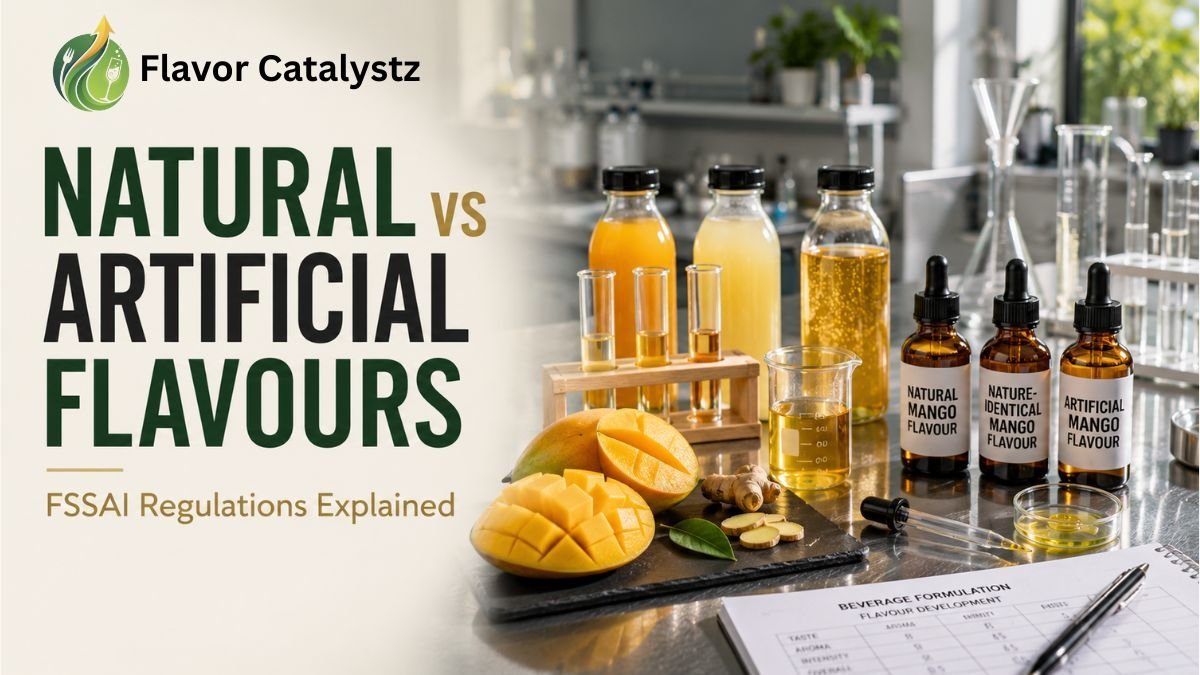
You are formulating a mango drink. Your flavour supplier offers you three options: natural mango flavour, nature-identical mango flavour, and artificial mango flavour. Each gives a slightly different taste profile, each has a different cost, and each requires a different declaration on your beverage label.
Which one can you use? What exactly do you have to write on the label? And what happens if you call your drink “natural” when it contains a nature-identical flavour?
These are not trivial questions. FSSAI has specific, detailed regulations around flavour use and declaration in beverages — and mistakes here are among the most common label compliance failures in the Indian food and beverage industry.
This guide explains the rules clearly.
The Three Categories of Flavours Under FSSAI
FSSAI’s Food Safety and Standards (Food Products Standards and Food Additives) Regulations classify flavouring substances into three categories. Understanding these categories is the foundation of flavour compliance.
1. Natural Flavouring Substances
Flavouring substances obtained exclusively by physical, microbiological, or enzymatic processes from plant or animal raw materials — either in their natural state or after processing for human consumption.
In plain terms: Extracted directly from a natural source. Real mango extract from mango fruit. Real ginger oil from ginger root. No chemical synthesis involved.
Label declaration: “Natural Flavouring Substance” or “Natural [flavour name] Flavour” (e.g., “Natural Mango Flavour”)
2. Nature-Identical Flavouring Substances
Flavouring substances that are chemically synthesised or isolated by chemical processes — but are chemically identical to natural flavouring substances.
In plain terms: Made in a lab, but the molecule is exactly the same as what you would find in nature. Vanillin synthesised from guaiacol is chemically identical to vanillin extracted from vanilla beans — but the source is synthetic. This is the most commonly used category in commercial beverage production due to cost and consistency.
Label declaration: “Nature-Identical Flavouring Substance” or “Flavouring Substance” — NOT “Natural”
Critical point: Nature-identical flavours cannot be described as “natural” on the label. This is one of the most common and consequential label errors in Indian beverages.
3. Artificial Flavouring Substances
Flavouring substances that have not been identified in a natural product — i.e., molecules that do not exist in nature and are entirely synthetic.
In plain terms: Completely man-made flavour molecules with no natural counterpart.
Label declaration: “Artificial Flavouring Substance” — must be clearly distinguished from natural and nature-identical
Flavor Catalystz
Not sure if your flavour declarations are FSSAI compliant?
From natural and nature-identical flavours to colour declarations and clean-label positioning — we help beverage brands avoid costly compliance mistakes.
FSSAI Schedule II: The Flavour Permitted List
FSSAI’s Schedule II of the Food Products Standards and Food Additives Regulations contains the list of permitted flavouring substances for use in food and beverages in India. Only substances on this list may be used as flavours in commercially produced food and beverages.
Key points about Schedule II:
- If a flavouring substance is not on Schedule II, it cannot be used in a commercial beverage regardless of whether it is “natural”
- The list is periodically updated — always verify against the current version before finalising a formulation
- International flavour suppliers typically provide documentation confirming which of their flavours comply with FSSAI Schedule II — request this from your supplier
For new or unusual flavour combinations — particularly botanical, herbal, or exotic fruit flavours — verifying Schedule II compliance is a critical step before production. Our beverage formulation service includes regulatory verification of all flavour ingredients.
How to Declare Flavours on a Beverage Label
The ingredient list on a beverage label must declare flavours using the correct category terminology. Here are the rules:
If using only natural flavours: → Declare as: “Natural Flavouring Substance” or “Natural [X] Flavour” → You may use the word “natural” in your marketing claims (subject to overall product composition)
If using nature-identical flavours: → Declare as: “Nature-Identical Flavouring Substance” or “Flavouring Substance” → You CANNOT use the word “natural” in association with the flavour → You CANNOT describe the product as “naturally flavoured”
If using artificial flavours: → Declare as: “Artificial Flavouring Substance” → Must be clearly declared — you cannot obscure this with vague terminology
If using a mix of natural and nature-identical: → Declare all types present — e.g., “Natural and Nature-Identical Flavouring Substances”
Specific flavour name: The specific flavour name (mango, strawberry, vanilla) is optional in the declaration but is commonly included for consumer clarity.
The “Natural” Claim on Beverages: When Can You Use It?
This is one of the most contested areas in beverage label compliance. FSSAI’s general principle is that claims must not be misleading — but there is no single, precisely defined threshold for what makes a product “natural.”
Practical guidance based on FSSAI’s regulatory intent:
A beverage can legitimately describe itself as “made with natural flavours” or “naturally flavoured” only if:
- All flavouring substances used are natural flavouring substances (not nature-identical or artificial)
- The overall product does not contain artificial colours, artificial preservatives, or other synthetic additives that would make a “natural” claim misleading
If your beverage uses nature-identical flavour but no artificial flavour, you cannot call it “naturally flavoured” — but you can say “no artificial flavours” if that is accurate.
Common non-compliant label language seen in Indian beverages:
- “Natural mango flavour” when the flavour is actually nature-identical ✗
- “All natural ingredients” when the product contains synthetic preservatives ✗
- “Made from natural sources” with a nature-identical flavour ✗
Colour Regulations in Beverages: Connected to Flavour Compliance
Colour and flavour compliance are often reviewed together since both affect the “natural” claim and both are governed by similar regulatory principles.
FSSAI’s Schedule III lists permitted synthetic food colours for use in food and beverages. Permitted colours include:
- Carmoisine (Red 3 / E122) — common in fruit drinks
- Tartrazine (Yellow 4 / E102) — common in lime/lemon drinks
- Sunset Yellow (E110) — orange/yellow beverages
- Brilliant Blue (E133) — blue-coloured drinks
- Allura Red (E129) — red fruit drinks
Each has a maximum permitted level per product category. Several colours permitted in India are banned in the EU (e.g., Sunset Yellow requires a warning label in the EU). This matters enormously for beverage brands with export ambitions.
Natural colour alternatives (permitted under FSSAI):
- Beetroot extract (red-pink)
- Curcumin / turmeric extract (yellow)
- Caramel colour (Class I, II, III, IV — different categories permitted for different applications)
- Anthocyanins from hibiscus, butterfly pea (pink-blue-purple)
- Chlorophyll (green)
For brands positioning as “no artificial colours,” all colour must come from natural sources — and the formulation must be designed to maintain natural colour stability through shelf life, which is a genuine technical challenge.
Flavour Compliance for Specific Beverage Categories
Fruit Beverages: If the drink is labelled as a fruit juice or nectar, the flavour contribution must come primarily from the declared fruit. Adding mango flavour to a product with minimal actual mango and calling it “mango juice” is non-compliant — both on the “juice” claim and the natural flavour claim.
Traditional Indian Beverages: Products like shikanji, jaljeera, aam panna — when commercialised — must declare all flavouring substances used. “Traditional recipe” or “homestyle” marketing language does not exempt the product from flavour declaration requirements.
Carbonated Drinks: Cola, lemon, orange flavoured sodas use predominantly nature-identical or artificial flavour profiles. These must be declared correctly — “flavouring substance” or “artificial flavouring substance” as applicable.
Functional Beverages: Herbal and botanical ingredients used as flavour and function ingredients (ginger, tulsi, ashwagandha) must be declared in the ingredient list by their common name — not hidden under generic “flavouring substance” declaration if they are ingredients in their own right.
Getting Flavour and Label Compliance Right
Flavour compliance is one of the detail-level areas where beverage label errors happen most frequently — often because brand owners rely on their flavour supplier’s documentation without verifying the label declaration implications.
A label reviewed against current FSSAI regulations — by someone who knows the nuance between “natural flavouring substance” and “nature-identical flavouring substance” and what each means for your marketing claims — is worth the investment before print.
At Flavor Catalystz, our beverage consultant team reviews formulations and labels specifically for this kind of compliance detail. Get in touch today.
FAQs: Natural and Artificial Flavours in Beverages — FSSAI
What is the difference between natural, nature-identical, and artificial flavours under FSSAI?
Natural flavours are extracted directly from plant or animal sources. Nature-identical flavours are chemically synthesised but molecularly identical to natural compounds. Artificial flavours are entirely synthetic with no natural counterpart. Each requires a different label declaration.
What is FSSAI Schedule II for flavours?
Schedule II of FSSAI’s Food Products Standards and Food Additives Regulations is the permitted list of flavouring substances that may be used in commercially produced food and beverages in India. Only substances on this list can be legally used as flavours.
Can I label my drink “naturally flavoured” if it contains nature-identical flavour?
No. Nature-identical flavours must be declared as “nature-identical flavouring substance” and cannot be described as natural. Using “naturally flavoured” or “natural flavour” language for a product using nature-identical flavour is a non-compliant claim.
What are the FSSAI rules for using artificial colours in beverages?
Artificial colours in beverages must be from FSSAI’s permitted list (Schedule III), used within maximum permitted levels for the specific product category, and declared in the ingredient list by functional class name and INS number or specific name (e.g., “Colour (INS 122)” or “Colour (Carmoisine)”).
What does “nature-identical flavouring substance” mean on a label?
It means the flavour compound is chemically synthesised but is molecularly identical to a compound that exists in nature. It is not natural — it is synthetic — but the molecule is the same as its natural counterpart.
If I use natural colour and natural flavour, can I call my beverage “all natural”?
If all ingredients — not just colour and flavour, but also preservatives, sweeteners, and all other additives — are from natural sources, a “natural” or “all natural” claim may be supportable. If any synthetic additive is present, the claim is misleading.