Jul 2026 · 10 min read
A founder rarely loses a product launch to a bad recipe. Far more often, the delay happens after the recipe is finalised — at the packaging and label stage, when a printed run gets rejected, a distributor flags a missing declaration, or a state food inspector questions a claim on the front panel. Packaging and labelling sit at the exact point where food science, design, and law intersect, and treating them as a late-stage formality is one of the most expensive mistakes a food business can make.
This guide covers what actually needs to go on a food label in India today, how the 2026 FSSAI labelling amendment changes that picture, how to think about packaging material selection, and where most brands go wrong. It is written for founders, product managers, and packaging teams who need a working reference — not a legal opinion.
What Food Packaging and Labelling Actually Cover
Packaging and labelling are two connected but distinct disciplines, and conflating them is where many first-time brands lose time.
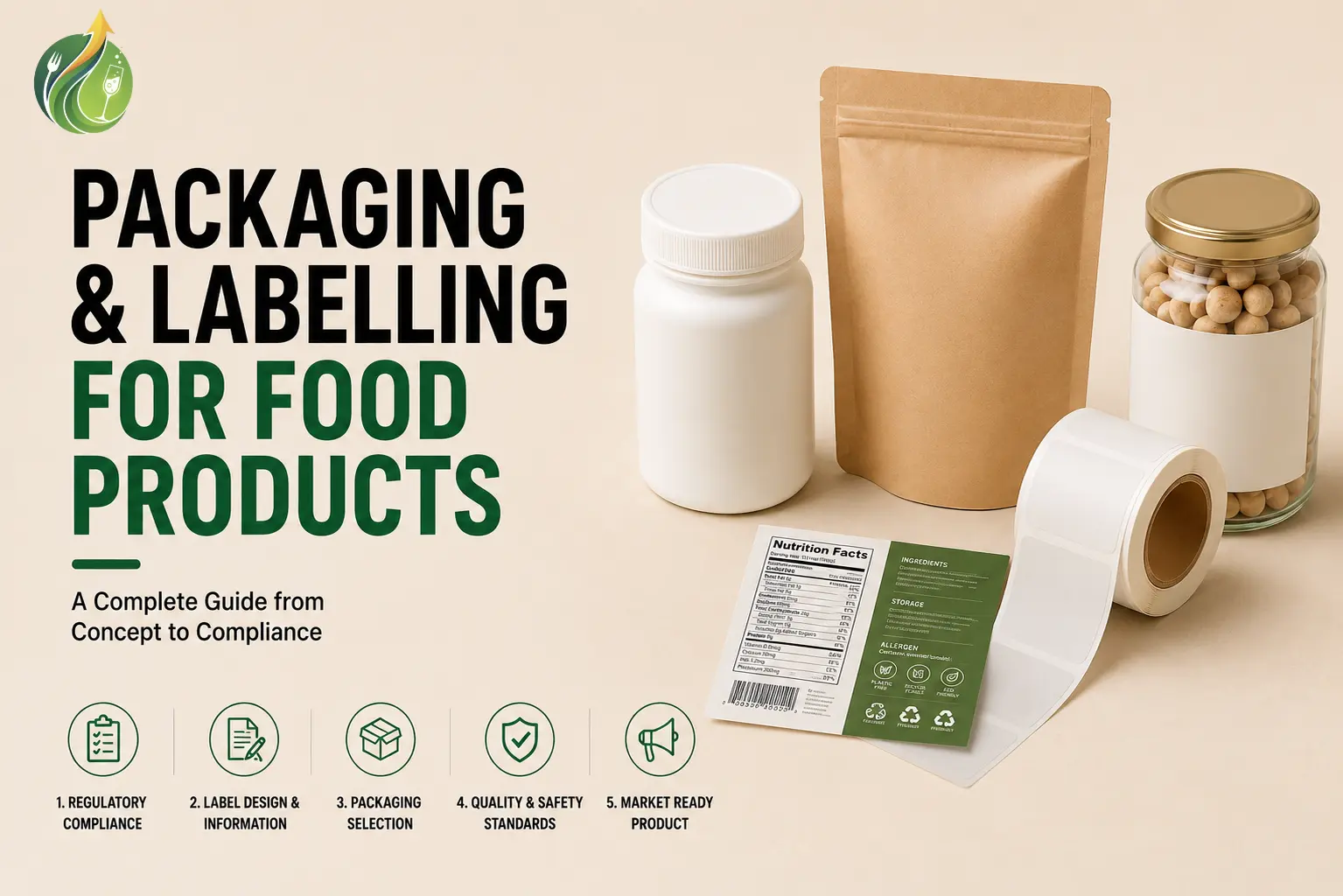
Packaging is the physical system that protects, preserves, and transports the product — the pouch, bottle, carton, or tub, along with the barrier film, seal, and closure that keep the product safe from the point of manufacture to the point of consumption. Labelling is the information layer printed or affixed to that packaging: the declarations, claims, and identifiers that a regulator, retailer, and consumer all read differently but simultaneously.
A package can be structurally excellent and still fail at market entry if the label is non-compliant. Equally, a perfectly worded label printed on packaging that cannot survive the intended shelf life or distribution route is just as costly a failure. Both have to be solved together, and both are governed — directly or indirectly — by the Food Safety and Standards Authority of India (FSSAI).
The FSSAI Mandatory Label Checklist
Every pre-packaged food product sold in India must carry a specific set of declarations under the Food Safety and Standards (Labelling and Display) Regulations, 2020. Missing even one of these is one of the most common reasons FSSAI issues notices to food businesses, and it can mean scrapping an entire print run before it reaches the shelf.
| Mandatory element | What it must include |
| Name of food | Standard/prescribed name, or a clear descriptive name; must not mislead (a “fruit drink” cannot be labelled as “fruit juice”) |
| Ingredient list | Descending order of weight; allergens highlighted in bold, italic, or a different colour within the list |
| Allergen declaration | A separate “Contains: [allergen]” statement near the ingredient list, covering the 8 major allergen categories |
| Nutritional information | Per 100g/100ml or per serving — energy, protein, carbohydrate, sugars, fat, saturated fat, trans fat, and sodium |
| Net quantity | In metric units, exclusive of packaging weight |
| FSSAI licence/registration number | The 14-digit number, starting with 1 or 2, displayed exactly as issued |
| Date marking | “Best Before” for shelf-stable products (≤3 months) or “Use By” for perishables, plus date of manufacture/packing |
| Batch/lot/code number | A traceable identifier linking the pack to its production run |
| Manufacturer details | Full name and address; for contract manufacturing, “Manufactured by [Name] for [Brand Owner]” |
| Veg/non-veg symbol | Green dot for vegetarian, brown/red dot for non-vegetarian, placed on the principal display panel |
| Country of origin | Mandatory for imported foods |
| Instructions for use | Where the product requires preparation, storage, or reconstitution guidance |
All of this must be legible, prominent, and in English or Hindi (Devanagari script); additional languages are permitted as long as they do not contradict the primary declaration.
Packaging & Labelling
Need Expert Help with FSSAI Packaging & Labelling?
Get expert guidance on FSSAI packaging rules, mandatory declarations, label design, nutrition facts, and food packaging compliance for your products.
What Changes Under the FSSAI Labelling Amendment, 2026
FSSAI notified the Food Safety and Standards (Labelling and Display) First Amendment Regulations, 2026 on March 24, 2026, with the changes scheduled to take effect from July 1, 2027. Brands planning packaging artwork now have a runway to build these into their design and print workflows rather than reprinting later.
| Change | What it means for your packaging |
| Non-retail container overhaul | Bulk/B2B packs must now show product name, FSSAI logo/licence number, date marking, storage instructions, lot number, and manufacturer details directly on the container, or in accompanying documents that are clearly traceable to it |
| Mandatory identification statement | Non-retail containers must be marked “NON-RETAIL CONTAINER” or “NOT FOR DIRECT SALE TO CONSUMER” |
| Small-pack logo exemption | Packages with a surface area of 100 sq. cm or less may omit the FSSAI logo, though it must still appear on the outer multi-unit pack |
| Infant nutrition simplification | Per-serve % RDA contribution and number-of-servings declarations are no longer mandatory for these products |
| Fortified food declaration | Every fortified product must state “fortified with [fortificant name]” alongside the prescribed fortification logo |
| Sweetener warnings | Products containing Aspartame-Acesulfame salts require a specific warning that they are not recommended for children, pregnant, or lactating women |
| Front-of-Pack Nutrition Labelling (FOPNL) | Still being finalised, but products high in fat, sugar, or salt should expect to require a visible front-panel indicator — brands should design front-panel real estate with this in mind now |
The practical takeaway: this is a compliance runway, not a deadline to ignore. Reprints are one of the costliest, most avoidable expenses in a product launch, and packaging artwork typically has a longer lead time than any other part of a launch plan.
Choosing the Right Packaging Material
Once the label content is locked, the packaging format has to match the product’s physical and chemical behaviour — its moisture sensitivity, oxygen sensitivity, fat content, and intended shelf life. A well-worded label on the wrong material still fails the product.
| Packaging type | Common materials | Best suited for |
| Flexible plastic | Multi-layer laminates, PE, PP, metallised films | Snacks, chips, dry mixes, frozen foods, liquids in pouches |
| Rigid plastic | PET, polypropylene, PVC clamshells | Dairy, cut fruit, salads, ready-to-eat meals |
| Glass | Soda-lime glass | Sauces, preserves, premium beverages, products needing full inertness |
| Paper and bagasse | Kraft paper, duplex board, moulded fibre | Bakery, dry snacks, takeaway, eco-positioned brands |
| Aluminium foil / laminate | Foil-laminate pouches | Hot foods, products needing complete light and oxygen barrier |
Two regulatory points matter here beyond FSSAI’s labelling rules. First, India’s 2022 single-use plastics restriction means any plastic packaging in use must be compliant and, for carry bags, above the prescribed thickness threshold — a detail that catches smaller manufacturers off guard when they switch converters. Second, active and smart packaging — oxygen scavengers, moisture-barrier coatings, and mono-material structures designed for easier recycling — is moving from a “nice to have” to a genuine differentiator as both regulators and quick-commerce retailers push for more recyclable formats.
This is also where packaging decisions loop back into the product itself. A shelf-life claim printed on the label has to be backed by real stability data under the packaging format actually being used — a pouch, a bottle, and a tub each create a different moisture and oxygen environment, and a formulation validated in one format cannot be assumed stable in another. Brands that plan packaging and formulation together, rather than sequentially, avoid the late-stage surprise of a product that tastes right but does not survive its stated shelf life. This is one of the reasons packaging strategy is typically built alongside the food formulation rather than after it, since the shelf-life validation, the label’s date marking, and the packaging barrier requirements all depend on the same underlying data.
Packaging and Labelling for Quick Commerce and D2C Brands
Selling through Blinkit, Zepto, Instamart, or a direct-to-consumer website adds a layer most first-time brands don’t plan for. Warehouse handling and last-mile delivery are rougher on packaging than a retail shelf — packs get stacked, dropped into delivery bags, and handled multiple times before reaching the consumer, so seal integrity and drop-resistance matter more than they do for a product that only needs to survive a supermarket aisle. On the labelling side, quick-commerce platforms increasingly cross-check the FSSAI number, nutritional panel, and allergen declaration against the product listing before onboarding a SKU, so a mismatch between the printed label and the online listing can hold up a launch independently of any FSSAI review. In our work with Flavor Catalystz clients moving from retail-only to hybrid retail-plus-quick-commerce distribution, this cross-check has become a routine, not an occasional, part of onboarding.
Common Packaging and Labelling Mistakes
Most compliance notices trace back to a small, repeatable set of errors:
- Missing or incorrect FSSAI number — printed in the wrong format, or the licence has lapsed between print approval and production.
- Wrong veg/non-veg symbol — an incorrect colour or missing symbol on the principal display panel.
- No allergen “Contains” statement — allergens listed within the ingredient panel but not called out separately.
- Ambiguous date format — mixing DD/MM/YYYY inconsistently across SKUs, or omitting “Best Before” for a shelf-stable product.
- Unsubstantiated claims — front-panel words like “immunity-boosting” or “anti-inflammatory” without the scientific substantiation FSSAI now requires for any functional claim.
- Artwork not matching the FSSAI-prescribed logo dimensions — a design team resizing a mandated logo to “fit the layout” is a routine but entirely avoidable rejection reason.
- Packaging that cannot physically survive the stated shelf life — the label promises 9 months; the barrier film cannot deliver it.
Getting packaging and labelling right is rarely about one rule — it is about sequencing decisions correctly, so the shelf-life data, the packaging material, and the printed claims all agree with each other before a single unit goes to print. Flavor Catalystz works with food and beverage brands to align formulation, packaging, and FSSAI compliance from the same development timeline, so label reprints and last-minute rejections don’t become launch-day surprises.
Frequently Asked Questions
What is the difference between food packaging and food labelling?
Packaging is the physical container and barrier material that protects and preserves the product. Labelling is the printed information on that packaging — declarations, claims, and identifiers required by FSSAI and other regulators.
What mandatory information must appear on a packaged food label in India?
Name of food, ingredient list with allergens highlighted, nutritional information, net quantity, FSSAI licence number, date marking, batch number, manufacturer details, veg/non-veg symbol, and country of origin for imports.
What is the FSSAI Labelling and Display Amendment Regulations, 2026?
It is an amendment notified on March 24, 2026, that overhauls non-retail container labelling, refines nutritional exemptions for categories like infant nutrition, and updates fortification and sweetener warning requirements. It comes into force on July 1, 2027.
What penalties apply for non-compliant food labels in India?
Non-compliance can lead to product seizure, fines that can reach up to ₹3 lakh, and in serious cases, criminal prosecution under the Food Safety and Standards Act.
How do I choose the right packaging material for my food product?
Match the material to the product’s moisture, oxygen, and fat sensitivity, plus its distribution route and target shelf life — flexible pouches for dry and frozen foods, rigid plastic or glass for liquids and dairy, and paper-based formats where an eco-positioning matters commercially.
Can I use health claims like “boosts immunity” on my food label?
Only with regulatory substantiation. FSSAI restricts disease-specific and unproven functional claims; nutrient function claims are allowed only where they are backed by permitted evidence for that specific ingredient and dosage.
Do small packages need the full FSSAI label information?
Packages with a surface area of 100 sq. cm or less may skip some declarations, including the FSSAI logo, but if sold as part of a multi-unit pack, the full information must appear on the outer packaging.
How long does it take to get packaging and labelling right before a product launch?
For a straightforward SKU, label review and packaging finalisation typically run in parallel with the last stage of formulation, adding a few weeks; for functional or novel products requiring claim substantiation, this can extend to several months.