Jul 2026 · 10 min read
Walk down any snack aisle in 2026 and popcorn no longer looks like the plain, buttered kernel it was a decade ago. Cheese, peri-peri, tandoori masala, caramel sea salt, tomato basil — flavor has become the single biggest reason a shopper picks one pack over another, and India’s popcorn category is growing faster than almost any other snack segment in the country. Yet behind every pack that tastes the same in the first handful and the last, survives a Mumbai summer in a warehouse, and can be reproduced at a 500-kilogram batch size the same way it worked in a 500-gram lab trial, sits a technical discipline that rarely gets discussed in public: popcorn seasoning formulation. It is not simply “adding masala to popcorn.” It is a precise balance of particle size, oil chemistry, moisture control and flavor release. This guide breaks down the science, the process and the common failure points, in the way a food formulation team — including the one at Flavor Catalystz — actually approaches the problem when a snack brand walks in with an idea and needs to walk out with a production-ready recipe.
Why Popcorn Seasoning Formulation Decides Whether a Snack Brand Wins or Loses on Shelf
Global popcorn sales crossed roughly USD 10.85 billion in 2026 and are projected to keep growing at close to an 11% annual rate, with Asia Pacific — and India specifically — leading growth at well over 12–14% a year, according to multiple industry market-research trackers. Cheese and gourmet flavor segments are expanding even faster than the category average, and Indian consumers in particular are gravitating toward regional profiles such as masala, tandoori and peri-peri rather than plain salted corn. What this means practically is that kernels, popping equipment and packaging formats have become largely commoditized across manufacturers. The one variable that still differentiates one brand’s popcorn from another on a crowded shelf is the seasoning: how bold it tastes on the first bite, how consistent it is from the top of the bag to the bottom, and how well it holds up after weeks in transit and storage. That is precisely why popcorn seasoning formulation, more than the popping process itself, has become the technical center of gravity for snack product development.
POPCORN SEASONING FORMULATION 2026
Develop Commercial Popcorn Seasonings with Better Flavor and Adhesion
Flavor Catalystz develops popcorn seasoning formulations with optimized spice blends, cheese powders, flavor adhesion, flowability, shelf life, and commercial manufacturing support.
The Core Building Blocks of a Popcorn Seasoning Formulation
A working seasoning is rarely a single ingredient scaled up — it is a system of functional components, each doing a specific job. The table below summarizes what each component contributes and where it typically sits by weight in a dry seasoning powder blend.
| Component | Function | Common Options | Typical Level |
| Carrier / bulking agent | Carries flavor, controls flow and bulk density | Maltodextrin, rice flour, dextrose | 40–60% |
| Salt | Baseline taste and preservation | Sodium chloride, low-sodium potassium chloride blends | 15–25% |
| Flavor system | Primary taste identity of the SKU | Spray-dried or encapsulated flavors, natural extracts, cheese powder | 8–15% |
| Fat / oil carrier | Adhesion, mouthfeel, flavor release | Palm olein, sunflower oil, ghee-flavor fat | 1–3% (dusting) to 8–10% (oil-based) |
| Acidulant | Tang, flavor lift, mild preservation | Citric acid, malic acid | 1–3% |
| Color | Visual match to the flavor promise | Turmeric, beetroot, paprika oleoresin, permitted synthetic colors | 0.1–0.5% |
| Anti-caking agent | Keeps powder free-flowing during storage | Silicon dioxide, tricalcium phosphate | 0.5–2% |
| Antioxidant | Slows fat rancidity in storage | Mixed tocopherols, rosemary extract | 0.02–0.1% |
Adhesion agents such as native or modified starch are sometimes layered on top of this base — commonly around 8–10% of the blend — specifically to help the powder cling evenly to the popcorn surface rather than settling at the bottom of the bag. Getting this ratio wrong is one of the most common reasons a lab-approved recipe underperforms once it reaches a packaging line.
The Science of Adhesion: Why Many Popcorn Seasoning Formulations Fail to Stick
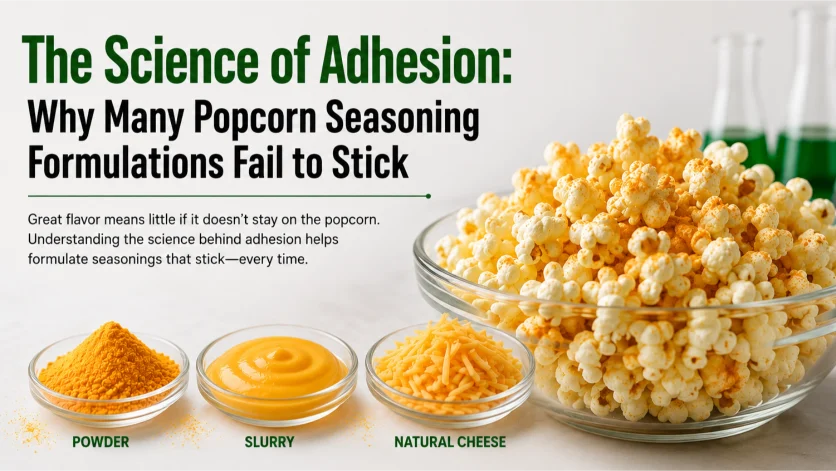
Flavor intensity on paper means nothing if the seasoning does not stay on the kernel. Adhesion is governed largely by two physical factors: particle size and surface oil. Seasoning powders generally perform best in the 50–150 micron range — fine enough to distribute evenly across every kernel, but coarse enough that it does not become airborne dust during blending and packing. A light oil film, typically around 1–2% of the popcorn’s weight, creates enough surface tension for particles in that range to cling rather than fall off during handling. Carrier agents such as maltodextrin also matter here: they can absorb several times their own weight in oil, which is part of why a maltodextrin-based carrier sticks noticeably better than loose ground spice.
| Adhesion Method | How It Works | Best Suited For | Main Limitation |
| Dry dusting on oil-popped corn | Seasoning clings to residual popping oil already on the kernel | Cinema-style, oil-popped snacks | Uneven coverage on low-oil kernels |
| Light oil-mist spray | Fine oil spray applied just before seasoning | Air-popped, baked or reduced-fat products | Adds a process step and equipment cost |
| Starch or gum binder blend | Starch swells slightly and binds particles to the surface | Long shelf-life packaged snacks | Can affect texture if overdosed |
| Water-in-oil emulsion, heat-activated | Emulsion vaporizes during microwave heating and deposits seasoning | Microwave popcorn | Needs careful emulsion stability testing |
Formulating for Different Popcorn Systems: Oil-Popped, Air-Popped and Microwave Popcorn Seasoning Formulation
A popcorn seasoning formulation that performs well on an oil-popped commercial line will not automatically perform the same way on an air-popped or microwave line, because the amount of surface oil available for adhesion is completely different in each system.
| Popping System | Baseline Surface Oil | Adhesion Challenge | Formulation Adjustment |
| Oil-popped (kettle/theatre style) | High (6–10% oil retained) | Low — oil already present | Standard dry seasoning at 5–8% inclusion |
| Air-popped / baked | Very low to none | High — nothing for powder to grip | Add oil-mist step or micro-encapsulated flavor with fat carrier |
| Microwave popcorn | Moderate, released during heating | Timing — oil and seasoning must combine mid-pop | Water/oil emulsion designed to vaporize at popping temperature |
Particle Size, Moisture Control and Shelf-Life Engineering
Once the flavor and adhesion system are settled, shelf life becomes a formulation exercise in its own right. Seasoning powders are generally engineered toward a low water activity — well under 0.4 — since moisture is what triggers clumping, microbial risk and loss of crisp texture on the popped kernel. Antioxidants such as tocopherols or rosemary extract are added specifically to slow down fat rancidity in the oil or fat carrier, which is usually the first thing to go off in a stored product, well before the flavor itself fades. On the packaging side, moisture-proof structures such as metalized BOPP laminates combined with nitrogen flushing are standard practice for maintaining both crunch and seasoning potency over a 9–12 month shelf life. Particle size distribution is typically verified through sieve analysis at every batch, since even a well-designed formulation will behave differently if the powder comes out coarser or finer than the validated specification.
Regulatory and Compliance Checkpoints for Popcorn Seasoning in India
Seasoning formulation cannot be finalized in isolation from regulatory review. In India, FSSAI’s food additive regulations govern permitted anti-caking agents, colors, antioxidants and preservatives, along with the maximum levels allowed for each category of snack food. Cheese-based seasonings need dairy allergen declaration, wheat-derived carriers need gluten disclosure, and any export-bound SKU typically has to be re-checked against the destination market’s additive list — BIS and FSSAI norms domestically, and frameworks such as the EU’s food additive regulation or US FDA rules for exports, since permitted colors and preservatives are not identical across markets. This is one of the reasons a structured food product development process treats regulatory review as a parallel workstream running alongside recipe formulation, rather than a compliance check done only after the recipe is finalized.
Common Formulation Mistakes That Cost Snack Brands Money
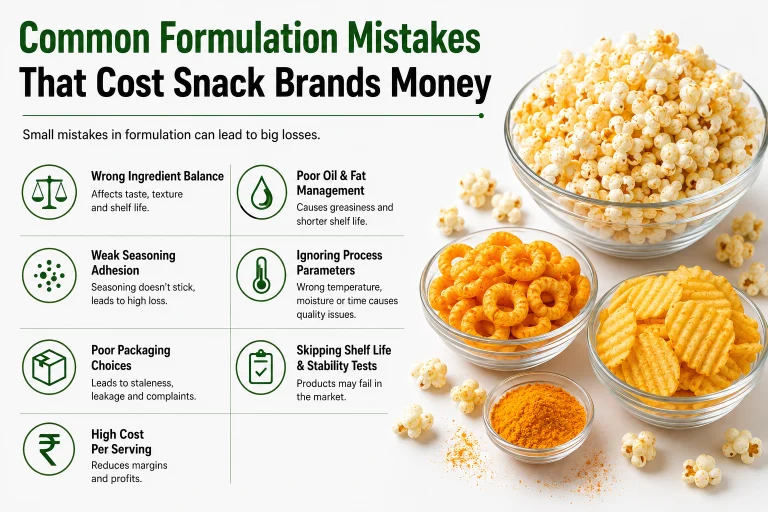
- Scaling a lab recipe by simply multiplying ingredient quantities, without re-testing adhesion at commercial mixer speed and blade type
- Ignoring water activity testing until a shelf-life complaint arrives from a distributor
- Choosing color and flavor pairings that fade or shift under high-intensity retail lighting or during transit heat
- Underestimating how the smoke point and flavor-release temperature of the chosen oil changes perceived flavor intensity
- Treating regulatory and labeling review as the very last step instead of running it in parallel with recipe trials
From Bench Recipe to Bulk Production: Scaling a Popcorn Seasoning Formulation
A recipe that tastes right in a 500-gram bench trial does not automatically behave the same way in a 500-kilogram ribbon blender. Scale-up typically involves a pilot batch to validate blend homogeneity, a recheck of sieve consistency at production speed, and a cost model that accounts for real ingredient sourcing prices rather than lab-sample pricing. Equipment matters too — a ribbon blender and a drum blender distribute oil and fine powders differently, and a formulation validated on one may need minor adjustment on the other. Brands building their first custom seasoning from scratch, rather than adapting an existing one, generally find it useful to follow a more structured, stage-by-stage development roadmap — the process of concept briefing, ingredient sourcing, bench trials, sensory panels and pilot-batch validation is covered in more depth in a companion guide to custom popcorn seasoning powder development.
Conclusion
Popcorn seasoning formulation sits at the intersection of taste, physics and regulation — and it rewards the brands that treat it as a structured discipline rather than a recipe tweak. Getting the carrier ratio right, matching the adhesion method to the popping system, and building in shelf-life and compliance checks early are what separate a seasoning that tastes good in a lab from one that performs consistently at commercial scale. Food formulation teams such as Flavor Catalystz work through exactly this sequence — component selection, adhesion testing, scale-up validation and regulatory review — when helping a snack brand move a seasoning idea from concept to a repeatable, market-ready recipe.
Frequently Asked Questions
What is the ideal shelf life of a popcorn seasoning powder?
With correct formulation — low water activity, antioxidant protection and moisture-proof packaging — a popcorn seasoning powder typically holds its flavor, color and free-flow properties for 9 to 12 months. Actual shelf life depends on the fat content of the blend, storage temperature and pack barrier quality, so it is normally confirmed through accelerated and real-time storage trials rather than assumed from a standard figure.
How much oil is needed for popcorn seasoning to stick properly?
For dry seasoning powders, a light oil film of roughly 1–2% of the popcorn’s weight is usually enough to create the surface tension needed for adhesion. Oil-popped products already carry higher residual oil and need less additional oil, while air-popped or baked products often need a dedicated oil-mist step before seasoning is applied.
What role does maltodextrin play in popcorn seasoning formulation?
Maltodextrin acts as the main carrier and bulking agent in most seasoning powders. Beyond adding bulk, it can absorb several times its own weight in oil, which improves how evenly the seasoning disperses and how well it adheres to the kernel compared to using loose ground spice alone.
Can popcorn seasoning be formulated without artificial colors or MSG?
Yes. Clean-label versions typically replace synthetic colors with turmeric, beetroot or paprika oleoresin, and replace MSG with yeast extract or mushroom-derived umami sources. These natural alternatives usually need slightly higher inclusion levels and may be less heat- or light-stable, so formulation and shelf-life testing has to account for that trade-off.
What particle size works best for popcorn seasoning powder?
Most commercial seasoning powders are formulated in the 50–150 micron range. This size distributes evenly across the kernel surface without becoming airborne dust during blending, sieving and packaging.
Why doesn’t homemade popcorn seasoning taste the same as commercial seasoning?
Homemade blends usually lack the carrier system, controlled particle size and encapsulated flavor technology used in commercial formulation. Commercial seasoning is engineered for even adhesion, consistent flavor release and extended shelf stability — factors that are difficult to replicate with a simple spice mix at home.
Is FSSAI approval required to sell seasoned popcorn in India?
Seasoned popcorn sold in India needs to comply with FSSAI’s food safety and labeling standards, including permitted additive limits, allergen declaration and license or registration requirements depending on production scale. Export markets typically add further compliance layers on top of domestic FSSAI norms.