May 2026 · 16 min read
India’s protein beverage market is at an inflection point. Just five years ago, a protein drink in India meant a thick whey shake blended at home or a powdered supplement sold in a gym. Today, it means RTD (Ready-To-Drink) protein shakes on quick-commerce, protein water with 20g+ protein per bottle, plant-based protein blends targeting vegans, and Amul entering the protein water category — signaling that this is now a mainstream Indian consumer product, not just a sports nutrition niche.
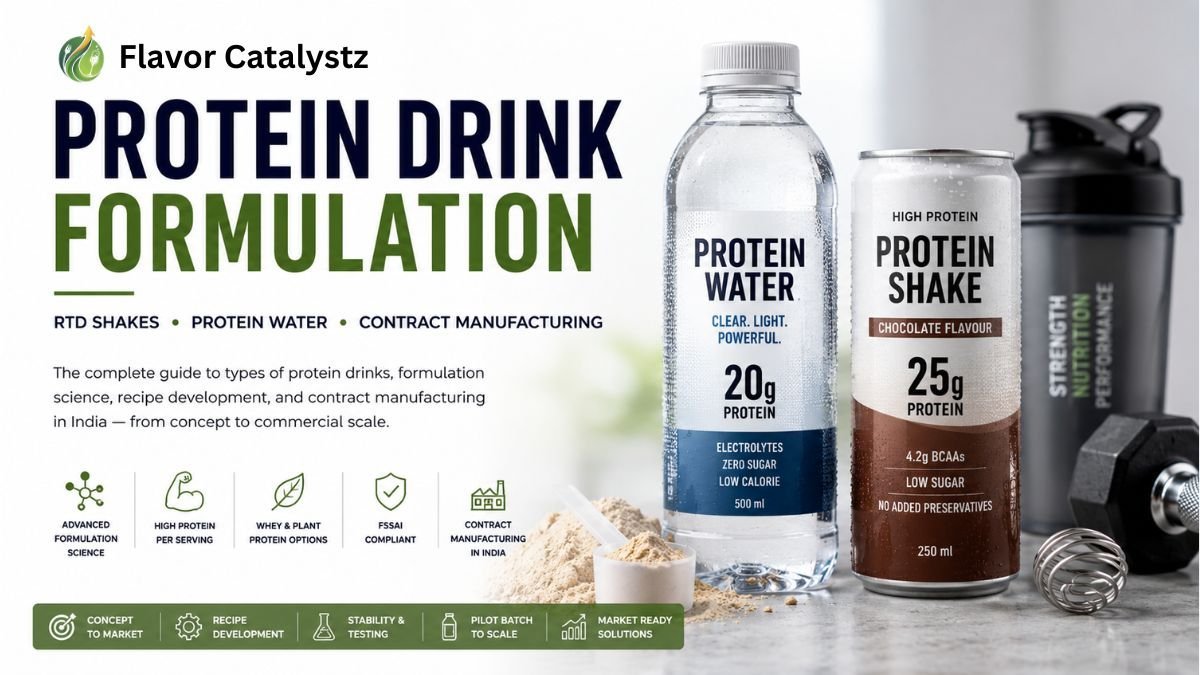
If you are a brand founder, nutrition entrepreneur, gym chain, or FMCG company looking to launch a protein drink in India — this guide covers everything: types of protein drinks and protein water, the formulation science, the commercial recipe development process, and how protein drink contract manufacturing works in India from pilot to scale.
What Are Protein Drinks? Types and Market Overview
Protein drinks are beverages that deliver a meaningful dose of protein — typically 15–35g per serving — in a convenient, ready-to-consume format. They are distinct from protein powder supplements (which must be mixed by the consumer) and from general dairy beverages like flavored milk (which deliver only 6–8g protein per serving).
| Type | Protein Content | Indian Examples | Format |
| RTD Protein Shake | 20–30g per 250ml | MuscleBlaze RTD, Fast&Up, Ritebite | PET/can, chilled or ambient |
| Protein Water (Clear) | 15–25g per 500ml | Amul Protein Water, Aquatein | PET bottle, ambient |
| Protein Milk / Flavored Milk | 15–25g per 250ml | Amul High Protein, Epigamia | Tetra Pak, glass, PET |
| Plant-Based Protein Drink | 15–25g per 300ml | Evolve, emerging D2C brands | PET, ambient/chilled |
| Protein Smoothie RTD | 15–20g per 300ml | Urban Platter, D2C brands | PET, chilled |
| Protein Collagen Water | 10–15g protein + collagen | Emerging beauty-nutrition brands | Glass/PET bottle |
| Sattu Protein Drink | 15–20g per 300ml (natural) | Regional & D2C brands, Bihar | PET, ambient |
Protein Water: India’s Fastest-Growing Protein Drink Format
Protein water is the most exciting sub-category in the Indian protein drink market right now. Unlike traditional protein shakes (opaque, milky, heavy texture), protein water is a clear, light, refreshing beverage that looks and feels like enhanced water but delivers 15–25g of protein per bottle.
What Is Protein Water?
Protein water is a clear, non-dairy, low-calorie beverage made by dissolving hydrolyzed whey protein isolate (WPI) or clear-filtered pea protein in water with flavors, acidulants, sweeteners, and electrolytes. The key technical achievement is clarity — standard whey protein in water turns white and opaque; protein water requires hydrolyzed or acid-stable protein isolates that remain transparent at the target pH (typically 3.0–3.8).
Are Proteins Soluble in Water?
Yes — proteins are soluble in water, but solubility varies significantly by protein type and processing. Whey protein isolate (WPI) is highly water-soluble at neutral pH but becomes turbid at acidic pH unless specifically hydrolyzed. Hydrolyzed whey protein isolate (h-WPI) is soluble at low pH (3.0–4.0) — making it the protein of choice for clear protein water formulations. Pea protein isolate is partially soluble but requires significant processing to achieve clarity. Casein is poorly soluble in water and not suitable for clear protein water. The answer to the common exam/search question “are proteins soluble in water” is: it depends on protein type, molecular weight, pH, and processing — but for food applications, engineered protein isolates are designed to be highly water-soluble.
Protein Water Brands in India: Current Market
The protein water market in India is young but growing fast, signaled by Amul’s entry into this category:
- Amul Protein Water: India’s largest dairy brand entered protein water in 2024 — validating the category for mass-market India. Positioned at ₹50–80 per bottle, 24g protein per 250ml, whey-based, available through milk distribution network.
- Aquatein Protein Water: One of India’s early protein water brands — aquatein protein water pioneered the clear protein water format in the D2C segment before mass brands entered.
- Emerging D2C Protein Water Brands: Multiple D2C brands are launching protein water targeting gym-goers, working professionals, and health-conscious urban consumers at ₹80–150 per bottle.
Protein Sources for Drink Formulation: Whey, Plant, and Beyond
The choice of protein source is the single most important formulation decision for any protein drink. Each protein has distinct functional properties, flavour profiles, and technical challenges in beverage applications:
| Protein Source | Protein % | Solubility in Water | Best For | Key Limitation |
| Whey Protein Isolate (WPI) | 90–95% | High at neutral pH | RTD shakes, protein milk | Turbid at acidic pH; dairy-based |
| Hydrolyzed WPI (h-WPI) | 85–92% | High at acidic pH (3.0–4.0) | Clear protein water, fruit-flavored RTD | Higher cost; slight bitter note |
| Casein / Micellar Casein | 80–90% | Low in water | Slow-release protein products | Not suitable for clear beverages |
| Soy Protein Isolate (SPI) | 90–92% | Medium | Plant-based RTD, dairy-free | Beany off-note requires masking |
| Pea Protein Isolate (PPI) | 85–90% | Medium (processed) | Vegan protein drinks, plant-based | Earthy flavor; colour in beverage |
| Rice Protein Isolate | 75–85% | Medium | Hypoallergenic protein drinks | Lower amino acid completeness |
| Sattu (Chickpea Protein) | 20–25% whole, conc. available | Good in acidic medium | Traditional protein water (Indian) | Sedimentation in RTD; indigenous |
| Collagen Hydrolysate | 90%+ | High at all pH | Beauty protein water, skin-health drinks | Incomplete amino acid profile; cost |
Protein Drink Recipe Formulation: The Science Explained
Protein drink recipe formulation is technically more complex than most other beverage categories. Proteins are large, active molecules that interact with pH, heat, minerals, and other ingredients in ways that dramatically affect texture, appearance, taste, and shelf life. Here is a structured breakdown of the formulation science:
1. Protein Level and Source Selection
Define your protein target (typically 15–30g per serving) and select the protein source based on: product format (opaque shake = WPI or casein; clear water = h-WPI), consumer positioning (dairy = whey; vegan = pea/rice/soy), price point (h-WPI most expensive; soy protein most economical), and flavor compatibility (vanilla, chocolate flavors work well with whey; fruit flavors work better with h-WPI at low pH).
2. pH Engineering — The Most Critical Step
pH is the single most important variable in protein drink formulation. Standard WPI has a pI (isoelectric point) of approximately 5.0 — the pH at which it is least soluble and most likely to precipitate. This is why protein drinks must be formulated AWAY from pH 5.0: RTD protein shakes are formulated at pH 6.5–7.0 (above pI, protein is soluble and negatively charged). Clear protein water (h-WPI) is formulated at pH 3.0–3.8 (far below pI, protein is positively charged and soluble in acidic medium). Getting pH wrong is the #1 cause of protein precipitation, sedimentation, and product failure in beverage development.
3. Sweetener System
Protein drinks are typically low-sugar or sugar-free to align with their health positioning. Sweetener options: Sucralose — most common; pH-stable, excellent heat stability, clean taste; 600x sweeter than sugar. Stevia (Rebaudioside A) — natural; slight licorice aftertaste that needs masking with flavor; preferred for clean-label brands. Acesulfame-K (Ace-K) — commonly blended with sucralose to improve sweetness profile. Erythritol — natural, zero calorie; good mouthfeel restoration, works well in protein shakes. Standard sugar at 4–6% w/v — suitable for mass-market protein drinks where calorie content is not the primary concern.
4. Flavour System and Off-Note Masking
All proteins — especially plant proteins — carry inherent off-notes: whey has a milky, slightly sulfurous note; pea protein has an earthy, beany character; soy protein has a distinct beany off-note. Professional protein drink formulation requires flavour masking at two levels: primary flavour (chocolate, vanilla, strawberry, mango) to create the desired taste identity, and a masking agent — specific molecular compounds (typically aldehydes, esters) that bind to the protein off-note compounds and neutralize their perception. This is one of the areas where expert formulation knowledge makes the biggest difference.
5. Emulsification and Texture
For opaque RTD protein shakes and protein milk, emulsification is critical to achieving a smooth, stable texture without sedimentation. Common emulsifiers: Sunflower lecithin (preferred over soy lecithin for cleaner label), carrageenan (for dairy protein stability in milk systems), and xanthan gum (low levels — 0.05–0.1% — for light body and suspension stability). Over-use of hydrocolloids makes a protein drink feel gummy or slimy — the goal is the minimum level necessary for stability.
6. Heat Stability and Processing Technology
Proteins denature (unfold and aggregate) when heated, which causes protein drinks to become gritty, lumpy, or opaque during processing. Commercial protein drink production uses one of two approaches: UHT (Ultra-High Temperature) processing — 135–145°C for 2–5 seconds; achieves commercial sterility for 9–12 months ambient shelf life; requires protein ingredients specifically tested for heat stability. Cold-fill (aseptic) processing — no heat applied; protein integrity preserved; requires aseptic filling line and pre-sterilized packaging. For clear protein water at low pH, hot-fill at 85°C for 15–20 seconds can also achieve adequate shelf life due to the protective effect of acidity.
Commercial Protein Drink Base Recipe: RTD Protein Shake and Protein Water
Base Formula 1: Clear Protein Water (Per 500ml bottle, 20g protein)
| Ingredient | Quantity | Function |
| Hydrolyzed Whey Protein Isolate (h-WPI) | 20–22 g | Primary protein source; clear at low pH |
| Water (RO-treated) | Fill to 500ml | Carrier base |
| Citric Acid | 1.8–2.2 g | pH reduction to 3.0–3.5; flavor sharpness |
| Sweetener (Sucralose) | 0.04–0.06 g | Sweetness balance |
| Fruit Flavour Concentrate | 0.3–0.8 ml | Taste identity (lemon, mango, berry) |
| Electrolytes (Sodium, Potassium) | 0.1–0.3 g blend | Hydration + mild salty mouthfeel |
| Vitamin C (Ascorbic Acid) | 0.05 g | Antioxidant + label claim |
| Colour (if required) | 0.001–0.01 g | FSSAI-approved natural color |
Base Formula 2: RTD Protein Shake — Chocolate Whey (Per 250ml, 25g protein)
| Ingredient | Quantity | Function |
| Whey Protein Isolate (WPI 90%) | 25–28 g | Primary protein; 25g protein per serving |
| Water (RO-treated) | Fill to 250ml | Carrier base |
| Skim Milk Powder (optional) | 5–10 g | Creaminess, additional protein, calcium |
| Cocoa Powder (alkalized) | 3–5 g | Chocolate flavour and colour |
| Sucralose + Ace-K blend | 0.05–0.1 g | Sweetness (sugar-free version) |
| Sunflower Lecithin | 0.5–1.0 g | Emulsification, smooth mouthfeel |
| Xanthan Gum | 0.1–0.2 g | Suspension, body, prevent sedimentation |
| Carrageenan (Iota) | 0.02–0.05 g | Protein stability in dairy system |
| Chocolate Flavour + Masking Agent | 0.3–0.8 ml | Flavour identity + whey off-note masking |
| Vitamin & Mineral Premix | 1.0–2.0 g | Nutritional fortification, label claims |
Protein Drink Contract Manufacturing in India: How It Works
Protein drink contract manufacturing is the process of outsourcing the production of your protein beverage — whether RTD shake, protein water, or protein milk — to a specialist manufacturer who has the equipment, regulatory credentials, and quality systems to produce it at scale. This is the preferred model for most new protein drink brands in India because it eliminates the need for ₹5–15 crore factory investment during the validation phase.
What to Look For in a Protein Drink Contract Manufacturer
- FSSAI Central Manufacturing License: Essential — all protein drink contract manufacturers must be FSSAI-licensed. Check their license category covers beverages and health supplements.
- GMP + HACCP Certification: Protein beverages have high microbiological risk. Ensure your contract manufacturer operates under GMP and HACCP food safety systems.
- Protein-Specific Processing Equipment: UHT line or aseptic filler for ambient shelf-stable protein drinks; cold chain infrastructure for refrigerated RTD shakes; protein dissolving tanks with controlled shear mixing.
- Clean-Room Filling Capability: Protein beverages require microbiologically controlled filling environments — standard beverage filling lines are not always adequate.
- Minimum Order Quantity (MOQ): Most protein drink contract manufacturers in India have MOQs of 2,000–10,000 units for pilot batches. Clarify this upfront.
- Quality Control Lab: In-house or accredited third-party QC lab for protein content verification (Kjeldahl/Dumas method), microbiological testing, and FSSAI label compliance testing.
Protein Drink Contract Manufacturing Cost in India
| Cost Head | Cost Range | Notes |
| Protein Drink Formulation R&D | ₹80,000 – ₹3,00,000 | Higher cost for protein beverages vs standard CSD |
| Lab Testing (protein content, micro, stability) | ₹25,000 – ₹80,000 | Protein verification + full shelf life study |
| FSSAI Compliance + Label Review | ₹15,000 – ₹40,000 | Including health claim substantiation if applicable |
| h-WPI Raw Material (per kg) | ₹800 – ₹2,500/kg | Hydrolyzed WPI significantly pricier than standard WPI |
| Standard WPI Raw Material (per kg) | ₹600 – ₹1,400/kg | Whey protein isolate |
| Pea Protein Isolate (per kg) | ₹200 – ₹500/kg | Most economical plant protein for India |
| Contract Manufacturing (per unit) | ₹18 – ₹55/unit | Higher than standard beverage due to protein handling |
| Packaging (PET + label, 250ml) | ₹4 – ₹12/unit | CSD-grade PET or food-grade barrier PET |
| Total Pilot (5,000 units, 250ml) | ₹3,00,000 – ₹12,00,000 | Full pilot including R&D, testing, and production |
Protein Water Contract Manufacturing in India: What’s Different
Protein water contract manufacturing has specific requirements that distinguish it from standard RTD protein shake manufacturing:
- Acidic pH manufacturing — most protein water is manufactured at pH 3.0–3.8, requiring acid-resistant SS316 tanks and dosing systems that standard beverage facilities may not have
- h-WPI handling — hydrolyzed whey protein isolate is hygroscopic (absorbs moisture) and must be stored and handled in controlled-humidity environments to prevent clumping and quality degradation
- Turbidity validation — protein water clarity must be validated against a turbidity standard (typically <5 NTU) at time of production and throughout shelf life; any hazing is a product failure
- Hot-fill capability — protein water at pH 3.0–3.5 can be hot-filled at 85°C without protein denaturation issues (unlike neutral pH protein shakes which require aseptic or cold-fill); confirms manufacturer has hot-fill PET capability
- Flavor compatibility — h-WPI has a slight bitterness from hydrolysis; fruit flavors (lemon, mango, berry) are specifically chosen to mask this; manufacturer must be able to work with high-flavor-load systems
FSSAI Compliance for Protein Drinks in India
Protein drinks in India are regulated under multiple FSSAI categories depending on product type:
- RTD Protein Shakes (dairy-based) → Category 1.2 (Fermented/processed milk products) or Category 6.3 (Cereal/legume products) depending on base
- Clear Protein Water → Category 14.1.4 (Water-based flavoured drinks) — critical: must not make unauthorized health claims
- Protein Supplements (functional) → Category 13.6 (Foods for Special Dietary Use) — requires specific regulatory notification
- Plant-Based Protein Drinks → Category 1.2.9 (Processed plant-based dairy alternatives) — new FSSAI framework
Key compliance watch-points: Protein content claims on label (“20g protein per serving”) must be supported by lab analysis. Health claims (“supports muscle recovery,” “aids weight loss”) require FSSAI Health Claims Regulation 2022 substantiation. Amino acid profiles may need to be declared for products positioned as complete protein sources. FSSAI Schedule 7 compliance for all added vitamins and minerals.
Full FSSAI compliance walkthrough available in our FSSAI beverage compliance guide.
How Flavor Catalystz Helps With Protein Drink Development
Protein drink formulation is one of the most technically demanding beverage development projects — pH management, protein heat stability, off-note masking, emulsification, and FSSAI health claim compliance all require specialist expertise. Flavor Catalystz provides:
- Full protein drink recipe formulation — clear protein water, RTD shakes, protein milk, plant-based protein beverages
- Protein source selection and vendor qualification — h-WPI, WPI, soy, pea, rice protein from FSSAI-approved suppliers
- pH optimization and turbidity validation for clear protein water
- Off-note masking and flavor development — proprietary masking systems for whey, pea, and soy off-notes
- UHT and hot-fill stability validation — shelf life studies at accelerated conditions
- FSSAI compliance and label review — protein content claims, health claim substantiation, and category classification
- Contract manufacturer identification — connecting you to protein-capable co-manufacturers across India
For global protein beverage market data, see Grand View Research — Protein Beverages Market. For protein science reference, see FSSAI.gov.in — Food Product Standards.
Also Read From Flavor Catalystz
- How to Make Protein Water in India — Complete Guide
- Functional Beverage Development India
- Beverage Contract Manufacturing India
- Natural Electrolyte Drink Recipe Development
- Beverage Formulation Cost India
- Non-Alcoholic Beverage Development India
Conclusion: The Protein Drink Market in India Is Wide Open
India’s protein drink and protein water market is at an early inflection point — Amul’s entry signals mass-market validation, but the category is far from saturated. The brands that win will be the ones that get the formulation right: the right protein source, the right pH, the right flavor system, the right packaging, and the right contract manufacturing partner.
Flavor Catalystz has the technical depth to develop your protein drink from concept to commercial production — and the manufacturing network to scale it. Whether you want to launch a clear protein water, a chocolate whey shake, or a plant-based protein drink for the Indian market, we are ready to start.
FAQs
What is protein water and how is it different from a protein shake?
Protein water is a clear, water-like beverage containing 15–25g protein per bottle, made using hydrolyzed whey protein isolate (h-WPI) that stays transparent at acidic pH (3.0–3.8). A protein shake is opaque and creamy, typically made with standard WPI or casein at neutral pH. Protein water is lighter, lower calorie, and more hydrating in character; protein shakes provide more satiety and a richer mouthfeel.
Are proteins soluble in water?
Yes — proteins can dissolve in water, but solubility depends on protein type and pH. Hydrolyzed whey protein isolate (h-WPI) is soluble at acidic pH (3.0–4.0), making it ideal for clear protein water. Standard WPI is soluble at neutral pH (6.5–7.0). Casein has low water solubility. Pea and soy protein isolates have moderate solubility and require processing to achieve clarity.
What is protein drink contract manufacturing?
It is outsourcing the production of your protein beverage (RTD shake, protein water, protein milk) to a specialized co-manufacturer. The manufacturer handles raw material procurement, mixing, processing (UHT or hot-fill), filling, and quality control. You own the brand and formulation; they provide the facility and equipment. Most protein drink contract manufacturers in India require MOQs of 2,000–10,000 units and produce at ₹18–55 per unit depending on format.
How much protein is in water (naturally)?
Natural water contains no protein. Protein water is a formulated product — plain water (mineral, tap, RO) has zero protein content. The protein content of ‘protein water’ products (15–25g per bottle) comes entirely from dissolved protein ingredients (h-WPI, pea protein) added during manufacturing.
What is the best protein source for a clear protein water drink?
Hydrolyzed Whey Protein Isolate (h-WPI) is the best-established protein source for clear protein water. It remains soluble and transparent at acidic pH (3.0–3.8), is highly bioavailable, has a complete amino acid profile (BCAA-rich), and pairs well with fruit flavors. Plant-based alternatives for clear protein water include clear-filtered pea protein and rice protein hydrolysate — both require more formulation work to achieve adequate clarity.
Will drinking water reduce protein in urine?
Increased water intake can help dilute urine and reduce the concentration of protein in urine (proteinuria), which may lower apparent protein levels in a urine test. However, persistent proteinuria is a medical condition that requires physician evaluation — it may indicate kidney disease and should not be self-treated by increasing water intake alone. If you have concerns about protein in urine, please consult a doctor.
What FSSAI category applies to protein water in India?
Protein water (clear, low pH, no dairy) falls under FSSAI Category 14.1.4 (Water-based flavoured drinks) for basic labeling purposes. If the product makes protein content claims (“20g protein per serving”), these must be substantiated by lab analysis. If functional or therapeutic claims are made, the product may require classification under Category 13.6 (Foods for Special Dietary Use), which has additional regulatory requirements.
What is the minimum order quantity (MOQ) for protein drink contract manufacturing in India?
Most protein drink contract manufacturers in India operate with MOQs of 2,000–10,000 units for pilot batches, depending on the production format (UHT, hot-fill, cold-fill). For a 250ml PET bottle format, a typical 5,000-unit pilot run costs ₹3–12 lakh all-in (including formulation, testing, packaging, and production). Larger commercial runs (50,000+ units) bring per-unit costs down significantly.