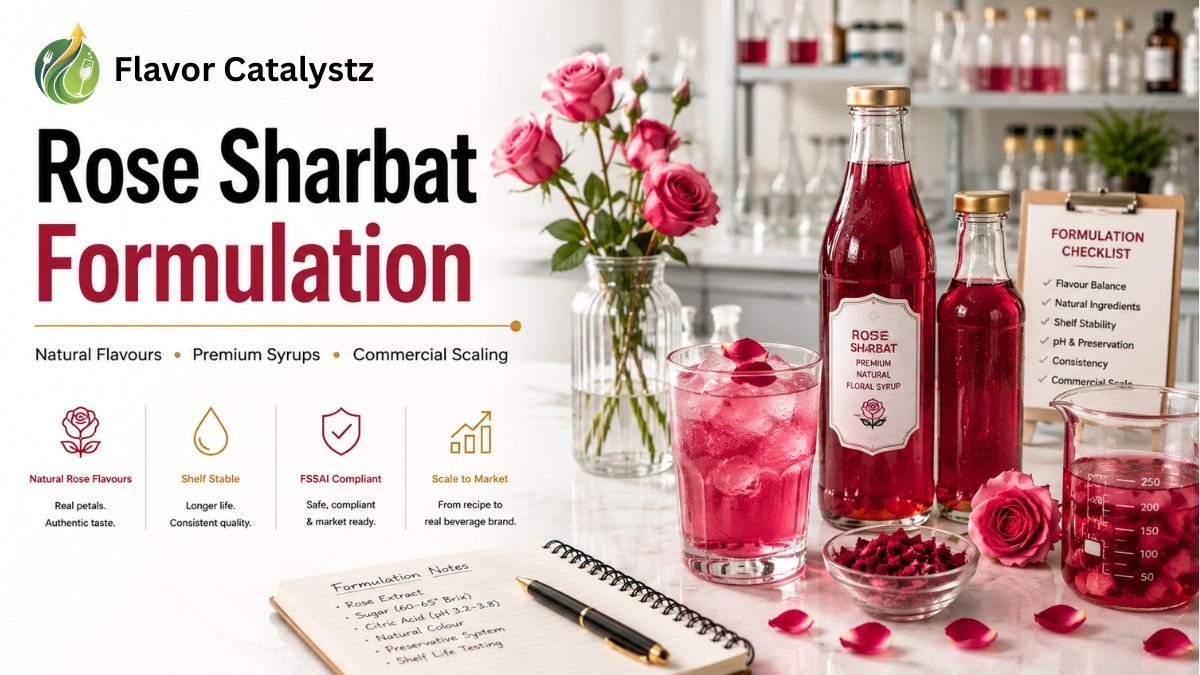
May 2026 · 9 min read
Rose sharbat is one of those beverages that every Indian has a memory attached to. The deep pink colour in a tall glass of cold water, the unmistakable floral sweetness, the cooling sensation on a May afternoon — it is as much a part of summer in India as mangoes and ceiling fans.
And yet, despite this cultural ubiquity, the commercial rose sharbat market in India is remarkably underdeveloped. Most branded rose syrups are loaded with synthetic colour and artificial rose flavour. Nobody has done a genuinely premium, natural rose sharbat that earns a place on modern cafe menus and wellness retail shelves.
That is the opportunity this guide is about.
Whether you want to launch a rose syrup brand in India, develop a ready-to-drink gulab sharbat, or create a floral beverage as part of a broader Indian traditional drinks brand — here is everything you need to understand about rose sharbat formulation at commercial scale.
What Is Rose Sharbat and Why Is It a Commercial Opportunity?
Rose sharbat (also spelled rose sherbet or gulab sharbat) is a traditional Indian sweetened beverage concentrate made from rose petals or rose extract, sugar, and water — sometimes with additions like rose water, citric acid, cardamom, or gulkand (rose petal preserve).
It is consumed across India, particularly in North India, during summers and at festive occasions. Rooh Afza — arguably the most famous rose sharbat brand in India — has been around for over a century and still commands enormous loyalty. But beyond Rooh Afza and a handful of regional syrups, the category is largely untapped by modern, premium, or natural-positioning brands.
The commercial opportunity lies in the gap between what the market currently offers and what today’s consumers want:
- Natural ingredients and clean labels (no artificial colours, no synthetic flavours)
- Premium packaging that reflects the heritage and beauty of the product
- Contemporary formats — RTD drinks, sparkling rose sharbat, rose sharbat mocktail bases
- Functional positioning — rose has documented cooling (thandai) properties and is associated with Ayurvedic wellness
A well-formulated, well-positioned rose sharbat brand targeting the premium urban consumer has significant commercial headroom.
Flavor Catalystz
Want to launch a premium rose sharbat brand in India?
From natural rose flavour formulation and shelf-life stability to FSSAI compliance and commercial production — we help brands develop scalable floral beverage products.
The Core Ingredients in Rose Sharbat Formulation
Getting the ingredients right is everything in rose sharbat. Here is how each component works:
Rose Extract or Rose Distillate
The primary flavour carrier. Commercial rose sharbat formulation can use:
- Rose water (Gulab Jal): A distillate of rose petals in water. Widely available, consistent in quality when sourced from reputed suppliers. Concentration varies — typically 1–3% by volume in the final syrup.
- Rose absolute or rose extract: More concentrated and more expensive. Used in smaller quantities for high-intensity flavour. More common in premium positioning.
- Dried rose petal infusion: Steep dried rose petals (Damask rose or Desi Gulab) in warm water, strain, and concentrate. This gives the most authentic flavour but has the shortest shelf stability without additional preservation.
- Natural rose flavour (FSSAI-approved): Standardised extract used in commercial production for consistent flavour delivery batch to batch.
For a premium brand claiming “natural” on the label, rose water combined with natural rose flavour is typically the most practical and FSSAI-compliant approach.
Sweetener System
Traditional rose sharbat uses sugar — and for authentic flavour, a sugar-based formula is hard to beat. However, the sweetener choice has significant formulation and marketing implications:
- Refined sugar (sucrose): Gives the cleanest, most neutral sweetness. Standard Brix target for rose syrup is 60–65° Brix for a 1:5 dilution ratio.
- Khandsari or raw cane sugar: Adds a slight caramel note that complements the floral character. Works well for artisanal or heritage positioning.
- Reduced sugar / low calorie: Use of stevia or erythritol to partially replace sugar — relevant for health-conscious positioning. Note: sweetener combinations need to be checked against FSSAI’s permitted additives list.
Colour
Natural rose sharbat colour comes from the rose petals themselves — a pale pink to light rose. Commercial brands often add colour to deepen this:
- Natural colour options: Beetroot extract (gives a red-pink hue), carmine (deep red, not vegan), hibiscus extract (pink-red, pH sensitive)
- Synthetic option: Carmoisine (Red 10) — permitted under FSSAI, gives the classic deep pink Rooh Afza look
- Clean label positioning: Butterfly pea flower + hibiscus combination can achieve beautiful pink-to-purple tones naturally
The choice between natural and synthetic colour is a brand positioning decision as much as a formulation one.
Acidulant
Citric acid (permitted under FSSAI) is used in rose sharbat for two reasons: flavour balance (cutting the sweetness and adding brightness) and preservation (lowering pH to inhibit microbial growth). Target pH for a stable rose sharbat syrup is 3.2–3.8.
Preservation System
For a commercial syrup with ambient shelf life:
- Sodium benzoate (E211): Widely used in India, FSSAI-permitted in beverages at up to 250mg/kg. Very effective at the pH range used in sharbat.
- Potassium sorbate (E202): Used alone or in combination with sodium benzoate. Effective against yeast and moulds.
- Clean label approach: High sugar concentration (60°+ Brix) itself provides preservation by reducing water activity. Combined with low pH, a natural-label syrup with no declared preservatives is possible — but requires stricter processing controls.
Optional Traditional Additions
- Gulkand: Rose petal jam. Adds depth, a slightly fermented-floral note, and authentic character. Challenges: colour stability and texture in liquid.
- Cardamom (Elaichi): A small quantity elevates the overall aromatic complexity significantly.
- Kewra water: Traditional north Indian floral water that complements rose beautifully.
Rose Sharbat Formulation for Different Commercial Formats
The formulation changes depending on the product format you are targeting:
Concentrated Syrup (1:5 or 1:7 dilution ratio)
The most commercially practical format. High Brix, long shelf life, low shipping weight. Consumer dilutes with water, soda, or milk. This is the Rooh Afza model. Target: 60–65° Brix, pH 3.2–3.8, shelf life 12–18 months ambient.
Ready-to-Drink (RTD) Rose Sharbat
A pre-diluted, ready-to-consume drink. Lower Brix (8–12°), lower sweetness, more refreshing. Requires either: UHT processing + aseptic filling for ambient shelf life, or cold chain distribution for a shorter-shelf-life fresh positioning. Target: pH below 4.0, shelf life 6–12 months (ambient UHT) or 30–60 days (chilled).
Sparkling Rose Sharbat
A carbonated RTD that positions gulab sharbat for the modern cafe and restaurant market. Formulation must account for carbonation (CO₂ affects flavour perception — increase sweetness slightly), and packaging must handle internal pressure (glass or aluminium preferred over PET for premium positioning).
Rose Sharbat Mocktail Base / Mixer
A versatile concentrate designed for bartenders and cafes — dilute with tonic water, sparkling water, or lime soda to create signature mocktails. Premium packaging, smaller bottle sizes (250ml–500ml), and strong recipe serving suggestions. This format has high margin potential and strong HoReCa placement opportunity.
FSSAI Compliance for Rose Sharbat
Understanding the regulatory landscape is essential before any commercial launch.
Rose sharbat falls under the FSSAI category of “Fruit-based beverages” or “Sharbat/Squash” depending on the format. Key compliance requirements:
- Licence: FSSAI Central Licence for manufacturing (turnover above ₹20 lakh). State licence for smaller operations. Your product category determines the applicable standards.
- Permitted ingredients: All colours, flavours, preservatives, and sweeteners must be from FSSAI’s approved list. Natural rose flavour must be declared as “natural flavouring substance” on label.
- Label requirements: Product name, ingredient list (in descending order), nutritional information per 100ml, net weight, manufacturer details, FSSAI licence number, best before date, and batch code.
- Claims: “Natural,” “No artificial colour,” “Made with real rose” — each claim has a regulatory definition and cannot be used loosely. A beverage consultant can review your label claims before printing.
- Lab testing: Commercial launch typically requires third-party lab testing for microbiological safety, heavy metals, and preservative levels.
Navigating FSSAI for a traditional beverage like rose sharbat is manageable — but the details matter. Our beverage consultant team guides brands through the compliance process from licence application to label sign-off.
How to Commercialise Rose Sharbat: The Step-by-Step Path
Here is the practical roadmap for a rose sharbat brand launch in India:
Step 1 — Recipe Development and Formulation
Define your product format (syrup, RTD, sparkling). Develop your base formulation — flavour profile, Brix, pH, colour, preservation system. Run sensory panels. Finalise the formula.
Step 2 — Stability Testing
Test the product at accelerated (40°C, 75% RH) and ambient conditions to confirm shelf life claims. This typically takes 4–12 weeks depending on target shelf life.
Step 3 — FSSAI Licensing
Apply for the appropriate FSSAI licence. Prepare your product dossier — formulation details, ingredient specifications, process description.
Step 4 — Label Design and Review
Design packaging with all mandatory FSSAI label elements. Get the label reviewed against regulations before printing. Errors here are expensive to correct post-print.
Step 5 — Manufacturer Selection and Trial Run
Identify a contract manufacturer with experience in syrup or RTD beverage production. Run a pilot batch. Evaluate quality against your approved specification.
Step 6 — Go-to-Market
Define your channel strategy — direct-to-consumer (D2C online), modern trade, HoReCa, or gifting. Build your launch plan around the channel’s requirements.
For end-to-end support on this journey, see our beverage formulation service and how to start a beverage brand in India.
Ready to Build Your Rose Sharbat Brand?
Rose sharbat has everything a modern premium beverage needs — deep cultural roots, beautiful visual identity, documented wellness associations, and a flavour profile that works across multiple formats and occasions. The gap in the market is real. The consumer appetite is there.
What it takes to capitalise on that opportunity is a technically sound product, a well-structured brand, and a reliable commercialisation path.
Talk to our team at Flavor Catalystz — and let’s build the rose sharbat brand the Indian market has been waiting for.
FAQs
What is the difference between rose sharbat and rose syrup?
They are often used interchangeably, but technically rose sharbat (or sherbet) is the ready-to-drink diluted version, while rose syrup is the concentrated base. Commercially, both terms are used for concentrated products.
What gives rose sharbat its pink colour naturally?
The natural colour in rose sharbat comes from rose petals (pale pink), and is often enhanced with hibiscus extract, beetroot extract, or butterfly pea flower for a deeper, more vibrant hue without synthetic colours.
How long does commercial rose sharbat last?
A properly formulated rose syrup with correct preservation and packaging typically lasts 12–18 months at ambient temperature. RTD formats using UHT processing can achieve 6–12 months ambient. Naturally preserved versions with high Brix and low pH can achieve comparable shelf life with clean label status.
Is FSSAI approval required to sell rose sharbat commercially in India?
Yes. Any food or beverage sold commercially in India requires FSSAI registration or licensing. The licence type (registration, state, or central) depends on your business size and turnover.
Can rose sharbat be made without preservatives?
Yes — a high-sugar syrup (60°+ Brix) at low pH (below 3.5) has significant natural preservation. However, this approach requires stringent processing hygiene and appropriate packaging. For broader distribution, a minimal preservation system is recommended.