Jun 2026 · 8 min read
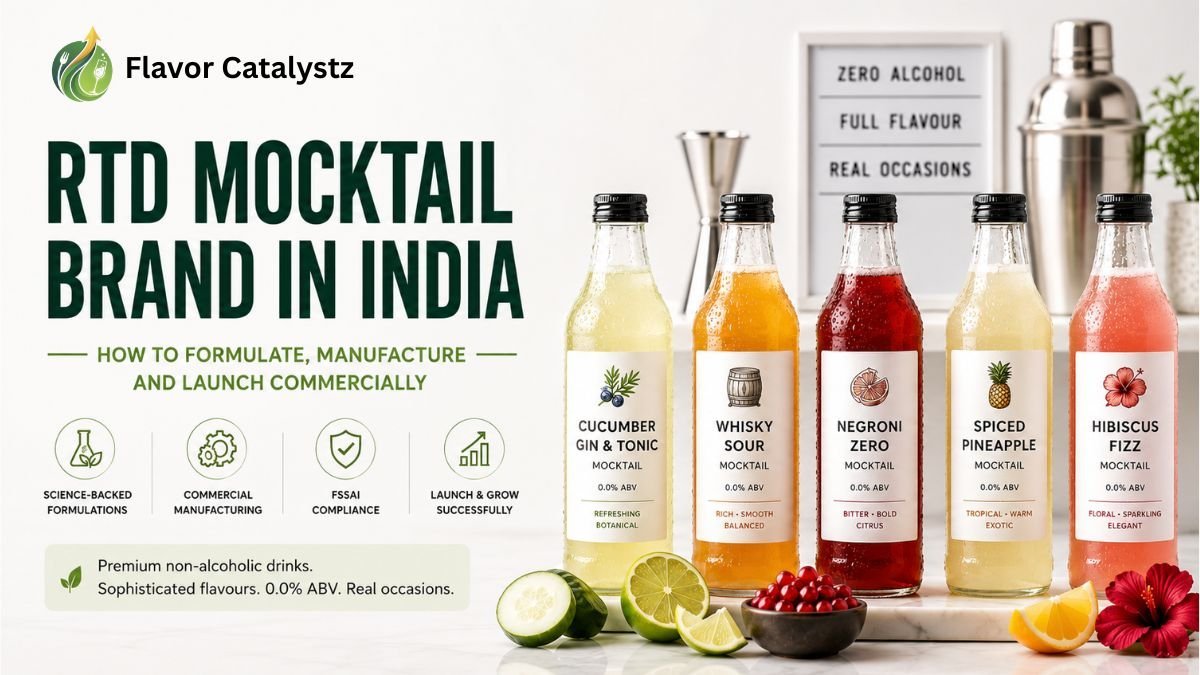
The non-alcoholic beverage revolution is creating a category that barely existed in India five years ago: ready-to-drink mocktails. Not the flat, overly sweet “mocktail” from a soda fountain — but genuinely sophisticated, well-crafted non-alcoholic drinks that deliver the complexity, the ritual, and the occasion of a cocktail without the alcohol.
In India, where a large portion of the population does not drink alcohol for cultural, religious, or health reasons, and where social occasions increasingly require premium non-alcoholic options, the RTD mocktail category has enormous untapped potential. HoReCa buyers, modern trade buyers, and direct-to-consumer platforms are all actively looking for quality products in this space.
This guide covers everything you need to build a commercial RTD mocktail brand — from formulation science to manufacturing to FSSAI compliance to market launch.
Building an RTD Mocktail Brand?
The success of a premium mocktail brand depends on flavour architecture, shelf stability, carbonation management, and regulatory compliance. Start with a commercially viable formulation strategy.
What Is an RTD Mocktail and Why Is the Market Growing?
An RTD (Ready-to-Drink) mocktail is a pre-formulated, shelf-stable or refrigerated non-alcoholic beverage designed to replicate the flavour experience, visual appeal, and social occasion of a cocktail — without any alcohol.
The distinction from standard soft drinks is intentional and important. RTD mocktails are:
- Sophisticated in flavour: Complex, multi-layered flavour profiles — not just sweet juice or plain soda
- Visually premium: Designed to look as good as a cocktail when poured or served
- Occasion-specific: Positioned for social drinking moments — dinner, celebration, unwinding
- Zero or low alcohol: 0.0% ABV or below 0.5% ABV
Why the market is growing in India:
- A significant portion of India’s population does not drink alcohol — this consumer has been underserved by premium beverages
- Urban millennials are “sober curious” — actively reducing alcohol intake while maintaining social drink occasions
- Women consumers in India are a large, underserved segment for premium non-alcoholic beverages
- HoReCa venues need quality non-alcoholic options that match their food and cocktail menu standards
- The Dry January and no-alcohol trend is becoming culturally mainstream even in India’s metros
RTD Mocktail Formulation: Building Complexity Without Alcohol
The core formulation challenge of an RTD mocktail is replicating the sensory complexity that alcohol provides — the warmth, the slight bitterness, the mouthfeel weight, the complexity — using only food-safe non-alcoholic ingredients.
Alcohol (ethanol) contributes several sensory properties to a cocktail:
- Warmth: The burning sensation at the back of the throat
- Bitterness carrier: Alcohol is an excellent solvent for bitter compounds
- Mouthfeel: Alcohol adds body and weight to a drink
- Volatility: Alcohol helps carry aromatic compounds to the nose
Replacing these requires a deliberate formulation approach:
Replacing Warmth
- Ginger extract: The most effective warming agent. Provides heat from gingerol/shogaol without alcohol. Include at 200–600mg per serving depending on desired intensity.
- Black pepper extract (piperine): Adds warmth and complexity. Use at 5–15mg per serving.
- Cinnamon and clove extracts: Gentle warmth for specific flavour profiles (winter spice mocktails).
Replacing Bitterness and Complexity
- Non-alcoholic bitters: Available commercially — concentrated botanical bitter extracts specifically designed for zero-proof applications. Angostura-style non-alcoholic bitters add extraordinary complexity at 1–3 dashes per serving.
- Tonic water base: Quinine provides pleasant bitterness for gin-and-tonic style mocktails.
- Gentian, wormwood, cinchona extracts: Bitter botanicals used at flavouring levels to add aperitif-style complexity.
- Cold brew coffee or tea: Adds tannin-driven bitterness and complexity.
Replacing Mouthfeel
- Glycerin (glycerol): Food-grade glycerin at 0.5–2% adds body and a slightly viscous mouthfeel similar to spirits. FSSAI-permitted as a humectant.
- Egg white powder or aquafaba: For cocktail-style foaming (think whisky sour format mocktails). Aquafaba is the chickpea liquid — an excellent vegan foaming agent.
- Gum acacia (acacia gum): Adds body and mouthfeel at 0.5–1%.
Building Flavour Architecture
A well-formulated RTD mocktail is built on the classic cocktail architecture:
Base flavour (50–60% of volume): Fruit juice, sparkling water, tonic, coconut water — the primary liquid that carries the drink.
Complexity layer (15–25%): Botanical extracts, bitters, shrubs, cold brew — what makes the drink interesting.
Acid balance (10–15%): Fresh citrus juice (or citric acid + natural citrus flavour), verjuice, or shrub — the sour component that prevents flatness.
Sweetness (adjusted to target Brix 8–12°): Sugar, honey, agave — balanced against the acid layer.
Finish (trace amounts): Warming agents, bitters, salt — what the consumer tastes 5 seconds after swallowing.
Popular RTD Mocktail Formats and Formulas
Gin & Tonic Style Mocktail
Base: Tonic water (60%), cucumber juice (15%), lime juice (10%) Complexity: Non-alcoholic botanical spirit base or juniper-citrus extract (5%) Finish: Rosemary extract, trace salt Carbonation: Medium-high (3.0–3.5 volumes CO2)
Whisky Sour Style Mocktail
Base: Apple juice (40%), lemon juice (15%), non-alcoholic malt base (20%) Complexity: Non-alcoholic bitters (3 dashes equivalent), vanilla Finish: Egg white foam (aquafaba), trace smoke flavour (liquid smoke at 0.01%) Still format: 150–200ml
Negroni Style (Bitter-Sweet)
Base: Blood orange juice (40%), pomegranate juice (20%) Complexity: Gentian extract, cinchona, cardamom — Italian aperitif-style bitterness Sweetness: Jaggery syrup (balanced against bitterness) Finish: Trace orange oil, warming ginger
Indian-Inspired RTD Mocktails
The strongest commercial positioning for an Indian RTD mocktail brand is formats grounded in Indian flavour tradition:
- Shikanji Spritz: Lemon + black salt + cumin + sparkling water
- Aam Panna Mixer: Raw mango + mint + rock salt — functional summer drink
- Jaljeera Tonic: Jeera-spiced base + lime + fizz — pairs brilliantly with food
- Rose-Cardamom Fizz: Rose water + cardamom + lime + tonic
These formats have flavour profiles Indian consumers already love — presented in a premium RTD format. For the underlying formulations, see our mocktail recipe formulation guide and jaljeera drink guide.
Manufacturing: From Formulation to Commercial Production
Processing Options
Still RTD mocktails (non-carbonated): Hot fill + acidification: pH below 4.0, hot fill at 85°C, seal, invert, cool. Ambient shelf life 9–12 months. HPP: Cold processing for premium, fresh-flavour positioning. 30–60 days refrigerated.
Sparkling RTD mocktails (carbonated): Requires carbonation-rated packaging (aluminium cans or pressure-rated PET/glass). Standard cold fill under CO2 counter-pressure. Pasteurisation before carbonation if required. Shelf life: 9–12 months ambient for canned format.
Packaging Options
Aluminium cans (250ml, 330ml): Most practical for carbonated RTD mocktails. Excellent shelf life, pressure-rated, modern premium perception, growing sustainability preference.
Glass bottles (200ml, 330ml): Premium, HoReCa-appropriate. Higher cost, heavier distribution weight.
PET bottles: Lower cost. Suitable for still (non-carbonated) formats only unless carbonation-rated.
For contract manufacturing support, see our beverage contract manufacturing guide.
FSSAI Compliance for RTD Mocktails
Product classification: RTD mocktails are typically proprietary food under FSSAI — they do not conform to a standard product category and contain combinations of ingredients that require product approval.
Alcohol content: Zero-proof means genuinely 0.0% or below 0.5% ABV. FSSAI regulates beverages above 0.5% ABV as alcoholic beverages — completely different licensing and regulatory framework. Ensure your formulation is genuinely below 0.5% ABV and test this in production.
Ingredient compliance: All botanical extracts, bitters, and flavour compounds must be FSSAI-permitted. Non-alcoholic botanical extracts used at flavouring levels are generally acceptable — but verify against FSSAI’s Schedule II.
Label claims: “Zero alcohol,” “0.0% ABV,” “non-alcoholic” — all factual declarations permitted. Do not use “alcohol-free” if the product contains any trace alcohol from fermented ingredients.
Carbonation: If carbonated, packaging must meet pressure requirements and label must follow carbonated beverage standards.
For complete compliance guidance, see our FSSAI beverage label mandatory guide.
Commercial Strategy: Launching an RTD Mocktail Brand in India
HoReCa first: Restaurants, cafes, and hotels are the ideal launch channel for a premium RTD mocktail brand. Bartenders and beverage managers understand the category and can position the product correctly to consumers. Start with 10–20 quality accounts in a single city before expanding.
Premium modern trade: Health food stores, gourmet supermarkets, and airport retail suit the premium pricing and consumer profile of RTD mocktails.
Quick commerce (Blinkit, Zepto): Urban millennial consumers who want a premium drink for an evening at home — quick commerce captures this impulse purchase brilliantly.
D2C: A direct website with a curated set of SKUs (3–4 flavours) and a “build your mocktail box” gifting option performs well for RTD mocktail brands with strong brand identity.
Pricing: ₹150–350 per unit depending on format and channel. Premium glass bottle in HoReCa: ₹200–400 menu price.
Ready to Launch Your RTD Mocktail Brand?
The zero-proof beverage category is one of the most exciting commercial opportunities in Indian drinks right now. The consumer need is real, the occasion is clear, and the competitive landscape is still wide open for a brand that gets the product quality and positioning right.
At Flavor Catalystz, we formulate RTD mocktails and non-alcoholic beverages for commercial production. Talk to our team today.
Ready to Launch a Premium RTD Mocktail Brand?
From flavour development and carbonation systems to shelf-life validation, manufacturing scale-up, and FSSAI compliance, Flavor Catalystz helps founders create sophisticated non-alcoholic beverages built for modern retail, HoReCa, and quick-commerce channels.
FAQs
What is an RTD mocktail?
A ready-to-drink non-alcoholic beverage formulated to replicate the flavour complexity, visual appeal, and social occasion of a cocktail — with 0.0% or below 0.5% ABV.
How do you make an RTD mocktail taste complex without alcohol?
Use non-alcoholic bitters for complexity, ginger or pepper extract for warmth, glycerin for mouthfeel, and a well-balanced acid-sweet-bitter architecture. The combination of these elements replicates the sensory depth that alcohol provides.
What FSSAI approval is needed for an RTD mocktail?
RTD mocktails are proprietary food under FSSAI and require product approval before commercial sale. All botanical and flavour ingredients must be FSSAI-permitted. Alcohol content must be verified below 0.5% ABV.
What is the best format for an RTD mocktail brand in India?
Aluminium cans for carbonated formats (modern, premium, practical). Glass bottles for HoReCa positioning. 250–330ml single-serve sizes work best for the social occasion format.
What is the commercial opportunity for RTD mocktails in India?
Significant — India has a large non-drinking population and growing sober-curious consumer segment. Premium non-alcoholic occasion beverages are severely underserved by current commercial offerings.