Jun 2026 · 8 min read
India has a sleep problem. According to multiple studies, India ranks among the most sleep-deprived countries in the world. Urban professionals, students, new parents, shift workers — poor sleep quality affects a significant and growing portion of the Indian population. And increasingly, these consumers are looking for solutions beyond prescription medication.
This is the commercial backdrop for the sleep drink category — one of the fastest-growing functional beverage segments globally and still largely untapped in India.
A sleep drink is a functional beverage containing ingredients clinically associated with relaxation, stress reduction, and improved sleep onset or quality. Consumed in the evening as a pre-bed ritual, these products occupy a unique occasion — the “wind-down” moment — that no other beverage category serves well.
The commercial opportunity in India is early-stage but compelling. This guide covers the formulation science, ingredient options, FSSAI pathway, and commercial strategy for building a sleep drink brand.
Flavor Catalystz
Planning to launch a sleep or relaxation beverage brand?
From L-theanine, chamomile, magnesium, and ashwagandha dosage selection to flavour development, FSSAI compliance, and commercial scaling — we help brands formulate sleep-support beverages that consumers actually enjoy.
The Key Functional Ingredients in Sleep Drinks
The formulation of a sleep drink is built around a selection of evidence-backed relaxation and sleep-support ingredients. Here is the landscape:
Melatonin
The most clinically validated sleep ingredient globally. Melatonin is the hormone the body produces naturally at night to signal sleep onset. Supplemental melatonin at low doses (0.5–3mg) has robust clinical evidence for improving sleep onset, particularly for people with delayed sleep phase or jet lag.
FSSAI status: This is the critical issue for Indian sleep drink brands. Melatonin occupies a complex regulatory space in India. It is not listed in FSSAI’s permitted food additives or nutraceutical schedule as of current regulations. Melatonin-containing products in India have historically been sold as pharmaceutical products (under AYUSH or Schedule H) rather than food products.
Practical implication: Building a commercial sleep drink around melatonin in India currently requires regulatory advice specific to your product format and dose. Do not include melatonin in a FSSAI food product without confirming its current regulatory status and approval pathway.
L-Theanine
An amino acid found naturally in tea leaves (particularly green tea). L-theanine promotes alpha brain wave activity — associated with a state of calm alertness that transitions naturally into sleep. It reduces anxiety without causing sedation, making it appropriate for evening consumption.
Dosage: 100–200mg per serving — well-supported by clinical evidence.
FSSAI status: L-theanine is available as a nutraceutical ingredient and has been used in FSSAI-approved products. As a tea-derived compound, it has food-safe precedent. Verify current FSSAI nutraceutical schedule status before inclusion.
Flavour: L-theanine is largely tasteless — excellent for beverage formulation. No masking required.
Chamomile Extract
Chamomile (Matricaria chamomilla) has centuries of traditional use as a calming herb. Clinical studies support modest improvements in sleep quality and anxiety reduction with chamomile supplementation. The active compound associated with its effects is apigenin, which binds to GABA receptors in the brain.
Dosage: 200–400mg chamomile extract per serving.
FSSAI status: Chamomile is a traditional botanical ingredient with food-safe use history. Permitted as a flavouring/herbal ingredient in beverages. Can be declared as “chamomile extract” in the ingredient list.
Flavour: Distinctive floral, slightly apple-like flavour. Pleasant in warm drink formats. Works well in combination with honey, vanilla, or lavender.
Ashwagandha (for sleep-specific application)
Among ashwagandha’s documented benefits, sleep quality improvement is one of the better-evidenced outcomes — particularly with KSM-66 at 300mg per serving. Multiple studies have shown improvements in sleep onset and quality with regular ashwagandha supplementation.
See our full ashwagandha drink formulation guide for dosage and formulation details.
Magnesium
Magnesium glycinate or magnesium citrate at 200–400mg supports GABA receptor activity and has associations with improved sleep quality, particularly in magnesium-deficient individuals. Added benefit of being a permitted mineral supplement under FSSAI.
Tart Cherry Juice
Montmorency tart cherries are a natural source of melatonin — one of the only food sources with meaningful melatonin content. Tart cherry concentrate has clinical evidence for improved sleep duration and quality. As a juice/concentrate, it falls within FSSAI’s standard food framework — no special approval required for the ingredient itself.
Flavour: Tart, slightly sour cherry. Works well with honey, vanilla, and warming spices.
Lavender Extract / Passionflower Extract
Traditional calming botanicals. Some clinical evidence for anxiety and sleep improvement. Primarily used at flavouring levels in beverages — the functional dose is more relevant in supplement formats.
Formulation Approaches: Building a Sleep Drink Stack
The most commercially credible sleep drinks combine 2–3 evidence-backed ingredients in a complementary “stack” rather than relying on a single ingredient. Here are practical formulation templates:
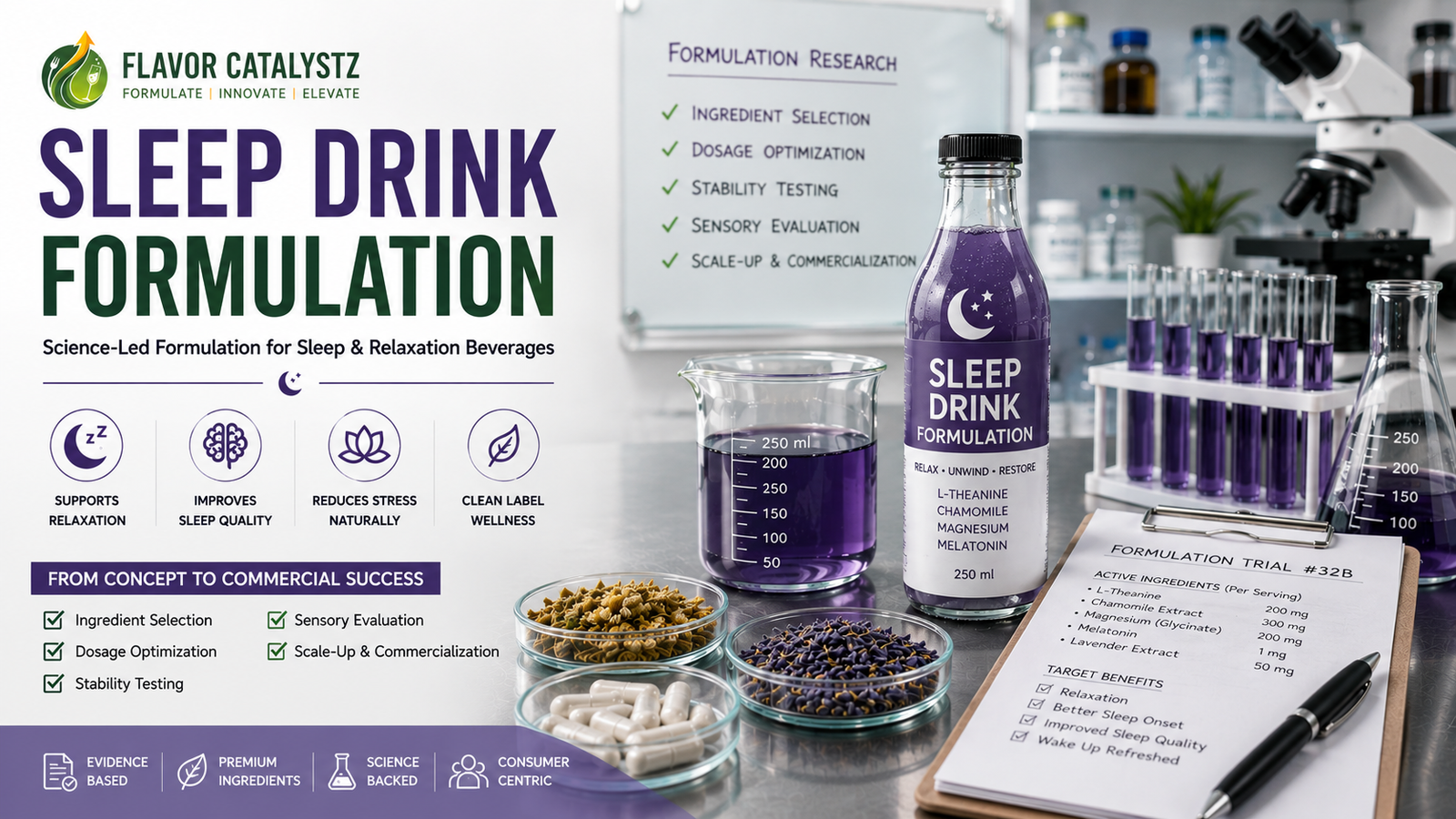
Stack 1 — L-Theanine + Chamomile + Magnesium The cleanest FSSAI pathway — all three ingredients have food/nutraceutical precedent. L-theanine 200mg + chamomile extract 300mg + magnesium glycinate 200mg. Warm, honey-chamomile flavour format. Calm, gentle positioning.
Stack 2 — Ashwagandha + L-Theanine + Tart Cherry Strong functional story. KSM-66 300mg + L-theanine 200mg + tart cherry concentrate. Tart cherry provides natural colour and flavour. Positions as stress + sleep combined.
Stack 3 — Chamomile + Passionflower + Lavender All-botanical, all-traditional. Works well as a herbal sleep tea RTD. Clean label, no synthetic additions. Strongest for consumers who prefer traditional/herbal positioning over supplement-style labelling.
Flavour and Format: What Works for Evening Consumption
The sleep drink occasion is fundamentally different from an energy drink or sports drink occasion. Consumers are winding down, not powering up. The flavour, temperature, and ritual all matter.
Warm formats work: A warm sleep drink (served like a herbal tea or golden milk) fits the pre-bed ritual naturally. Consumers are already accustomed to warm drinks at night — herbal tea, milk, kadha. A premium RTD warm drink or a powder sachet to dissolve in warm water/milk fits this occasion perfectly.
Calming flavour profiles: Chamomile-honey, lavender-vanilla, warm spice (cinnamon-cardamom-nutmeg), tart cherry-berry. Avoid sharp citrus or mint — these signal waking/refreshment, not winding down.
Format options:
- Powder sachet (dissolve in warm water or milk): Most practical. Ambient stable. Easy to distribute. Consumer controls temperature. Recommended for early-stage brand.
- Canned RTD (chilled): More convenient, premium. Works for consumers who take sleep drinks without a warm format preference.
- Concentrated shot (30ml): High ingredient density. Mix-into-milk or direct consumption. Premium gifting potential.
Sweetener choice: Honey is the ideal sweetener for a sleep drink — traditional associations with sleep (warm milk and honey), flavour compatibility with calming botanicals, and a natural label claim. Jaggery works for Indian-positioned variants. Avoid artificial sweeteners — they conflict with the natural/calming positioning.
FSSAI Compliance for Sleep Drinks
This requires careful navigation — particularly around melatonin.
Melatonin: As noted above, melatonin’s status in Indian food products is uncertain. Do not include without specific regulatory clearance. The good news: an effective sleep drink can be built without melatonin using the ingredient stacks described above.
L-theanine, chamomile, magnesium, tart cherry: These have clearer FSSAI pathways — either as nutraceutical ingredients or traditional herbal/food ingredients. Product approval as proprietary food or nutraceutical is still required.
Claims: “Sleep,” “relaxation,” and “calming” claims on beverage labels require careful framing. Permitted: “Contains chamomile, traditionally used as a calming herb.” Not permitted: “Treats insomnia,” “Cures sleep disorders,” “Clinically proven sleep aid.”
AYUSH consideration: If your product is positioned strongly around traditional Ayurvedic or herbal formulation, an AYUSH licence pathway (rather than FSSAI food pathway) may be more appropriate for certain formulations — this depends on the specific ingredients and their concentrations.
For complete regulatory guidance on sleep drink compliance, see our FSSAI functional beverage approval guide or talk to our beverage consultant team.
Ready to Launch Your Sleep Drink Brand?
The sleep beverage market in India is genuinely early — which means the window for building a category-defining brand is open. The consumer need is real, the ingredient science is credible, and the evening ritual occasion is underserved by existing beverage categories.
Getting the formulation right — effective ingredients at meaningful doses, compliant with FSSAI, in a format and flavour that supports the wind-down ritual — is the foundation of a sleep drink brand with real staying power.
At Flavor Catalystz, we formulate relaxation and sleep functional beverages for commercial launch. Talk to our team today.
FAQs
What ingredients are used in sleep drinks?
Common sleep drink ingredients include L-theanine, chamomile extract, magnesium, tart cherry juice, ashwagandha, passionflower, and lavender. Melatonin is widely used globally but has uncertain FSSAI status in India for food products.
Is melatonin allowed in beverages in India?
Melatonin’s regulatory status as a food ingredient in India is unclear under current FSSAI regulations. It is typically classified as a pharmaceutical rather than a food ingredient. Always verify current FSSAI status before including melatonin in a commercial beverage.
How do you formulate a sleep drink without melatonin?
Effective sleep drinks can be built around L-theanine (200mg), chamomile extract (300mg), magnesium (200mg), ashwagandha (300mg), and/or tart cherry concentrate — all of which have clinical evidence for sleep support and clearer FSSAI compliance pathways.
What is the best format for a commercial sleep drink in India?
A warm-dissolving powder sachet (consumer adds to warm water or milk) fits the Indian pre-sleep ritual most naturally. RTD canned format works for convenience-oriented urban consumers. Both are commercially viable.
What flavour works best for a sleep drink?
Chamomile-honey, lavender-vanilla, warm spice, or tart cherry-berry profiles align with the calming, wind-down occasion. Avoid sharp citrus or mint — these signal energy and wakefulness.
Can I claim “helps with sleep” on a sleep drink label in India?
Not directly — this would be a disease/medical claim under FSSAI. Use ingredient-level framing: “Contains chamomile, traditionally used as a calming herb” or “Contains L-theanine, which promotes relaxation.” Keep claims factual and ingredient-referenced.