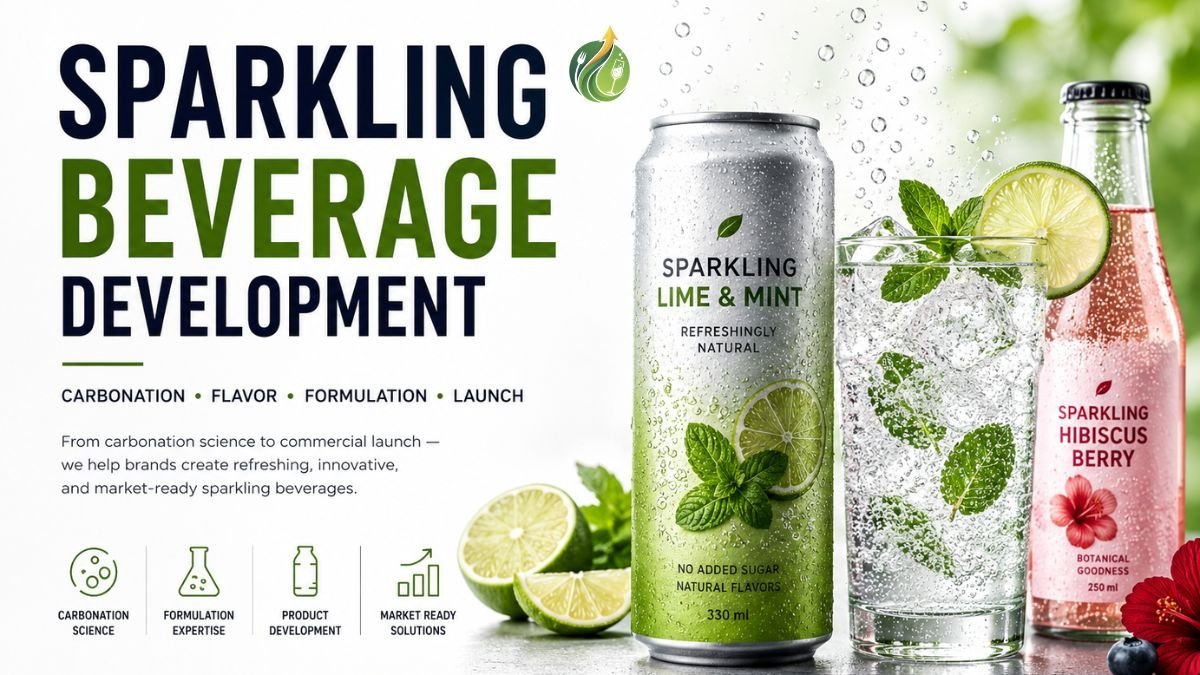
May 2026 · 15 min read
There is something undeniably satisfying about a sparkling beverage. The moment CO₂ meets your palate — that light, tingling effervescence that amplifies aroma, refreshes instantly, and makes even simple water feel like something special — is one of the most universally loved sensory experiences in the drink world. It is why carbonated beverages have been at the heart of global drink culture for over 200 years, and why the sparkling beverage category continues to evolve, innovate, and expand in every direction.
In India, the sparkling beverage market is undergoing a significant transformation. The era of plain cola dominance is giving way to a far more diverse landscape: botanical sparkling drinks, sparkling juice beverages, non-alcoholic sparkling beverages with functional ingredients, sparkling water with Indian flavors, and premium carbonated formats of traditional drinks like Jeera Masala Soda and Shikanji.
This guide covers everything you need to know about sparkling beverages — what they are, the different types, the science of carbonation, the sparkling beverage development process, and how Flavor Catalystz helps brands formulate and launch sparkling drinks in India.
What Are Sparkling Beverages? Definition and Types
A sparkling beverage is any drink that contains dissolved carbon dioxide (CO₂) gas, which creates bubbles and effervescence when the pressure is released — typically when you open the bottle or can, and as you drink it. The carbonation can be naturally occurring (as in naturally carbonated mineral water) or artificially added through a carbonation process (force carbonation or in-line injection).
The sparkling beverage category includes:
| Type | CO₂ Level | Examples |
| Sparkling Water / Soda Water | Light — 3.0–3.7 vol CO₂ | Bisleri Sparkle, Evian Sparkling, club soda |
| Carbonated Soft Drinks (CSD) | Medium — 3.0–4.5 vol CO₂ | Thums Up, Pepsi, Appy Fizz, Lahori Zeera |
| Sparkling Juice Beverage | Light to Medium — 2.5–3.5 vol CO₂ | Tropicana Fizz, sparkling mango, sparkling kokum |
| Sparkling Traditional Indian Drinks | Light to Medium — 2.5–3.5 vol CO₂ | Jeera Masala Soda, Sparkling Shikanji, Aam Panna Fizz |
| Non-Alcoholic Sparkling Beverages | Light to High — 2.5–4.0 vol CO₂ | Coolberg NA Beer, Jimmy’s Cocktail mixers |
| Sparkling Ice Beverage | Medium — 3.0–4.0 vol CO₂ | Fruit-infused sparkling, botanical sparkling |
| Functional Sparkling Drinks | Light to Medium — 2.5–3.5 vol CO₂ | Probiotic soda, adaptogen sparkling, prebiotic soda |
| Naturally Carbonated Mineral Water | Natural CO₂ from source | San Pellegrino, Perrier, natural spring sources |
Sparkling Water vs Soda Water: What Is the Difference?
“Sparkling water” and “soda water” are among the most confused terms in the sparkling beverage category. Here is a precise breakdown:
| Term | Definition | Key Difference |
| Sparkling Water | Carbonated water — either naturally carbonated (from mineral springs) or force-carbonated | May have natural minerals; no added salts or flavors |
| Soda Water | Artificially carbonated water with added salts (sodium bicarbonate, potassium sulfate, sodium chloride) | Added minerals give slight salty/crisp taste; used in cocktails |
| Club Soda | Same as soda water — artificially carbonated with added mineral salts | Common bar term; same as soda water in most markets |
| Tonic Water | Carbonated water + quinine (bitter) + sugar | Distinctively bitter; used in gin & tonic; has calories |
| Sparkling Mineral Water | Naturally carbonated water from mineral springs with defined mineral content | Premium segment; natural CO₂ and minerals; no additives |
For sparkling beverage development in India, the most common starting point is force-carbonated water (soda water base) to which flavor systems, sweeteners, acidulants, and functional ingredients are added. True naturally carbonated mineral water requires a mineral spring source and is a premium, high-barrier-to-entry segment.
Sparkling Water Benefits: What Science Actually Says
One of the most common questions about sparkling beverages is whether they are as hydrating and healthy as still water. Here is an honest, science-backed answer:
- Hydration: Equal to Still Water: Multiple studies confirm that sparkling water hydrates as effectively as still water. The CO₂ does not interfere with fluid absorption — a person can meet their daily hydration needs entirely from sparkling beverages without negative effects.
- Digestion: Genuine Benefit: Carbonation stimulates gastric motility and has been shown to relieve nausea, indigestion, and the sensation of fullness in some individuals. This is the science behind traditional Indian carbonated digestive drinks like Jeera Masala Soda and Aam Panna Fizz.
- Bone Density: Unfairly Maligned: Cola drinks (which contain phosphoric acid) have been linked to reduced bone density. Plain sparkling water does NOT contain phosphoric acid and has no proven negative effect on bone density. The concern is with cola specifically, not carbonation generally.
- Acid Reflux: Context-Dependent: For people with GERD or acid reflux, highly carbonated beverages can exacerbate symptoms by increasing gastric pressure. However, lightly carbonated beverages (2.5 vol CO₂ or less) are generally better tolerated.
- Ghrelin and Appetite: One study suggested that carbonated beverages may increase ghrelin (the hunger hormone) slightly compared to still water. This effect is relatively minor and context-dependent — it does not apply equally to all sparkling beverages or all individuals.
- Dental Health: Minimal Risk for Plain Sparkling Water: Plain sparkling water (no added acid or sugar) has a pH of approximately 4.5–5.0 — acidic, but far less damaging to enamel than fruit juices (pH 3.0–4.0) or cola (pH 2.5). Flavored sparkling beverages with added citric acid have a lower pH and higher erosion potential.
What Is CSD in Beverage? CSD Meaning and Category Overview
CSD stands for Carbonated Soft Drink — the industry term for the broad category of sparkling beverages that are sweetened, flavored, and carbonated. This is the largest volume sub-category of sparkling beverages globally and in India, encompassing cola, lemon soda, orange soda, masala soda, fruit-flavored fizzy drinks, and more.
Key facts about the CSD beverage category in India:
- India’s CSD market is estimated at ~₹15,000–20,000 crore and is growing at 6–8% CAGR
- Coca-Cola India (Thums Up, Limca, Sprite, Fanta) and Varun Beverages (PepsiCo — Pepsi, Mountain Dew, 7UP, Mirinda) dominate the organized CSD market
- Regional CSD challenger brands — Lahori Zeera, Banta Soda, local masala sodas — are growing rapidly in semi-urban and rural markets
- Sugar-free CSD variants (sweetened with stevia, sucralose, or monk fruit) are the fastest-growing reformulation trend in the CSD category
- Functional CSDs — carbonated drinks with added probiotics, adaptogens, or vitamins — are an emerging premium segment with strong D2C growth
Sparkling Beverage Development Process: Stage by Stage
Sparkling beverage development is significantly more technically complex than developing a still (non-carbonated) drink. The addition of CO₂ fundamentally changes how flavors behave, how the product must be packaged, and what processing technology is required. Here is the complete sparkling beverage development process:
Stage 1: Concept, Category, and Carbonation Level Decision
Every sparkling beverage development project starts with a core decision: What type of sparkling beverage are you developing? The carbonation level (measured in volumes of CO₂, or “vols”) has a massive impact on flavor perception, mouthfeel, packaging requirements, and processing. Light sparkling (2.0–2.8 vols) gives gentle effervescence suitable for juice beverages and traditional Indian drinks. Standard carbonation (3.0–4.0 vols) is the classic CSD level. High carbonation (4.0–5.0 vols) is used for tonic water and some NA beers. Defining this upfront prevents costly reformulation later.
Stage 2: Flavor Formulation for Carbonated Conditions
This is the most technically demanding stage of sparkling beverage development and where most first-time developers make critical mistakes. CO₂ is not flavor-neutral — it reacts with flavor compounds in specific ways: CO₂ enhances sour and bitter notes (which is why cola tastes sharper carbonated than flat), suppresses sweet perception (carbonated drinks need 15–20% more sweetener than still drinks to taste equivalent), and amplifies spice and menthol sensations (critical for masala soda and mint-based sparkling drinks). Flavor compounds selected for a still drink formulation will often taste significantly different when carbonated. Sparkling beverage formulation requires flavor systems designed specifically for carbonated conditions.
Stage 3: pH and Acid System Design
The pH of a sparkling beverage is critical for three reasons: (1) CO₂ dissolves in water to form carbonic acid, naturally lowering pH — the final product pH must be modeled accounting for carbonation level; (2) lower pH enhances CO₂ retention in the bottle, improving shelf life and carbonation stability; (3) the acidulant choice (citric acid, malic acid, phosphoric acid, tartaric acid) significantly affects taste and compatibility with natural flavors. For Indian sparkling beverages using lemon or tamarind-forward flavor profiles, citric acid is standard at 0.15–0.35% w/v.
Stage 4: Sweetener System Selection
Sugar remains the most commonly used sweetener in Indian sparkling beverages due to cost, mouthfeel contribution, and consumer familiarity. However, the growing demand for low-calorie and sugar-free sparkling beverages is driving adoption of high-intensity sweeteners: Stevia (natural, zero-calorie — provides clean sweetness but slight licorice aftertaste that must be masked), Sucralose (synthetic, zero-calorie — very clean sweetness, excellent carbonation stability), Monk Fruit Extract (natural, zero-calorie — premium positioning, smooth sweetness profile), and blends of sugar + stevia (partial sugar reduction — best for mainstream sugar-free positioning in India).
Stage 5: Functional Ingredient Integration
One of the most exciting areas of sparkling beverage development in 2026 is functional sparkling drinks — beverages that combine the sensory pleasure of carbonation with meaningful health benefits. Key functional ingredients being integrated into sparkling beverages include probiotics (Bacillus coagulans — spore-forming strain that survives CO₂ and pasteurization; ideal for sparkling probiotic sodas), adaptogens (ashwagandha KSM-66, brahmi, tulsi — used in sparkling wellness drinks; heat-sensitive, require cold addition), prebiotics (inulin, FOS — support gut health; can be added at 2–5% w/v without significant flavor impact), and vitamins (Vitamin C, B complex — widely used in functional sparkling beverages; ascorbic acid also acts as antioxidant to protect natural colors).
Stage 6: Carbonation Process and CO₂ Management
At production scale, carbonation is achieved through one of three methods: (1) Pre-mix carbonation — the complete beverage formula (syrup + water + CO₂) is blended and carbonated together before filling, giving consistent carbonation but requiring precise temperature control; (2) Post-mix filling — syrup and carbonated water are filled separately and mixed at the filling nozzle — common for high-volume CSD production; (3) In-line carbonation — water is carbonated on a continuous basis during the filling process. CO₂ purity must be food-grade (99.99% minimum), and all CO₂ equipment must be validated for food contact under FSSAI norms.
Stage 7: Packaging Selection for Carbonated Products
Packaging for sparkling beverages is more demanding than for still beverages because the internal CO₂ pressure can range from 2–5 bar at ambient temperature. Suitable packaging formats include PET (Polyethylene Terephthalate) bottles — most common; must be CSD-grade PET (higher wall strength than standard PET); fills from 200ml to 1.5L; cost-effective for mass market. Aluminum cans — premium presentation; excellent CO₂ barrier; no light exposure; widely used for energy drinks and functional sparkling beverages. Glass bottles — highest premium positioning; best for traditional Indian drinks (Jeera Soda, Aam Panna Fizz) and NA spirits; requires crown cap or pressure-resistant closure.
Stage 8: Stability Testing and Shelf Life Validation
Sparkling beverages require specific stability tests that still drinks do not: CO₂ retention testing (carbonation loss over time at 25°C and 38°C), headspace pressure monitoring, flavor stability under elevated CO₂ and low pH conditions, and package integrity testing (seam integrity for cans; closure torque for PET; crown cap seal for glass). For functional sparkling beverages, active ingredient stability (probiotic CFU count, vitamin retention, adaptogen bioactivity) must be validated across the full shelf life at the specified storage temperature.
Sparkling Beverage Market in India: Opportunity and Trends
The Indian sparkling beverage market is moving in a direction that strongly favors innovation, authenticity, and health — creating significant opportunities for new brands and products:
- Indian CSD Market Size: ~₹15,000–20,000 crore; growing at 6–8% CAGR. Dominated by Coca-Cola India and Varun Beverages (PepsiCo), but challenger segment growing faster.
- Premium Sparkling Water Growing Fast: India’s sparkling water market (Bisleri Sparkle, Himalayan Sparkling, international brands) is growing at 20%+ as urban consumers switch from CSD to lighter, cleaner hydration.
- Functional Sparkling Beverages — Fastest Emerging Segment: Probiotic sparkling sodas, prebiotic carbonated drinks, and adaptogen-infused sparkling beverages are entering premium Indian retail and D2C channels. Global revenue for functional carbonated drinks is projected to exceed $20 billion by 2028.
- Traditional Indian Drinks Going Sparkling: Jeera Masala Soda (Lahori Zeera), sparkling Shikanji, Aam Panna Fizz, and sparkling Kokum Sharbat represent a high-growth niche that combines cultural authenticity with the premium sparkling beverage format.
- Non-Alcoholic Sparkling Beverages for Sober-Curious Consumers: India’s NA beer and NA spirits market is growing rapidly. Non-alcoholic sparkling beverages like Coolberg (NA beer), Jimmy’s Cocktails (cocktail mixers), and botanical tonics are finding distribution in premium bars, airlines, and D2C channels.
- Sugar-Free Reformulation Pressure: FSSAI’s front-of-pack labeling and growing consumer awareness are accelerating the shift to reduced-sugar and sugar-free sparkling beverages — creating reformulation opportunities across the entire CSD category.
Sparkling Water Brands in India: Market Landscape
The sparkling water segment in India is distinct from the broader CSD category. Here’s the current landscape of sparkling water brands in India:
| Brand | Segment | Positioning |
| Bisleri Sparkle | Domestic — Mass Premium | India’s largest water brand entering sparkling; affordable premium tier |
| Himalayan Sparkling | Domestic — Premium | Natural Himalayan spring water; glass bottle premium positioning |
| Vedica Sparkling (HCCB) | Domestic — Premium | Coca-Cola India’s premium still + sparkling Himalayan spring water |
| San Pellegrino | International — Ultra Premium | Italian naturally carbonated mineral water; hotel/restaurant focus |
| Perrier | International — Ultra Premium | French naturally carbonated mineral water; premium retail + bars |
| Evian Sparkling | International — Ultra Premium | Alpine sparkling water; premium gifting and luxury segment |
| Schweppes (Coca-Cola) | Domestic — Mixer Premium | Classic tonic water and soda water for cocktail mixer segment |
| Clear Splash / D2C Brands | D2C — Emerging | Flavored sparkling water; keto/zero-sugar positioning; Instagram-native brands |
How to Start a Sparkling Beverage Company in India
Starting a sparkling water or sparkling beverage company in India is genuinely achievable through the contract manufacturing model. Here’s a realistic pathway:
- Define your sparkling beverage concept clearly: Are you building a premium sparkling water brand, a functional CSD, a traditional Indian drink in sparkling format, or a NA sparkling spirit alternative? Each has a different formulation brief, target consumer, and distribution channel.
- Develop your sparkling formulation with a specialist: Sparkling beverage formulation is technically more complex than still drink formulation. Work with an experienced beverage formulation partner who understands carbonation chemistry, CO₂-flavor interaction, and CSD-grade packaging requirements.
- Secure FSSAI compliance for your carbonated product: Sparkling beverages fall under FSSAI Category 14.1.3 (Carbonated water and flavored carbonated water). Your additives, label, and license must comply with this category’s specific standards.
- Identify a CSD-capable contract manufacturer: Not all beverage contract manufacturers in India have CSD-grade carbonation equipment. You need a co-manufacturer with a carbonation system (pre-mix or in-line), CSD-grade filling line (isobaric filler), and the ability to handle CO₂ food-grade supply.
- Plan your packaging for carbonation: CSD-grade PET bottles, aluminum cans, or glass with crown caps. Work with your contract manufacturer on packaging compatibility before finalizing your formulation.
Flavor Catalystz and Sparkling Beverage Development
Flavor Catalystz is India’s specialist beverage development partner with deep expertise in sparkling beverage formulation across CSD, sparkling juice, traditional Indian sparkling drinks, and functional carbonated beverages. Our sparkling beverage development service covers the full technical and regulatory journey:
- Sparkling flavor formulation — flavor systems designed specifically for carbonated conditions, not adapted from still drink recipes
- Carbonation level optimization — defining the right CO₂ volume for your product’s flavor profile and packaging format
- Sweetener system design — sugar, sugar-free, and reduced-sugar formulations for mass market and premium CSD
- Functional ingredient integration — probiotics, adaptogens, vitamins, and prebiotics in sparkling format with validated stability
- FSSAI compliance — Category 14.1.3 product registration, label review, and additive compliance
- CSD-capable contract manufacturer identification — linking you to facilities with carbonation lines across India
For regulatory reference on CSD beverage standards in India, see the FSSAI official portal — Food Products Standards. For global sparkling beverage category data, see Statista — Carbonated Soft Drinks India Market Outlook.
Also Read: Related Guides From Flavor Catalystz
- Cold Drink Recipe Formulation
- Jeera Drink Recipe Formulation — India’s Sparkling Street Classic
- Shikanji Recipe Formulation
- Non-Alcoholic Beverage Development India
- Beverage Formulation Cost India
- Beverage Contract Manufacturing India
Conclusion: The Sparkling Beverage Opportunity in India Is Wide Open
The sparkling beverage category in India is no longer just about cola. It is about culturally rooted carbonated drinks that carry an authentic Indian identity, functional sparkling beverages that address real health needs, premium sparkling water that competes on quality and experience, and sophisticated non-alcoholic sparkling alternatives that are reshaping how urban India drinks at social occasions.
If you have a sparkling beverage concept — whether it’s a jeera masala soda, a probiotic sparkling drink, a premium sparkling juice, or a zero-sugar botanical carbonated drink — the formulation science, regulatory pathway, and manufacturing infrastructure to bring it to market exists in India. Flavor Catalystz is the development partner to help you navigate all of it.
Frequently Asked Questions
Q1. What are sparkling beverages?
Sparkling beverages are carbonated drinks with dissolved CO₂ that create bubbles and fizz.
Q2. What is the CSD category in beverages?
CSD means Carbonated Soft Drinks — sweetened, flavored, fizzy non-alcoholic beverages.
Q3. What is the difference between sparkling water and soda water?
Sparkling water is plain carbonated water, while soda water contains added mineral salts.
Q4. What are the benefits of sparkling water?
Sparkling water supports hydration and may help digestion without added calories.
Q5. Does sparkling water increase ghrelin?
Some studies suggest a minor effect, but evidence is limited and unclear.
Q6. Can carbonated drinks affect bone density?
Plain sparkling drinks do not affect bone density; concerns are mainly linked to cola phosphoric acid.
Q7. How to start a sparkling water company in India?
Develop your formula, get FSSAI approval, choose manufacturing, packaging, and launch channels.
Q8. What makes sparkling beverage development different from still drink development?
Sparkling drinks require carbonation control, pressure-safe packaging, and flavor balancing.