May 2026 · 12 min read
Most food products fail not because the idea was bad, but because the development process was handled incorrectly. Ingredients were chosen without checking FSSAI compatibility. The recipe worked in the kitchen but fell apart in a 100-kg batch. Shelf life was assumed rather than tested. The packaging was chosen before the product’s moisture sensitivity was understood.
This guide covers every major step in food product development — from the first idea to the moment your product is ready for commercial production. It is written for founders, product managers, and brand builders who want to understand the full process before they start spending on it.
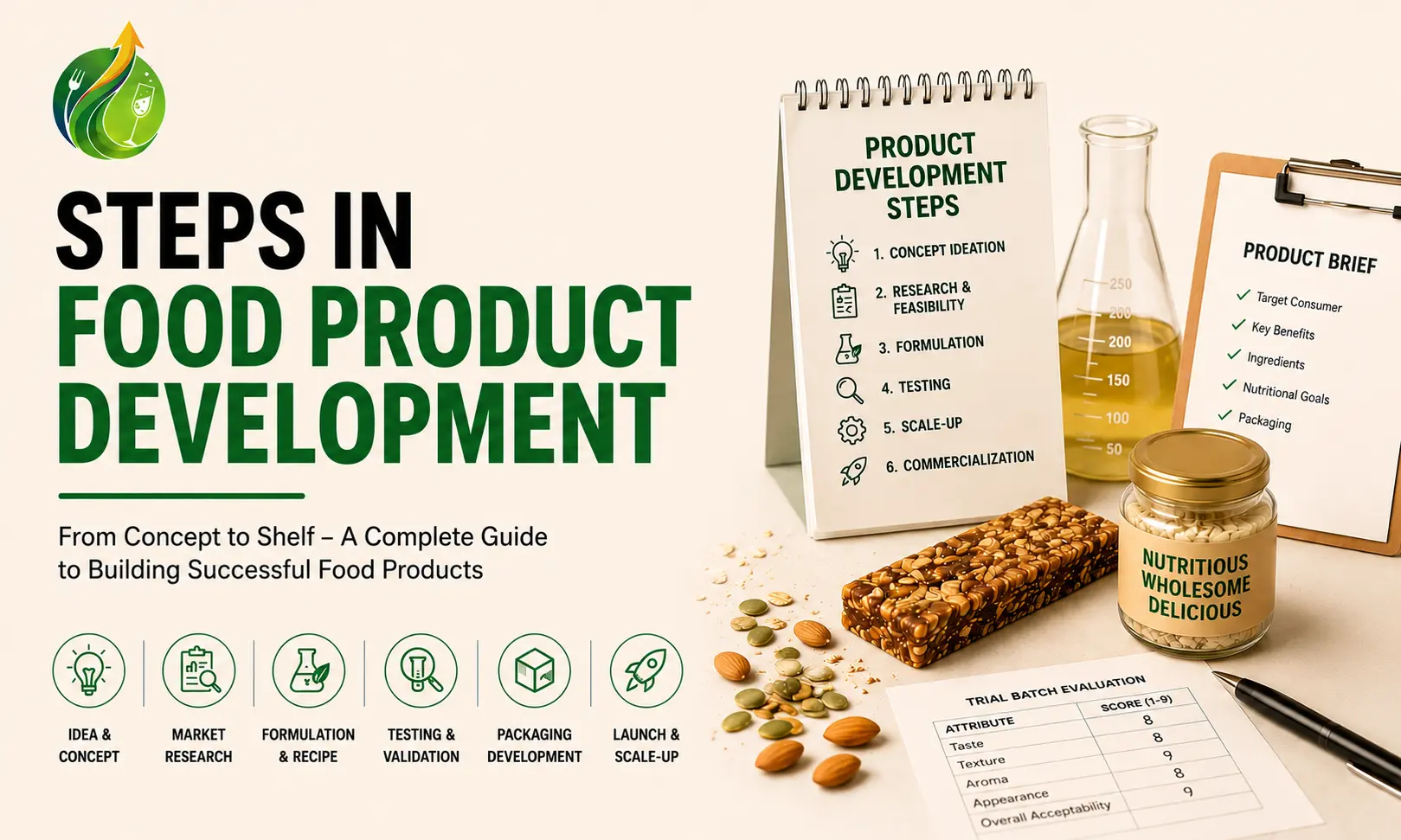
Latest Food Product Development Steps 2026
Step 1: Concept Development and Market Validation
Every product starts with an idea. But not every idea should become a product. The first step is turning a vague idea into a defined product concept, and then checking whether that concept has a real market.
A strong product concept should answer four questions: What is the product? Who is it for? What problem does it solve or what occasion does it serve? Why would someone choose it over what they already buy?
Market validation does not require expensive research at this stage. It means checking whether similar products exist, what they cost, where they are sold, and whether there is a gap your product can genuinely occupy. It also means checking whether your target consumer segment actually wants what you are offering — not just whether you think they do.
This step seems basic but is often skipped. Skipping it leads to products that are technically excellent but commercially unviable.
Step 2: Ingredient Research and Feasibility
Once the concept is defined, the next step is checking whether the ingredients needed to build it are commercially available, legally permitted under FSSAI regulations, affordable at scale, and compatible with each other.
In India, FSSAI regulates which ingredients can be used in which food categories, at what maximum permitted levels. This is not optional. A formulation built around an ingredient that is not permitted under FSSAI for your specific product category will fail at the regulatory stage, regardless of how good the product tastes.
Ingredient feasibility also covers cost. The ingredient that makes your prototype perfect may be available in small quantities from an importer but unavailable or unaffordable at commercial batch sizes. This needs to be known before formulation begins, not after.
Key questions to answer in this step:
- Is this ingredient listed in the relevant FSSAI food category?
- Is there a maximum permitted level that limits the dose you planned to use?
- Is it available from reliable suppliers in India at the volumes you will need?
- What is the cost per kg and how does it affect your target COGS?
- Does it have known interactions with other ingredients in your formulation?
Step 3: Recipe Development and Formulation
This is where the actual food science work begins. A food technologist or formulator takes the concept brief and starts building the recipe — defining ingredients, ratios, processing parameters, and target sensory attributes.
Good formulation is not cooking. It is engineering. A formulator is not just trying to make something taste good. They are trying to make something that tastes good, is safe, stays stable for six to twelve months, can be manufactured consistently at a 100-kg to 1,000-kg batch size, and meets your cost target.
Formulation typically goes through multiple rounds. The first version answers whether the concept is technically possible. Each subsequent version improves taste, texture, appearance, stability, or cost — usually in that order of priority, though FSSAI compliance is always non-negotiable.
For functional or fortified products, formulation also includes calculating the final nutritional profile after processing losses, since heat and processing reduce the effective level of many vitamins, minerals, and botanical extracts.
Step 4: Prototype Development and Internal Evaluation
Once a formulation is stable, it goes into small-scale prototype development — typically 1 to 5 kg batches in a development kitchen or lab. These prototypes are evaluated internally against a set of defined criteria: taste, texture, appearance, aroma, and basic stability.
At this stage, the product is being compared against your own brief, not consumer expectations. The goal is to reach a formulation that you and your team are confident in before spending on consumer testing.
Multiple prototypes are usually developed in parallel when the formulation direction is not yet confirmed — for example, testing three different protein levels in a bar to find which gives the best taste without being chalky.
Step 5: Consumer Sensory Testing
Once the internal team is satisfied with a prototype, the next step is putting it in front of real consumers. Sensory testing is structured — it is not asking friends and family whether they like the product.
A proper sensory panel evaluates specific attributes: sweetness, saltiness, bitterness, texture on first bite, texture after chewing, aftertaste, aroma intensity, and overall liking. For comparison products already in the market, it also includes head-to-head preference testing.
Consumer sensory testing gives you data, not opinions. It tells you whether your product scores above or below the benchmark, and what specific attributes are dragging down the score. This informs the next round of formulation refinement.
For Indian brands, it is important to conduct sensory testing with consumers from your actual target market — not just urban metro consumers if your product is going to be distributed in smaller cities.
Step 6: Nutritional Analysis and Label Compliance
Before a product can be labelled and sold in India, it must have a nutritional declaration on the packaging that meets FSSAI’s labelling regulations. This requires sending the final formulation to an NABL-accredited laboratory for nutritional analysis.
The lab analyses: energy, protein, total fat (including saturated and trans fat), carbohydrates, total sugars, sodium, and any other nutrients that are being claimed on the label.
If your product makes a health or nutrient claim — such as ‘high protein’ or ‘source of fibre’ — FSSAI sets minimum thresholds that the product must meet. For example, to claim ‘high protein’, the product must provide at least 12 grams of protein per 100 grams (or 20% of energy from protein). These thresholds must be verified with actual lab data, not calculated estimates.
Label compliance also covers the ingredient list (in descending order of weight), allergen declarations, net quantity, batch number, manufacturing date, best before date, and FSSAI licence number.
Step 7: Shelf Life and Stability Testing
Shelf life testing determines how long your product remains safe and maintains acceptable quality under defined storage conditions. This is one of the most important and most often underestimated steps in food product development.
There are two types of shelf life testing: real-time and accelerated. Real-time testing stores the product under normal conditions and checks it at regular intervals over the full intended shelf life period. Accelerated testing stores the product at elevated temperature and humidity to simulate ageing faster, which gives early guidance before real-time data is complete.
What is being tested during shelf life studies:
- Microbiological safety: no harmful bacterial growth
- Sensory attributes: taste, texture, colour, and aroma remain acceptable
- Nutritional stability: vitamins and functional ingredients are retained at declared levels
- Physical stability: no separation, clumping, or structural breakdown
- Packaging integrity: no migration of packaging components into the product
For functional food products that make specific ingredient claims, shelf life testing must also confirm that the active ingredient — whether a probiotic, vitamin, or botanical extract — is present at the declared level at the end of the shelf life period, not just at the time of manufacture.
Step 8: Pilot Production and Scale-Up
A formulation that works in a 5-kg lab batch does not automatically work in a 500-kg factory batch. Scale-up is a separate and often challenging stage of food product development.
During pilot production, the recipe is adapted from lab conditions to actual manufacturing equipment. Mixing times, cooking temperatures, homogenisation speeds, and processing sequences often need adjustment. What was a two-minute mix in a lab mixer might need six minutes in a large-scale blender to achieve the same texture.
Pilot batches typically range from 50 kg to 500 kg, depending on the product category and manufacturing equipment. The goal of a pilot batch is to validate that the formulation is manufacturable at commercial scale and that the output meets the quality standards set during development.
Pilot production also generates the product samples needed for shelf life testing, regulatory submissions, and retailer or distributor presentations.
Step 9: FSSAI Licensing and Regulatory Clearance
Before commercial production and sale, the manufacturing unit must hold the appropriate FSSAI licence — registration for very small operators, state licence for medium-scale operations, and central licence for larger manufacturers, importers, or exporters.
For products in certain categories — particularly functional foods, novel food ingredients, or products with specific health claims — additional FSSAI product approval may be required before commercial sale. This involves submitting technical dossiers with formulation details, ingredient safety data, and supporting literature.
Common FSSAI compliance requirements across product categories:
- FSSAI licence or registration for the manufacturing unit
- FSSAI-compliant label with mandatory declarations
- Ingredients within permitted limits under the relevant FSSAI food standard
- Any health claims backed by eligible nutrient levels and permitted claim language
- NABL-accredited lab test reports for nutritional analysis
Step 10: Contract Manufacturer Finalisation and Commercial Launch
Unless you are building your own manufacturing facility, the final step before commercial launch is identifying and onboarding the right contract manufacturer. This is not a simple vendor selection — it involves technical qualification, process validation, quality system verification, and agreement on quality parameters and batch documentation.
A qualified contract manufacturer should hold the relevant FSSAI licence for your product category, be able to run your formulation consistently using their equipment, have quality control systems in place, and be able to provide the batch documentation you need for your regulatory file.
Once manufacturing is confirmed, the commercial launch process begins: packaging procurement, first commercial production run, distribution setup, and market activation. At this point, the product development process is complete — and the brand-building work begins.
Common Mistakes in Food Product Development
Knowing the steps is useful. Knowing where brands go wrong is equally valuable.
- Starting formulation before checking FSSAI ingredient eligibility
- Assuming shelf life instead of testing it
- Making health claims on labels without verifying they meet FSSAI thresholds
- Skipping consumer sensory testing and launching based on internal preference
- Choosing packaging before understanding the product’s moisture, oxygen, or light sensitivity
- Overlooking scale-up differences between lab and factory conditions
- Fixing the price before understanding the true cost of goods
In The End
In food product development, success depends on far more than a good recipe. From formulation and FSSAI compliance to shelf-life testing, packaging, pilot production, and scale-up, every stage directly affects whether a product succeeds commercially or fails after launch. Brands that invest in structured food formulation, regulatory planning, and scientific product development build products that are safer, more scalable, and more competitive in the Indian market.
Frequently Asked Questions
What is the first step in food product development?
The first step is concept development and market validation — defining exactly what the product is, who it is for, and whether there is a real market need. This comes before any formulation work begins.
How many steps are there in the food product development process?
The full food product development process has ten core steps: concept development, ingredient feasibility, recipe formulation, prototype development, consumer sensory testing, nutritional analysis, shelf life testing, pilot production, FSSAI compliance, and contract manufacturer finalisation. Some simpler products may complete these faster, but the steps themselves apply to all categories.
What is FSSAI and why is it important in food product development?
FSSAI stands for the Food Safety and Standards Authority of India. It is the regulatory body that sets the rules for what can be used in food products, how they must be labelled, and what claims can be made. Every food product sold in India must comply with FSSAI regulations. Building FSSAI compliance into the development process — rather than trying to add it at the end — saves significant time and cost.
What is shelf life testing in food product development?
Shelf life testing is the process of determining how long a food product remains safe and maintains acceptable quality under defined storage conditions. It involves both microbiological testing and sensory evaluation at regular intervals. The result is a validated best-before date and confirmation that the product will perform consistently from manufacture to consumption.
What is the difference between a prototype and a pilot batch in food development?
A prototype is a small-scale sample made in a lab or development kitchen, typically 1 to 5 kg, used to evaluate the formulation. A pilot batch is a larger run — typically 50 to 500 kg — made using actual manufacturing equipment, used to validate that the formulation works at commercial scale. Both are necessary steps before a full commercial production run.
Can I develop a food product at home and then scale it to a factory?
Home development is useful for the initial concept stage. However, home kitchens are not the right environment for formulation work that will be handed to a factory, because the equipment, temperatures, and ingredient quantities used at home do not represent industrial conditions. A professional food technologist working in a proper development kitchen or lab will produce a formulation that is genuinely scalable.
How much does it cost to develop a food product in India?
Development costs in India vary by product complexity. A straightforward snack or beverage formulation with standard ingredients may cost Rs. 50,000 to Rs. 2 lakh for formulation and basic testing. Functional food products requiring stability testing, FSSAI documentation, and pilot batches may cost Rs. 5 lakh to Rs. 20 lakh or more. Manufacturing setup and packaging costs are separate from development costs.
Do I need FSSAI approval before starting food product development?
You do not need FSSAI approval to begin formulation work in a lab. FSSAI registration or licensing is required before you manufacture and sell commercially. However, FSSAI compliance must be built into the development process from the start — checking ingredient eligibility, label requirements, and claim thresholds during formulation rather than after.