Jul 2026 · 13 min read
Sugar-free cookie formulation is the process of rebuilding a cookie’s bulk, moisture, browning, and sweetness using sugar substitutes for cookies once sucrose is removed — it is not a regular cookie recipe with the sugar quietly deleted. Try that once in a test kitchen and the result is usually flat, pale, crumbly, or hard as a cracker within a day of baking. Sugar is doing at least five different jobs inside a cookie dough at the same time, and every one of those jobs has to be reassigned to something else through careful sugar-free biscuit manufacturing before the product will hold its shape, its shelf life, and its taste.
This is also a live regulatory topic in India right now. Through 2026, the Food Safety and Standards Authority of India has been issuing show-cause notices to packaged food brands over “no added sugar” and similar claims, and has told manufacturers that a non-addition claim cannot stand if a sugar-acting ingredient — including certain fruit concentrates and syrups — is doing the same job as sugar in the formula. For any brand planning a sugar-free or reduced-sugar cookie launch, the formulation decisions and the label claim are now the same conversation, not two separate ones.
This guide walks through what sugar actually does in a cookie, how formulators replace each function one at a time, where most sugar-free cookie projects go wrong, and what the current compliance picture looks like before you commit to a production run. The staged approach below mirrors how bakery reformulation is typically handled in commercial R&D labs, including the process food scientists at Flavor Catalystz follow when converting an existing cookie line into a sugar-free or reduced-sugar variant.
Better Sugar-Free Cookies Begin with Better Formulation.
Flavor Catalystz develops sugar-free cookie formulations with optimized sweetener systems, texture, shelf life, and commercial manufacturing support for food brands.
Sugar-Free Cookie Formulation: Why You Cannot Just “Remove” the Sugar
Sugar-free cookie formulation fails most often when sugar is simply deleted from a recipe instead of being functionally replaced. In a standard cookie, sucrose is a structural ingredient before it is a flavour ingredient. Pulling it out disturbs the dough at a molecular level, not just on the tongue. The table below breaks down what sugar is responsible for and what tends to fail first when it is removed without a replacement plan.
| Function of sugar in cookie dough | What goes wrong if it’s simply removed | Why it happens |
| Bulk and volume | Cookie shrinks, dough feels dense and pasty | Sugar contributes solid mass; nothing is left to occupy that volume |
| Spread and shape during baking | Cookie stays domed and puffy instead of spreading | Sugar melts and thins the dough at oven temperature; without it, structure sets too early |
| Moisture retention (humectancy) | Cookie turns dry and hard within 24-48 hours | Sugar binds water; removing it lets moisture migrate out faster |
| Browning (Maillard reaction) | Cookie bakes pale and looks underdone | Reducing sugars drive the browning reaction with proteins; less sugar means less colour |
| Sweetness | Cookie tastes flat or “off” even if texture is fixed | Obvious, but often the last problem solved, not the first |
| Tenderness / crumb structure | Cookie turns tough or gritty | Sugar interferes with gluten development and starch gelatinisation |
Once this list is in front of a product developer, it becomes clear why a sugar-free cookie recipe for commercial production is a systems problem, not a single-ingredient swap.
Best Sugar Substitute for Cookies: Replace Function, Not Just Sweetness
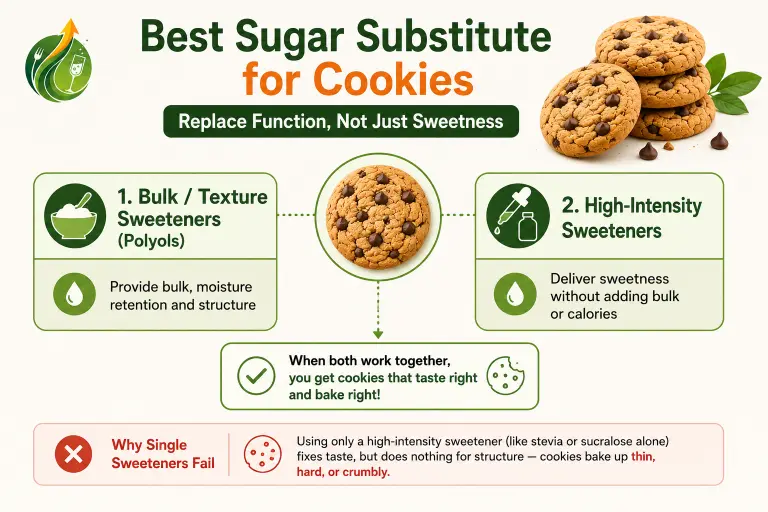
The best sugar substitute for cookies is rarely a single ingredient — it is a system of two ingredient categories working together. Working formulators typically split the sugar’s job into two separate ingredient categories, then layer them together:
- Bulk/texture sweeteners (polyols) — carry volume, moisture retention, and some sweetness
- High-intensity sweeteners — carry the remaining sweetness without adding bulk or calories
Using only a high-intensity sweetener (like stevia or sucralose alone) is the single most common mistake in early-stage sugar-free cookie development. It fixes taste and does nothing for structure, which is why so many first-draft sugar-free cookies taste “right” but bake up thin, hard, or crumbly.
Common Sugar Substitutes for Cookies: A Comparison
| Sweetener/bulking agent | Relative sweetness vs sugar | Best-known role in cookie dough | Typical usage level | Formulation notes |
| Erythritol | ~0.6-0.8x | Bulk, mild cooling effect, low glycemic impact | 40-100% of sugar weight | Can crystallise/turn grainy if not processed finely; low hygroscopicity means drier cookies unless moisture is compensated |
| Xylitol | ~1x | Bulk, moisture retention, browning support | 50-100% of sugar weight | Performs closest to sucrose in bulk and water activity; toxic to dogs — a labelling and facility consideration for pet-adjacent brands |
| Maltitol | ~0.9x | Bulk, chewiness, moisture retention | 50-100% of sugar weight | Strong laxation effect at high intake; needs clear portion-size disclosure |
| Sorbitol | ~0.6x | Moisture retention, softness | Often blended, rarely used alone | Good humectant but weak sweetness; usually paired with a high-intensity sweetener |
| Polydextrose / soluble fibre | Non-sweet | Bulk and fibre-claim support | 10-30% of sugar weight replaced | Adds fibre label claim potential; can affect mouthfeel if overdosed |
| Monk fruit extract | 150-250x | Sweetness top-up, clean flavour profile | Fractions of a percent | Pairs well with a polyol bulk system; premium-priced |
| Stevia glycosides | 200-300x | Sweetness top-up | Fractions of a percent | Bitter/liquorice aftertaste risk at higher inclusion; masking agents often needed |
| Allulose | ~0.7x | Bulk, browning, moisture, low-calorie | 50-100% of sugar weight | Recent favourite for its close functional match to sucrose; regulatory status and availability vary by market |
A well-designed sugar-free cookie formulation almost always blends a bulk polyol with a small dose of a high-intensity sweetener, rather than relying on a single ingredient to do everything sugar used to do.
How to Formulate a Sugar-Free Cookie Recipe for Commercial Production
There is no universal sugar-free cookie recipe that works across every flour type, fat system, and market, but formulators generally move through the same seven-stage sequence when developing one for commercial scale-up:
| Stage | What is decided | Typical validation check |
| 1. Baseline benchmarking | Full-sugar control recipe is baked and measured (spread ratio, moisture %, colour, hardness) | Gives the target values the sugar-free version must match |
| 2. Bulk sweetener selection | Choose primary polyol(s) based on cost, glycemic goals, and label strategy | Bench trial for spread and crumb structure |
| 3. Sweetness top-up | Add high-intensity sweetener at fractional dose to hit target sweetness | Sensory panel scoring against the control |
| 4. Moisture and fat rebalancing | Adjust fat, egg, or hydrocolloid levels to restore softness and shelf life | Water activity (Aw) testing |
| 5. Browning correction | Add reducing sugars in trace amounts (where label allows), or adjust bake temperature/time | Visual colour matching (colorimeter or panel) |
| 6. Shelf-life and stability trials | Accelerated shelf-life testing under heat/humidity | Texture and moisture drift over 30/60/90 days |
| 7. Scale-up trial | Recipe re-tested on production-line equipment, not just bench mixers | Batch-to-batch consistency check |
This is the same disciplined, stage-gated approach used in broader food formulation work — the sequence changes in detail from category to category, but the principle of locking one variable at a time before moving to the next stays constant across bakery, snacks, and beverages alike.
Sugar-Free Cookie Texture Problems: Troubleshooting the Most Common Defects
Most sugar-free cookie texture problems trace back to one of eight formulation causes. The table below matches each visible defect to its likely cause and fix.
| Defect observed | Most likely cause | Formulation fix |
| Cookie is too hard or dry within a day | Insufficient humectancy (polyol chosen has low moisture retention) | Switch to or blend in xylitol/maltitol; consider a small hydrocolloid addition |
| Cookie doesn’t spread, stays domed | Bulk sweetener has too low a molecular weight, or baking soda/leavening ratio is off | Trial a higher molecular weight polyol blend; re-check leavening timing |
| Pale, underbaked appearance | Loss of Maillard browning without reducing sugars | Add a small amount of allulose or a permitted reducing sugar; increase bake temperature slightly |
| Gritty or crystalline mouthfeel | Polyol recrystallising (common with erythritol at high inclusion) | Use finer particle size grade; blend with a non-crystallising polyol |
| Cooling/menthol aftertaste | High erythritol inclusion (known negative heat of solution) | Reduce erythritol ratio; blend with maltitol or allulose |
| Bitter or liquorice-like aftertaste | Excess stevia or monk fruit without masking | Lower high-intensity sweetener dose; add flavour maskers (vanilla, malt notes) |
| Shortened shelf life / faster staling | Water activity too high or packaging barrier insufficient | Re-run Aw testing; review pack film/laminate specification |
| Digestive discomfort complaints from testers | Excess polyol intake, especially maltitol/sorbitol | Cap per-serving polyol dose; disclose on label as required |
FSSAI Sugar-Free Label Rules: What Changed in 2026
FSSAI’s sugar-free label rules tightened significantly through 2026, and this is the part of sugar-free cookie development that has changed the most recently — it now directly affects how a formulation is built, not just how it’s labelled.
- Through 2026, FSSAI has actively issued notices to packaged food brands over “no added sugar,” “100%,” and similar claims that did not match the underlying ingredient composition — including cases where date paste, fruit concentrate, or similar ingredients were functioning as a sugar substitute while the label implied no substitute sugar was used at all.
- The regulator has clarified that a non-addition claim relates specifically to the ingredient list, and it must not create a false impression when read against the nutrition panel — the two must be consistent, not contradictory.
- Front-of-pack labelling for products high in fat, sugar, or salt is moving toward mandatory implementation, which means a “sugar-free” cookie’s full nutrition profile (including polyol-derived carbohydrate and calorie content) is under more scrutiny, not less.
- Practical implication for formulators: decide the exact label claim you want (“sugar-free,” “no added sugar,” “reduced sugar,” “diabetic-friendly”) before finalising the sweetener system, because each claim has a different compositional threshold, and reworking the formulation after packaging is printed is expensive.
Because this area is actively being enforced and reinterpreted, any commercial sugar-free cookie project should have its label claim verified against the current Food Safety and Standards (Labelling and Display) Regulations, 2020 and subsequent amendments before packaging is finalised — not assumed from what competitors are already printing on shelf.
Sugar-Free Cookie Shelf Life, Packaging and Manufacturing Cost
Sugar-free cookie shelf life depends on three variables that a bench trial alone won’t reveal. A sugar-free cookie formulation is only commercially viable if it survives real-world distribution, not just a lab test:
- Water activity (Aw): Polyol-based cookies often run a different Aw profile than sugar-based ones. This needs to be re-measured, not assumed to match the original recipe, since Aw drives microbial stability and staling rate.
- Packaging barrier: Many polyols are more hygroscopic or less hygroscopic than sucrose depending on the type, which changes how much moisture barrier the pack film needs to provide to hit a declared shelf-life claim.
- Ingredient cost stack: Bulk polyols and high-intensity sweeteners both carry a materially different cost profile than sucrose, and that cost has been moving with global polyol demand. A commercial formulation needs a costed bill of materials early, not after the recipe is “finalised,” so that pricing and margin decisions aren’t a surprise at scale-up.
This is also the stage where sugar-free cookie projects tend to reveal whether they were built as a recipe or as a true production formulation — one that performs identically in batch one and batch one thousand, across seasons, humidity levels, and manufacturing sites, which is the actual definition of food product development done properly rather than a one-off kitchen success.
Conclusion
Sugar-free cookie formulation succeeds when bulk, moisture, browning, and sweetness are solved together instead of one at a time. A dependable low glycemic cookie formulation blends a bulk polyol — xylitol, erythritol, maltitol, or allulose — with a small dose of a high-intensity sweetener, then locks water activity, bake profile, and packaging barrier through real shelf-life trials rather than assumption. In 2026, that technical work cannot be separated from the label claim: FSSAI’s sugar-free label rules mean a “sugar-free,” “no added sugar,” or “reduced sugar” claim on a commercial cookie has to match the formulation, not just the marketing brief. Brands that treat clean label sugar-free cookies as a formulation-and-compliance project from day one avoid the costly rework that comes from testing sweetness first and structure second.
Sugar-free cookie development sits at the intersection of food science, sensory work, and regulatory compliance — the same disciplines that shape any packaged food launch, from concept through food product development to a shelf-ready product. Formulation teams such as Flavor Catalystz work through exactly this kind of stage-gated food formulation process when reformulating a bakery product for a sugar-free or reduced-sugar claim.
Frequently Asked Questions
Is erythritol or xylitol better for sugar-free cookies?
Xylitol tends to match sugar’s bulk, browning, and moisture retention more closely, giving a texture closer to a conventional cookie. Erythritol has a lower glycemic impact and fewer digestive side effects at typical doses but can bring a cooling aftertaste and a grainy texture if used at high inclusion without particle-size control. Many commercial formulations blend the two rather than choosing one exclusively.
Can a cookie legally be called “sugar-free” in India?
It depends on the exact composition and the current FSSAI framework, which has tightened significantly through 2026, particularly around claims like “sugar-free” and “no added sugar.” A cookie sweetened with an ingredient that functions as a sugar substitute (including certain fruit-based sweeteners) may not qualify for a “no added sugar” claim even without added sucrose. Claims should be verified against the current Food Safety and Standards (Labelling and Display) Regulations before printing packaging.
Why do sugar-free cookies go stale faster than regular ones?
Usually because the substitute sweetener system doesn’t retain moisture as effectively as sucrose did in the original recipe. This is fixable by choosing a more humectant-active polyol (like xylitol or maltitol), adjusting fat or egg levels, or improving the packaging’s moisture barrier — but it needs to be tested with real shelf-life trials rather than assumed.
Do sugar-free cookies need a different baking time or temperature?
Often yes. Because many sugar substitutes don’t caramelise or brown the same way sucrose does, bakers frequently need to adjust bake temperature or time slightly to get comparable colour, and dough spread behaviour can shift too, which affects tray spacing and baking uniformity at scale.
What is the biggest formulation mistake brands make with sugar-free cookies?
Replacing sugar with a high-intensity sweetener alone and not solving for bulk, moisture, and browning at the same time. This is why so many early-stage sugar-free cookies taste correct in a first bite but fail on texture, shelf life, or appearance once produced at scale.
Can stevia or monk fruit be used alone in a sugar-free cookie?
Not effectively on their own for a bakery product, since both are hundreds of times sweeter than sugar and contribute almost no bulk. They are typically used as a small top-up alongside a bulk sweetener like a polyol, rather than as the sole sweetening system.
How much does it cost to reformulate a regular cookie into a sugar-free version?
Costs vary widely by scale, sweetener system, and number of trial rounds needed, but bulk polyols and high-intensity sweeteners generally cost more per kilogram than sucrose, and the project typically needs multiple bench and pilot trials before a stable, scalable recipe is confirmed — so it is rarely a one-step ingredient swap on the cost sheet either.
Are sugar-free cookies actually suitable for diabetics?
Many are formulated to have a lower glycemic impact than standard cookies, but “suitable for diabetics” is a specific regulatory and clinical claim, not a marketing assumption. Total carbohydrate content, portion size, and the specific polyols used all affect blood glucose response differently between individuals, so brands should be cautious about implying a direct diabetic-safe claim without appropriate substantiation.