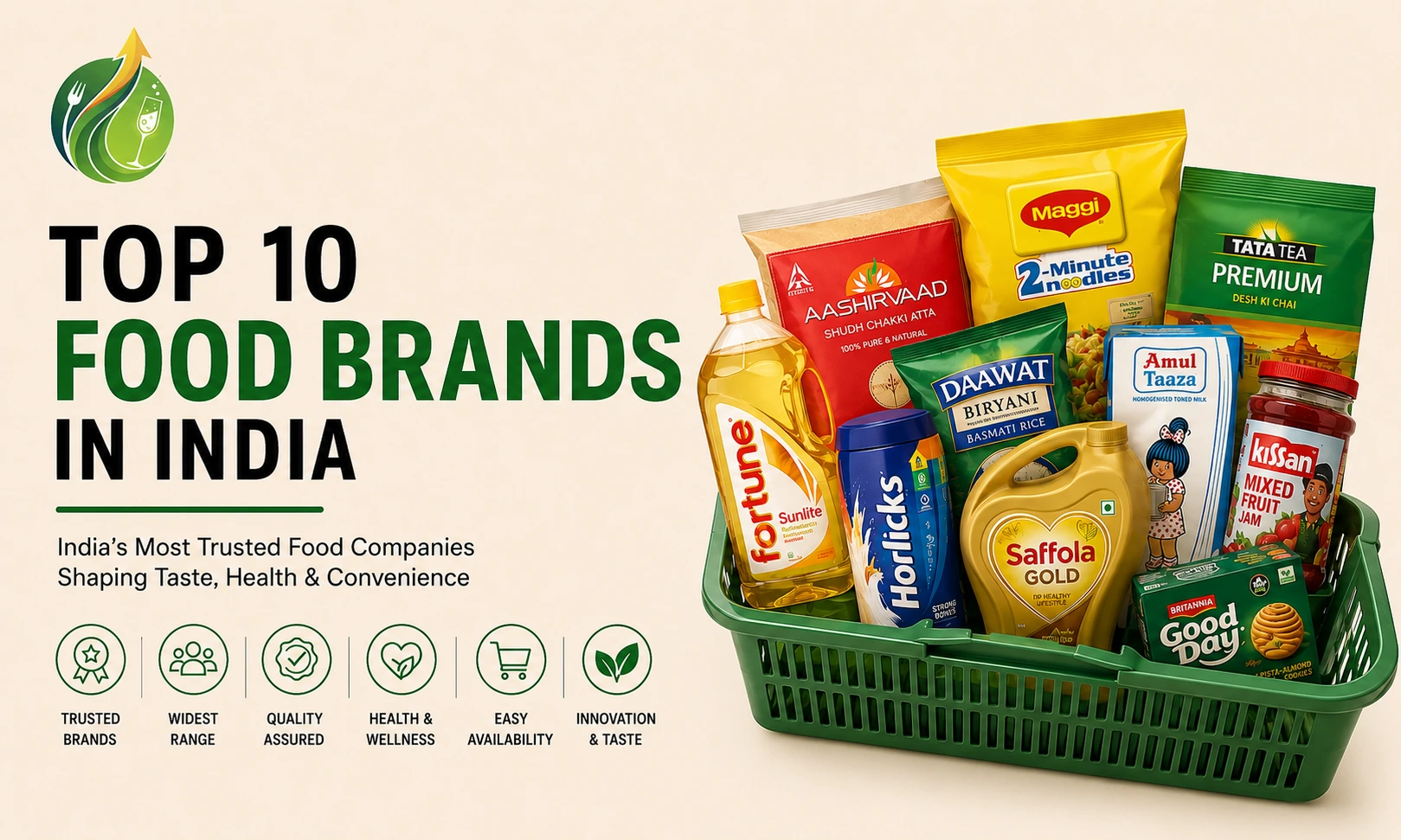
May 2026 · 13 min read
India’s packaged food industry is one of the fastest-growing consumer sectors in the world. By 2026, the country’s food and beverage market has crossed Rs 5 lakh crore in annual value, driven by rising incomes, urbanisation, expanding retail and quick-commerce infrastructure, and a rapidly growing base of health-conscious consumers.
Yet not every food brand shares in this growth equally. A small number of companies dominate shelf space, consumer recall, packaged food sales, and category leadership across India. This article profiles the top 10 food brands in India in 2026, explaining what drives their leadership, which products have made them household names, and how the competitive landscape, packaged food sector, and food product development industry are shifting.
Start a Food Brand
Launch Your Dream Food Brand
Launch a new food brand from idea to market-ready with expert guidance in food formulation, flavouring, shelf-life optimization, FSSAI License, and ready-to-scale manufacturing solutions.
The ranking considers market share, brand recall, distribution depth, revenue performance, product innovation, and presence across both urban and rural markets. It focuses specifically on food and beverage products, setting aside personal care and home care revenues from diversified FMCG conglomerates.
At a Glance: India’s Top 10 Food Brands in 2026
| Rank | Brand / Company | Key Food Categories | Notable Products |
| 1 | Amul (GCMMF) | Dairy, butter, cheese, ice cream, beverages | Amul Butter, Amul Milk, Amul Ice Cream, Amul Cheese, Amul Pro |
| 2 | Parle Products | Biscuits, confectionery, snacks | Parle-G, Hide & Seek, Krackjack, Parle Monaco, Melody |
| 3 | Britannia Industries | Biscuits, dairy, bakery | Good Day, Marie Gold, NutriChoice, 50-50, Tiger, Milk Bikis |
| 4 | Nestle India | Noodles, chocolate, beverages, dairy, infant nutrition | Maggi Noodles, KitKat, Nescafe, Munch, Milkmaid |
| 5 | ITC Foods | Staples, snacks, noodles, biscuits | Aashirvaad Atta, Sunfeast Yippee!, Bingo!, Sunfeast Marie |
| 6 | Haldiram’s | Namkeen, sweets, ready-to-eat snacks | Bhujia, Aloo Bhujia, Dal Moth, Rasgulla, packaged sweets |
| 7 | Tata Consumer Products | Tea, salt, pulses, spices, RTD beverages | Tata Tea, Tata Salt, Tata Sampann, Tetley, Eight O’Clock Coffee |
| 8 | PepsiCo India | Snacks, beverages, juices | Lay’s, Kurkure, Doritos, Tropicana, Aquafina, 7UP |
| 9 | Patanjali Foods | Edible oil, staples, herbal products | Patanjali Atta, Saffola (via Marico overlap), Patanjali Ghee, Coronil |
| 10 | Marico | Edible oil, health foods, oats | Saffola Gold, Saffola Oats, Saffola Masala Oats, Parachute |
1. Amul: India’s Dairy Giant
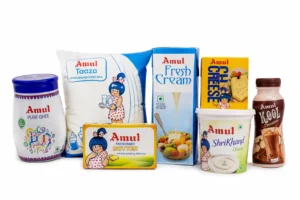
Amul, managed by the Gujarat Cooperative Milk Marketing Federation (GCMMF), remains the most recognisable food brand in India across both urban and rural markets. Its cooperative structure, which connects more than 3.6 million dairy farmers across Gujarat and other states to the national market, gives it a procurement advantage that private dairy brands cannot replicate.
In 2026, Amul operates across dozens of product subcategories within dairy: fresh milk, processed milk, butter, ghee, cheese, paneer, yogurt, ice cream, flavoured milk, UHT milk, infant formula, protein supplements (Amul Pro), and beverages. Amul Butter alone has held the leadership position in the Indian butter market for decades.
Amul’s distribution network, which spans roughly 5 million retail outlets across the country, is one of the deepest in Indian FMCG. The brand’s advertising is among the most iconic in Indian marketing history, with the Amul girl mascot appearing in topical billboards for over sixty years.
What sustains Amul’s leadership in 2026 is not just legacy. The cooperative has invested in cold chain infrastructure, expanded its product range into high-growth areas such as whey protein, lactose-free milk, and probiotic dairy, and maintained competitive pricing through the cooperative model’s structure.
- Estimated revenue (GCMMF FY2024): Over Rs 55,000 crore
- Presence: Pan-India retail, institutional, and export markets
- Key competitive advantage: Cooperative model, farmer integration, cold chain depth, price positioning
2. Parle Products: The Biscuit Market Leader by Volume
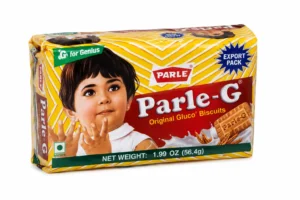
Parle-G is not just a biscuit. It is arguably the most consumed packaged food product in Indian history by unit volume. At a price point accessible to the lowest-income households, Parle-G has held a near-permanent position as India’s largest-selling biscuit by volume, a fact confirmed repeatedly in consumer reach studies including the Kantar Brand Footprint report.
Parle Products operates across glucose biscuits (Parle-G), cream biscuits (Hide & Seek, Bourbon), crackers (Monaco, Krackjack), confectionery (Melody, Poppins, Mango Bite), and snacks. The company maintains extensive backward integration in its supply chain and operates multiple manufacturing facilities across India.
In 2026, Parle continues to defend its mass-market position while extending into premium biscuit and snack formats to capture urban consumers moving up the value ladder. The company’s consistent CRP (Consumer Reach Points) in brand footprint studies places it among India’s most penetrated food brands.
- Key products: Parle-G, Hide & Seek, Monaco, Krackjack, Melody, Poppins
- Market segment: Mass market, accessible price points, wide rural reach
- Key competitive advantage: Price leadership, distribution scale, raw material integration
3. Britannia Industries: Premiumisation in Biscuits and Dairy
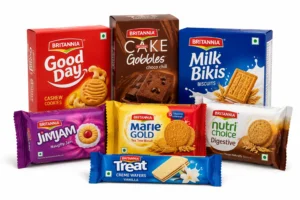
Britannia Industries holds the largest single-brand market share in India’s Rs 50,000 crore-plus biscuit industry. Its portfolio spans premium cookies (Good Day), everyday biscuits (Marie Gold, Milk Bikis, Tiger), health-positioned biscuits (NutriChoice), cream sandwiches (50-50), and bourbon-style biscuits.
Unlike Parle, Britannia has pursued a premiumisation strategy, investing in packaging innovation, flavour variety, and better-for-you product positioning. The company has also diversified into adjacent dairy categories including cheese, bread, and rusk.
By 2026, Britannia has extended its presence in the organised dairy sector with cheese slices, processed cheese, and yogurt, competing with Amul and regional dairy brands. Its strong supermarket and modern trade presence complements its mass-market distribution.
- Key products: Good Day, Marie Gold, NutriChoice, 50-50, Tiger, Milk Bikis, Bourbon
- Revenue (FY2024): Approximately Rs 17,500 crore
- Key competitive advantage: Brand equity in biscuits, premiumisation capability, modern trade distribution
4. Nestle India: Trust in Packaged Food and Beverages
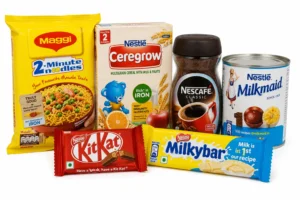
Nestle India is one of the most emotionally resonant food brands in the country. Maggi noodles, which returned to shelves in 2015 after a controversial but ultimately temporary ban, have recaptured their position as India’s dominant instant noodles brand. In 2026, Sunfeast Yippee! (ITC) is the only significant competitor in a two-brand market.
Beyond Maggi, Nestle India’s portfolio includes KitKat and Munch chocolate bars, Nescafe instant coffee, Milkmaid condensed milk, and the Nan range of infant formula products. Nestle’s focus on quality perception, R&D investment in India, and health and wellness positioning gives it strong pricing power compared to domestic competitors.
Nestle India has invested in growing its packaged food portfolio in areas such as whole grain cereals, protein-enriched products, and fortified foods, aligned with the broader health and wellness shift in Indian consumer behaviour.
- Key products: Maggi, KitKat, Nescafe, Munch, Milkmaid, Nestle Nan, Nestle Masala
- Revenue (FY2024): Approximately Rs 18,000 crore
- Key competitive advantage: Brand trust, R&D investment, quality perception, pricing power
5. ITC Foods: Agricultural Depth Meets Consumer Reach
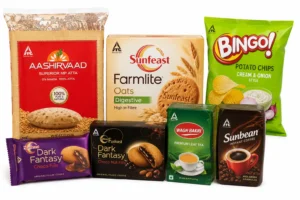
ITC‘s food division has built a portfolio that spans across staples, snacks, biscuits, and instant noodles by leveraging the company’s deep agricultural procurement network. Aashirvaad Atta is India’s single best-selling branded packaged wheat flour, and its dominance in the staples category reflects ITC’s ability to source wheat at scale through its e-Choupal rural initiative.
Sunfeast Yippee! noodles is the second-largest noodles brand in India, consistently competing with Maggi for share of a growing category. Bingo! snacks and chips compete in the salty snacks category against PepsiCo’s Lay’s and Kurkure.
ITC’s food distribution benefits from sharing infrastructure with its other large FMCG businesses, giving it reach into areas where food-dedicated competitors struggle. The company’s operating profitability in food has improved steadily as it gains scale benefits across its portfolio.
- Key products: Aashirvaad Atta, Sunfeast Yippee!, Bingo!, Sunfeast Marie Light, Dark Fantasy
- Key competitive advantage: Agricultural integration, distribution depth, cross-business infrastructure
6. Haldiram’s: The Snack and Sweet Category Leader
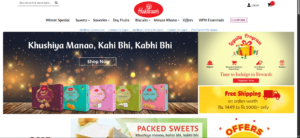
Haldiram’s occupies a unique position in the Indian food landscape. It is neither a pure packaged food company nor a restaurant chain, but a family-owned enterprise that has built dominance in namkeen (savoury snacks), traditional Indian sweets, and ready-to-eat foods across retail, institutional, and food service channels.
The Haldiram’s brand is associated primarily with bhujia, aloo bhujia, dal moth, chivda, and a range of other traditional savoury snacks that have been reformulated for longer shelf life without compromising the authentic taste that built the brand’s reputation in Bikaner and Nagpur before it went national.
In 2026, Haldiram’s competes with PepsiCo, Prataap Snacks, and a growing wave of regional snack brands. Its ability to maintain an authenticity perception while operating at industrial scale is one of its most valuable competitive assets. The company also runs a chain of quick-service restaurants and food courts across India.
- Key products: Bhujia, Aloo Bhujia, Dal Moth, packaged rasgulla, gulab jamun, ready-to-eat curries
- Key competitive advantage: Authenticity perception, snack category depth, QSR presence
7. Tata Consumer Products: Expanding Beyond Tea and Salt
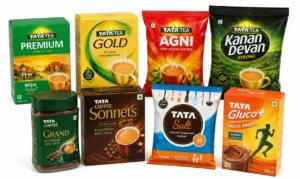
Tata Consumer Products (TCP) is the listed FMCG entity of the Tata Group housing its food and beverage brands. Tata Tea has historically been the company’s largest revenue contributor, operating across multiple price tiers (Tata Tea Gold, Tata Tea Agni, Tata Tea Premium, Chakra Gold, Gemini). Tata Salt holds a leadership position in the organised packaged salt segment.
In 2026, TCP has significantly expanded its food presence through the Tata Sampann brand, which covers pulses, spices, flour, and ready-to-eat products, and through organic growth in RTD (ready-to-drink) beverages, including NourishCo brands such as Himalayan water. The acquisition of Soulfull (millet-based breakfast foods) reflects TCP’s strategy to build presence in the health and wellness segment.
- Key products: Tata Tea Gold, Tata Salt, Tata Sampann, Tetley, Himalayan Water, Soulfull Ragi Bites
- Revenue (FY2024): Approximately Rs 15,000 crore
- Key competitive advantage: Tata brand trust, distribution integration, health food expansion
8. PepsiCo India: Dominance in Snacks and Beverages
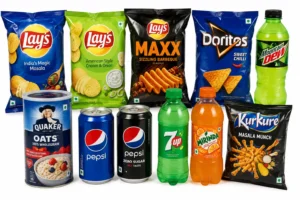
PepsiCo India operates across two major food categories: salty snacks and beverages. In snacks, Lay’s potato chips and Kurkure corn-based snacks are category leaders. In beverages, Tropicana juices, Pepsi and 7UP carbonated drinks, and Aquafina packaged water give PepsiCo a broad footprint.
By 2026, PepsiCo has invested significantly in the better-for-you snack segment, introducing baked variants, multigrain options, and reduced-sodium products to address evolving consumer health awareness. The company’s relationship with Varun Beverages, its largest franchisee in India, has enabled aggressive distribution expansion in Tier 2 and Tier 3 cities.
- Key products: Lay’s, Kurkure, Doritos, Tropicana, Aquafina, Pepsi, Mountain Dew, 7UP
- Key competitive advantage: Portfolio breadth, distribution via Varun Beverages, innovation investment
9. Patanjali Foods: Ayurvedic Positioning Meets FMCG Scale
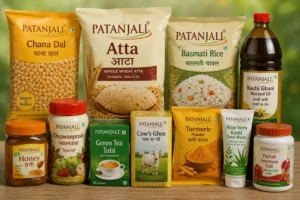
Patanjali Foods (formerly Ruchi Soya, now majority-owned by Patanjali Ayurved) operates one of India’s largest edible oil businesses while distributing Patanjali-branded consumer food products. Patanjali’s rise during the mid-2010s was driven by a powerful combination of ayurvedic positioning, aggressive pricing, and the personal brand of Baba Ramdev.
In 2026, Patanjali Foods’ strength lies in edible oils (particularly through its Nutrela brand), packaged ghee, atta, and a range of herbal food products. The company’s distribution has grown through dedicated Patanjali stores alongside traditional retail channels.
- Key products: Nutrela Soyabean Oil, Patanjali Ghee, Patanjali Atta, Nutrela protein products
- Key competitive advantage: Ayurvedic brand equity, price competitiveness, dedicated retail channel
10. Marico: Health Oils and Breakfast Foods
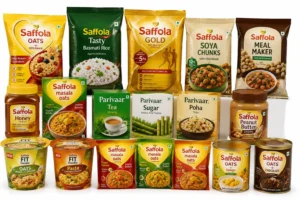
Marico occupies a distinct position in Indian FMCG as a company that has successfully built its food portfolio around health positioning. Saffola Gold, a blended edible oil marketed on heart health credentials, is one of the most recognisable health-positioned food brands in India. Saffola Oats and Saffola Masala Oats compete in the growing breakfast cereals segment.
Marico has expanded into adjacent health food categories, including honey, seeds, nuts, and natural foods, through its Saffola brand extension strategy. The company also acquired True Elements, a health snacking brand, to accelerate its presence in the urban health food segment.
- Key products: Saffola Gold, Saffola Oats, Saffola Honey, Parachute Coconut Oil, True Elements
- Key competitive advantage: Health positioning, urban consumer trust, brand extension discipline
What Separates Category Leaders from Followers in India
Looking across these ten brands, several common factors explain sustained market leadership in Indian food:
- Distribution depth: The ability to serve not just metros and Tier 1 cities but Tier 2, Tier 3, and rural markets is a key differentiator. Brands like Parle, Amul, and ITC invest enormously in last-mile distribution.
- Price tiering: The most durable food brands operate across multiple price points, serving both the mass market and aspiring consumers with premium variants.
- Product innovation pace: Brands that introduce new variants, formats, and flavours consistently create more reasons for consumers to engage.
- Ingredient authenticity and trust: Particularly in post-COVID India, brands that communicate clean ingredients, natural sourcing, and product safety clearly have a consumer confidence advantage.
- Supply chain resilience: Brands with backward integration into agriculture (Amul’s cooperative, ITC’s e-Choupal) can manage input cost volatility more effectively than those dependent on open market procurement.
Emerging Food Brands to Watch in India
Beyond the established top 10, several newer brands are gaining significant traction in specific categories that are growing faster than the overall food market:
- Yoga Bar (acquired by ITC): A clean-label protein bar and breakfast food brand with strong urban consumer following, now benefiting from ITC’s distribution.
- The Whole Truth Foods: A digital-first brand known for its no-hidden-ingredients positioning in protein bars and nut butters, popular with health-conscious young consumers.
- Rage Coffee: A premium instant coffee brand competing in the growing speciality and functional coffee segment.
- Soulfull (Tata Consumer): Millet-based breakfast and snack products riding the millets revival in India.
Happilo: A growing nuts and dry fruits brand competing in the Rs 12,000 crore premium snacking market.
Closure Insights
India’s food sector in 2026 is a market of scale, complexity, and accelerating change. The brands that lead it have earned their positions through decades of distribution investment, product trust, and the ability to serve India’s extraordinarily diverse consumer base across income levels, geographies, and food cultures.
At the same time, the market is not static. New health and wellness priorities, the rise of quick commerce, the growing middle class in Tier 2 and Tier 3 cities, and the millet and clean-label movements are all creating genuine space for category disruption. Understanding which brands hold leadership positions today and why is essential context for food entrepreneurs, investors, professionals exploring how to start a food business, and anyone working in the Indian food market.
Frequently Asked Questions
Which is the No. 1 food brand in India?
Amul is consistently cited as India’s most recalled and distributed food brand, with the deepest rural and urban reach of any dairy company. Parle-G holds the largest single-product sales volume in the biscuit category. The answer depends on the metric: brand recall, revenue, distribution reach, or product-level market share.
Which is the largest FMCG food company in India?
Hindustan Unilever Limited (HUL) is India’s largest FMCG company by revenue across all categories, though its food portfolio is smaller than its personal care and home care businesses. ITC is often cited as the largest FMCG company specifically in food, while Nestle India leads in packaged food by per-category depth.
Which Indian food brands are known internationally?
Amul exports dairy products to over 60 countries. Haldiram’s snacks are popular in the Indian diaspora market globally. Patanjali products are sold in several international markets. ITC’s Aashirvaad and Sunfeast have some export presence as well.
What are the fastest-growing food segments in India in 2026?
The fastest-growing food segments include health snacks and protein bars, millet-based products, ready-to-eat meals, functional beverages, premium packaged dairy, and plant-based protein alternatives.
Why is Maggi still popular despite the 2015 controversy?
Maggi’s return in late 2015 after being cleared by the National Food Laboratory was accompanied by a transparent communication campaign by Nestle. Consumer loyalty, taste familiarity, and competitive pricing allowed the brand to rebuild market share rapidly. By 2026, Maggi commands over 60% of India’s instant noodles market.
Which food company in India is best for investment?
This is a financial decision that depends on individual risk appetite, investment horizon, and portfolio strategy. From a business fundamentals perspective, companies with strong brand equity, distribution depth, and growing health food presence are well-positioned. We recommend consulting a SEBI-registered financial advisor for investment decisions.