May 2026 · 13 min read
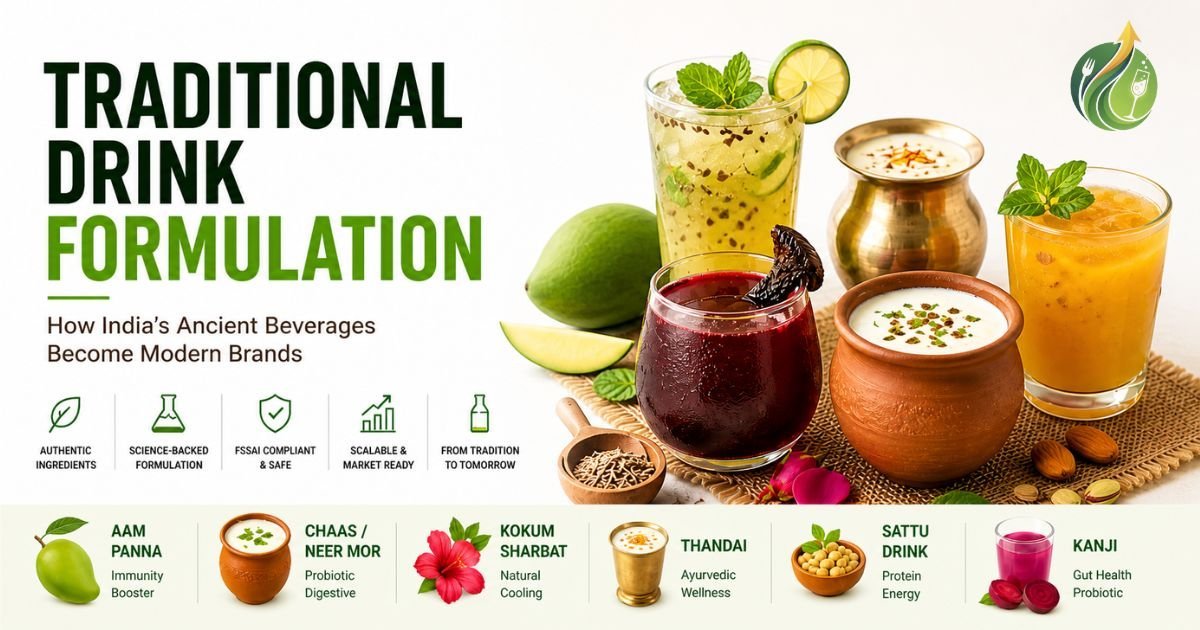
India is one of the world’s oldest beverage civilizations. Long before carbonated sodas or energy drinks existed, Indian households, temples, and royal courts had already developed an extraordinary repertoire of traditional drinks — cooling sharbats, fermented rice beers, spiced milk tonics, and fruit-based summer refreshers. These weren’t just beverages. They were functional formulations, each built around specific ingredients chosen for taste, therapeutic benefit, and seasonal relevance.
Today, the same traditional drinks that filled clay pots and brass vessels are being rediscovered by entrepreneurs, food technologists, and beverage brands looking for authentic differentiation in a market saturated with synthetic flavors. The global demand for traditional, natural, and functional beverages has never been higher — and India’s traditional drink heritage is a goldmine waiting to be formulated, scaled, and branded.
At Flavor Catalyst, we help brands turn traditional drink recipes into commercially viable, FSSAI-compliant products. This guide covers what traditional drink formulation really means, which Indian traditional drinks have the highest commercial potential, and how the formulation process works from recipe to retail shelf.
What Is a Traditional Drink? Defining the Category
A traditional drink is a beverage that has been prepared and consumed within a specific cultural or regional community over generations, using locally available ingredients and techniques passed down through oral or written tradition. Traditional drinks are defined not just by their ingredients, but by the cultural context in which they exist.
In the Indian context, traditional drinks broadly fall into these categories:
- Dairy-Based Traditional Drinks: Lassi, Chaas (buttermilk), Doodh with haldi — fermented or spiced milk preparations
- Fruit & Flower-Based Sharbats: Aam Panna, Kokum Sharbat, Rose Sharbat, Bael Sherbet — high-fruit, naturally sweetened
- Spice & Herb Tonics: Thandai, Panakam, Jal Jeera, Ginger-Tulsi drinks — Ayurvedic functional profile
- Grain-Based Traditional Drinks: Sattu Drink, Ragi Ambali, Kanji (fermented carrot/rice water) — high-fiber, probiotic
- Regional Specialty Drinks: Solkadhi (Goa/Maharashtra), Neer Mor (Tamil Nadu), Banta Soda, Toddy-based infusions
- Fermented Traditional Drinks: Rice beer (Apong, Judima), Handia, Feni (Goa) — tribal and regional heritage
Each of these categories represents a distinct formulation challenge and a distinct market opportunity. The non-alcoholic traditional drink segment — lassi, sharbats, thandai, chaas, aam panna — is where commercial product development has the most immediate, scalable potential.
Top Traditional Indian Drinks With Commercial Formulation Potential
Not every traditional drink translates equally well to commercial production. The best candidates have wide cultural recognition, a strong flavor profile that survives processing, functional ingredients that support health claims, and raw materials with a reliable supply chain. Here are the highest-potential traditional drinks for commercial formulation:
| Traditional Drink | Region of Origin | Key Ingredients | Commercial Opportunity |
| Aam Panna | North + West India | Raw mango, jeera, kala namak, mint | Summer RTD, immunity drink |
| Thandai | Rajasthan, UP, Punjab | Milk, badam, saunf, khas khas, rose, saffron | Festive RTD, dairy beverage |
| Kokum Sharbat | Goa, Konkan, Kerala | Kokum fruit, sugar, salt, jeera | Premium health drink, Goa traditional drink |
| Chaas / Neer Mor | Pan-India / Tamil Nadu | Buttermilk, jeera, ginger, curry leaves | Probiotic beverage, digestive drink |
| Lassi | Punjab, Rajasthan | Curd, sugar/salt, cardamom, rose water | Premium dairy RTD, protein drink |
| Sattu Drink | Bihar, UP, Bengal | Roasted chickpea flour, lemon, jeera | Protein functional drink, sports nutrition |
| Solkadhi | Goa, Maharashtra | Kokum + coconut milk + garlic + green chilli | Goa traditional drink, digestive shot |
| Panakam | South India (temple) | Jaggery, dry ginger, pepper, lemon | Ayurvedic functional drink |
| Bael Sherbet | North + East India | Bael fruit pulp, sugar, cardamom | Natural digestive, health beverage |
| Kanji | North India | Fermented black carrot / beetroot | Probiotic RTD, gut health beverage |
What Is Traditional Drink Formulation? The Science Explained
Traditional drink formulation is the process of taking a culturally established beverage recipe and engineering it to be manufactured at industrial scale with consistent quality, safe shelf life, regulatory compliance, and authentic taste. It is where food heritage meets food science.
Here’s what changes — and what must be preserved — when a traditional drink goes from kitchen to production line:
1. Ingredient Standardization
Traditional recipes use fresh, seasonal, and locally sourced ingredients that vary enormously in flavor, color, and chemistry. A commercial formulation must replace these with standardized raw materials — concentrated fruit purees, spray-dried extracts, food-grade essential oils, and oleoresins — that deliver consistent results in every batch, regardless of season or geography.
Example: Fresh raw mango for Aam Panna varies in acidity, Brix, and color. Commercial Aam Panna formulation uses standardized raw mango concentrate (at defined Brix and pH) + amchur extract + citric acid to hit the same flavor profile every time.
2. pH Control and Acid Management
Most traditional Indian non-alcoholic drinks are naturally acidic (pH 2.8–4.0), which is favorable for shelf stability. Commercial formulation precisely controls pH using food-grade acidulants (citric acid, malic acid, tartaric acid) to hit target ranges that inhibit microbial growth and maintain FSSAI compliance. For dairy-based traditional drinks like lassi, pH management is even more critical — the product must be pasteurized at the right pH to prevent curdling and ensure microbiological safety.
3. Color and Appearance Stability
Traditional drinks often derive their color from natural sources — kokum’s deep magenta, aam panna’s translucent yellow-green, kanji’s vivid purple. These natural pigments are photo-sensitive and degrade over time, especially in clear PET bottles. Formulation addresses this through antioxidant inclusion (ascorbic acid), UV-protective packaging, and in some cases, FSSAI-approved natural color stabilization.
4. Texture, Mouthfeel, and Suspension
Many traditional drinks have characteristic textures — the light frothiness of fresh chaas, the dense creaminess of thandai, the slight viscosity of bael sherbet. Replicating these textures in a shelf-stable product requires the use of approved hydrocolloids (xanthan gum, pectin, guar gum) at carefully calibrated usage levels to avoid over-thickening or synthetic mouthfeel.
5. Preservation and Shelf Life Engineering
Traditional drinks are made fresh and consumed immediately. Commercial formulation must engineer 6–12 months ambient shelf life without compromising taste or safety. The approach varies by product: high-acid drinks use hot fill + low pH; dairy-based drinks use UHT processing or retort sterilization; fermented drinks may use controlled fermentation with defined microbial strains. Preservative selection (potassium sorbate, sodium benzoate within FSSAI limits) is product-specific and must be validated through accelerated shelf life testing.
Traditional Drink Formulation in Action: Three Case Studies
Case Study 1: Aam Panna — North India’s Summer Cooler
Aam Panna (raw mango drink with jeera and kala namak) has 260+ monthly searches for “traditional Indian drinks” and aligns perfectly with the heatwave + immunity narrative. The formulation challenge: raw mango pulp oxidizes rapidly and loses its bright green-yellow color within hours. Commercial solution — UHT-processed raw mango concentrate + ascorbic acid as antioxidant + standardized kala namak and cumin oleoresin. Target: pH 3.0–3.2, Brix 12–14°, shelf life 9 months in amber PET.
Case Study 2: Kokum Sharbat — Goa’s Traditional Digestive Drink
Kokum (Garcinia indica) is one of India’s most underutilized functional fruits. The Goa traditional drink “Solkadhi” (kokum + coconut milk) and plain Kokum Sharbat are deeply regional but have exploding demand in urban markets due to their natural deep-pink color and well-documented digestive benefits. Formulation involves kokum extract concentration, anthocyanin stabilization (critical — degrades rapidly above pH 3.5), and emulsification for the coconut milk variant. A kokum RTD can retail at ₹60–120 positioning as a premium natural digestive.
Case Study 3: Thandai — The Festive Dairy Drink With Year-Round Potential
Thandai — a spiced milk drink with almonds, fennel seeds, poppy seeds, rose petals, cardamom, and black pepper — is traditionally made during Holi and Mahashivratri. The formulation opportunity is to position it as a year-round premium dairy RTD in the ₹80–150/bottle segment. Key challenges: nut milk emulsification stability, rose flavor authenticity without synthetic rose fragrance, and UHT processing without destroying heat-sensitive cardamom volatiles. Solution: dual-stage processing (high-acid infusion first, dairy addition second) with microencapsulated spice flavor for heat stability.
FSSAI Regulatory Framework for Traditional Drink Products
Traditional drink products in India are regulated by FSSAI under the Food Safety and Standards (Food Products Standards and Food Additives) Regulations. Depending on the product type, they fall under different categories:
- Non-carbonated fruit/spice drinks (Aam Panna, Kokum Sharbat, Bael Sherbet) → Category 14.1.4
- Dairy-based traditional drinks (Lassi, Thandai, Chaas) → Category 1.1 / 1.2 (milk and milk products)
- Fermented traditional drinks (Kanji, probiotic chaas) → Category 1.2.1 (fermented milk)
- Carbonated traditional drinks (traditional drinks in soda format) → Category 14.1.3.3
Key compliance requirements for all traditional drink products include FSSAI Manufacturing License (State or Central depending on turnover), complete ingredient declaration with INCI names, nutritional labeling per FSSAI 2020 regulations, permitted additives only (as per Schedule 7), and microbial standards certification. For a complete walkthrough, refer to our FSSAI beverage compliance guide.
The Market Opportunity: Why Traditional Drink Brands Are Winning in 2026
The global movement towards natural, authentic, and culturally rooted food and beverages has created a perfect moment for traditional Indian drinks to enter the mainstream. Several market tailwinds are converging:
- Clean Label Consumer Demand: Urban Indian consumers are actively avoiding artificial flavors, synthetic preservatives, and mystery ingredients. Traditional drinks built on recognizable ingredients (aam, kokum, jeera, tulsi) carry inherent clean-label credibility.
- Functional Beverage Boom: The Indian functional beverage market is projected to grow significantly through 2028. Traditional drinks are naturally functional — Ayurvedic ingredients, digestive herbs, and probiotic profiles are built-in product stories.
- D2C & Premium Retail Growth: Premium grocery chains (Nature’s Basket, Godrej Nature’s Basket, Modern Bazaar), quick-commerce platforms (Blinkit, Swiggy Instamart), and D2C brands have created distribution channels that reward premium, authentic traditional drinks.
- Indian Diaspora Global Market: Traditional Indian drinks have enormous potential in global markets among the Indian diaspora in the US, UK, UAE, Canada, and Australia — countries that already show significant search volume for these products.
- Competitive White Space: Compared to lime sodas or cola — which are dominated by massive players — the traditional Indian drink RTD space has genuine white space for regional brands and startup challenger brands.
How Flavor Catalyst Helps You Formulate and Launch a Traditional Drink Brand
Flavor Catalyst is India’s beverage development partner for entrepreneurs, FMCG brands, and regional manufacturers who want to take a traditional drink recipe to market. Our traditional drink formulation process is built around one principle: preserve the soul of the recipe while engineering it for commercial reality.
- Recipe Analysis & Sensory Benchmarking — We analyze your traditional drink recipe, identify its defining flavor compounds, and set a sensory brief that all industrial batches must hit.
- Ingredient Standardization & Sourcing — We identify FSSAI-approved, commercially available equivalents for every fresh ingredient in your traditional recipe.
- Prototype Development — Multiple bench-scale trials with taste panels to achieve authentic flavor in an industrially reproducible formulation.
- Stability & Shelf Life Validation — Full accelerated shelf life testing (physical, chemical, microbiological) to validate 6–12 months shelf life.
- FSSAI Compliance Documentation — Product registration, label review, additive compliance, and license guidance.
- Contract Manufacturing Introduction — Connection to our network of certified beverage co-manufacturers across India.
Explore our complete non-alcoholic beverage development services and beverage formulation cost guide to understand the full investment map for launching a traditional drink brand.
Also Read: Related Guides From Flavor Catalyst
- Shikanji Recipe Formulation — Scale India’s Favourite Summer Drink
- Jeera Drink Recipe Formulation
- Cold Drink Recipe Formulation India
- Functional Beverage Development India
- Natural Electrolyte Drink Recipe
- Types of Beverages: Complete Guide
Conclusion: India’s Traditional Drinks Are Ready for Their Commercial Moment
India’s traditional drinks are not relics of the past — they are the future of the beverage industry. Every traditional drink that has survived centuries of oral tradition carries within it a validated flavor profile, a functional ingredient story, and a cultural authenticity that no new synthetic flavor can replicate.
Traditional drink formulation is the bridge between this heritage and the modern consumer. With the right formulation partner, your grandmother’s aam panna recipe, your region’s traditional kokum drink, or India’s beloved thandai can become a branded product that competes on the national shelf — and eventually, the global shelf. Flavor Catalyst is ready to build that bridge with you.
Ready to Formulate Your Traditional Drink Brand? Contact Flavor Catalyst for a free formulation consultation today.
FAQs: Traditional Drink & Traditional Drink Formulation
Q1. What is a traditional drink?
A traditional drink is a beverage that has been prepared and consumed within a specific cultural or regional community over generations, using locally available, seasonal ingredients and preparation techniques passed down through tradition. In India, traditional drinks include Lassi, Aam Panna, Thandai, Kokum Sharbat, Chaas, Jaljeera, Sattu Drink, Kanji, Solkadhi, and dozens of other regionally distinct beverages — each with a distinct flavor identity and functional purpose.
Q2. What is the formulation of a traditional drink for commercial production?
Traditional drink formulation is the process of standardizing a culturally established recipe for industrial-scale manufacturing. It involves replacing fresh, seasonal, or variable ingredients with standardized raw materials (fruit concentrates, extracts, oleoresins), controlling pH and Brix for consistency, engineering shelf life through pasteurization or preservation technology, ensuring FSSAI regulatory compliance, and validating the product through accelerated shelf life testing and sensory panels — all while preserving the drink’s authentic flavor identity.
Q3. Which are the most popular traditional Indian non-alcoholic drinks?
India’s most popular traditional non-alcoholic drinks include Lassi and Chaas (yogurt/buttermilk based), Aam Panna (raw mango cooler), Kokum Sharbat (Goa/Konkan digestive), Thandai (spiced milk with nuts), Jaljeera (cumin-spiced water), Sattu Drink (roasted chickpea protein drink), Bael Sherbet (wood apple cooler), Neer Mor (Tamil Nadu spiced buttermilk), Nimbu Pani, and Shikanji. Each has deep regional roots and strong functional profiles.
Q4. What is the traditional drink of Goa?
Goa has two iconic traditional drinks: Feni (an alcoholic distilled spirit made from cashew apple or coconut) and Kokum Sharbat / Solkadhi (a non-alcoholic digestive drink made from kokum fruit, with or without coconut milk). For commercial non-alcoholic product development, Kokum Sharbat and Solkadhi have immense potential — they have a naturally beautiful deep-pink/pink-white color, a tangy-cooling flavor, and strong digestive health claims supported by Garcinia indica research.
Q5. What is the traditional drink of Kerala?
Kerala has several traditional drinks including Sambharam (spiced buttermilk with ginger, green chilli, and curry leaves), Nannari Sharbat (made from Indian sarsaparilla root, naturally cooling), Ela Ada drink, and tender coconut water. Sambharam is Kerala’s version of chaas — it is probiotic, cooling, and highly functional, making it an excellent candidate for commercial traditional drink formulation in the digestive beverage segment.
Q6. Can traditional drinks compete with modern soft drinks in the retail market?
Yes — and they are increasingly doing so. The modern Indian consumer’s growing rejection of artificial flavors, synthetic preservatives, and empty-calorie sodas has created genuine market demand for traditional drinks. Products like Paper Boat (which commercialized Aam Panna, Jaljeera, and Thandai) have demonstrated that well-formulated traditional drinks can achieve national scale and premium retail positioning. The opportunity is far from saturated — regional traditional drinks from Goa, Kerala, Tamil Nadu, and tribal communities remain almost entirely unbranded.
Q7. How long does it take to develop a commercial traditional drink product?
A typical traditional drink formulation and development timeline is 8–14 weeks: 2–3 weeks for recipe analysis and ingredient standardization, 2–3 weeks for prototype development and iteration, 3–4 weeks for stability and shelf life testing, and 1–2 weeks for FSSAI compliance documentation and label review. Contract manufacturing setup can run in parallel. Complex products like dairy-based thandai or fermented kanji may require additional validation time.
Q8. What are 7 types of traditional drinks found in India?
India’s traditional drinks can be classified into: (1) Dairy-based drinks — Lassi, Chaas, Thandai; (2) Fruit sharbats — Aam Panna, Kokum Sharbat, Bael Sherbet; (3) Spice/herb tonics — Jaljeera, Panakam, Ginger-Tulsi drink; (4) Grain-based drinks — Sattu drink, Ragi Kanji, Rice Kanji; (5) Fermented drinks — Kanji (black carrot), Neer Mor; (6) Regional specialty drinks — Solkadhi (Goa), Sambharam (Kerala), Nannari Sharbat; (7) Flower-based sharbats — Rose Sharbat, Khus Sharbat, Hibiscus Drink.