Aug 2026 · 11 min read
Trail mix looks like the simplest snack in the entire food industry — a handful of nuts, some dried fruit, maybe a few seeds tossed together in a bag. That simplicity is exactly why so many brands get it wrong. A jar that tastes great in a home kitchen can separate, turn soggy, or smell rancid within weeks once it moves to commercial packaging and a six-month shelf date.
The trail mix category is not small or stagnant either. Industry estimates put the global trail mix market at roughly $4.8 billion in 2026, growing toward $8.6 billion by 2035, and most of that growth is going to brands that treat trail mix formulation as a science rather than a garnish exercise. This guide breaks down the ratios, ingredient behaviour, shelf-life engineering, and compliance checkpoints that separate a home recipe from a commercially viable trail mix — whether you’re building your first SKU or reformulating an existing one for a cleaner label.
What Is Trail Mix?
Trail mix formulation is the process of combining nuts, seeds, dried fruit, and optional add-ins in fixed, documented proportions so that every batch delivers the same taste, texture, nutrition, cost, and shelf life — not just a pleasant one-off blend. A home recipe says “a handful of this, a scoop of that.” A formulation says exact percentages by weight, approved supplier grades, moisture limits for each ingredient, an allergen statement, and a nutrition panel that has to hold true across thousands of packs.
This distinction matters because trail mix behaves differently at scale. Denser ingredients like nuts settle to the bottom during transport, moist dried fruit transfers water to drier components over time, and a ratio that tastes balanced in a 200-gram batch can taste completely different once it’s blended in a 200-kilogram mixer. Formulation is what keeps a trail mix consistent from the first commercial batch to the fiftieth.
TRAIL MIX FORMULATION 2026
Develop Premium Trail Mix Products with the Right Ingredient Balance
Flavor Catalystz develops trail mix formulations with optimized ingredient ratios, nutrition, texture, shelf life, packaging, and commercial manufacturing support for food brands.
Core Ingredient Categories and Their Role
| Category | Common Examples | Function in the Mix | Typical Share by Weight |
| Nuts & seeds | Almonds, cashews, peanuts, pumpkin seeds, sunflower seeds | Protein, healthy fats, crunch, satiety | 45–65% |
| Dried fruit | Raisins, cranberries, apricots, dates, banana chips | Natural sweetness, chew, quick-release carbohydrates | 15–25% |
| Grains & crunch | Puffed rice, pretzels, roasted chickpeas, cereal pieces | Texture contrast and cost control | 10–20% |
| Sweet add-ins | Dark chocolate chips, yoghurt drops, coated candies | Indulgence and repeat-purchase appeal | 5–10% |
| Seasoning & coating | Salt, tamari, chilli, spice blends | Flavour enhancement, electrolyte contribution | Under 3% |
The Ideal Nut-to-Fruit Ratio: Getting Trail Mix Formulation Right
The single biggest lever in any trail mix formula is the ratio between nuts/seeds and dried fruit. A widely used industry benchmark is roughly three parts nuts and seeds to one part dried fruit — enough sweetness to keep the mix craveable without turning it into a sugar-forward snack. When dried fruit crosses about 60% of the total weight, the product is functionally a candied fruit blend with a few nuts added for appearance, not a balanced trail mix.
Sodium needs the same discipline. A commonly cited formulation target is to keep sodium under 200 mg per 40-gram serving, since some seasoned or salted commercial mixes carry 200–300 mg of sodium in just a quarter-cup portion — a meaningful share of the FDA’s recommended 2,300 mg daily sodium limit once other salty foods are added to the day.
Recommended Formulation Ratios by Trail Mix Type
| Mix Type | Nuts & Seeds | Dried Fruit | Extras/Grains | Approx. kcal per 40g |
| Classic / daily snacking | 55–60% | 20–25% | 15–20% | 180–190 |
| Sports / endurance | 40–45% | 35–40% | 15–20% | 175–190 |
| High-protein / keto-leaning | 65–70% | 10–15% | 15–20% | 200–210 |
| Kids’ / fun mix | 40–45% | 20–25% | 30–35% | 190–210 |
| Budget / value mix | 35–40% | 15–20% | 40–45% | 160–175 |
These ranges are general formulation guidance drawn from category norms, not fixed rules — the exact split should be validated against your target cost, nutrition claims, and sensory testing before it becomes a production spec.
Formulating Trail Mix for Different Use-Cases
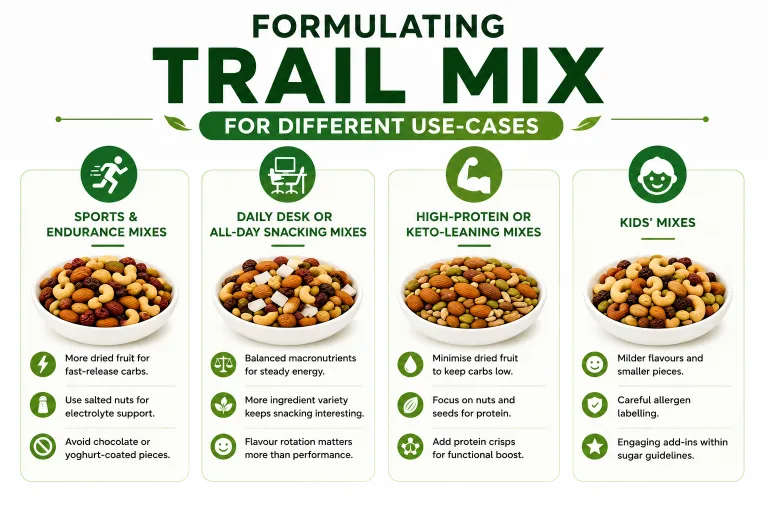
A single “one size fits all” trail mix rarely performs well across every shopper segment. Four use-case formulations cover most of the commercial demand seen today:
- Sports and endurance mixes: lean toward a higher share of dried fruit for fast-release carbohydrates, use salted nuts for electrolyte contribution, and avoid chocolate or yoghurt-coated pieces that soften in heat or during physical activity.
- Daily desk or all-day snacking mixes: balanced macronutrient ratios with more ingredient variety, since flavour rotation matters more than performance nutrition for this shopper.
- High-protein or keto-leaning mixes: minimise dried fruit, lean heavily on almonds, pistachios, pumpkin and sunflower seeds, and consider protein crisps as a functional add-in.
- Kids’ mixes: milder flavours, smaller pieces, careful allergen labelling, and visually engaging add-ins that stay within sugar guidelines rather than defaulting to candy-heavy formulas.
Whichever use-case you formulate for, the goal is the same — a documented ratio, a repeatable sensory profile, and a nutrition panel that matches what’s actually in the pouch.
Sodium, Sugar and Clean-Label Rules Every Trail Mix Formulation Must Follow
Clean-label expectations have reshaped how trail mix is formulated over the last few years. A modern clean-label snack formulation typically avoids partially hydrogenated oils entirely — the FDA phased out partially hydrogenated oils as the primary source of artificial trans fat in 2020 because trans fats raise LDL cholesterol and lower HDL cholesterol. Fully hydrogenated oils are still permitted as stabilisers in some packaged foods, but they add no nutritional value and are increasingly flagged by clean-label shoppers reading ingredient panels.
Chocolate inclusions deserve the same scrutiny. If a formulation includes chocolate, using dark chocolate at 70% cocoa or higher (a threshold recommended by Harvard’s School of Public Health for meaningful flavanol content) delivers more nutritional credibility than standard milk chocolate chips, which mainly add sugar without the same antioxidant benefit.
Shelf-Life, Rancidity Control and Packaging Engineering
Nuts and seeds are the most fragile part of any trail mix. Their natural oils oxidise over time — a process accelerated by heat, light, and moisture — and this oxidation, or rancidity, is the leading cause of trail mix quality failure long before any food-safety issue develops. A federal procurement specification for trail mix requires a minimum remaining shelf life of six months when stored below 15.5°C, and notes that shelf life can roughly double under refrigerated storage.
The bigger engineering challenge is moisture migration. Trail mix combines low-moisture nuts with comparatively higher-moisture dried fruit in the same pouch, and over time moisture travels from the fruit into the nuts, softening both and accelerating spoilage. Sulfur dioxide is sometimes used in the dried-fruit drying process to prevent enzymatic browning and preserve colour — a detail that must be disclosed on the label where applicable. Commercial brands address the migration problem with barrier packaging, nitrogen flushing to displace oxygen, and tamper-evident, resealable formats that limit repeated air exposure after the pack is opened.
This kind of shelf-life and packaging engineering is exactly where structured food formulation work earns its cost — mapping ingredient interaction, water activity, and packaging compatibility before a recipe ever goes into commercial trial, rather than discovering a stability problem after launch.
From Recipe to Commercial Batch: Scaling a Trail Mix Formula
Home ratios rarely translate directly into commercial batches. Industrial blenders can cause denser ingredients to settle unevenly, supplier ingredient grades vary batch to batch, and a formula that isn’t cost-engineered can quietly erode margin as commodity nut prices move. A practical approach many commercial snack developers use is to bulk up the base of the mix with lower-cost ingredients — peanuts, cereal pieces, raisins — and use smaller, controlled amounts of higher-cost inclusions such as specialty nuts or freeze-dried fruit to keep the cost of goods predictable without compromising the eating experience.
At Flavor Catalystz, formulation projects of this kind typically move through recipe trials, sensory panels, and pilot batches before a product is validated for full commercial production — a sequence that mirrors the broader food product development process that takes any snack concept from an initial brief through to a shelf-ready SKU. For founders exploring co-manufacturing, this stage-gated approach is also where a private label trail mix programme is usually built — starting from a validated formula rather than a kitchen recipe scaled up on guesswork.
Regulatory and Compliance Checklist for Trail Mix Brands in India
Commercial trail mix formulation doesn’t end at the recipe — it has to survive a compliance review before it reaches a retail shelf. In India, that review sits largely with FSSAI requirements:
| Compliance Area | What It Requires |
| Nutrition labelling | Accurate per-serving values for energy, protein, fat, carbohydrate, sugar, and sodium, calculated from the final validated formula |
| Allergen declaration | Clear call-outs for tree nuts, peanuts, and any cross-contact risk from shared processing lines |
| Claims substantiation | Terms like “high protein” or “no added sugar” must meet defined thresholds before they appear on pack |
| Batch coding & shelf life | Lot numbers, manufacturing date, and a best-before date backed by real shelf-life or accelerated-ageing data |
| Net weight declaration | Declared weight must match the packed weight within permitted tolerance across production runs |
Common Trail Mix Formulation Mistakes to Avoid
- Letting dried fruit exceed 50–60% of total weight, turning the product into a sweetened fruit snack rather than a balanced mix.
- Over-salting to compensate for bland base ingredients instead of improving ingredient quality.
- Combining high-moisture and low-moisture ingredients without a moisture buffer or barrier packaging, leading to premature softening.
- Skipping accelerated shelf-life testing before committing to a best-before date on the final pack.
- Chasing trend ingredients (freeze-dried exotic fruit, novel seeds) without validating their stability and cost impact at commercial volume.
- Underestimating allergen cross-contact risk when multiple nut types run on shared manufacturing lines.
Where Trail Mix Formulation Is Heading in 2026
Three directions are shaping new product development in this category right now: protein-fortified and electrolyte-infused mixes aimed at fitness consumers, functional add-ins such as adaptogens or fibre-forward ingredients aimed at the wellness segment, and a steady shift toward recyclable, resealable flexible packaging as brands respond to sustainability pressure from both regulators and shoppers. Clean-label scrutiny is also pushing reformulation toward no-added-sugar and reduced-sodium variants, particularly as certified organic and non-GMO sourcing becomes a stronger purchase driver in health-focused retail channels.
For brands evaluating a private label trail mix launch, this is also the moment to decide early whether the formulation will lean commodity-driven or premium-positioned, since that single decision shapes ingredient sourcing, packaging format, and price point for the life of the SKU.
Conclusion
Trail mix formulation rewards brands that treat it as a structured discipline rather than a garnish exercise. Getting the nut-to-fruit ratio, sodium load, shelf-life engineering, and compliance details right the first time saves both reformulation costs and time-to-market in a category that’s growing fast enough to reward accuracy. Flavor Catalystz works with food and beverage brands on exactly this kind of formulation, R&D, and scale-up work — turning ratio science and shelf-life data into a production-ready, compliant trail mix rather than a recipe that only works in a small batch.
Frequently Asked Questions
What is the ideal nut-to-dried-fruit ratio for trail mix?
A commonly used benchmark is roughly three parts nuts and seeds to one part dried fruit by weight. This keeps added sugar in check while still delivering enough sweetness and chew to make the mix enjoyable.
How long does a commercially formulated trail mix stay fresh?
Properly packaged commercial trail mix is generally formulated for a minimum six-month shelf life when stored below 15.5°C, and shelf life can roughly double under refrigeration. Once opened, most mixes are best consumed within about a month due to oxidation and moisture exposure.
Is trail mix a healthy snack for weight loss or daily eating?
It can be, in the right portion and ratio. Because nuts and dried fruit are calorie-dense, trail mix works best as a controlled 30–40 gram serving between meals or around activity, rather than an unmeasured snack eaten straight from a large pack.
How much sodium should a serving of trail mix contain?
A reasonable formulation target is under 200 mg of sodium per 40-gram serving, since some heavily seasoned commercial mixes can carry 200–300 mg in a much smaller quarter-cup portion.
What causes trail mix to taste rancid, and how does formulation prevent it?
Rancidity comes from oxidation of the natural oils in nuts and seeds, sped up by heat, light, and moisture. Good formulation controls this through fresh, well-graded ingredients, barrier packaging, nitrogen flushing, and cool, dry storage recommendations on the pack.
Can trail mix be made without added sugar in a clean-label formula?
Yes. A clean-label version typically relies on unsweetened dried fruit, avoids hydrogenated oils and artificial preservatives, and uses natural salt or spice for flavour rather than added sugar coatings.
What ingredients go into a classic trail mix (GORP)?
The traditional formula — sometimes called GORP, or “good old raisins and peanuts” — combines nuts (often peanuts or almonds), raisins or another dried fruit, and occasionally a small amount of chocolate. Modern formulations expand this with seeds, alternate nuts, and functional add-ins while keeping the same core ratio logic.
How is commercial trail mix formulation different from a homemade recipe?
Commercial formulation fixes exact percentages by weight, uses graded and food-safety-checked ingredients, accounts for moisture migration and shelf-life testing, and must produce a nutrition panel and allergen declaration that hold true across every batch — none of which a home recipe needs to consider.