Jul 2026 · 13 min read
Vegan cookie formulation is one of the more deceptive challenges in food product development. On paper, replacing eggs and butter with plant-based ingredients looks like a simple swap. In practice, spread, chew, colour, and shelf life can fall apart the moment a single animal-derived ingredient is removed, because eggs and butter are rarely doing just one job in a dough. Our food scientists at Flavor Catalystz have worked through this exact problem across multiple bakery and snacking projects, and the pattern is almost always the same: brands that treat it as a science problem succeed, and brands that treat it as a recipe edit end up reformulating three or four times before launch. This guide walks through the ingredient science, the step-by-step formulation process, common failure points, and the commercial factors that decide whether a vegan cookie survives contact with a real production line.
What Is Vegan Cookie Formulation?
Vegan cookie formulation is the structured process of designing a cookie recipe that replaces every animal-derived ingredient — eggs, dairy butter, milk solids, and sometimes honey — with plant-based alternatives, while still matching the taste, texture, spread, and shelf life of a conventional cookie. It is distinct from simply making a recipe ‘eggless’ or ‘butter-free’ at home, because a commercial formulation has to behave consistently across batches, hold up during transport and storage, and meet a specific cost target per unit. A home baker can adjust dough by feel; a formulator has to document exact ratios, functional roles, and tolerances so the same cookie comes out of a factory oven the same way every single time.
Why Vegan Cookie Formulation Is Scientifically Different From Regular Baking
In a standard cookie, eggs and dairy butter are doing several jobs at once: eggs bind the dough, retain moisture, help the cookie rise slightly, and contribute to browning; butter controls fat content, flavour, aeration, and how far the dough spreads in the oven. Removing both ingredients at the same time means several functions break simultaneously, not just one. This is why a single 1:1 substitute rarely works — a flax egg might restore binding but not browning; coconut oil might restore fat content but destroys spread control because it lacks the water content that dairy butter naturally contains.
Formulators typically build a ‘function map’ before choosing substitutes: they list every job the original ingredient performs, then select vegan ingredients that cover each function individually, rather than searching for one ingredient that does everything eggs or butter used to do.
Commercial Vegan Cookies Start with the Right Formulation.
Flavor Catalystz develops vegan cookie formulations with optimized ingredients, texture, shelf life, and production-ready processes for commercial manufacturing.
The Vegan Cookies Market: Why Brands Are Investing in Formulation Now
Demand for plant-based bakery products has moved from a niche health trend to a mainstream retail category, and cookies are one of the fastest-growing segments within it. The table below summarises the scale of this shift.
| Market / Segment | Data Point | Reference Period |
| Global vegan cookies market | Estimated at roughly USD 420–425 million, growing at a CAGR of about 8.8–8.9% | 2025–2033/2035 forecast |
| Global vegan baking ingredients market | Valued at about USD 1.63 billion in 2025, projected to reach USD 2.65 billion | 2026–2033 forecast |
| Biscuits & cookies segment (vegan baking ingredients) | Projected CAGR of about 6.6%, the fastest-growing application segment | 2026–2033 forecast |
| Asia-Pacific vegan cookie growth | Regional CAGR of roughly 9.3%, led by India, China, Japan and Australia | 2025–2030 outlook |
| Global vegan cookie product launches | Rose by approximately 24% year-on-year as gluten-free and vegan claims expanded across categories | 2024–2025 |
In India specifically, the growth story is less about a small vegan niche and more about flexitarian consumers — people who already eat plant-forward snacks like roasted chana and masala makhana — now looking for branded, certified, nutritionally optimised versions of familiar formats. Regional flavour localisation, such as coconut-cardamom or masala chai profiles, has become a differentiator for Indian plant-based bakery brands rather than a novelty.
Core Ingredient Categories in Vegan Cookie Formulation
Every conventional cookie ingredient performs one or more of five functions: structure, moisture, fat, leavening, and browning. Vegan cookie formulation replaces each function individually rather than swapping ingredients one-for-one.
| Function in Dough | Conventional Ingredient | Common Vegan Alternative | Formulation Note |
| Binding & structure | Whole egg | Flax egg, aquafaba, chickpea-based egg replacer | Choose based on required moisture level and dough strength |
| Fat & tenderness | Dairy butter | Vegan butter blend, coconut oil, plant oil blends | Vegan butter blends generally track dairy butter performance more closely than pure oils |
| Moisture retention | Egg, milk | Applesauce, mashed banana, plant milk | Requires re-balancing flour hydration to avoid a gummy crumb |
| Leavening & aeration | Egg, baking soda | Baking soda/powder paired with an acid source | pH balance affects both spread and final colour |
| Browning & flavour depth | Milk solids, egg yolk | Non-dairy milk powder, malt extract, brown sugar ratio | Removing dairy solids reduces Maillard browning unless compensated |
| Sweetening | Refined sugar, honey | Cane sugar, coconut sugar, agave (for honey) | Sugar source and refining process affect chew, colour and vegan certification eligibility |
Egg Replacement in Vegan Cookie Formulation: What Actually Works
Eggs are usually the hardest ingredient to remove because they perform multiple functions at once. Food scientists generally build a control batch with eggs and a matched batch without them, then measure exactly what changes in spread, moisture, and structure before selecting a replacer. The table below compares the most commonly used options in commercial vegan cookie formulation.
| Egg Replacer | Best Suited For | Effect on Texture | Watch-Out |
| Ground flaxseed + water | Chewy, dense cookies | Adds binding strength; slightly nutty flavour | Can darken the finished dough colour |
| Aquafaba (chickpea brine) | Light, airy cookies | Whips into a foam that mimics egg-white structure | Viscosity varies batch to batch unless standardised |
| Commercial plant-protein egg replacer blends | Large-scale commercial production | Neutral flavour, consistent batch-to-batch performance | Higher ingredient cost; sourcing consistency matters |
| Blended silken tofu | Soft, cake-style cookies | Adds structure without an eggy flavour | Adds extra moisture; may need a shorter bake time |
| Nut or seed butter | Dense, rich cookies | Adds fat plus mild binding | Changes flavour profile and introduces an allergen |
| No replacer (omission) | Simple chocolate-chip-style formulas | Works when egg’s role is minor relative to fat and sugar | Only suitable for certain formulations — must be trialled, not assumed |
One point that surprises many first-time formulators: a growing number of validated vegan cookie recipes skip an egg replacer entirely. Where fat and sugar content are already high enough to provide structure, adding a replacer can actually make the dough spread more than intended. This is exactly why the function-mapping step matters more than picking a ‘trendy’ substitute.
Fat and Butter Replacement for Texture and Spread Control
Dairy butter is roughly 80% fat and about 15–18% water, and that water content is part of what keeps a cookie from spreading too thin. Coconut oil, by contrast, is close to 100% fat with no water, which is why cookies made with coconut oil alone tend to spread more, bake thinner, and turn out crisper or greasier than intended. Commercial vegan butter blends are formulated specifically to replicate the fat-to-water ratio of dairy butter, which is why they generally give more predictable spread control than a single oil.
Emerging food-science research is also exploring structured fat systems — such as plant-based bigels made from oleogels and hydrogels — as a way to replace solid dairy fat while improving the nutritional fat profile of the finished cookie without compromising texture. This is still moving from lab research into commercial application, but it signals where fat-replacement formulation is heading over the next few years.
Step-by-Step Vegan Cookie Formulation Process
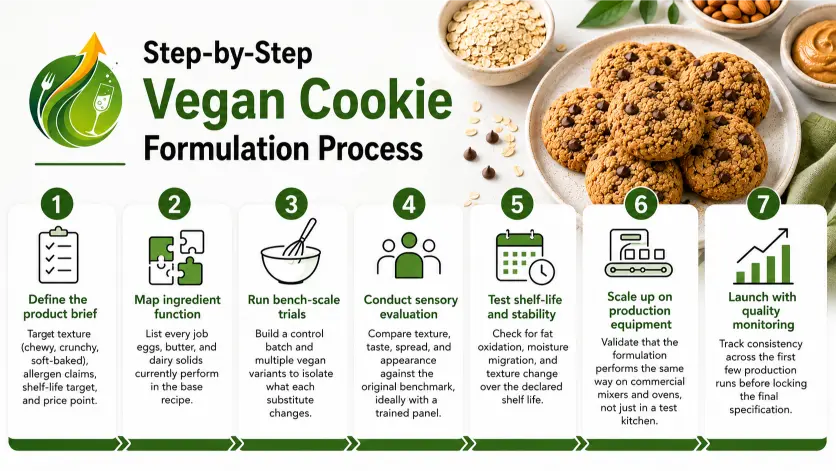
Vegan cookie formulation is not a single trial-and-error session; it follows the same disciplined stages used across food product development, adapted specifically for plant-based baking.
- Define the product brief — target texture (chewy, crunchy, soft-baked), allergen claims, shelf-life target, and price point.
- Map ingredient function — list every job eggs, butter, and dairy solids currently perform in the base recipe.
- Run bench-scale trials — build a control batch and multiple vegan variants to isolate what each substitute changes.
- Conduct sensory evaluation — compare texture, taste, spread, and appearance against the original benchmark, ideally with a trained panel.
- Test shelf-life and stability — check for fat oxidation, moisture migration, and texture change over the declared shelf life.
- Scale up on production equipment — validate that the formulation performs the same way on commercial mixers and ovens, not just in a test kitchen.
- Launch with quality monitoring — track consistency across the first few production runs before locking the final specification.
This mirrors our 7-stage food product development process, which we use across bakery, snacking, and beverage categories — vegan cookies simply add an extra layer of ingredient-function complexity to the formulation stage.
Common Vegan Cookie Formulation Problems and Fixes
| Problem | Likely Cause | Fix |
| Cookies spread too thin and turn greasy | Coconut oil used as the sole fat source (100% fat, no water) | Blend with vegan butter, or reduce total fat ratio slightly |
| Dry, crumbly texture that falls apart | Egg replacer lacks sufficient moisture-binding capacity | Combine a flax egg with applesauce, or increase hydration slightly |
| Pale, underbaked appearance | Missing browning agents normally supplied by milk solids or egg yolk | Add non-dairy milk powder or malt extract, adjust brown sugar ratio |
| Inconsistent results across batches | Variable viscosity in fresh aquafaba or homemade flax egg | Switch to a standardised commercial egg replacer for scale production |
| Short shelf life or rancid off-notes developing early | Unstable plant fat oxidising faster than dairy butter | Use oxidation-stable fat blends, add natural antioxidants, review packaging barrier |
Shelf Life, Packaging, and Regulatory Compliance for Vegan Cookies
Plant-based fats generally oxidise faster than dairy butter, which means vegan cookies can be more prone to off-flavours developing before their declared shelf life ends unless the formulation and packaging are designed to compensate. Accelerated shelf-life testing under controlled temperature and humidity is the standard way to validate a realistic shelf-life claim before launch, rather than guessing based on a home-baked batch.
In India, brands making a vegan claim on packaging need to align with FSSAI’s vegan logo and labelling requirements, which cover both the ingredient list and any cross-contamination risk during manufacturing. Packaging also plays a direct role in shelf life: barrier films that limit oxygen and moisture transfer help slow fat oxidation, which matters more for vegan cookies than for butter-based ones because of the fat source difference discussed above.
Vegan Cookie Trends Shaping 2026
- Protein-fortified vegan cookies using pea, soy, or chickpea protein to add a functional nutrition claim.
- Regional flavour localisation — coconut-cardamom, masala chai, and date-spiced profiles are outperforming generic ‘vegan chocolate chip’ launches in local markets.
- Clean-label reformulation, replacing gums and stabilisers with functional flours and whole-food binders where possible.
- Structured fat systems (oleogels, bigels) entering early commercial use to improve the nutritional fat profile without losing texture.
- Sustainable and recyclable packaging formats, driven by both regulation and consumer preference in Europe and increasingly in Asia-Pacific.
- Growth of direct-to-consumer cookie subscriptions and online-first plant-based bakery brands.
Cost Considerations in Commercial Vegan Cookie Formulation
Vegan cookie formulation usually carries a modest ingredient cost premium over conventional recipes — commercial egg replacer blends and vegan butter typically cost more per kilogram than eggs and dairy butter at scale. However, this premium tends to narrow as order volumes grow and as formulators optimise the recipe to avoid over-engineering (for example, using a cheaper flax-based binder instead of a premium protein blend where the application allows it). Pilot-scale trials before full commercial investment are the most reliable way to validate real per-unit cost, since bench-scale ratios do not always translate directly to commercial batch economics.
When Brands Bring In a Professional Food Formulation Partner
Most brands attempt an initial vegan cookie recipe internally or with a home-scale developer, and bring in outside formulation support when one of a few patterns shows up: the recipe won’t scale beyond a small batch, texture is inconsistent from batch to batch, shelf life fails once the product leaves a controlled environment, or the vegan/allergen claims need regulatory validation before packaging is finalised.
This is typically where structured food formulation support becomes worth the investment — not to replace the brand’s recipe vision, but to translate it into something that behaves the same way on a production line as it did in the first test batch.
Conclusion
Vegan cookie formulation rewards brands that treat it as a structured food science exercise rather than a single ingredient swap. The recipes that make it from a test kitchen to a retail shelf are the ones where every function eggs and butter used to perform — binding, moisture, fat, leavening, and browning — has been deliberately replaced and validated through real trials, not assumed. This is the discipline our team applies at Flavor Catalystz whenever a plant-based bakery project moves from an early concept to a production-ready formulation, and it is the same discipline that separates a cookie that works once in a home oven from one that performs reliably at commercial scale.
Frequently Asked Questions
What is vegan cookie formulation?
Vegan cookie formulation is the process of designing a cookie recipe that replaces eggs, dairy butter, and other animal-derived ingredients with plant-based alternatives, while keeping the taste, texture, and shelf life close to a conventional cookie and ensuring the recipe performs consistently at commercial scale.
What is the best egg substitute for vegan cookies?
There is no single best option — it depends on the cookie type. Flaxseed and water work well for chewy, dense cookies; aquafaba suits light, airy textures; commercial egg replacer blends give the most consistent results for large-scale production; and some chocolate-chip-style recipes work without any egg replacer at all.
Can vegan cookies taste as good as regular cookies?
Yes, when the formulation accounts for every function eggs and butter perform — binding, moisture, fat, leavening, and browning — rather than swapping a single ingredient. Cookies that taste noticeably ‘off’ are usually missing a browning agent or have an unbalanced fat-to-water ratio, not a flaw inherent to vegan baking.
Why do my vegan cookies spread too much in the oven?
This is most often caused by using a fat source, like coconut oil, that has no water content. Dairy butter naturally contains water that limits spread; blending vegan butter with coconut oil, or slightly reducing total fat, usually corrects the issue.
Do vegan cookies need FSSAI vegan certification in India?
If a product carries a vegan claim on its packaging in India, it needs to align with FSSAI’s vegan food labelling and logo requirements, which cover ingredient sourcing and cross-contamination controls during manufacturing.
How long do vegan cookies stay fresh?
It depends on the fat source and packaging, but plant-based fats generally oxidise faster than dairy butter, so vegan cookies can have a shorter realistic shelf life unless the formulation includes oxidation-stable fats and the packaging provides an adequate moisture and oxygen barrier.
Is coconut oil better than vegan butter for cookies?
Not necessarily. Coconut oil is close to 100% fat and tends to cause more spreading and a crisper, sometimes greasier texture. Vegan butter blends are formulated to mimic dairy butter’s fat-to-water ratio, which generally gives more predictable spread and a closer texture match to conventional cookies.
How much does commercial vegan cookie formulation cost?
Costs vary by scale, ingredient choices, and how many formulation rounds are needed, but vegan ingredients typically carry a modest premium over conventional ones at small volumes, which usually narrows as order quantities increase and the recipe is optimised for cost efficiency.