Jul 2026 · 15 min read
Vegetable chips have moved from a niche health-food shelf to one of the fastest-growing segments in modern snacking, driven by shoppers who want cleaner labels, functional nutrition, and bold, vegetable-forward flavor instead of another bag of fried potato. But turning a sliced beetroot, a kale leaf, or a sweet potato round into a crunchy, shelf-stable, retail-ready product is far harder than it looks in a home kitchen. A batch that tastes great on a countertop can turn soggy, greasy, discolored, or inconsistent the moment it is scaled to a commercial line. This is exactly where vegetable chip formulation stops being a recipe and becomes a science. At Flavor Catalystz, this is the kind of problem our food scientists are asked to solve on a regular basis — so this guide breaks down the ingredients, processing choices, and formulation science that actually decide whether a vegetable chip survives contact with a real production floor and a real shelf life.
What Is Vegetable Chip Formulation?
Vegetable chip formulation is the structured process of selecting vegetables, ingredients, and processing parameters — slice thickness, moisture-removal method, oil type, seasoning system, and packaging barrier — so that the final chip is crisp, safe, flavorful, and reproducible in every batch, not just the first one. A home recipe only has to work once. A formulation has to work identically whether it is the tenth batch or the ten-thousandth, across different seasons, different vegetable lots, and different humidity conditions in the plant.
In practical terms, a working vegetable chip formulation is built around a small number of measurable targets: final moisture content, usually in the 1.5–3% range; water activity low enough (typically under 0.3–0.4) to prevent microbial growth and staling during shelf life; a controlled oil percentage if the chip is fried; a fracturable, non-leathery texture; and stable color and flavor over the stated shelf life. Everything else in the formulation — the vegetable variety, the pre-treatment, the cooking method, the seasoning system — exists to hit those targets consistently.
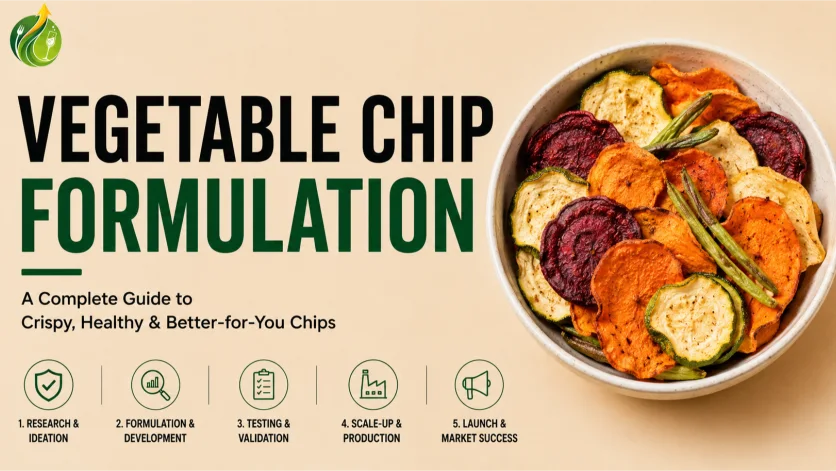
VEGETABLE CHIP FORMULATION 2026
Develop Premium Vegetable Chips with Better Texture and Shelf Life
Flavor Catalystz develops vegetable chip formulations with optimized vegetable selection, texture, seasoning, oil control, shelf life, and commercial manufacturing support.
Why Vegetable Chips Are a High-Growth, High-Intent Category
The vegetable and root chip category sits at the intersection of two consumer trends that are not slowing down: the shift toward better-for-you snacking, and the demand for more variety beyond potato and corn. Beetroot, sweet potato, kale, okra, raw banana, and multi-vegetable blends now compete for the same shelf space once dominated by a handful of potato SKUs. For brand owners and manufacturers, this creates real commercial opportunity — but it also raises the bar. Buyers evaluating a new vegetable chip line want proof of consistent texture, verified shelf life, clean-label ingredient decks, and accurate nutrition claims before they commit shelf space or a production slot. A formulation built on guesswork rarely survives that scrutiny; one built on food science usually does.
Choosing the Right Base Vegetables for Chip Formulation
Not every vegetable behaves the same way under heat, so the choice of base vegetable is the first formulation decision, not an afterthought. Sugar content, starch structure, and natural moisture all change how a slice fries, bakes, or dries, and how likely it is to scorch, curl, or turn limp.
| Vegetable | Approx. Raw Moisture | Key Formulation Behavior | Commonly Suited Method |
| Potato | ~78–80% | High starch; needs blanching to control reducing sugars and browning | Frying, vacuum frying |
| Sweet Potato | ~70–77% | Higher natural sugar; prone to fast browning at high heat | Vacuum frying, baking |
| Beetroot | ~87–90% | High moisture and sugar; color (betalains) degrades with heat and time | Vacuum frying, air drying |
| Carrot | ~88–90% | High moisture; benefits from blanching for texture and color retention | Baking, vacuum frying |
| Raw Banana / Plantain | ~65–70% | High starch, low sugar; fries to a firm, stable crunch | Deep frying, vacuum frying |
| Kale / Leafy Greens | ~85–90% | Very low mass yield; needs careful oil drainage to avoid greasiness | Baking, low-temp dehydration |
| Okra | ~88–90% | Mucilage content affects crisping; needs pre-drying or coating | Frying with pre-dusting |
| Taro / Colocasia | ~70–73% | Contains calcium oxalate; requires proper cooking to reduce irritant compounds | Frying, vacuum frying |
Core Components of a Vegetable Chip Formulation
A commercial vegetable chip formulation is built from several interacting components, each with its own function:
- Base vegetable matrix — variety, slice thickness (typically 1.5–3 mm), and cut orientation, which together control cook time and final texture.
- Pre-treatment — blanching, brief osmotic dehydration, or dips in mild acid or calcium salts to fix color, slow enzymatic browning, and firm the cell structure before cooking.
- Cooking medium — the oil type (sunflower, rice bran, palm olein, or a blend) chosen for smoke point, oxidative stability, and flavor neutrality, or the absence of oil in a baked or air-dried system.
- Starch or binder systems — used in reconstituted or sheeted chips made from vegetable purees, where starches and gums hold the dough together before cutting and cooking.
- Seasoning and flavor system — dry seasoning adhered through residual surface oil or a light oil/dextrin carrier, or a slurry applied before final drying.
- Antioxidants and shelf-life aids — natural options such as rosemary extract or mixed tocopherols to slow oil oxidation and rancidity over the stated shelf life.
- Packaging barrier — moisture- and oxygen-resistant film, often with nitrogen flushing, to protect the low water activity the formulation worked hard to achieve.
Processing Methods Compared: Deep-Fried, Baked, Vacuum-Fried, and Air-Dried Vegetable Chips
The processing method is where a vegetable chip formulation and a home recipe diverge the most. Food science research on vacuum frying has repeatedly shown that lowering the pressure during frying reduces the boiling point of both the oil and the moisture in the vegetable, which allows chips to cook at a much lower temperature — often around 90–130°C instead of the 170–190°C used in atmospheric frying. That lower temperature is the reason vacuum-fried vegetable and fruit chips typically hold more of their natural color and flavor, and generally pick up less oil than conventionally fried products.
A baked chip formulation takes a different route to the same goal: instead of removing water by frying it out in oil, heat and airflow do the work, so the final oil content depends only on what is sprayed or tossed onto the slices before baking, not on absorption during cooking. This usually means a lower-fat finished chip, though achieving the same shatter-crisp texture as a fried chip takes more careful control of slice thickness and bake time, since baked vegetable slices are more prone to turning leathery rather than crisp if moisture removal is uneven.
| Method | Typical Oil Content | Texture Outcome | Relative Cost to Scale | Best Fit |
| Deep (atmospheric) frying | Higher (25–40%) | Classic crisp, robust crunch | Lower equipment cost | High-volume, cost-sensitive SKUs |
| Vacuum frying | Lower (15–25%) | Crisp with better natural color/flavor retention | Higher capital investment | Premium, better-for-you positioning |
| Baked chip formulation | Low (5–12%, added) | Lighter, can be less uniformly crisp | Moderate | Low-fat, clean-label claims |
| Air / hot-air drying | Near zero (unless sprayed) | Denser, chewier unless finished by frying | Moderate to high (longer cycle) | Dehydrated or raw-style snacks |
The Science of Moisture, Oil Uptake, and Crispness
Crispness in a vegetable chip is really a story about water. As a slice cooks, moisture moves from the interior to the surface and evaporates, and the resulting porous, dehydrated structure is what gives a chip its characteristic snap. Research on frying kinetics has shown that oil uptake and moisture loss are not perfectly simultaneous events — a meaningful share of the final oil content is drawn into the chip’s porous crust during cooling, after frying, as vapor inside the pores condenses and creates a slight vacuum that pulls surface oil inward. This is one reason quick, controlled cooling and proper oil draining immediately after frying can noticeably reduce the final oil percentage of a batch.
Case hardening is the other phenomenon formulators need to manage: if the surface dries and hardens too quickly at high heat, it traps moisture inside the slice, producing a chip that looks done on the outside but turns soft or chewy within hours of packing. Controlling frying or baking temperature curves, slice thickness, and pre-treatment (such as a short blanch) helps prevent this and gives a more even, predictable texture across a batch.
| Quality Parameter | Typical Target for a Shelf-Stable Vegetable Chip |
| Final moisture content | 1.5% – 3.0% (product dependent) |
| Water activity (aw) | Below 0.30 – 0.40 |
| Oil content (fried products) | 15% – 30%, depending on method |
| Peroxide value (oil quality, storage limit) | Monitored against a set upper limit to flag rancidity onset |
| Typical ambient shelf life (properly packaged) | 6 – 9 months for fried/vacuum-fried chips; shorter for baked, lower-oil formats |
Formulating Protein-Enriched and Better-For-You Vegetable Chips
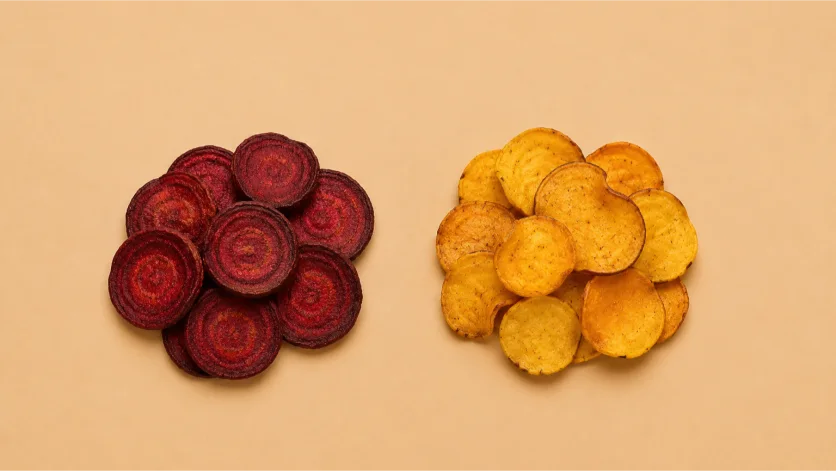
One of the fastest-moving areas of demand right now is protein chip formulation — vegetable chips reformulated or fortified to carry a legitimate “good source of protein” or “high protein” claim rather than relying on the vegetable’s naturally modest protein content. This is generally approached in one of two ways. The first is fortification of a sliced vegetable chip with protein-rich dusting or seasoning systems, or by blending in pulse-based flours during a pre-treatment step. The second, more structural approach is building the chip from a sheeted dough rather than a raw slice — combining vegetable purees or powders with pulse protein isolates, pea protein, or dehydrated legume flours, then sheeting, cutting, and frying or baking the dough into chip shapes.
The second route gives formulators far more control over protein percentage, fiber content, and sodium, but it also introduces new formulation variables: dough hydration, sheeting thickness, gluten-free binder selection where required, and a different frying or baking curve than a raw vegetable slice would need. Getting the ratio of starch to protein to fiber right is usually the difference between a chip that holds together through packing and transport, and one that crumbles in the bag.
Seasoning Application and Flavor System Design
Seasoning adhesion depends heavily on the surface state of the chip. Fried and vacuum-fried chips carry a thin residual oil film that lets dry seasoning cling naturally; baked and air-dried chips, having little to no surface oil, usually need a light oil or flavor-carrier spray applied just before seasoning so the powder adheres evenly instead of settling to the bottom of the pack. Flavor systems for vegetable chips typically layer a base savory note (salt, onion, garlic), a signature top note (herbs, spice blends, tangy or smoky accents), and, increasingly, a controlled heat element for regional flavor profiles. Because vegetable chips already carry natural sweetness and earthiness from the base ingredient, seasoning ratios usually need to be lighter than they would be on a neutral potato or corn base — a formulation copied directly from a potato chip seasoning system will often taste unbalanced on beetroot or sweet potato.
Shelf-Life, Packaging, and Stability Testing
A vegetable chip formulation is not finished when it tastes right in the lab — it is only proven once it survives real storage conditions. Oxidative rancidity in the frying oil, moisture pickup through the packaging film, and color fading are the three failure modes that most commonly cut a vegetable chip’s shelf life short. Accelerated shelf-life testing (storing samples at elevated temperature and humidity to predict long-term stability in a shorter time) is a standard step before a formulation is signed off for commercial production.
| Shelf-Life Factor | Formulation / Packaging Response |
| Oil oxidation (rancidity) | Use oxidatively stable oils, add natural antioxidants, avoid oil reuse beyond safe limits |
| Moisture pickup from air | High-barrier film (metallized BOPP or similar), heat-sealed packs, desiccant where needed |
| Oxygen exposure | Nitrogen flushing / modified atmosphere packaging to displace oxygen in the pack |
| Color and flavor fade | Light-blocking packaging, shorter shelf-life claims for pigment-sensitive vegetables like beetroot |
Common Formulation Mistakes That Sink Vegetable Chip Launches
- Choosing a high-sugar vegetable variety without adjusting frying temperature, leading to scorching, bitterness, or excess browning.
- Inconsistent slice thickness, which causes uneven cooking — thin pieces burn while thicker ones stay underdone in the same batch.
- Skipping blanching or an acid dip on vegetables prone to enzymatic browning, resulting in dull, grey-brown chips within hours of cutting.
- Poor oil quality control (oxidized or overused frying oil), which shortens shelf life regardless of how well the rest of the formulation is designed.
- Applying a seasoning system copied from a different base (like potato) without adjusting for the vegetable’s natural flavor and sugar profile.
- Moving straight from a small lab batch to full commercial scale without shelf-life validation, which is one of the most common causes of costly post-launch recalls or reformulations.
Regulatory and Compliance Considerations for Vegetable Chips
In India, packaged vegetable chips fall under FSSAI’s food safety and labeling requirements, which cover permitted additives and antioxidant limits, nutrition and ingredient labeling accuracy, and substantiation for any claim made on the front of pack — “baked, not fried,” “high protein,” “low oil,” or “no added preservatives” all need to be backed by actual formulation and testing data, not just a marketing decision. Building these checks into the formulation stage, rather than treating them as a final approval step, avoids expensive relabeling or reformulation later.
This is generally handled as part of a structured food formulation process, where regulatory review, nutrition claim validation, and recipe development move forward together instead of one blocking the other at the last stage before launch.
From Prototype to Commercial Launch: The Vegetable Chip Development Roadmap
Getting a vegetable chip from a working lab sample to a stable, sellable, repeatable commercial product generally follows a consistent sequence: defining the target consumer and product brief, selecting and testing base vegetables and pre-treatments, running sensory trials to fix the seasoning and texture, validating shelf life under real packaging conditions, and finally trialling the formulation on production-scale equipment before a full commercial run. Skipping or rushing any one of these stages is usually where launches run into trouble later — a formulation that behaves well in a 2 kg lab batch does not always behave the same way in a 200 kg production batch, where heat transfer, oil turnover, and mixing dynamics are different.
This sequencing mirrors the broader food product development process that most successful snack launches follow, where formulation, sensory validation, and manufacturing scale-up are planned together rather than treated as separate, disconnected steps.
Bringing It Together
A vegetable chip that performs well on a shelf is rarely the result of a single great recipe — it is the outcome of deliberate choices around vegetable selection, pre-treatment, processing method, seasoning system, and packaging, each tested and validated before the product ever reaches commercial scale. Brands that treat formulation as a science from the first prototype tend to avoid the costly reformulations, shelf-life failures, and inconsistent batches that derail so many snack launches. Flavor Catalystz works with food brands through exactly this kind of formulation and scale-up process, turning early-stage vegetable chip concepts into consistent, market-ready products.
Frequently Asked Questions
What is the ideal moisture content for vegetable chips?
Most commercial vegetable chips target a final moisture content between 1.5% and 3%, along with a water activity below roughly 0.3–0.4. This combination is what keeps the product microbiologically stable and crisp for the intended shelf life.
Which vegetables are best suited for making chips?
Root and tuber vegetables with lower natural sugar and moisture — potato, sweet potato, raw banana, and taro — tend to be the most forgiving for frying and vacuum frying. Higher-moisture vegetables like beetroot, carrot, and leafy greens can also be formulated into excellent chips, but usually need more careful pre-treatment and are often better suited to vacuum frying, baking, or dehydration.
How is oil content reduced in fried vegetable chips?
Oil content is most effectively reduced through vacuum frying, which cooks at a lower temperature and pressure than atmospheric frying and typically results in noticeably lower oil pickup. Additional reductions come from proper post-fry draining, faster and more controlled cooling, and, in some formulations, surface coatings that limit how much oil the porous chip structure can absorb during cooling.
What is the difference between baked and fried vegetable chip formulation?
In a fried formulation, oil is both the cooking medium and a texture contributor, so oil content is a byproduct of the cooking process itself. In a baked chip formulation, moisture is removed by heat and airflow alone, and any oil in the finished product comes only from what is deliberately applied before baking — usually resulting in a lower-fat chip, though texture control needs to be more precise to avoid a leathery rather than crisp bite.
How long do vegetable chips typically stay fresh?
Properly formulated and packaged fried or vacuum-fried vegetable chips commonly hold a 6 to 9 month ambient shelf life, while baked or lower-oil formats often have a shorter stable shelf life due to faster moisture pickup and oxidation. Actual shelf life should always be confirmed through accelerated and real-time stability testing on the specific formulation and packaging combination.
Can vegetable chips be made high in protein?
Yes. Protein chip formulation is typically achieved either by fortifying a sliced vegetable chip with protein-based seasoning or coating systems, or by building the chip from a sheeted dough made with pulse or legume protein blended into the vegetable base, which allows for a more significant, label-worthy protein claim.
What causes vegetable chips to turn soggy or lose crunch?
The most common causes are insufficient moisture removal during processing, case hardening (a hard outer surface trapping moisture inside), and packaging that does not provide an adequate moisture and oxygen barrier. Even a well-formulated chip will lose crunch quickly if it is packed in a film with poor barrier properties or without proper sealing.
What regulatory approvals are needed to sell vegetable chips in India?
Vegetable chip manufacturers and brands need FSSAI licensing appropriate to their production scale, compliant nutrition and ingredient labeling, and documented substantiation for any claims made on pack, such as “baked,” “low oil,” or “high protein.” These requirements are generally addressed alongside formulation development rather than after the product is finalized.